The short answerA glutathione injection is a shot of glutathione, an antioxidant your body makes on its own, often paired with vitamin C. The human evidence is thin: given into a vein, half of it leaves the blood in about 14 minutes, the one placebo-controlled IV skin trial wasn’t significant, and the FDA warned in 2026 about contaminated glutathione in injections.
Glutathione injection ads usually promise brighter skin, a detox, or more energy. Below, each claim is sorted by what human studies actually tested, route by route, followed by the FDA’s warnings, who should skip these shots, and how the Revita Shot on our wellness shot menu fits. This is general information, not medical advice.
What is a glutathione injection?
A glutathione injection delivers glutathione, a naturally occurring antioxidant that helps protect cells from oxidative stress, as a shot into a vein, a muscle, or under the skin. Your body makes its own supply, so the real question is whether a shot adds anything.
Glutathione isn’t an ingredient in any FDA-approved drug, the FDA’s 2022 advisory committee minutes note. Vitamin C is different: FDA-approved vitamin C injections, ASCOR and its generics, are approved only to treat scurvy for up to a week when vitamin C can’t be taken by mouth, not for low vitamin C without signs of scurvy.
Glutathione injection benefits: what human studies show, by route
Most claims about glutathione injection benefits borrow from studies of a different route. Here’s what each route has shown in people.
Into a vein: half leaves the blood in about 14 minutes
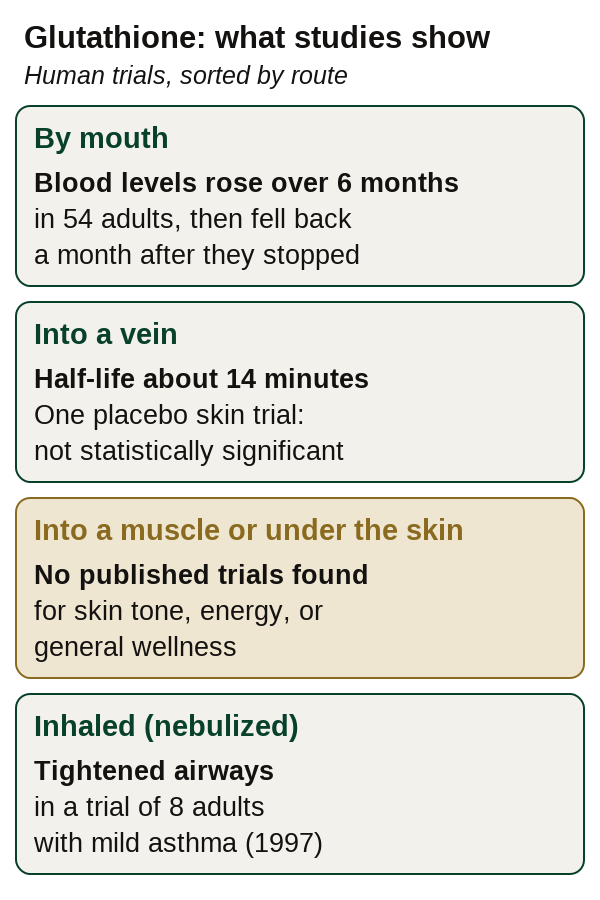
In 10 healthy volunteers given a large IV dose, glutathione left the blood with a half-life of about 14 minutes, and the amount passed in urine rose about 300-fold over the next 90 minutes. For skin, a 2025 systematic review in the International Journal of Dermatology found one placebo-controlled IV study, and its result (37.5% vs 18.7%) wasn’t statistically significant. The authors concluded IV glutathione “is contraindicated due to lack of efficacy and side effects.” A 2026 review adds that the same trial, which gave vitamin C alongside, reported liver enzyme rises in eight people and one case of anaphylaxis, a severe allergic reaction, and rates such reactions rare but potentially serious.
Closer to home, a 2009 pilot trial led by University of South Florida researchers in Tampa gave IV glutathione three times a week for 4 weeks to 21 people with Parkinson’s disease. It was well tolerated, but symptom scores showed no significant difference from placebo; the authors said a mild effect was possible and called for a larger study.
By mouth: slow, and it fades
A 6-month trial in 54 adults, supported by the maker of the glutathione it tested, found daily capsules raised glutathione in blood and cells, and levels returned to baseline a month after people stopped. For skin, the 2025 review found five placebo-controlled trials in which capsules modestly reduced skin melanin, an effect that didn’t last; earlier reviews called the evidence inconclusive.
Into a muscle or under the skin: untested for wellness
We found no published trial of glutathione shots into a muscle or under the skin for skin tone, energy, or general wellness (PubMed search, November 2026). Muscle injections have been tried only in small medical trials, such as male infertility, ALS, and nerve protection during chemotherapy. The injection studies we did find mixed glutathione and vitamin C with other ingredients into the skin over dark patches, a different treatment.
Inhaled: a warning sign for asthma
In a 1997 trial, 8 adults with mild asthma breathed in nebulized glutathione. Their airways narrowed sharply, lung function fell 19%, and some coughed or felt breathless; the authors linked it to sulfite forming from the glutathione. We found no study of whether a shot does the same, so mention asthma or a sulfite sensitivity first.
The route a claim comes from matters: the only steady rise in glutathione came from months of capsules, and shots into muscle or skin are untested for wellness.
Glutathione and vitamin C injection: what the vitamin C adds
Most people in the United States already get enough vitamin C from food, the NIH Office of Dietary Supplements reports, and the body tightly controls vitamin C levels when it’s taken by mouth. A vitamin C injection into a vein can push blood levels far higher, but we could not find good trials showing that it helps people who aren’t deficient.
High doses carry their own label warnings. The ASCOR label (revised January 2024) warns of kidney damage from oxalate after prolonged high-dose infusion, with higher risk in kidney disease, a history of oxalate kidney stones, and older adults; severe breakdown of red blood cells in people with G6PD deficiency, an inherited enzyme condition; and interference with blood and urine glucose tests. G6PD deficiency is also a reason to skip methylene blue. MeliOra doesn’t claim any shot prevents illness; our immune boosting shots guide covers what vitamin C does and doesn’t do for colds.
FDA warnings on glutathione injections, 2015 to 2026
Skin lightening. In a 2015 consumer warning, updated in 2017, the FDA said injectable skin lightening products may be unsafe and ineffective and may contain unknown ingredients or contaminants, and that it has not approved any injectable drug for skin whitening. U.S. Marshals had seized glutathione whitening kits in 2014.
Contaminated glutathione. In 2019, the FDA reported seven patients at one clinic who fell ill within minutes of IV glutathione made from powder labeled as a dietary supplement, one of whom was moved to a hospital, plus a patient elsewhere who was hospitalized after IV glutathione from the same supplier; FDA testing found bacterial endotoxin up to five times the appropriate limit. On August 27, 2026, it reported at least 30 more patients with fever, chills, pain, dizziness, signs of shock, or sepsis-like symptoms after IV glutathione traced to one supplier’s dietary-supplement-grade lot, some hospitalized. Between August and October 2026, four Texas compounding pharmacies recalled glutathione vials for endotoxin, some shipped to Florida, including vials labeled for muscle or under-the-skin use.
Where glutathione stands. Pharmacies may compound glutathione while the FDA evaluates it: on the FDA’s May 2026 list it sits in Category 1, “under evaluation.” At a 2022 advisory meeting, the FDA proposed leaving it off the official list of ingredients pharmacies may compound with; the committee voted 8 to 5, with 1 abstention, to add it, and as of the May 2026 list the question is still open.
The Why, What, Where, Who check before any glutathione shot
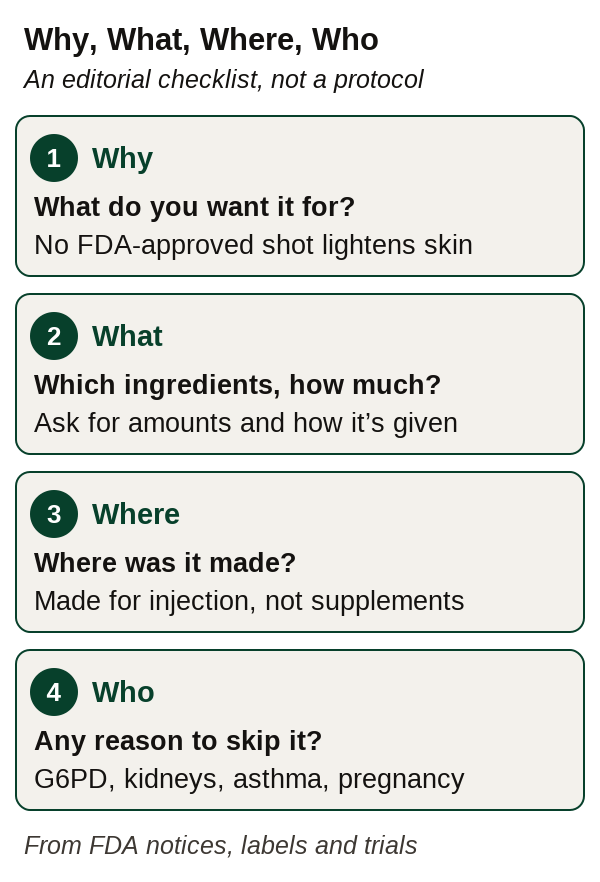
Our editorial checklist for readers, built from the sources above. It isn’t a medical protocol or a MeliOra procedure.
Why: name your goal. If it’s lighter skin, the FDA has not approved any injectable drug for that. If it’s a detox, immunity, or treating a disease, we found no good evidence that a shot delivers it.
What: ask for every ingredient, the amount of each, and how it’s given.
Where: ask where the glutathione came from and whether it was made for injection. The FDA asks health care professionals to check that source with their pharmacy.
Who: say whether you have G6PD deficiency, kidney disease or kidney stones, or asthma, or are pregnant or breastfeeding.
Four questions to ask before any glutathione or vitamin C shot, wherever you get it.
Glutathione injection side effects, and who should skip it
Glutathione and vitamin C shots haven’t been through large safety trials, so no one can give you a reliable side effect rate. The most common effect of any shot is brief soreness, redness, or a small bruise where the needle went in. The serious reactions in FDA reports (fever, chills, signs of shock) were linked to contaminated product.
Talk to your physician first, or skip glutathione and vitamin C shots, if you:
Have G6PD deficiency: high-dose vitamin C can trigger severe breakdown of red blood cells
Have kidney disease or have had kidney stones, especially oxalate stones: high-dose vitamin C can harm the kidneys
Have asthma or a sulfite sensitivity
Are pregnant or breastfeeding: the ASCOR label keeps vitamin C to the recommended daily amount then, and glutathione shots have little safety data
Are in cancer treatment: vitamin C may interact with radiation and some chemotherapy
Have diabetes and check your blood sugar: high-dose vitamin C can interfere with glucose tests
Have iron overload (hemochromatosis), or an allergy to any ingredient
After any glutathione or vitamin C shot, use this table. The first six rows follow the after-shot guidance on our other wellness shot pages, with the allergy rows matched to the MedlinePlus signs of anaphylaxis; the fainting row reflects the shock risk named in the 2026 recall notices, and the last two come from the vitamin C injection label.
After a glutathione or vitamin C shot, if you notice
What to do
Chest pain, trouble breathing or swallowing, wheezing, or swelling of the face, eyes, lips, tongue, or throat
Call 911. These can be signs of a severe allergic reaction
Flushing, dizziness, nausea, or a racing heart within minutes to an hour of a shot, especially with itching or hives
This could be a severe allergic reaction. Call 911
Hives, itching, or a rash with no trouble breathing
A possible allergic reaction. Get medical help right away, and call 911 if it gets worse
Fever, chills, shaking, or vomiting
Call your physician right away; go to the ER if you feel faint or very ill
Mild nausea or dizziness hours later that doesn’t pass, with no other signs
Contact your physician the same day
A shot spot that gets more painful, swollen, red, or warm over the next few days, or drains pus
Call your physician today. These can be signs of a skin infection
Fainting or nearly fainting, confusion, or cold, clammy skin
Call 911
Dark urine, yellow skin or eyes, unusual tiredness, or a racing heart, especially if you have G6PD deficiency
Get medical care right away; high-dose vitamin C can break down red blood cells in G6PD deficiency
Severe pain in your back or side that won’t go away, or blood in your urine
Contact your physician right away; these can be kidney stone signs
If you used an injectable skin lightener and have side effects, the FDA advises seeing a doctor as soon as possible, and you can report the problem to FDA MedWatch.
The next-step hurdle: how often, and whether it’s worth repeating
There is no research-based schedule for glutathione shots. Capsule levels fell back within a month of stopping, and half an IV dose leaves the blood in about 14 minutes, so no study tells you how often a shot would need repeating, or whether repeating it changes anything you’d notice.
If you try one, pick a concrete reason and a date to reassess, and treat it as optional rather than a fix for fatigue. Ongoing tiredness deserves a workup; vitamin shots for energy covers low B12 and other causes. The same scrutiny applies to Lipo-C injections and to NAD+ injections vs IV drips.
How MeliOra’s Revita Shot fits
MeliOra’s Revita Shot contains glutathione and vitamin C. It’s $30 on its own, or part of the $80 Wellness Boost Package, which is exactly four shots: Lean Ease, NAD, Revita, and BLean. Glutathione is an antioxidant your body makes on its own, and most people already get enough vitamin C from food. We could not find good trials showing that this shot helps people who are not deficient, so think of it as optional nutrient support.
We don’t claim the Revita Shot detoxes your body, prevents illness, lightens skin, or treats any condition. Ask Dr. Espinet at your visit how much of each ingredient it contains, how it’s given, and where its glutathione comes from; MeliOra doesn’t offer IV drips. Tell her if you have kidney disease, a history of kidney stones, G6PD deficiency, asthma or a sulfite sensitivity, iron overload, diabetes, or any allergy, or if you’re pregnant, breastfeeding, or in cancer treatment.
Visits can be at your home, your office, or the Lutz office, with no travel fee anywhere in Hillsborough, Pasco, and Pinellas counties. At any house call, including ours, ask how the product was stored on the way and what the plan is for a serious reaction. See the full wellness shots menu in Lutz, or book a visit.
Frequently asked questions about glutathione injections
Do glutathione injections lighten skin?
The evidence doesn’t support it. The FDA has not approved any injectable drug for skin lightening and has warned these products may be unsafe. A 2025 review found one placebo-controlled IV trial, without a statistically significant result, and called IV glutathione for lightening contraindicated. MeliOra makes no skin-lightening claim.
What are the side effects of glutathione injections?
The most common effect of any shot is brief soreness or bruising where the needle went in. Glutathione shots haven’t had large safety trials. Fever, chills, and signs of shock have followed contaminated IV glutathione, and inhaled glutathione tightened airways in people with asthma. Vitamin C adds kidney and G6PD cautions.
Is a glutathione shot better than a pill?
We found no study comparing them head to head. Daily capsules raised blood glutathione over six months in one trial, then levels fell back after people stopped. Half an IV dose leaves the blood in about 14 minutes, and we found no trials of shots into a muscle or under the skin for wellness.
What does vitamin C add to a glutathione shot?
Vitamin C is a nutrient most people in the United States already get enough of from food. Given into a vein, it reaches much higher blood levels than pills do, but we could not find good trials showing a benefit for people who aren’t deficient. High doses carry kidney and G6PD warnings.
Who should not get a glutathione injection?
Talk to your physician first, or skip it, if you have G6PD deficiency, kidney disease or kidney stones, asthma or a sulfite sensitivity, iron overload, or an allergy to an ingredient, or if you’re pregnant, breastfeeding, or in cancer treatment. Ask any provider where the glutathione came from.
Does MeliOra offer glutathione injections?
MeliOra’s Revita Shot contains glutathione and vitamin C. It’s $30, or part of the $80 Wellness Boost Package of Lean Ease, NAD, Revita, and BLean. It’s optional nutrient support, not a detox, immunity, or skin-lightening treatment. Ask Dr. Espinet whether it suits you.