Blog · Wellness
Methylene Blue: What’s Approved, What’s Studied, and What’s Sold Online
Methylene blue drops are sold online, but its only FDA-approved form is an injection given into a vein for methemoglobinemia. Photo: SHVETS production on Pexels
Blog · Wellness
Methylene blue drops are sold online, but its only FDA-approved form is an injection given into a vein for methemoglobinemia. Photo: SHVETS production on Pexels
Methylene blue went viral as a “nootropic,” with people posting their blue-stained tongues. Below, we separate the three things the name can mean, what human trials found, the side effects on the label, the medicines it can’t be mixed with, and who should skip it. General information, not medical advice.
Methylene blue is a synthetic blue dye that is also a medicine. As a drug, it’s approved as an injection into a vein to treat acquired methemoglobinemia, in which blood hemoglobin can carry oxygen but can’t release it well to the body’s tissues.
It was first made in 1876 as a dye for cotton and was later used against malaria, National Geographic reports. Today it’s also a surgical and lab stain, and lab studies show it can carry electrons inside mitochondria, the basis for its marketing as a mitochondria booster. If that pitch sounds familiar, our guide to what NAD is covers another mitochondria trend and what its evidence shows.
Our editorial guide to the trend: the same name covers three different things, each with a different level of evidence.
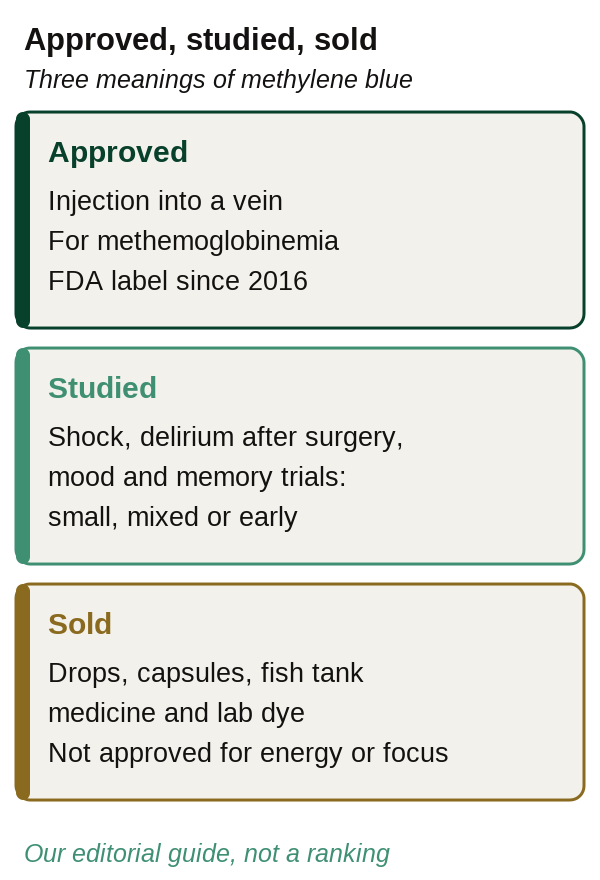
ProvayBlue, approved in 2016, and several generic injections are labeled for acquired methemoglobinemia in children and adults. In the label’s studies of 31 adults, 26 of the 28 with a baseline level had their methemoglobin fall by at least half at the first check after treatment. Every FDA-approved methylene blue product we found on DailyMed is one of these injections.
Online, methylene blue is sold as drops and capsules. National Geographic reported in 2025 that users claim it improves cognitive function, energy and mood. The same chemical is listed on DailyMed in aquarium products and as an animal-drug bulk ingredient, and prescription urinary tablets that contain it are listed as unapproved drugs. DailyMed also lists two 1% drop products whose labels call them dietary supplements, claim memory and fatigue benefits, and carry no warning about antidepressants, G6PD deficiency or pregnancy. The FDA doesn’t approve dietary supplements, or their labels, for safety and effectiveness before they’re sold. A UC San Diego professor told National Geographic that with liquid drops, “it is very easy to overdose.”
MeliOra does not offer methylene blue. If you came here looking for more energy, our wellness shot menu lists what we do offer, with no claim that any shot boosts the brain or treats fatigue, and you can book a visit to ask Dr. Espinet whether anything on it fits you.
Most of the brain and anti-aging story comes from cells and animals. Here’s what was tested in people:
Who paid matters. Both Alzheimer’s trials were funded by the maker of the related compound; the 2026 report blames its 52-week result on that low-dose comparison group, and its later differences in people with mild cognitive impairment compared starting the drug a year earlier or later, not drug against placebo. The memory trial was funded by a federal research grant and a university endowment. The anti-aging review’s senior author founded a skincare company. If low energy is the real problem, ongoing fatigue deserves a workup; our guide to vitamin shots for energy covers low B12 and other causes.
The label’s side effect data come from people given the injection for methemoglobinemia. Among 31 adults, the reactions reported in at least 2% were headache, low potassium, diarrhea, low magnesium, muscle jerks, nausea and seizure-like episodes. The label also warns that:
We found no trial of the supplement drops sold online (PubMed search, November 2026). In the 6-month bipolar trial, side effects were mild and passed; in the 15-month Alzheimer’s trial of the related compound, stomach and urinary effects were the most common reasons people stopped. The same gap in long-term data applies to many wellness trends; see NAD side effects for another example.
The boxed warning says ProvayBlue “may cause serious or fatal serotonergic syndrome when used in combination with serotonergic drugs and opioids,” and continues: “Avoid concomitant use of PROVAYBLUE with selective serotonin reuptake inhibitors (SSRIs), serotonin norepinephrine reuptake inhibitors (SNRIs), monoamine oxidase inhibitors (MAOIs) and opioids.” Literature reports suggest it’s a potent reversible inhibitor of monoamine oxidase, the label notes, the same action as MAOI antidepressants, and the label lists the medicines to avoid with it. For people given the injection, it advises not starting a serotonergic drug within 72 hours after the last dose.
The warning isn’t limited to the hospital injection: the FDA’s 2016 review of ProvayBlue notes that in 2011 the agency warned “serious CNS reactions may occur when methylene blue in any formulation is administered to patients taking serotonergic drugs.” CNS means the brain and nerves.
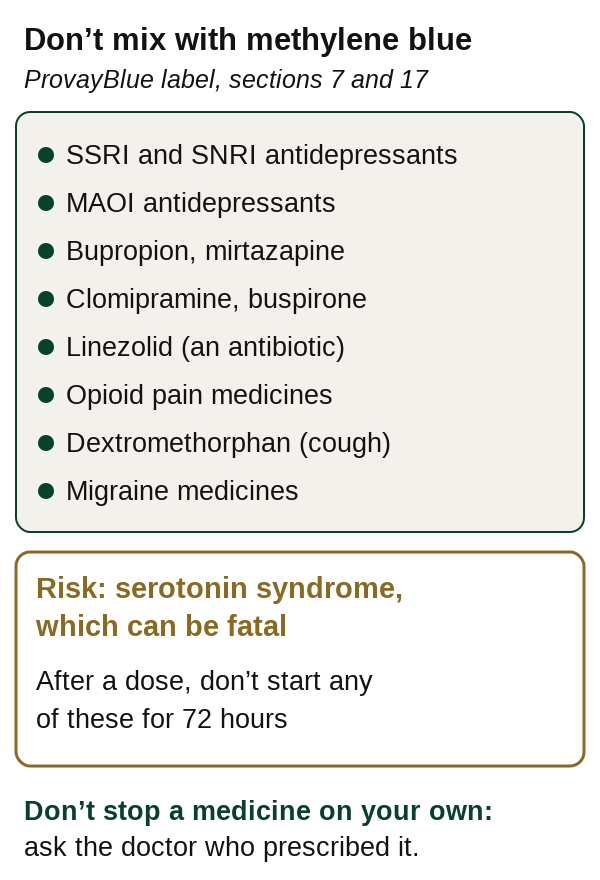
Don’t stop an antidepressant to try methylene blue, and if you already take one of these medicines, don’t skip or stop it to make room for methylene blue. MedlinePlus advises talking to your provider before stopping a medicine, and serotonin syndrome symptoms can start within minutes to hours of combining medicines. MedlinePlus also ties serotonin syndrome to fentanyl, meperidine and street drugs such as amphetamines, cocaine, ecstasy and LSD. If you already took methylene blue while on one of these medicines, watch for the signs in the table below.
Skip it and talk to a physician if you take any medicine in the figure above, have G6PD deficiency (more common in men and in African American, Middle Eastern and Mediterranean people, MedlinePlus says), are pregnant or breastfeeding, have kidney or liver disease, or have had an allergic reaction to a thiazine dye. The label says it may cause fetal harm and advises stopping breastfeeding for up to 8 days after treatment. G6PD deficiency is also a reason to avoid high-dose vitamin C, as our glutathione injection guide explains.
| If you notice | What to do |
|---|---|
| Agitation, confusion, hallucinations, fever, heavy sweating, tremor, muscle twitching or stiffness, a fast heartbeat, or a seizure, especially if you also take an antidepressant, opioid, triptan, cough medicine with dextromethorphan, or a stimulant or party drug | Call 911. These can be signs of serotonin syndrome, which can be fatal |
| Swelling of the face, lips, tongue, or throat (even on its own), trouble breathing or swallowing, wheezing, or fainting, with or without hives | Call 911. These can be signs of a severe allergic reaction |
| Chest pain, shortness of breath, or feeling faint, whatever color your skin or lips look | Call 911. Methylene blue stains skin blue and can make a pulse oximeter read falsely low, so don’t rely on either |
| You or a child swallowed more than intended | Call Poison Help at 1-800-222-1222, or go to an emergency room right away |
| Dark urine (not just blue or green), yellow skin or eyes, unusual tiredness, or a racing heart, even a day or more later | Get medical care right away. Red blood cells may be breaking down, especially with G6PD deficiency. A racing heart with agitation, sweating, fever or confusion: call 911 |
| Mild dizziness or blurry vision with no other signs, and you take none of the medicines in the figure above | Don’t drive or use machinery until it passes, and contact your physician. Any new confusion or agitation: call 911 |
| A burning rash or blistering after sun exposure | Get out of the sun and contact your physician |
| You’re pregnant or breastfeeding and took methylene blue | Contact your obstetrician or physician |
| Thoughts of harming yourself | Call or text 988, the Suicide and Crisis Lifeline, right away. If you might act on them or are in immediate danger, call 911 |
Blue or green urine and a blue tongue on their own are expected staining, not an emergency. Tell every prescriber, anesthesia team and pharmacist if you use any methylene blue product.
We don’t claim any shot sharpens the brain, slows aging, or treats any illness. Our wellness shots are $30 each, or $80 for the Wellness Boost Package of Lean Ease, NAD+, Revita and BLean, as optional nutrient support. Read what NAD is before choosing an NAD+ shot, and bring your full medicine and supplement list to any visit.
Dr. Espinet is a board-certified Family Medicine physician. To ask whether a wellness shot, Botox with Jeuveau or Xeomin, or physician-led weight loss fits you, book a visit.
Its FDA-approved use is an injection, given into a vein, for acquired methemoglobinemia, a blood disorder that keeps hemoglobin from releasing oxygen. It’s also a surgical and lab dye. Uses for shock and delirium after surgery are being studied, and online sellers market it for energy, focus and aging without approval.
The proven benefit is treating methemoglobinemia. Small trials suggest possible effects on mood in bipolar depression and on brain activity during memory tasks, but results are mixed, and a related compound didn’t beat its comparison in two large Alzheimer’s trials. Anti-aging claims come mostly from cells and animals.
The label lists headache, low potassium, diarrhea, nausea, muscle jerks and seizure-like episodes, plus blue urine and skin, sun sensitivity, confusion, dizziness and vision changes. It can break down red blood cells, especially in G6PD deficiency, and with antidepressants it can cause serotonin syndrome.
No. The label’s boxed warning says methylene blue may cause serious or fatal serotonin syndrome with SSRIs, SNRIs, MAOIs, opioids and other serotonergic drugs. Don’t stop your antidepressant to try it; talk to your prescriber first. If you combined them, call 911 for agitation, fever, sweating, stiffness or confusion.
We found no trial of the drops and capsules sold online, and no supplement form is an FDA-approved drug. Risks include serotonin syndrome with many medicines, red blood cell breakdown in G6PD deficiency, harm in pregnancy, and easy overdosing with drops. Talk to a physician before trying it.
It’s a strong dye that passes into the urine, so urine, other body fluids, the tongue and sometimes the skin can turn blue or green. That staining is expected. Dark brown or tea-colored urine, yellow eyes or unusual tiredness are different and need medical care right away.
Serving Lutz, Wesley Chapel, Land O'Lakes, Carrollwood, New Tampa & greater Tampa Bay.
Book Your Consultation
Free download · 15 pages
Typical units and cost by area, Botox brands Jeuveau vs. Xeomin, aftercare, a results timeline and a planner you can fill in. Free, and yours to keep.
Get the free guide