Cortisol Face: Morning Puffiness, Moon Face, and the Signs That Need a Doctor
Dr. Melanie Espinet, board-certified Family Medicine physician ·
Most morning puffiness is fluid that eases by afternoon; a true moon face stays round all day and builds over months. Photo: cottonbro studio on Pexels
The short answerCortisol face is a social media name, not a diagnosis. Everyday puffiness has ordinary causes (overnight fluid, salt, alcohol, short sleep, allergies) and often eases by afternoon. A true moon face is round, red and full, builds over months, and comes with other signs of Cushing’s syndrome, most often from steroid medicines. Never stop a prescribed steroid on your own.
Videos tagged cortisol face blame a puffy or rounder face on stress hormones. Here’s what doctors mean by moon face, the signs that point to Cushing’s syndrome, and when to see a doctor. General information, not medical advice.
What is cortisol face?
Cortisol face is a TikTok term for a puffy or rounder face blamed on high cortisol. It isn’t a medical diagnosis. Doctors describe the round, full face of long-term cortisol excess as moon face, or moon facies, a sign of Cushing’s syndrome.
Cortisol, made by your adrenal glands, helps your body respond to stress and keeps blood pressure and blood sugar steady, the NIDDK explains. Cortisol is generally higher when you wake up and lowest at night, University of Colorado endocrinologist Christie Turin More, MD, told her university’s news office in 2024. “Cortisol face and moon face are not medical terms,” she said.
Does stress cause a puffy face?
Stress, getting sick and the time of day all affect cortisol levels, and in those cases, Dr. Turin More said, people often have no symptoms of high cortisol. A face changes when cortisol stays high for a long time. Depression, anxiety, heavy drinking, poorly controlled diabetes and obesity can raise cortisol off and on without Cushing’s long-term effects, which the NIDDK calls pseudo-Cushing’s syndrome. Our cortisol belly guide covers what stress does to the waistline.
Moon face vs a puffy face: how they differ
MedlinePlus lists a “round, red, full face (moon face)” among symptoms most people with Cushing’s syndrome have. The roundness comes from fat building up in the face and the redness, called facial plethora, from more blood flow, Dr. Turin More explained. Everyday puffiness is fluid, and it moves. The table is our editorial summary of the sources on this page, not a diagnostic rule.
Morning puff vs moon face
What to look at
Morning puff
Moon face
When you notice it
Worst on waking, often eases by afternoon
There all day, building over months
What came before it
A salty meal, drinks, a short night, allergy season
Steroid medicine, or no clear trigger
What else shows up
Maybe puffy eyelids or a stuffy nose
Bruising, weak hips or shoulders, wide purple stretch marks
MedlinePlus also uses “moon face” and “puffy face” as names for facial swelling in general, so the terms blur online. A face that looks hollow after weight loss is a different problem; see Ozempic face.
Puffy face, but not cortisol: the everyday causes
Puffy faces have many ordinary causes, each backed by a study or a MedlinePlus page:
Lying flat: fluid shifts toward the head overnight; in a sleep lab study of 23 men, the more fluid left the legs, the more the neck measurement grew (faces weren’t measured), and MedlinePlus suggests raising the head of the bed for facial swelling
Salt: MedlinePlus lists too much salt or sodium as a cause of swelling
Alcohol: in a survey of 3,267 women who rated their own faces, heavy drinking (8 or more drinks a week) and moderate drinking were both tied to more under-eye puffiness
A short night: 40 raters judged the same 10 people as having more swollen eyes after a night of 5 hours’ sleep and 31 hours awake
Allergies: hay fever can cause puffiness and dark circles under the eyes
Infection: sinusitis, a tooth abscess or a stye can swell part of the face
The alcohol survey was funded by Allergan and shows associations, not cause. Some causes need a doctor: an untreated underactive thyroid can puff the face, hands and feet; nephrotic syndrome, a kidney disease, can swell the face and the area around the eyes and cause foamy urine; and some heart, blood pressure and diabetes medicines cause swelling. Fullness that came with weight gain everywhere else, with none of the telling signs below, is often a weight question; physician-led medical weight loss is one place to start.
Cushing face: why a round face is the least telling sign
Cushing’s syndrome means too much cortisol over a long time. When the body makes the extra itself, it’s rare: estimates range from about 40 to 70 people per million, mostly adults aged 30 to 50, about three times as many women as men, the NIDDK says. The most common cause is long-term, high-dose glucocorticoid medicine, such as prednisone.
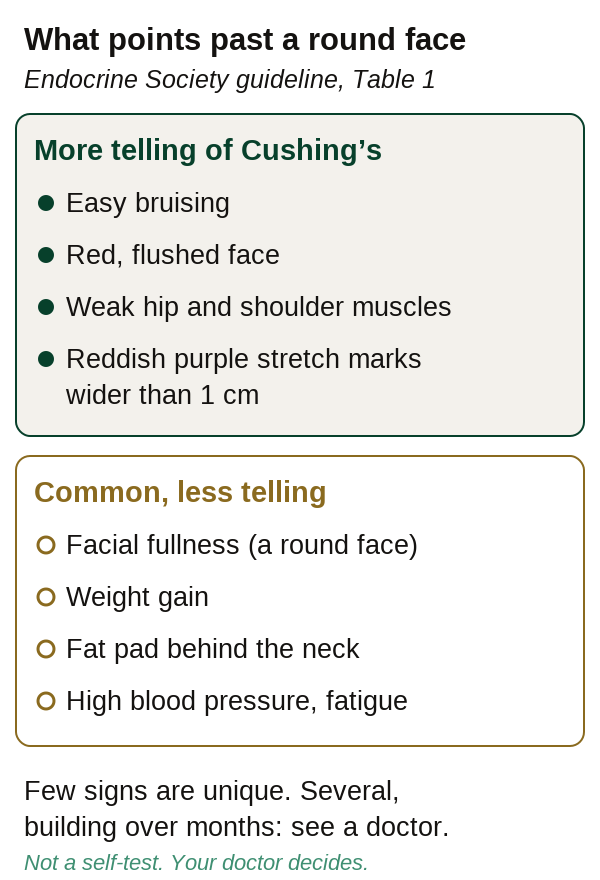
What the videos miss: the Endocrine Society’s diagnosis guideline lists facial fullness among features that are common in the general population and less telling. The signs that best set Cushing’s apart are easy bruising, a red, flushed face, weak hip and shoulder muscles, and reddish purple stretch marks wider than 1 cm. Few, if any, signs are unique, the guideline says; several signs building up over time raise the odds. Cushing’s can also be mistaken for polycystic ovary syndrome or metabolic syndrome, the NIDDK notes.
A round face sits in the common, less telling group; bruising, redness, weak hips or shoulders and wide purple stretch marks point further.
Moon face from steroid medicine
In a French study of 88 people starting high-dose steroid treatment (20 mg a day or more) meant to last three months or longer, 61% had a rounder face or a fat pad on the back of the neck (a buffalo hump) on standardized photos by month 3, and 69% by month 12, the abstract reports, more often in women and people under 50.
Steroids also come as joint injections, skin creams, inhalers, eye drops and enemas, MedlinePlus notes, and the guideline warns that steroids hidden in skin creams (including skin lighteners) and herbal remedies are easy to overlook. Don’t stop or cut back a prescribed steroid on your own: stopping suddenly after long use, usually more than 2 weeks, can trigger a life-threatening adrenal crisis. The risk depends on the dose, how long you took it, how strong it is and how it was given, the Endocrine Society’s 2024 guideline notes. Your prescriber can lower the dose gradually to the lowest that controls your condition, or sometimes switch you to a non-steroid medicine.
The Morning Puff or Moon Face log: a two-week check
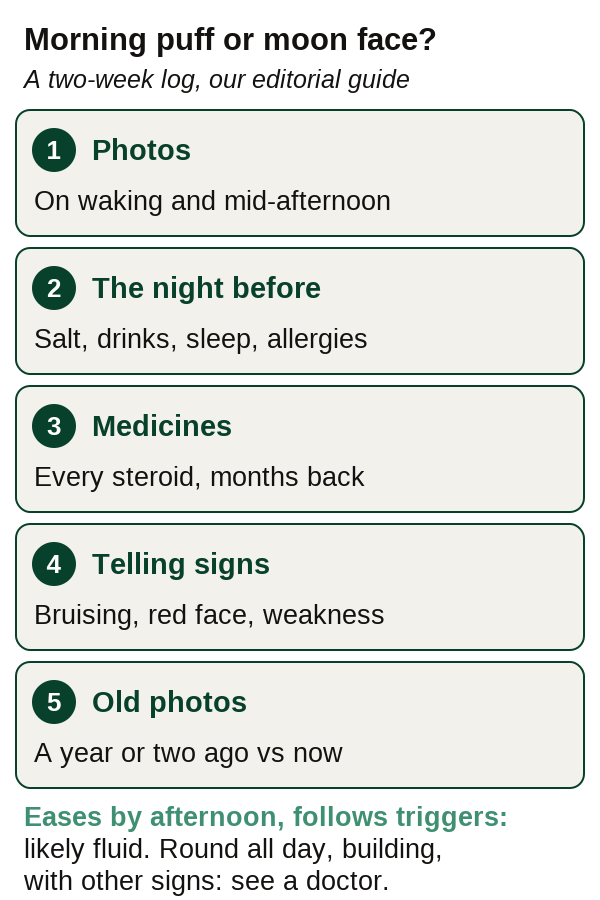
Our editorial guide, built from the sources above. It isn’t a diagnostic test or a MeliOra procedure, and it isn’t a reason to wait: if you have several telling signs, take a steroid, or notice any urgent sign in the table below, see a doctor now.
Photos: take a photo on waking and another in mid-afternoon, same spot, same light, every day for two weeks.
The night before: note salty meals, drinks, hours slept, crying and allergy symptoms.
Medicines: list every steroid from the past several months, including inhalers, creams, eye drops and joint shots.
Telling signs: check for easy bruising, a red face, weak hips or shoulders, and purple stretch marks wider than 1 cm.
Old photos: compare your face now with photos from a year or two ago.
Puffiness that eases by afternoon and follows a trigger points to fluid; a face that stays round and keeps changing, with other signs, needs a doctor.
How to read it: a face puffier in the morning photos and after salt, drinks or a short night fits everyday fluid. A face round all day, rounder than a year ago, with any telling sign belongs with your primary care physician; the guideline notes old photos help doctors see change. Bring photos and your medicine list.
If your log points away from cortisol and the fuller face has come with steady weight gain, you can tell us about your goals and ask Dr. Espinet whether a physician-led weight loss plan fits you.
Should you get your cortisol tested?
Only with your doctor. The Endocrine Society guideline recommends ruling out steroid medicine first, then testing people with several worsening features, and recommends against widespread testing. First-line tests are a 24-hour urine cortisol, a late-night saliva cortisol, or a low-dose dexamethasone suppression test; an abnormal result goes to an endocrinologist for a second test. A random daytime blood cortisol isn’t accurate enough to diagnose Cushing’s, the guideline says.
Dr. Turin More said testing someone worried about a moon face is reasonable, and normal results let her reassure them. She knows of no diet that balances cortisol, she said, and a round face that goes away after a diet change or supplement was less likely from high cortisol. If you’re curious about the drink behind the trend, see what’s in an adrenal cocktail.
Can Botox help a cortisol face?
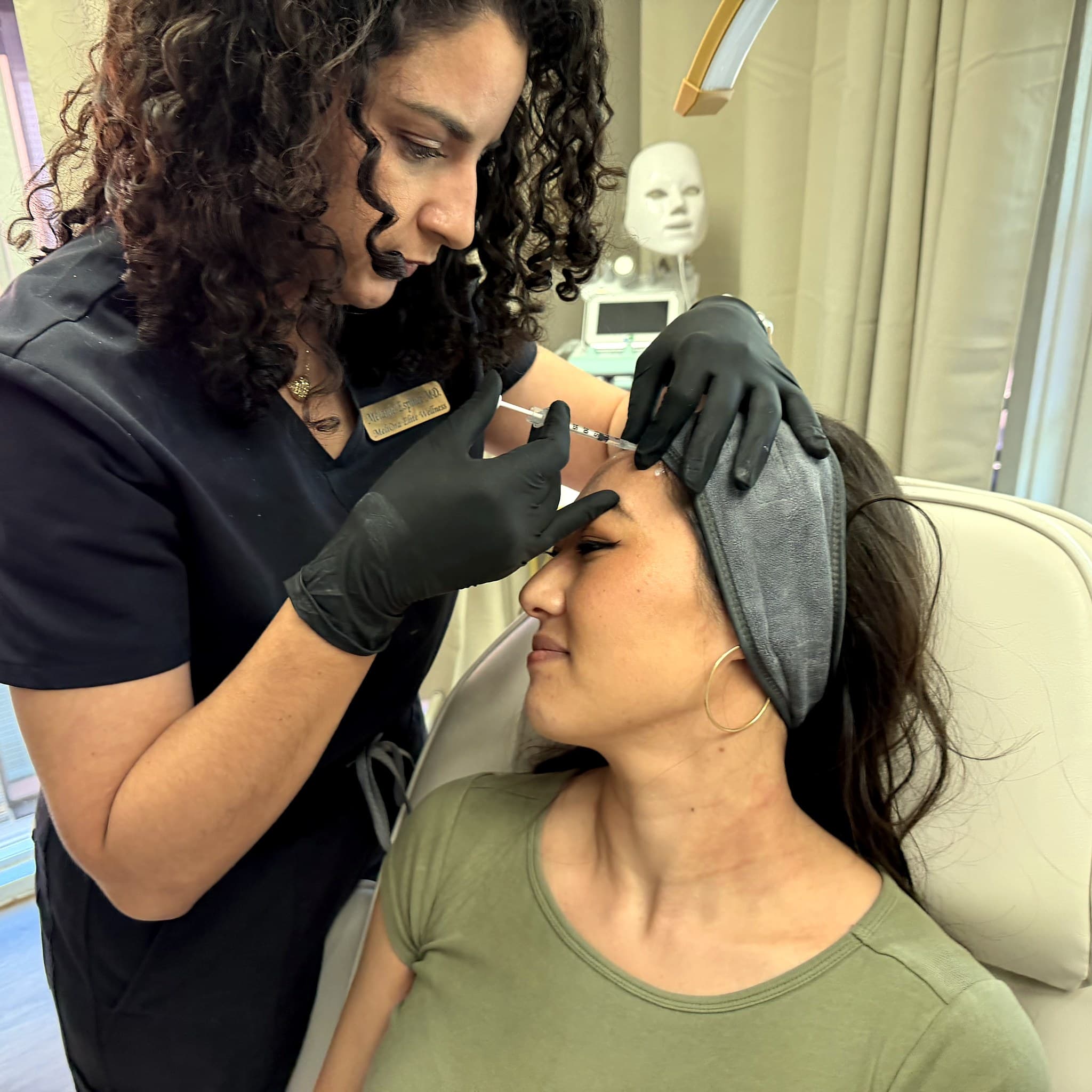
No. Botox with Jeuveau or Xeomin blocks the nerve signals that make a muscle contract (section 12.1 of each label). It doesn’t drain fluid or remove fat, so it can’t change puffiness or a moon face. One kind of wide face is muscle: a large masseter, the chewing muscle at the jaw corner. Jaw slimming with masseter Botox is on our treatment chart as an off-label use, and its risks are on our Botox side effects page.
When to see a doctor about a moon face or puffy face
See a physician instead of trying an online fix if you take or recently took a steroid, your face has stayed round for weeks and keeps changing, you have any telling sign, or you’re pregnant or gave birth in the past year. MedlinePlus advises contacting your provider for facial swelling that lasts or keeps getting worse. Our cortisol belly page covers the body signs below the neck.
If you notice
What to do
Swelling of the lips, tongue, or throat, even on its own, or facial swelling with trouble breathing or swallowing, wheezing, chest pain, throat tightness, hives, or fainting
Call 911. These can be signs of a severe allergic reaction
Any facial swelling with breathing problems, or after a burn
Get emergency care now: call 911
While taking a steroid or after stopping one: sudden severe pain in your lower back, belly, or legs, vomiting and diarrhea, weakness, confusion, or passing out
Call 911 or go to the emergency room. These can be signs of adrenal crisis, which can be life threatening
Pregnant or in the year after giving birth, with extreme swelling of your hands or face, a headache that won’t go away or gets worse, changes in your vision, severe belly pain (including under your right ribs), chest pain or a fast-beating heart, or dizziness or fainting
Seek medical care immediately, the CDC advises. These can be signs of preeclampsia. Trouble breathing: call 911. Sudden weight gain on its own: contact your provider right away
Sudden, painful, or severe facial swelling
Contact your provider right away
Facial swelling with fever, tenderness, or redness
Contact your provider the same day. These can be signs of infection
A rounder face while taking or after taking a steroid
Keep taking it as prescribed and contact your prescriber. Stopping suddenly can be dangerous
A rounder face with easy bruising, a red face, weak hips or shoulders, or purple stretch marks wider than 1 cm
See your physician soon. These signs point most toward Cushing’s syndrome
A puffy face or puffy eyes with swollen legs or feet, or foamy urine
See your physician soon. These can be kidney signs
A puffy face with feeling cold, tired, or slowed down, dry skin, or weight gain
See your physician and ask about a thyroid check
Thoughts of harming yourself
Call or text 988, the Suicide and Crisis Lifeline, right away. If you might act on them or are in immediate danger, call 911
Cushing’s can usually be cured, but it can be fatal if not treated, the NIDDK says, so a round face with other signs is worth a visit even if it feels minor.
How MeliOra fits
Cortisol testing and Cushing’s care belong with your primary care physician or an endocrinologist. MeliOra doesn’t claim any shot, drink or treatment lowers cortisol or slims a puffy face. We offer Botox with Jeuveau or Xeomin, physician-led weight loss with weekly semaglutide or tirzepatide, and wellness shots.
For Botox or weight loss, you can book a visit with Dr. Espinet.
Frequently asked questions about cortisol face
Is cortisol face real?
Not as a diagnosis; it’s a social media name. Long-term high cortisol, called Cushing’s syndrome, can cause a round, red, full face known as moon face, usually with other signs. Everyday puffiness often comes from fluid, salt, alcohol, short sleep or allergies instead.
What does a moon face look like?
A moon face is round, full and often red, stays that way all day, and builds slowly over months. In Cushing’s syndrome it usually comes with signs such as easy bruising, weak hip or shoulder muscles and wide purple stretch marks.
How do you get rid of cortisol face?
Treat the cause. Everyday puffiness often eases with sleep, less salt and alcohol, allergy care and raising your head at night. A moon face from steroids needs your prescriber to adjust the dose; other Cushing’s causes need a doctor. No diet is known to balance cortisol.
Can stress make your face puffy?
Everyday stress raises cortisol for a while, but that usually doesn’t change your face; cortisol has to stay high for a long time to cause a moon face. If your face looks puffier on stressful weeks, short sleep, alcohol, salty food or allergies are likelier culprits.
Does prednisone cause moon face?
It can. In one study of 88 people starting high-dose steroids meant to last months, most showed a rounder face or neck fat on photos within three months. Don’t stop or cut back on your own; your prescriber can lower the dose safely or suggest other options.
When should I worry about a puffy face?
Call 911 for any swelling of the lips, tongue or throat, or facial swelling with trouble breathing. In pregnancy or the year after birth, seek medical care immediately for extreme swelling of the face or hands. See a doctor soon for swelling that lasts, or a round face on steroids or with bruising or weakness.