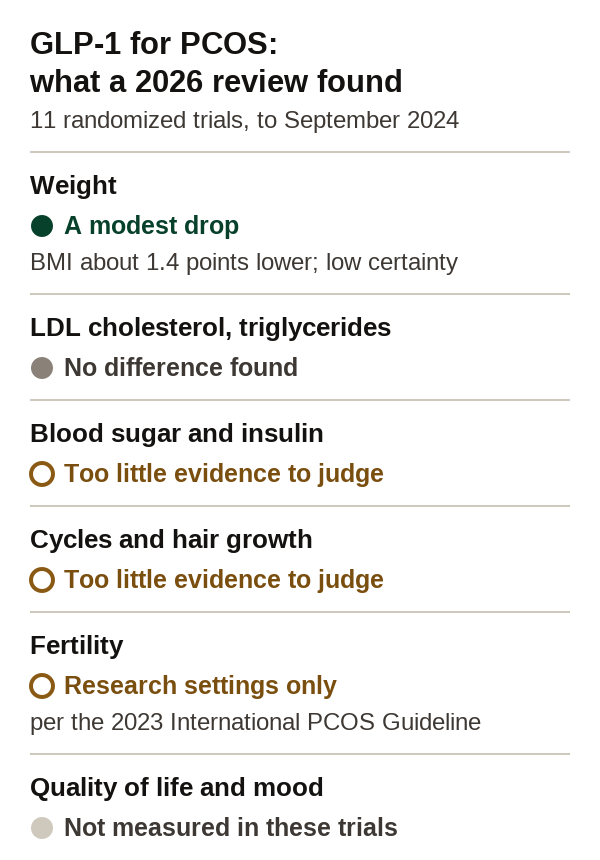
The short answerNo GLP-1 medicine is approved for PCOS itself, so using one for PCOS is off-label, and you qualify through the usual weight-management criteria. The 2023 international PCOS guideline says these medicines could be considered for higher weight, alongside lifestyle changes. In a 2026 review of 11 PCOS trials, weight loss was modest, and effects on cycles, hair growth, and fertility remain unproven.
Below: what GLP-1 for PCOS trials show, who qualifies under Florida’s rules, how a GLP-1 compares with metformin, and why birth control matters. Dr. Espinet prescribes semaglutide and tirzepatide for medical weight loss. This page is general information, not medical advice.
Is GLP-1 for PCOS off-label, and who qualifies?
Yes, GLP-1 use for PCOS is off-label: no GLP-1 label lists PCOS. Zepbound (tirzepatide) is labeled for weight reduction in adults with obesity, or overweight plus at least one weight-related condition, and for sleep apnea in adults with obesity. Wegovy (semaglutide) is labeled for weight reduction and heart risk reduction, among other uses. Ozempic is labeled only for type 2 diabetes.
So PCOS alone doesn’t qualify you; the weight criteria do. In Zepbound’s main weight trial, that meant a BMI of 30 or more, or 27 to 30 with a weight-related condition such as high blood pressure or high cholesterol. Whether a PCOS-related condition counts as yours is your physician’s call. Effects on cycles, androgens, or fertility aren’t the labeled purpose and aren’t proven.
The 2023 International Evidence-based Guideline for PCOS, developed with the Endocrine Society, ASRM, ESHRE, and the European Society of Endocrinology, agrees: anti-obesity medicines, naming liraglutide and semaglutide as well as orlistat, “could be considered, in addition to active lifestyle intervention, for the management of higher weight in adults with PCOS as per general population guidelines.”
Florida’s rule for weight-loss prescribing
Florida Board of Medicine Rule 64B8-9.012 sets a floor for any weight-loss medicine: an initial BMI of 30 or above, a BMI greater than 27 with at least one other condition, or body fat of at least 30% of body weight for women. It also requires:
A history, physical exam, and relevant tests before the first prescription
Written informed consent covering benefits and risks
A re-evaluation at least once every 3 months
A copy of Florida’s Weight-Loss Consumer Bill of Rights
The same rule bars weight-loss ads that promise specific results or claim “rapid, dramatic, incredible, or safe” weight loss, so this page reports findings, not promises. First-prescription steps are in how to get a semaglutide prescription.
What GLP-1 medicines have shown in PCOS trials
A 2026 systematic review in the European Journal of Endocrinology included 11 randomized trials. Added to other care, GLP-1 medicines lowered BMI by about 1.4 points more than comparison groups, on low-certainty evidence, with no difference in LDL cholesterol or triglycerides. The evidence on glucose, insulin, hirsutism, and cycle regularity was too limited to draw conclusions, and none of the 11 trials measured quality of life or mental health. The authors called the weight loss modest and short-term.
That review’s search ended in September 2024. Since then, small trials have reported more regular cycles and more natural pregnancies, including a 16-week trial in 60 women where tirzepatide added to metformin beat metformin alone on weight and cycle recovery; a 2026 review of three trials rated the natural-pregnancy finding moderate certainty. It’s early evidence, and another reason to use birth control if you aren’t trying.
In the review’s 11 trials, only weight clearly improved, and the review rated even that low certainty.
Newer trials are under way. ClinicalTrials.gov lists a placebo-controlled tirzepatide trial planned for 198 women with PCOS and overweight or obesity, due to finish in 2029, and an 80-person open-label study of whether semaglutide restores ovulation, due in 2028. The big trials behind the Zepbound and Wegovy labels weren’t PCOS trials.
How GLP-1 and GIP medicines work, and which is best
GLP-1 is a gut hormone that helps regulate appetite and how much you eat, and these medicines mimic it. Insulin resistance is a core feature of PCOS, but whether these medicines improve it in PCOS is still unsettled. No trial has compared semaglutide with tirzepatide in PCOS, so there is no evidence-based “best” for PCOS itself. Tirzepatide also acts on a second gut hormone, GIP, explained in our guide to what GIP is. How the two compare in general weight care is covered in semaglutide vs tirzepatide, and the basics are in what is GLP-1.
PCOS has a new name: PMOS
In May 2026, a global consensus published in The Lancet renamed PCOS polyendocrine metabolic ovarian syndrome (PMOS), after work with 56 organizations and survey answers from 14,360 people with the condition and health professionals. The name drops the misleading “cysts” and reflects the hormone and metabolic sides of a condition that affects about one in eight women. We use PCOS here, the name most people still search.
GLP-1 vs metformin for PCOS
The 2023 guideline speaks more firmly about metformin: it “should be considered” in adults with PCOS and a BMI of 25 or more for weight and metabolic outcomes, while GLP-1 medicines “could be considered” for higher weight. It also tells women that metformin and an active lifestyle program work about equally well.
Metformin vs GLP-1 medicines
What the 2023 guideline says
Metformin
GLP-1
Wording
Should be considered at a BMI of 25 or more
Could be considered for higher weight, with lifestyle change
Basis
Evidence-based recommendation
Consensus recommendation
Side effects
Mild stomach upset, often dose-related; possible low vitamin B12
Stomach side effects, so doses go up gradually
Cycles and hair growth
May be considered for irregular cycles if the birth control pill isn’t suitable; hair growth may need other treatment
Too little evidence to judge
Long term
Appears safe long term
Weight regain likely after stopping; long-term safety data lacking
Many people take both, and semaglutide’s labels call for no metformin dose change. Outside PCOS, our metformin vs Ozempic guide compares the two medicines job by job. Ask your prescriber before adding or stopping either. If you use the birth control pill for cycles or hair growth, read the tirzepatide pill rule below before you start.
The Qualify, Protect, Track check before a GLP-1 for PCOS
Our editorial tool, built from the guideline, the labels, and Florida’s rule. It doesn’t replace a medical evaluation.
1. Qualify
Do you meet the weight criteria above, and are you ready for the eating and activity changes the guideline pairs with these medicines? A GLP-1 is an add-on to a lifestyle program, not a replacement for one. Before the first dose, mention any eating disorder, past or present, including binge eating or restriction; the guideline asks clinicians to check for this in PCOS at any weight.
2. Protect
If you could become pregnant, have a birth control plan before the first dose. The guideline tells clinicians to ensure effective contraception with GLP-1 medicines “as pregnancy safety data are lacking.”
3. Track
Agree on what you’ll review at each 3-month check: weight, cycles, side effects, mood and eating, and the labs below.
If your answers point to a GLP-1, book a weight loss consultation with Dr. Espinet and bring your cycle history and current medicines.
The fertility paradox: why birth control still matters
Irregular periods don’t mean you can’t get pregnant. People with PCOS can ovulate and conceive on their own across their reproductive years, a 2026 opinion paper in Human Reproduction notes, and ACOG’s 2026 advisory says weight loss on these medicines may improve fertility. Whether a GLP-1 restores ovulation in PCOS is what the semaglutide study above is testing.
So plan for each direction:
Not trying to conceive: use effective birth control. On tirzepatide, the label says to switch from the pill to a non-oral method or add a barrier method for 4 weeks after starting and after each dose increase.
Trying to conceive: tell your prescriber first. The Wegovy label says to stop semaglutide at least 2 months before a planned pregnancy; the Zepbound label sets none, and ACOG suggests considering 1 to 2 months for any GLP-1. Both labels say to stop if you become pregnant. The guideline also advises a glucose tolerance test before you try.
Want help getting pregnant: the guideline recommends anti-obesity medicines for fertility outcomes “only in research settings” and names letrozole the first-line medicine to induce ovulation in PCOS. That is fertility care; ask at your visit whether MeliOra can help with any part of it.
Our guide to Zepbound and pregnancy covers the birth control rule, pregnancy registries, and the 2026 pregnancy data in detail.
The next-step hurdle: labs, side effects, and stopping
The guideline’s PCOS screening advice makes a good list to ask about:
Blood sugar: checked at diagnosis and every 1 to 3 years by risk; a 75 g oral glucose tolerance test is the most accurate test in PCOS, and A1C or fasting glucose is less accurate.
Cholesterol: a lipid profile for everyone with PCOS.
Not an insulin level: the guideline says insulin blood tests have limited clinical relevance and aren’t recommended in routine care.
Sleep: ask about snoring and daytime sleepiness, since sleep apnea is more common in PCOS; Zepbound is also labeled for sleep apnea with obesity.
Side effects are mostly stomach-related at first, which is why doses rise gradually. If you stop, regain is common: the guideline flags a high risk of weight regain and a lack of long-term safety data, so plan the long term early, as our guide to stopping semaglutide explains. If progress stalls, see weight loss plateaus on GLP-1.
Who shouldn’t take one, and when to get help
Neither tirzepatide nor semaglutide is for anyone with a personal or family history of medullary thyroid carcinoma, anyone with MEN 2, or anyone who has had a serious allergic reaction to the medicine. Both are stopped in pregnancy and aren’t recommended with severe gastroparesis. Tell your prescriber first about pancreatitis, gallbladder disease, kidney problems, diabetic eye disease, insulin or sulfonylurea use, breastfeeding, or planned surgery, and tell any surgeon or anesthesia team that you take it.
If you notice
What to do
Swelling of your face, lips, tongue, or throat, trouble breathing or swallowing, severe rash or itching, a very fast heartbeat, fainting, or dizziness
Stop the medicine and call 911 or go to an emergency room
Severe stomach pain that won’t go away, sometimes reaching your back
Stop the medicine and call your prescriber right away; it can mean pancreatitis
Shakiness, sweating, or confusion if you take insulin or a sulfonylurea
Possible low blood sugar: treat it as you were taught and call your prescriber; call 911 if you faint or are too confused to treat it
A positive pregnancy test
Stop the medicine and call your prescriber that day
Nausea, vomiting, diarrhea, or other stomach problems that are severe or won’t stop
Call your prescriber right away; losing fluids can cause kidney problems
Upper stomach pain, fever, yellow skin or eyes, or clay-colored stools
Call your prescriber right away; it can mean gallbladder problems
A lump or swelling in your neck, hoarseness, trouble swallowing, or shortness of breath
Call your prescriber; these can be thyroid tumor signs
Heart racing at rest for several minutes, or vision changes with type 2 diabetes
Tell your prescriber
If you can’t reach your prescriber quickly about severe stomach pain, fever, or yellow skin, go to urgent care or an emergency room.
How MeliOra fits: GLP-1 care for weight, physician-led
MeliOra Elite Wellness offers GLP-1 care for weight management, led by Dr. Melanie Espinet, a board-certified family medicine physician in Lutz. She prescribes semaglutide or tirzepatide as weekly injections and tells you if a GLP-1 isn’t right for you. The label and trial facts on this page describe the brand-name products, so ask her exactly which medication you would receive. At your visit, also ask which other parts of your PCOS care she can help with.
Semaglutide weight loss starts at $150/month, or $240/month at higher dosing, and tirzepatide weight loss runs $230/month to $320/month. Each price includes physician visits, lab work, the medication and supplies, and dose adjustments and check-ins, with no consultation fee. MeliOra is a self-pay practice.
Dr. Espinet comes to your home or office across Hillsborough, Pasco, and Pinellas counties with no travel fee. Elsewhere in Florida, start with a telehealth weight loss visit at the same monthly price.
Frequently asked questions
Which GLP-1 is best for PCOS?
There’s no proven best. No trial has compared semaglutide with tirzepatide in PCOS, and the 2023 guideline names liraglutide and semaglutide as options for higher weight. The right choice depends on your health history, side effects, and goals.
Do people with PCOS qualify for Ozempic?
Not because of PCOS. Ozempic is labeled only for adults with type 2 diabetes, and so is Mounjaro. The weight-management brands are Wegovy (semaglutide) and Zepbound (tirzepatide). For weight care, people with PCOS qualify like anyone else: in Florida, a BMI of 30 or more, or above 27 with a weight-related condition, after a full evaluation.
Can semaglutide help you get pregnant with PCOS?
It isn’t proven. The 2023 guideline recommends anti-obesity medicines for fertility outcomes only in research settings, and a study of whether semaglutide restores ovulation is still running. Ovulation can return on its own, so use birth control if you’re not trying, and stop semaglutide at least 2 months before a planned pregnancy.
Can I take metformin and a GLP-1 together for PCOS?
Many people do, and semaglutide’s labels call for no metformin dose change. Both can cause stomach side effects, so your prescriber may adjust doses. The guideline supports metformin for metabolic outcomes and a GLP-1 for higher weight, each alongside lifestyle changes.
Does tirzepatide work for PCOS?
Only one small trial has finished: in 60 women, adding tirzepatide to metformin for 16 weeks led to more weight loss and more regular cycles than metformin alone, but it was short and open-label. Zepbound, a tirzepatide brand, is labeled for weight and sleep apnea, so in PCOS it is prescribed for weight. A larger placebo-controlled trial is due in 2029.
What happens to PCOS when you stop a GLP-1?
Weight regain is common. The 2023 guideline warns of a high risk of regain after stopping and notes a lack of long-term safety data, so it advises talking through long-term use before starting. Plan any stop with your prescriber, and keep birth control in place if your cycles have changed.