GLP-1 Friendly Foods: Read Past the Badge, Then Build a Holiday Plate
Dr. Melanie Espinet, board-certified Family Medicine physician ·
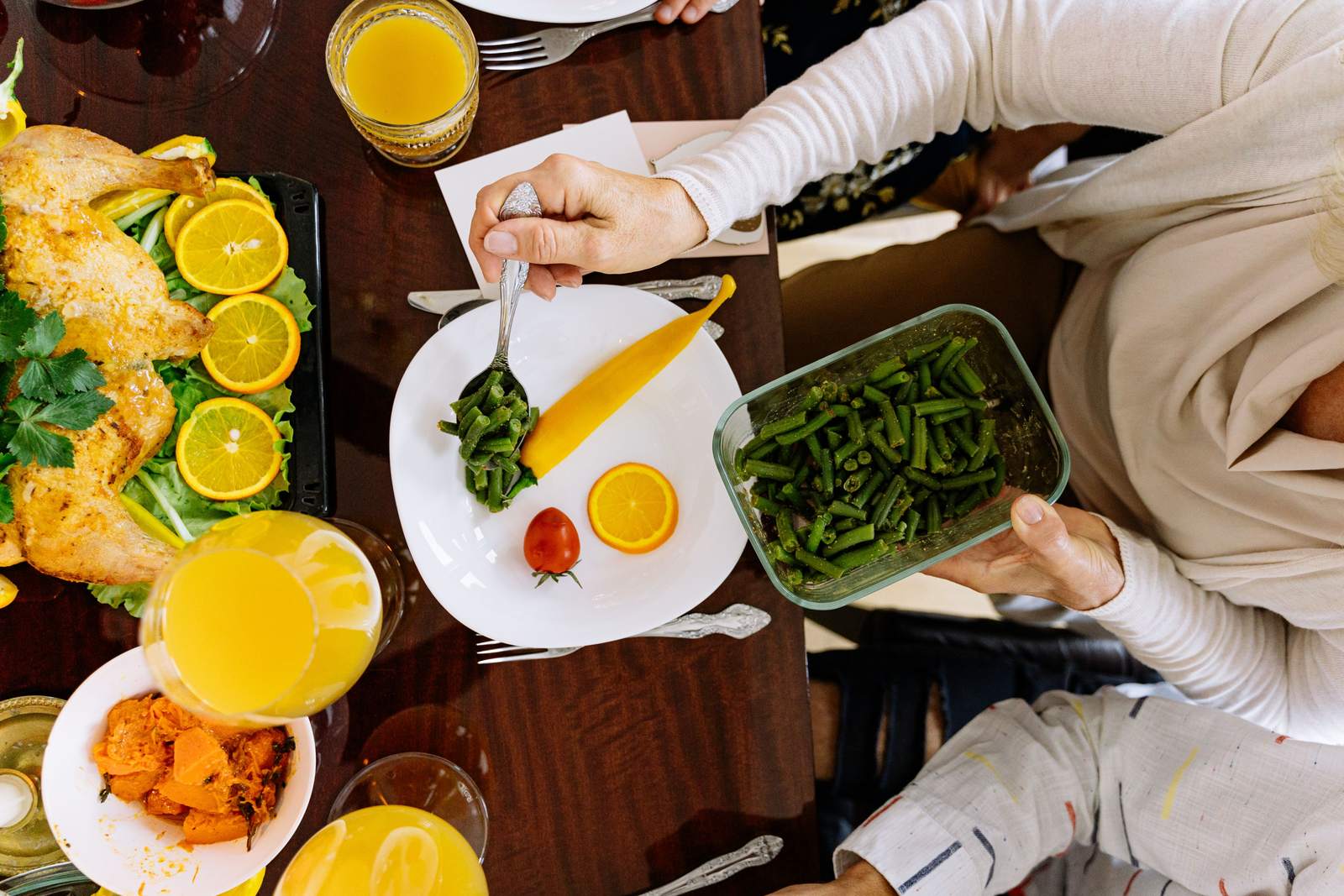
A GLP-1 friendly badge has no FDA definition, so read protein, fiber, portion, then added sugar, the same order that works for a holiday plate. Photo: Antoni Shkraba on Pexels
The short answer“GLP-1 friendly” is a marketing badge with no FDA definition. Read past it to the Nutrition Facts panel: protein, fiber, portion, then added sugar. The same order works for a holiday plate.
GLP-1 friendly foods now fill freezer aisles and restaurant menus. Here’s what the badge does and doesn’t promise, how to check a product in under a minute, and how to use the same order at Thanksgiving dinner on November 26. It’s general information, not medical advice.
Dr. Melanie Espinet prescribes weekly semaglutide or tirzepatide for medical weight loss. For the full eating guide, see what to eat on semaglutide; this page decodes labels and the holiday table.
What does “GLP-1 friendly” mean on a food label?
“GLP-1 friendly” is a phrase a company chooses to put on a package or menu. No federal rule defines it, so it carries no required amount of protein, fiber, calories, or sugar. Treat it as a pointer to the label, not a substitute.
Conagra says its Healthy Choice line was the first major brand to put it on a package. Its December 2024 release announced an “On Track” badge on 26 frozen meals, described as high in protein, low calorie, and a good source of fiber. No recipes changed: the badge highlighted existing meals, chosen partly for their smaller portions, and the company said the USDA had reviewed and approved every product carrying it for regulatory compliance. That is a label review, not a definition of the phrase.
In March 2026, a University of Arkansas extension nutrition specialist said the phrase “is not a standardized or regulated nutrition claim,” so brands and restaurants apply it differently. We found no FDA definition either (search of fda.gov, November 15, 2026). For what the medicine itself does, see what GLP-1 is.
Defined words vs. a marketing badge
Other words on the same package have legal meanings. Under 21 CFR 101.54, “high” means a food “contains 20 percent or more of the RDI or the DRV per reference amount customarily consumed,” and “good source” means “10 to 19 percent.” For a single food, per reference amount (the FDA’s standard serving for that food):
Words on the package
What a single food must contain
“High protein” or “excellent source of protein”
20% or more of the protein Daily Value of 50 grams, so at least 10 grams
“Good source of fiber”
10% to 19% of the fiber Daily Value of 28 grams, roughly 3 to 5 grams
“High fiber”
20% or more of the fiber Daily Value, at least 5.6 grams
“Healthy”
FDA criteria updated in December 2024: a set amount from a recommended food group, plus limits on added sugars, saturated fat, and sodium
“GLP-1 friendly”
No federal definition. The company sets its own criteria
Frozen meals and main dishes follow a looser rule: “high” or “good source” only means one food in the meal meets that level, and the label must say which food. The USDA oversees meat and poultry labels under its own rules. Either way, the Nutrition Facts panel tells you more than the badge.
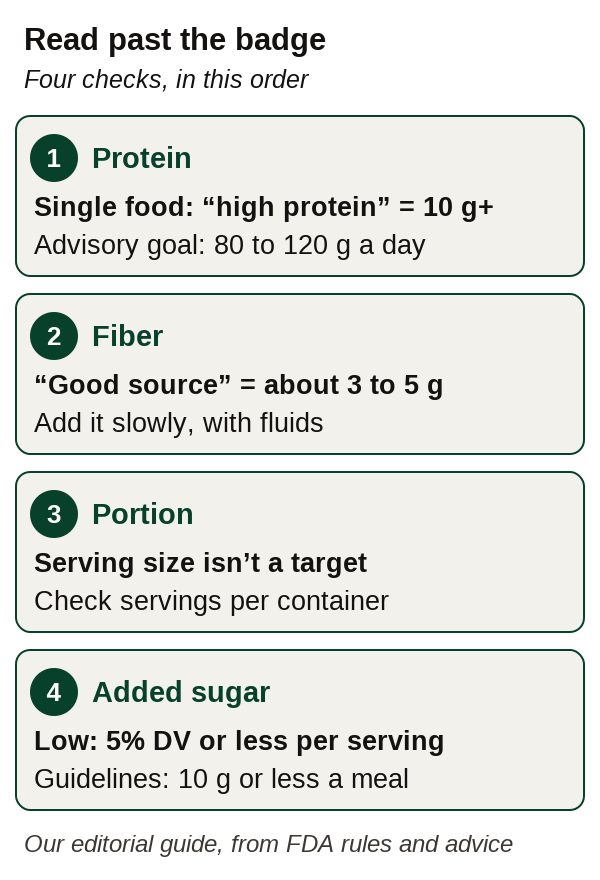
Read Past the Badge: protein, fiber, portion, sugar
Our four-step check for any GLP-1 friendly food, in the order that matters most when your appetite is small. It’s our editorial guide, built from FDA label rules and a 2025 advisory from four obesity and nutrition societies, not a MeliOra rule.
1. Protein: is it a real share of the meal?
With room for only a few bites, the 2025 advisory suggests eating protein-rich foods first so you get enough. It offers a simple target of 80 to 120 grams a day: roughly 27 to 40 grams a meal over three meals (our arithmetic). A single food that just clears the 10-gram “high protein” line covers only part of one meal. Your own number depends on your body and your kidneys; see muscle loss on GLP-1 medication.
2. Fiber: some, but not a sudden pile
Constipation was reported by 24% of adults on Wegovy 2.4 mg versus 11% on placebo, so fiber earns its place. More isn’t automatically better at the start: the advisory suggests avoiding fatty or very high-fiber foods in the first few days of treatment, then adding fiber-rich foods gradually with enough fluids. For the fiber trend, see fibermaxxing.
3. Portion: whose serving is it?
Check servings per container. The FDA says serving size reflects what people typically eat and is not a recommendation of how much you should eat. The advisory favors regular, small meals, since vomiting is more likely after large ones. A small single portion can be the most useful thing about a badged product.
4. Added sugar: the tiebreaker
Look at the Added Sugars line. The FDA’s rule of thumb: 5% of the Daily Value or less per serving is low, and 20% or more is high. The Dietary Guidelines for 2025 to 2030 say one meal should contain no more than 10 grams of added sugars, already 20% of the 50-gram Daily Value (our arithmetic). They also suggest limiting low-calorie sweeteners, so “no sugar added” doesn’t settle it.
Run the four checks in order on any GLP-1 friendly food, using the numbers on the Nutrition Facts panel.
Want your own protein and portion numbers instead of a badge’s?Book a weight loss consultation with Dr. Espinet, in person in Tampa Bay or by video anywhere in Florida.
GLP-1 friendly meals when there’s no label to read
Restaurant chains with 20 or more locations must post calories and, the FDA says, provide written nutrition information on request, including sugars, fiber, and protein. Ask for it. Without one, the extension specialist’s checklist works: a meaningful protein, fiber from vegetables, beans, or whole grains, a portion you could split, and fewer fried or very sweet items if nausea or reflux is a problem. See Ozempic burps and heartburn for meals that tend to bother people.
The next-step hurdle: habits that outlast the badge
A GLP-1 nudges your cart less than you’d expect. A 2026 Danish study of supermarket receipts from 293 people starting one found small shifts over the next year: protein rose from 6.6 to 6.9 grams per 100 grams of food bought, sugar fell from 15.7 to 15.1 grams, and ultraprocessed items dropped. The authors called the changes modest; two reported Novo Nordisk or Novo Nordisk Foundation grants.
A 2026 Swiss study of 56 adults with obesity, with Novo Nordisk among its funders, saw more protein, fiber, fruit, and vegetables in grocery purchases five months after starting a GLP-1, but by 10 months the pattern no longer differed meaningfully from before. The medicine turns appetite down; you still choose the cart. If progress stalls, see our GLP-1 plateau guide.
Thanksgiving on Ozempic: the holiday plate, in badge order
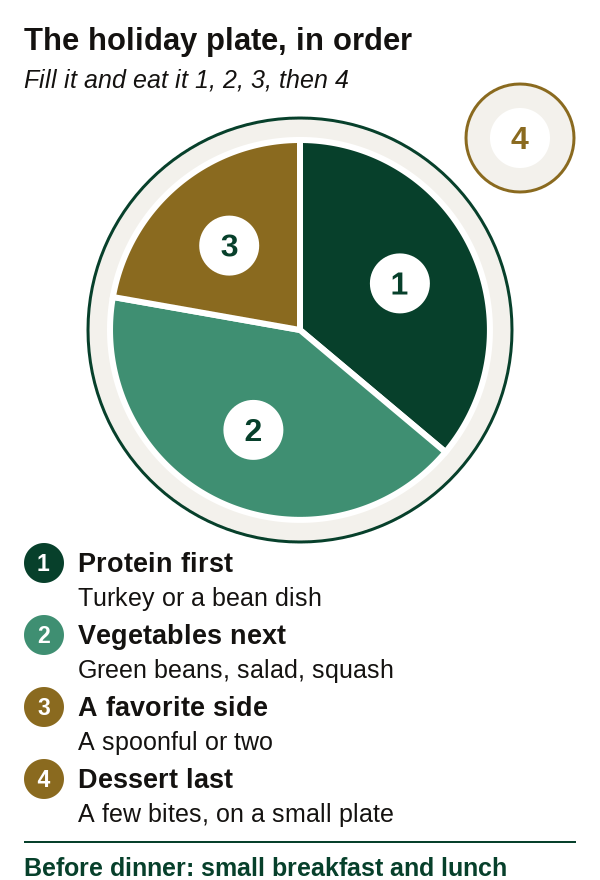
Ozempic is the name most people search; MeliOra prescribes semaglutide and tirzepatide, and this plan fits either. The 2025 advisory flags big meals (vomiting is more likely after them) and alcohol, which may worsen nausea and reflux. Our editorial plan for the day:
Don’t save up. Eat a small breakfast and lunch at your usual times; the advisory lists long stretches without meals as a habit to minimize.
Start with protein: turkey or a bean dish first.
Add vegetables next, then a spoonful or two of the sides you love most.
Use a smaller plate, and stop when you’re comfortably full.
Have dessert last and small; the advisory encourages portion-controlled treats.
Sip water, keep alcohol to a minimum, and pack leftovers into single portions.
If you take insulin or a sulfonylurea, the NIH warns that skipped or delayed meals, and alcohol without enough food, can lower your blood sugar. Don’t skip or move a dose for the holiday without asking your prescriber. For drinks, see semaglutide and alcohol or tirzepatide and alcohol.
On a GLP-1, fill a smaller plate in this order: protein, vegetables, a favorite side, then a few bites of dessert.
Who should be careful, and when to see a professional instead
A badge is written for a generic shopper. Talk to your physician or a dietitian first if you:
Have kidney disease or have had kidney stones: high protein targets may be too high for you
Take insulin or a sulfonylurea: smaller meals can mean low blood sugar unless your doses are adjusted
Have celiac disease or a food allergy: the badge says nothing about gluten or allergens
Have, or have had, an eating disorder: counting grams can feed restriction
At MeliOra, Dr. Espinet screens for eating disorders before prescribing, and if support from a dietitian or therapist would help, she discusses it at your consultation. A 2026 expert consensus says these medicines should generally be avoided with an active eating disorder and used with caution after one.
Food choices can’t fix a warning sign. Sorted from most to least urgent, these rows match our GLP-1 side effects guide, plus two rows for anyone eating very little or struggling with food:
Warning sign
What to do
Swelling of the face, lips, tongue, or throat, trouble breathing or swallowing, severe rash or itching, fainting or dizziness, or a very rapid heartbeat
A serious allergic reaction. Stop the medication and call 911 or go to an emergency room
Fainting, chest pain, a racing or skipped heartbeat, or confusion, especially after vomiting, using laxatives, or eating very little
Call 911 or go to an emergency room now
Low blood sugar you can’t treat yourself, passing out, or a seizure, if you take insulin or a sulfonylurea
Someone should call 911
Thoughts of harming yourself
Call or text 988, the Suicide and Crisis Lifeline, right away. If you might act on them or are in immediate danger, call 911
Sudden vision loss in one eye (often noticed on waking), blurred or missing patches of vision, faded or distorted colors, or eyesight that gets worse quickly
Call 911 or go to an emergency room now, and don’t drive yourself. The FDA warns GLP-1s may raise the risk of NAION, a rare optic nerve problem
Severe stomach pain that will not go away, sometimes reaching the back, with or without vomiting
Possible pancreatitis. Stop the medication and call your prescriber right away; if you can’t reach them quickly, go to an emergency room, not urgent care
Pain in the upper stomach, fever, yellow skin or eyes, or clay-colored stools
Possible gallbladder problems. Call your prescriber right away; if you can’t reach them quickly, go to an emergency room, not urgent care
Vomiting or diarrhea that will not stop, or not being able to keep fluids down
Dehydration, which can lead to kidney injury. Call your prescriber right away. Go to the emergency room now if you can’t keep fluids down, are barely urinating, your urine is very dark, you feel dizzy or lightheaded, or your heart is racing. Call 911 if you become confused or faint. If you have kidney disease, call at the first sign
You took too much, or took a dose twice
Call your prescriber or Poison Help at 1-800-222-1222, or go to an emergency room right away
Bingeing, purging, or restricting, or losing weight on a GLP-1 faster than your prescriber expects (often more than 1 to 2 pounds a week)
See your clinician this week and tell your prescriber. The 2026 consensus treats fast loss as a possible eating disorder warning sign and says GLP-1 medicines should generally be avoided with an active eating disorder
Shakiness, sweating, dizziness, confusion or drowsiness, headache, blurred vision, slurred speech, hunger, or a fast heartbeat
Possible low blood sugar, more likely with insulin or a sulfonylurea. Treat it as your prescriber taught you, then call them
Heart racing or pounding at rest for several minutes
Increased heart rate, which the Wegovy and Saxenda labels say to report. Call your prescriber
A lump or swelling in the neck, hoarseness, trouble swallowing, or shortness of breath
Possible thyroid tumor, the risk behind the labels’ boxed warning. Call your prescriber
Vision changes in someone with type 2 diabetes
Possible worsening of diabetic eye disease. Tell your prescriber
If something feels wrong, call your prescriber, and tell any emergency team which GLP-1 you take and when you last took it. A boxed warning about thyroid tumors in rodents rules these medicines out for anyone with a personal or family history of medullary thyroid carcinoma or MEN 2. See GLP-1 side effects for more.
How MeliOra fits: weekly semaglutide or tirzepatide with a physician
Dr. Melanie Espinet, a board-certified family medicine physician, prescribes weekly semaglutide or tirzepatide injections; bring your label questions to your check-ins. Semaglutide weight loss starts at $150/month, or $240/month at higher dosing, and tirzepatide weight loss runs $230 to $320/month. Each monthly price includes in-home physician visits, lab work, the medication and supplies, and dose adjustments and check-ins, with no consultation fee.
She makes house calls across Hillsborough, Pasco, and Pinellas counties with no travel fee, and sees select appointments at the Lutz office. At any house call, including ours, ask how the product was stored on the way and what the plan is for a serious reaction. Anywhere in Florida, you can choose telehealth weight loss instead: video visits replace in-home visits, the medication ships to your home, and the monthly price is the same.
Frequently asked questions about GLP-1 friendly foods
What are GLP-1 friendly foods?
They are foods or meals a company labels as suited to people taking GLP-1 medicines, usually higher in protein, with some fiber, in smaller portions. The phrase has no federal definition, so check the Nutrition Facts panel for protein, fiber, serving size, and added sugar yourself.
Is “GLP-1 friendly” regulated by the FDA?
Not as a defined term. We found no FDA definition of the phrase, and a University of Arkansas extension specialist called it not a standardized or regulated nutrition claim. Words like “high protein,” “good source of fiber,” and “healthy” do have FDA criteria, so they mean more than the badge.
How much protein should a GLP-1 friendly meal have?
There is no single number. A 2025 nutrition advisory offers 80 to 120 grams a day as a simple target, roughly 27 to 40 grams per meal over three meals. On a single food, “high protein” means at least 10 grams per reference serving; on a frozen meal, one qualifying food can earn it, so read the grams.
What should I eat at Thanksgiving on Ozempic?
Eat small meals earlier instead of saving up, then fill a smaller plate with protein first, vegetables next, and a spoonful of your favorite sides. Have dessert last and small, sip water, and keep alcohol minimal. Large meals make vomiting more likely on these medicines.
Are GLP-1 friendly frozen meals worth buying?
They can be convenient, mainly because the portions are small. Conagra said its badge highlighted existing meals without recipe changes. Judge each on its label: enough protein, some fiber, a serving you will actually eat, and low added sugar. A plain meal that passes works just as well.