The short answerGLP-1 patches don’t deliver GLP-1 medicine. None is FDA-approved, and a 2026 analysis of 25 patch and gel products found mostly plant and nutrient ingredients such as berberine, cinnamon, and pomegranate. Semaglutide and tirzepatide also weigh about 8 to 10 times a common rule-of-thumb size limit for crossing skin. Real semaglutide patches use microneedles and are only in early trials.
GLP-1 patches, GLP-1 drops, and the so-called Ozempic patch sell appetite control without a prescription or a needle. Ozempic is the popular name, but it’s a brand of semaglutide for type 2 diabetes sold as a weekly shot or a daily tablet; no patch version exists. MeliOra prescribes weekly semaglutide and tirzepatide injections through our physician-led weight loss program. This is general information, not medical advice.
Do GLP-1 patches work?
No published trial shows these patches cause weight loss. GLP-1 patches are adhesive stickers sold with GLP-1 wording, and the ones researchers have examined list plant and nutrient ingredients. None is FDA-approved.
In a 2026 analysis, University of Connecticut pharmacy researchers found 24 patches and 1 gel sold as “natural GLP-1” supplements, with about 7 ingredients each on average. Berberine, glutamine or glutamate, cinnamon, and pomegranate were listed most. None posted a certificate of analysis, many lacked the required FDA disclaimer, many used deceptive advertising, and several had one- or two-star reviews suggesting no effect or side effects.
The authors argue that every one of these products is illegal as sold, and the FDA’s definition supports the logic: dietary supplements “must be swallowed,” so topical products aren’t supplements. Our GLP-1 supplements guide covers the swallowed kind: berberine pills, fiber, and probiotics.
GLP-1 drops and the “Ozempic patch”
GLP-1 drops are liquids sold with GLP-1 in the name. On March 31, 2026, the FDA sent an advisory letter to one online seller about ten products, including GLP-1 drops, oral liquids, a nasal spray, and two “nano microneedle” patches. The FDA said website claims to treat or prevent type 2 diabetes, high blood pressure, stroke, heart disease, fatty liver, or cancer made them unapproved new drugs.
The same day, the FDA sent a formal warning letter to an eBay seller of a “SMGT-GLT-1 Nano Microneedle Patch.” The listing said the patch held fat-burning ingredients such as caffeine and green tea extract, yet promoted it for type 2 diabetes treatment and weight loss. The FDA called it an unapproved new drug.
No approved GLP-1 medicine comes as a patch, drop, or spray. The FDA’s November 9, 2026 table of approved GLP-1 medicines lists 12 brands, and each is a shot or a tablet.
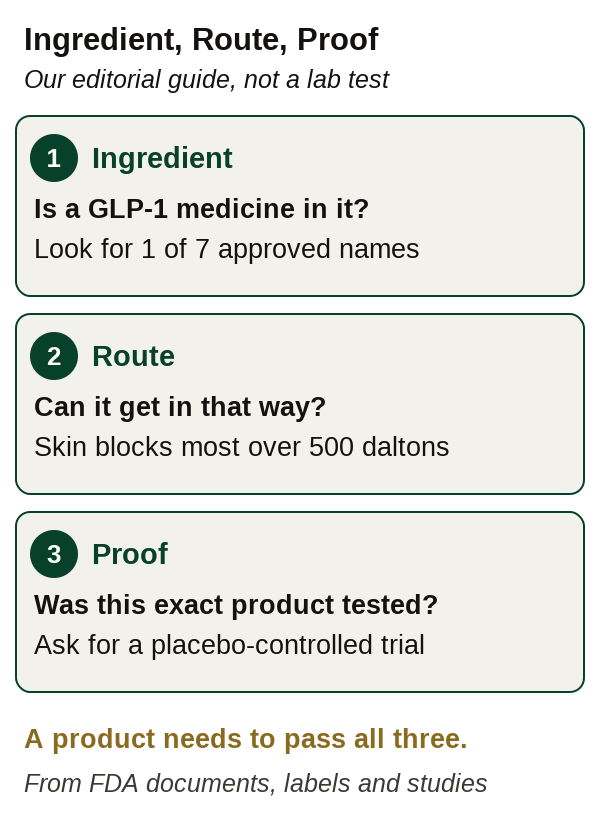
The Ingredient, Route, Proof check for any GLP-1 product
Use these three checks on any patch, drop, gummy, or spray sold with GLP-1 on the label. It’s our editorial guide, built from the FDA documents, labels, and studies on this page, not a lab test. A product needs to pass all three.
1. Ingredient: is a GLP-1 medicine actually in it?
The 12 approved GLP-1 brands use one of seven GLP-1 ingredients: semaglutide, tirzepatide, liraglutide, dulaglutide, exenatide, lixisenatide, or orforglipron. If a label lists berberine, cinnamon, or a “proprietary blend” instead, it holds no GLP-1 medicine, whatever the box says.
A product that claims to contain semaglutide or tirzepatide without a prescription raises a different red flag. The FDA warns that illegally sold versions may be counterfeit and could contain the wrong or harmful ingredients, or too little, too much, or none of the active ingredient.
2. Route: can it get in that way?
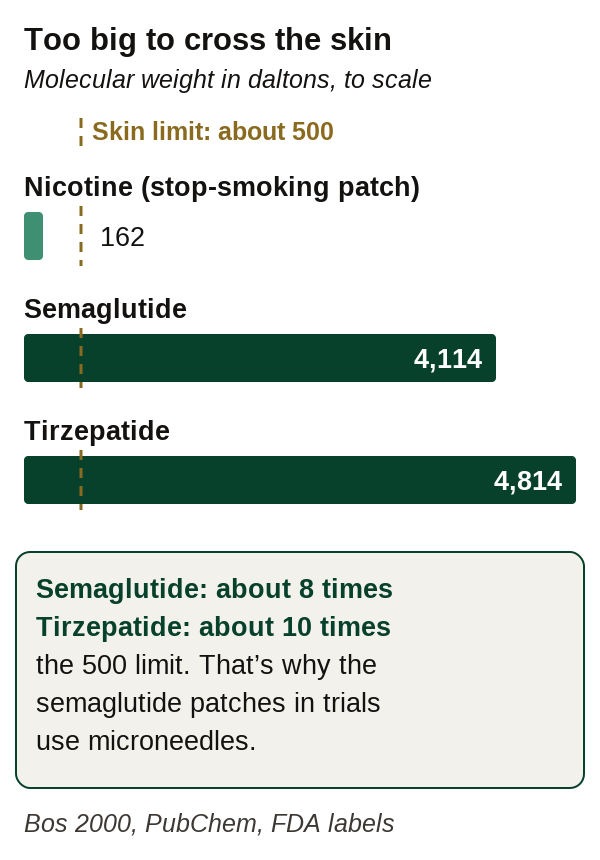
Skin is built to keep large molecules out. A rule of thumb from a 2000 dermatology paper holds that a compound must weigh under 500 daltons to pass through skin, and that every drug then used in skin patches did. Semaglutide weighs 4,114 and tirzepatide 4,814, per their labels: about 8 and 10 times that limit. Nicotine, the drug in stop-smoking patches, weighs 162.
Nicotine sits far under the skin’s rough 500 dalton limit; semaglutide and tirzepatide are about 8 and 10 times over it.
Swallowing doesn’t fix that. The Wegovy tablet pairs semaglutide with an absorption helper called SNAC, and its label still puts absorption at about 1% to 2%, versus 89% for the shot. So the pill is 25 mg a day: a week of pills holds about 73 times the semaglutide in one 2.4 mg weekly shot, for similar blood levels in people without type 2 diabetes. We found no human trial of semaglutide drops under the tongue, only animal studies (PubMed, November 2026).
Real skin delivery takes microneedles, tiny points that pierce the skin’s outer layer. A 2026 review describes microneedle GLP-1 delivery tested in animals and skin samples, held back by how little drug they carry and by regulatory hurdles. As of November 15, 2026, two early (phase 1) trials of semaglutide microneedle patches have begun in people, both measuring how much semaglutide reaches the blood compared with other forms of semaglutide. Neither has posted results, and none is approved.
3. Proof: was this exact product tested in people?
Approved GLP-1 medicines earned their labels in placebo-controlled trials. The Wegovy shot, for example, was tested for 68 weeks in 1,961 adults without type 2 diabetes; everyone also had diet and exercise counseling, and results varied from person to person. Ask any patch or drop seller for the same thing: a published, placebo-controlled trial of that exact product in people.
The Federal Trade Commission lists substantial weight loss from “wearing a product on the body or rubbing it into the skin” among seven ad claims that experts say “simply can’t be true,” and its consumer guide says nothing you wear or apply to your skin will cause you to lose weight. The FDA also says it has no authority to approve supplements before they’re sold.
Three questions to ask before buying any patch, drop, or spray sold with GLP-1 on the label.
The next-step hurdle: if GLP-1 patches don’t work, what does?
The real alternative is a prescription, which raises two questions: do you qualify, and is the source safe? In Florida, Rule 64B8-9.012 requires a BMI of 30 or above, a BMI greater than 27 with at least one related condition, or a high body fat measure before a weight loss medicine, plus an evaluation and written consent.
For a safe source, the FDA’s advice is short: get a prescription from your doctor and fill it at a state-licensed pharmacy. Its red flags include sellers that skip a screening and prescription by a licensed doctor and prices that seem too good to be true, the same pattern behind cheap Botox. Research peptide vials sold online get their own check in peptides for weight loss.
Who should skip GLP-1 patches and drops, and when to get help
See a physician instead of trying one of these products if any of these apply:
You have type 2 diabetes. Some of these products are marketed to treat it; don’t change your diabetes medicine without your doctor.
You take insulin, a sulfonylurea, cyclosporine or another transplant drug, or other daily medicines. Berberine, one of the most listed patch ingredients, can interact with medicines.
You’re pregnant, trying to conceive, or breastfeeding.
You have or have had an eating disorder, or you’re restricting food in ways that worry you.
If you’re pregnant, trying to conceive, or breastfeeding, skip weight loss products and talk to your doctor. NCCIH says people who are pregnant or breastfeeding should not use berberine, which can cause or worsen jaundice in newborns. For prescription GLP-1 medicines, ACOG’s October 2026 advisory suggests considering a stop 1 to 2 months before conception, advises against them during pregnancy, and recommends against them while breastfeeding a preterm baby or a newborn, and against pill forms while breastfeeding; see tirzepatide, birth control, and pregnancy.
If you used any product sold as a GLP-1, or you also take a prescription GLP-1, watch for these signs. The rows match our GLP-1 side effects guide, sorted from most to least urgent, plus one for skin under a patch:
Warning sign
What to do
Swelling of the face, lips, tongue, or throat, trouble breathing or swallowing, severe rash or itching, fainting or dizziness, or a very rapid heartbeat
A serious allergic reaction. Stop the medication and call 911 or go to an emergency room
Low blood sugar you can’t treat yourself, passing out, or a seizure, if you take insulin or a sulfonylurea
Someone should call 911
Thoughts of harming yourself
Call or text 988, the Suicide and Crisis Lifeline, right away. If you might act on them or are in immediate danger, call 911
Sudden vision loss in one eye (often noticed on waking), blurred or missing patches of vision, faded or distorted colors, or eyesight that gets worse quickly
Call 911 or go to an emergency room now, and don’t drive yourself. The FDA warns GLP-1s may raise the risk of NAION, a rare optic nerve problem
Severe stomach pain that will not go away, sometimes reaching the back, with or without vomiting
Possible pancreatitis. Stop the medication and call your prescriber right away; if you can’t reach them quickly, go to an emergency room, not urgent care
Pain in the upper stomach, fever, yellow skin or eyes, or clay-colored stools
Possible gallbladder problems. Call your prescriber right away; if you can’t reach them quickly, go to an emergency room, not urgent care
Vomiting or diarrhea that will not stop, or not being able to keep fluids down
Dehydration, which can lead to kidney injury. Call your prescriber right away. Go to the emergency room now if you can’t keep fluids down, are barely urinating, your urine is very dark, you feel dizzy or lightheaded, or your heart is racing. Call 911 if you become confused or faint. If you have kidney disease, call at the first sign
You took too much, or took a dose twice
Call your prescriber or Poison Help at 1-800-222-1222, or go to an emergency room right away
Shakiness, sweating, dizziness, confusion or drowsiness, headache, blurred vision, slurred speech, hunger, or a fast heartbeat
Possible low blood sugar, more likely with insulin or a sulfonylurea. Treat it as your prescriber taught you, then call them
Heart racing or pounding at rest for several minutes
Increased heart rate, which the Wegovy and Saxenda labels say to report. Call your prescriber
A lump or swelling in the neck, hoarseness, trouble swallowing, or shortness of breath
Possible thyroid tumor, the risk behind the labels’ boxed warning. Call your prescriber
Vision changes in someone with type 2 diabetes
Possible worsening of diabetic eye disease. Tell your prescriber
A rash, itching, or blisters where a patch was, or skin there that turns tender, red, or warm, or a fever
Possible contact dermatitis or infection. Take the patch off and call your doctor
No table covers everything. Bring the package to any visit, and report a problem with any product to the FDA’s MedWatch program. For the full picture on prescription medicines, see GLP-1 side effects.
How MeliOra fits: semaglutide or tirzepatide from a physician
MeliOra doesn’t offer GLP-1 patches, drops, sprays, or pills. Dr. Melanie Espinet, a board-certified family medicine physician in Lutz, prescribes weekly semaglutide or tirzepatide injections after an evaluation. She screens for eating disorders before prescribing, and if support from a dietitian or therapist would help, she discusses it at your consultation. Trial and label figures on this page describe the brand-name products studied, so ask her exactly which medication you would receive.
Semaglutide weight loss starts at $150/month, or $240/month at higher dosing, and tirzepatide weight loss runs $230 to $320/month. Each price includes in-home physician visits, lab work, the medication and supplies, and dose adjustments and check-ins, with no consultation fee.
Dr. Espinet makes house calls across Hillsborough, Pasco, and Pinellas counties with no travel fee, and sees select appointments at the Lutz office. At any house call, including ours, ask how the product was stored on the way and what the plan is for a serious reaction. Anywhere in Florida, telehealth weight loss replaces in-home visits with video visits, the medication ships to your home, and the monthly price is the same.
Frequently asked questions about GLP-1 patches
Do GLP-1 patches actually work for weight loss?
No published trial shows they do. The patches researchers examined in 2026 listed natural ingredients such as berberine and cinnamon. Semaglutide and tirzepatide are also far too large to pass through skin. The FTC says nothing you wear or apply to your skin causes weight loss.
Is there an Ozempic patch?
No. Ozempic is a brand of semaglutide for type 2 diabetes, sold as a weekly shot or a daily tablet, and every GLP-1 medicine on the FDA’s November 2026 list of approved brands is a shot or a tablet. A product sold online as an Ozempic patch isn’t Ozempic.
What is in a GLP-1 patch?
In a 2026 review of 24 patches and 1 gel, products listed about 7 ingredients each, most often berberine, glutamine or glutamate, cinnamon, and pomegranate. None posted a certificate of analysis, the lab report that shows what is actually inside, so the label is all you have to go on.
Do GLP-1 drops work?
No GLP-1 drop is FDA-approved, and we found no human trial of one. In March 2026 the FDA sent an advisory letter to a seller whose GLP-1 drops were promoted to treat or prevent diabetes and other diseases. Even semaglutide’s approved tablet, which carries an absorption helper, gets only about 1% to 2% into the blood when swallowed.
Are GLP-1 patches safe?
No one has tested them for safety in large trials, and their contents aren’t verified. Berberine, a common ingredient, can interact with medicines and may be unsafe in pregnancy. Adhesives can irritate skin. Products claiming real semaglutide without a prescription may be counterfeit or contain the wrong amount.
Will there ever be a real semaglutide patch?
Possibly. As of November 15, 2026, two early trials are testing semaglutide microneedle patches in people, measuring how much semaglutide reaches the blood. These patches use tiny needles to get through skin. Neither trial has posted results, and none is approved.