The short answerTirzepatide has a half-life of about 5 to 6 days, so roughly half is gone within a week of your last shot. By a common rule of thumb, five half-lives, nearly all of it clears in about 25 to 30 days. Semaglutide takes longer: nearly all of it clears in about 5 to 7 weeks, the time the Wegovy label says it stays in circulation. How you feel doesn’t follow the same clock.
How long tirzepatide stays in your system matters when you’re planning surgery, a pregnancy, or a switch, or you’ve missed a dose. The numbers below come from the current labels for Zepbound and Mounjaro (both tirzepatide, August 2026) and Wegovy (June 2026) and Ozempic (May 2026), both semaglutide.
Dr. Melanie Espinet prescribes weekly tirzepatide or semaglutide for medical weight loss; label facts describe the brand-name products. This is general information, not medical advice. Took an extra dose, or have severe stomach pain or trouble breathing now? Get care now; warning signs are below.
How long does tirzepatide stay in your system?
Tirzepatide stays in your system for weeks, not days. The August 2026 Zepbound label puts its elimination half-life, the time your body takes to clear half of it, at about 5 to 6 days; the Mounjaro label, for the same medicine, says about 5 days. A fatty acid chain helps it cling to albumin, a blood protein, which slows its clearance.
After a shot, blood levels peak in about 24 hours (anywhere from 8 to 72), and weekly doses reach a steady level after about 4 weeks. Your body breaks tirzepatide into pieces: the label says intact tirzepatide isn’t found in urine or stool.
The five half-lives rule of thumb
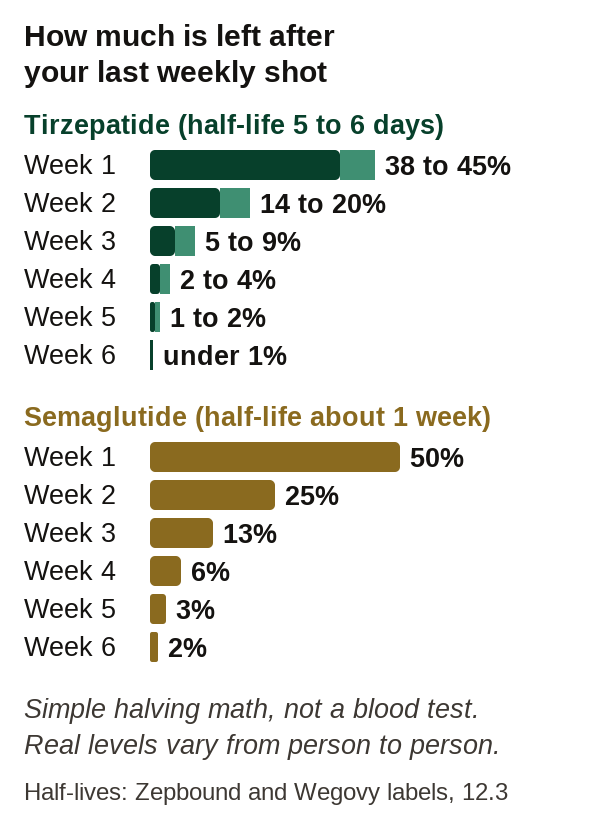
Each half-life halves what’s left, so after five, about 3% remains. That’s why five half-lives is a common rule of thumb for “mostly gone.” It isn’t label text, and a 2026 anesthesia review that uses it for semaglutide notes complete elimination can take longer. For tirzepatide, five half-lives is about 25 to 30 days.
By this estimate, a week after your last shot roughly 38% to 45% of tirzepatide and half of semaglutide is still on board.
How long does semaglutide stay in your system?
Semaglutide stays in your system longer. Its half-life is about 1 week, and the Wegovy label says it remains in circulation for about 5 to 7 weeks after the last 2.4 mg or 7.2 mg shot or 25 mg tablet. The Ozempic label, with lower top doses, says about 5 weeks.
Half-life, and five half-lives (rule of thumb)
Medicine
Half-life
Five half-lives
Tirzepatide (Zepbound, Mounjaro), weekly shot
About 5 to 6 days
About 25 to 30 days
Semaglutide (Wegovy, Ozempic), weekly shot
About 1 week
About 5 weeks; the Wegovy label says 5 to 7 weeks in circulation
Liraglutide (Saxenda), daily shot
About 13 hours
About 3 days
Orforglipron (Foundayo), daily pill
29 to 49 hours
About 6 to 10 days
Brand names don’t change the clock. Zepbound and Mounjaro are the same tirzepatide, so how long Zepbound stays in your system has the same answer. MeliOra prescribes weekly tirzepatide or semaglutide only.
Half-life isn’t how long the effects last
A half-life tracks the medicine in your blood, not how you feel. The Zepbound label says tirzepatide’s slowing of stomach emptying is largest after the first dose and smaller with later doses, while the drug is still in your blood. Its birth control pill warning runs for 4 weeks after starting and after each dose increase, not for as long as the drug lasts.
Side effects keep their own schedule too. A 2022 expert consensus funded by Novo Nordisk, drawing on semaglutide trials, found GLP-1 nausea usually clears within 8 days of when it begins, while the medicine is still in your blood. For what happens to appetite and weight after a last dose, see our guide to stopping semaglutide, and for why tirzepatide lasts days when your own GIP lasts minutes, see what GIP is.
The last-dose calendar: counting from your last shot
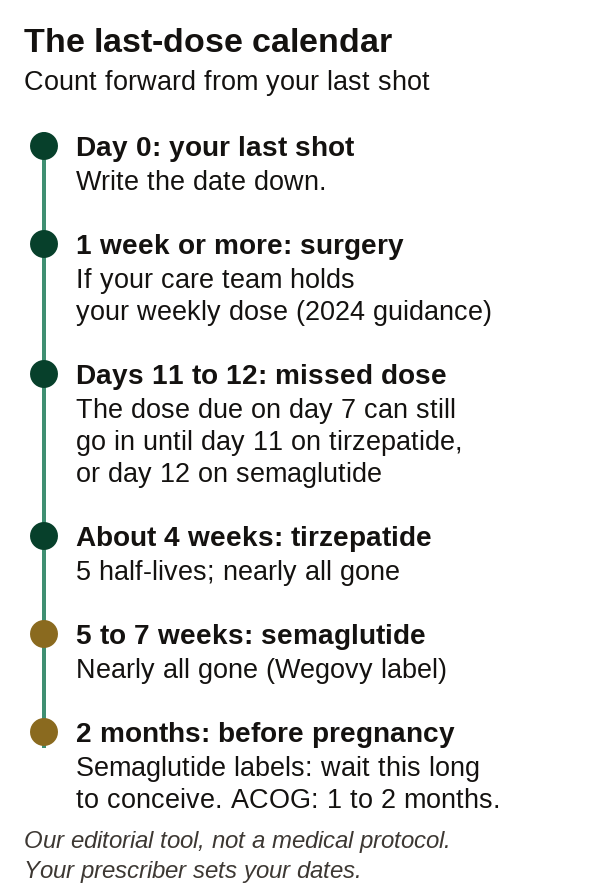
Most questions about how long tirzepatide stays in your system are really date questions. Write down the date of your last shot, then count forward to these checkpoints. It’s our editorial tool, built from the labels and guidance on this page, not a medical protocol; your prescriber sets your actual dates.
Day 0: your last shot. Note the date and the dose.
At least 1 week: surgery, if your care team holds your weekly dose. 2024 guidance allows continuing when your risk of a slow-emptying stomach isn’t raised.
Days 11 to 12: the missed-dose cutoff. The dose due on day 7 can still go in up to 4 days late on tirzepatide, or 5 days late on semaglutide.
About 4 weeks: tirzepatide is nearly all cleared, by the five half-lives rule.
5 to 7 weeks: semaglutide is nearly all cleared; the Wegovy label says it circulates this long.
2 months: the semaglutide labels’ minimum stop before a planned pregnancy. ACOG suggests considering 1 to 2 months for any GLP-1.
Count forward from the date of your last shot, then confirm each date with your prescriber.
Missed a dose of tirzepatide? The label windows
For a missed tirzepatide dose, the Zepbound and Mounjaro labels say to take it within 4 days (96 hours); after that, skip it and take the next dose on your usual day. You can move your injection day as long as doses stay at least 3 days (72 hours) apart. Away from home? Our guide to traveling with Ozempic or Zepbound covers time zones and storage.
For semaglutide, the Wegovy label says to take a missed shot if your next dose is more than 2 days (48 hours) away, and to skip it if not. After 2 or more missed weeks in a row, its label restarts at a lower dose to limit stomach side effects. The Zepbound label doesn’t address several missed weeks, so ask before restarting, and don’t take two doses to catch up. For drinking, see tirzepatide and alcohol.
The next-step hurdle: surgery, pregnancy, switching, and drug tests
Before surgery or sedation
Tell your surgeon and anesthesia team you take a GLP-1 and when you last took it. The labels report rare cases of stomach contents reaching the lungs under anesthesia and say the data are too limited to set fasting or stopping rules. Our guide to Ozempic before surgery covers colonoscopy, dental sedation, and what to ask.
2024 guidance from five medical societies, including the American Society of Anesthesiologists, says a GLP-1 may be continued before surgery when your risk of a slow-emptying stomach isn’t raised. It names the dose-increase phase, higher doses, weekly dosing, stomach symptoms, and conditions that slow the stomach as raising that risk; then the team may hold the weekly dose the week before or ask for a liquid diet for at least 24 hours. Other groups’ advice varies.
A held dose doesn’t empty your system: by the half-life math, roughly 40% of tirzepatide is still there a week after a shot. A 2026 review suggests assuming slower stomach emptying for 2 to 4 weeks after stopping tirzepatide, while noting the evidence is limited. Don’t stop on your own; let your care team decide.
Before a pregnancy
The Zepbound label sets no waiting period, while the Wegovy and Ozempic labels say to stop semaglutide at least 2 months before a planned pregnancy because it clears slowly. ACOG’s October 2026 advisory suggests considering a stop 1 to 2 months before conception and advises against GLP-1s while breastfeeding a preterm baby or newborn. If you’re already pregnant, stop the medicine and call your prescriber that day; ACOG advises against these medicines for the rest of the pregnancy. Our guide to tirzepatide, birth control, and pregnancy has the full plan.
Switching medicines
Because semaglutide lingers for weeks, some is usually still on board when tirzepatide starts, and no label sets a waiting period between them. The Zepbound, Wegovy, Saxenda, and Foundayo labels advise against taking two GLP-1 medicines together. See switching from semaglutide to tirzepatide.
Drug tests
GLP-1 medicines aren’t on the federal workplace drug testing panel. The panel HHS republished in March 2026 covers marijuana, cocaine, opioids including fentanyl, PCP, amphetamines, and MDMA. Other employers, sports bodies, or clinical labs can test for more, so list your prescriptions if you’re asked.
Who should be careful, and when to get help
Because these medicines last days to weeks, an extra dose or a side effect doesn’t wear off overnight. The overdose sections of the Zepbound and Wegovy labels say observation and treatment may be needed for a while, given the long half-life (Zepbound’s overdose section still says about 5 days). Neither medicine is for anyone with a personal or family history of medullary thyroid carcinoma, or MEN 2, because of a boxed warning about thyroid tumors in rodents.
Tell your prescriber about pancreatitis, gallbladder or kidney disease, diabetic eye disease, severe gastroparesis, insulin or a sulfonylurea, and pregnancy plans. Sorted from most to least urgent, these rows match our tirzepatide side effects guide, plus emergency steps:
Warning sign
What to do
Swelling of the face, lips, tongue, or throat, trouble breathing or swallowing, severe rash or itching, fainting or dizziness, or a very rapid heartbeat
A serious allergic reaction. Stop the medicine and call 911 or go to an emergency room
Low blood sugar you can’t treat yourself, passing out, or a seizure, if you take insulin or a sulfonylurea
Someone should call 911
Thoughts of harming yourself
Call or text 988, the Suicide and Crisis Lifeline, right away. If you might act on them or are in immediate danger, call 911
Sudden vision loss in one eye (often noticed on waking), blurred or missing patches of vision, faded or distorted colors, or eyesight that gets worse quickly
Call 911 or go to an emergency room now, and don’t drive yourself. The FDA warns GLP-1s may raise the risk of NAION, a rare optic nerve problem
Severe stomach pain that will not go away, sometimes reaching the back, with or without vomiting
Possible pancreatitis. Stop the medicine and call your prescriber right away; if you can’t reach them quickly, go to an emergency room, not urgent care
Upper stomach pain, fever, yellow skin or eyes, or clay-colored stools
Possible gallbladder disease. Inflamed gallbladder was reported in 0.7% on Zepbound vs 0.2% on placebo. Call your prescriber right away; if you can’t reach them quickly, go to an emergency room, not urgent care
Vomiting or diarrhea that will not stop, or not being able to keep fluids down
Dehydration, which can lead to kidney injury (0.5% vs 0.2% in the Zepbound trials). Call your prescriber right away. Go to the emergency room now if you can’t keep fluids down, are barely urinating, your urine is very dark, you feel dizzy or lightheaded, or your heart is racing. Call 911 if you become confused or faint. If you have kidney disease, call at the first sign
You took too much, or took two doses close together
Call your prescriber or Poison Help at 1-800-222-1222, or go to an emergency room right away
Shakiness, sweating, dizziness, confusion or drowsiness, headache, blurred vision, slurred speech, hunger, or a fast heartbeat
Possible low blood sugar, more likely with insulin or a sulfonylurea. Treat it as your prescriber taught you, then call them
Heart racing or pounding at rest for several minutes
Increased heart rate, which the Wegovy label says to report. Call your prescriber
A lump in the neck, lasting hoarseness, trouble swallowing, or shortness of breath
Possible thyroid tumor, the risk behind the label’s boxed warning. Call your prescriber
Vision changes in someone with type 2 diabetes
Possible worsening of diabetic eye disease. Tell your prescriber
No list covers everything. If something feels wrong, call your prescriber, and tell any emergency team which GLP-1 you take and the date of your last dose. For the full side-effect picture, see GLP-1 side effects.
How MeliOra fits: weekly tirzepatide or semaglutide with a physician
Dr. Melanie Espinet, a board-certified family medicine physician in Lutz, prescribes weekly tirzepatide or semaglutide injections. She screens for eating disorders before prescribing, and if support from a dietitian or therapist would help, she discusses it at your consultation. Tell her about any planned surgery, pregnancy plans, or missed doses.
Tirzepatide weight loss runs $230 to $320/month, and semaglutide weight loss starts at $150/month, or $240/month at higher dosing. Each price includes in-home physician visits, lab work, the medication and supplies, and dose adjustments and check-ins, with no consultation fee.
Dr. Espinet makes house calls across Hillsborough, Pasco, and Pinellas counties with no travel fee, and sees select appointments at the Lutz office. At any house call, including ours, ask how the product was stored on the way and what the plan is for a serious reaction. Anywhere in Florida, you can choose telehealth weight loss instead: video visits replace in-home visits, the medication ships to your home, and the monthly price is the same.
Frequently asked questions about how long tirzepatide stays in your system
How long does Zepbound stay in your system?
Zepbound is tirzepatide, so the answer is the same. Its half-life is about 5 to 6 days, and by the five half-lives rule of thumb nearly all of it is gone about 25 to 30 days after your last shot. Levels peak about a day after each shot and reach a steady level after about 4 weeks.
What is the half-life of tirzepatide?
The August 2026 Zepbound label gives tirzepatide an elimination half-life of about 5 to 6 days in people with overweight or obesity, and the Mounjaro label says about 5 days. Roughly half of a dose is cleared in that time, and about a quarter remains after twice as long.
How long does semaglutide stay in your system?
Semaglutide’s half-life is about 1 week. The Wegovy label says it stays in circulation about 5 to 7 weeks after the last 2.4 mg or 7.2 mg dose, and the Ozempic label says about 5 weeks. That long tail is why both labels say to stop at least 2 months before a planned pregnancy.
Should I stop tirzepatide before surgery?
Not on your own. 2024 guidance from five medical societies says a GLP-1 may be continued before surgery when your risk of a slow-emptying stomach isn’t raised. Dose increases, higher doses, weekly dosing, and stomach symptoms raise it; then your team may hold the weekly dose the week before or ask for a liquid diet for at least 24 hours.
Does tirzepatide show up on a drug test?
Not on the federal workplace drug testing panel, which HHS republished in March 2026. It looks for marijuana, cocaine, opioids, PCP, amphetamines, and MDMA, and GLP-1 medicines aren’t on it. Other tests can be broader, so list your prescriptions if you’re asked.