The short answerFood noise is constant, intrusive thinking about food that keeps going even when you aren’t hungry. Regular meals, enough sleep, fewer food cues, and less stress may help, though none has been tested on food noise by name, and GLP-1 medicines lowered cravings in trials. If you have ever restricted, binged, or purged, talk to a clinician before trying to quiet it.
How to stop food noise starts with naming it. The phrase spread as people taking GLP-1 medicines described their food thoughts going quiet, and researchers have only recently defined and measured it. Public figures use the phrase too; see what celebrities on Ozempic have actually said. This guide uses that published research and placebo-controlled trials, not marketing surveys, and it puts eating disorder safety first.
What is food noise?
Food noise is persistent, intrusive thinking about food, such as planning the next snack while still eating a meal, that feels hard to switch off and happens whether or not you are hungry. It is a description, not a medical diagnosis.
The first published definition, from a 2023 review, calls it heightened or persistent reactions to food cues that often lead to intrusive food thoughts and unhelpful eating. In a 2026 nationally representative survey of 1,000 U.S. adults, 51% said they had food noise at least occasionally and 18% frequently, though that rested on a single question. A 2026 preprint, not yet peer reviewed, that used a validated questionnaire put high scores at only about 4% to 9.5% of adults. Researchers also caution that the label can make ordinary thoughts about meals sound like a disorder; thinking about food is normal.
Hunger
Food noise
Builds slowly, hours after a meal
Can show up right after eating
Comes with body signals like a growling stomach or low energy
Mostly thoughts, plans, and cravings
Usually settles after a satisfying meal
Often keeps going after you are full
Most foods will do
Often fixes on specific treats or delivery apps
This is a rough guide, not a rule. After a stretch of eating too little, real hunger can feel urgent and specific, so don’t use it to talk yourself out of a meal.
A quick food noise self-check
The Food Noise Questionnaire, a five-question tool validated in 400 adults in a study funded by WW International, asks how much these fit you over the last 2 weeks:
You find yourself constantly thinking about food
Your thoughts about food feel uncontrollable
You spend too much time thinking about food
Food thoughts have negative effects on you or your life
Food thoughts distract you from what you need to do
There is no official cutoff, so treat your answers as notes for a conversation with your clinician, not a score.
What causes food noise?
Food noise has no single cause; researchers point to food cue reactivity, the pull you feel when you see, smell, or think about food, plus anything that turns that pull up.
Food cues: across 45 reports and 3,292 people, cue reactivity and craving predicted later eating and weight gain, and pictures and videos worked about as strongly as real food
Ultra-processed food: in an NIH inpatient trial of 20 adults, people ate about 508 more calories a day on an ultra-processed diet than on an unprocessed one
Short sleep: two nights of restricted sleep lowered leptin, a fullness signal from fat cells, by 18% and raised ghrelin, a hunger hormone from the stomach, by 28% in 12 young men
Stress: a review of 54 studies found a small link between stress and eating more unhealthy food and less healthy food
Long gaps and fasting: in a 5-year study of 496 teen girls, fasting for a day to control weight predicted later binge eating
Food noise or an eating disorder? Check this first
Some food noise is a sign of an eating disorder, and the right move then is care, not quieter thoughts. The National Institute of Mental Health says eating disorders are serious illnesses, not a choice, and can affect people of any weight.
Talk to a clinician before trying anything on this page if you:
Eat unusually large amounts in a short time and feel out of control, ashamed, or guilty afterward
Restrict food severely, fast, or exercise to make up for eating
Vomit or use laxatives after eating, now or in the past
Feel an intense fear of gaining weight, or fixated on weight, body shape, or controlling what you eat
Have ever been diagnosed with or treated for an eating disorder
If you have a history of restricting, quieting food thoughts is not the goal: regular, adequate meals and support are. Start with your primary care provider, who can refer you to an eating disorder specialist or other mental health professional. The ANAD Eating Disorder Helpline, 1-888-375-7767, answers Monday through Friday, 10 a.m. to 10 p.m. Eastern, and returns messages left after hours. If you are thinking about suicide, call or text 988.
How to stop food noise without medication: the QUIET plan
Our editorial tool, built from the research above, for people without eating disorder warning signs. It doesn’t replace medical advice, and none of these steps alone has been tested on food noise by name.
Q: Quit the long gaps
Eat regular meals and snacks with protein instead of skipping and fasting. Protein at a meal lowered hunger and the desire to eat in short-term trials, though long-term effects are unclear. Going a full day without eating to control weight predicted later binge eating in a 5-year study of 496 teen girls.
Regular meals you enjoy help you avoid the long, hungry gaps linked to stronger food urges.
U: Undo the cues
Move snacks out of sight and reach, mute food videos, and turn off delivery app alerts. A Cochrane review found that placing food farther away moderately cut how much people ate, though the evidence is low certainty. Favor minimally processed foods; in the NIH trial above, people ate about 500 fewer calories a day on them.
I: Improve sleep
Across 11 studies, people ate about 385 more calories on days after short sleep, with no change in calories burned. A steady bedtime with enough hours is one of the cheapest volume knobs you have.
E: Ease stress
Stress nudges choices toward comfort food. Notice when food thoughts spike with stress, then try a non-food reset: a short walk, a call, or a few slow breaths. For what stress does to your waist, see cortisol belly.
T: Tune in while you eat
Eat without screens and check your hunger before reaching for seconds. Mindfulness-based programs cut binge eating compared with no treatment in a 2025 review of 54 studies, but worked about as well as other therapies, not better.
If food noise still runs your day after steady effort, raise it with your clinician. If you are also working on your weight, book a weight loss consultation with Dr. Espinet, who evaluates you first, including screening for eating disorders, and tells you if a GLP-1 medicine isn’t right for you.
Do GLP-1 medicines quiet food noise? What the trials show
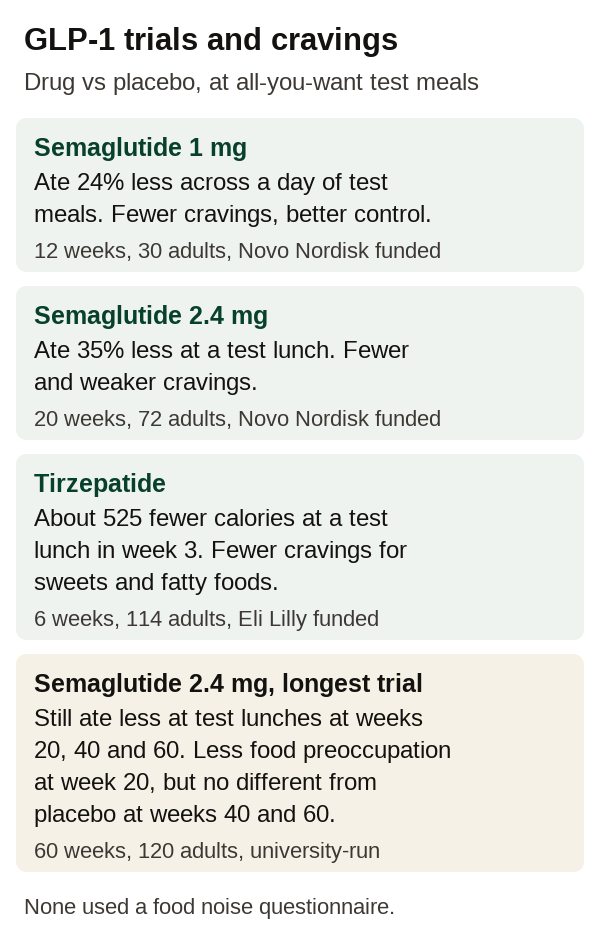
GLP-1 medicines lowered cravings and how much people ate in placebo-controlled trials, but none measured “food noise” by name, and the effect on food thoughts may fade. The Wegovy and Zepbound labels both say these medicines decrease calorie intake, likely by affecting appetite.
All four trials found people ate less at test meals, but in the longest one the drop in food preoccupation had faded by week 40.
The drug makers funded the first three; the 60-week trial was run by a university with a Novo Nordisk grant. Tirzepatide also acts on a second gut hormone, explained in our guide to what GIP is. Both medicines come with diet and activity changes, side effects led by nausea, and results that vary from person to person. A quieter appetite still needs enough food, especially protein; see what to eat on semaglutide.
Can you mimic Ozempic naturally?
Not with food. Half of your own GLP-1 clears in about 1 to 2 minutes, while semaglutide’s half-life is about 1 week and tirzepatide’s about 5 days. In 62 trials, viscous fiber lowered weight by about three-quarters of a pound on average. Good habits help, but they work differently from a weekly medicine. Viral hacks fare no better: our look at the gelatin trick found brief fullness and no added weight loss at 8 weeks.
Food noise alone isn’t a reason to prescribe
Florida’s Board of Medicine Rule 64B8-9.012 requires a BMI of 30 or more, a BMI over 27 with a related condition, or a high body fat measure before a weight loss medicine, plus an evaluation and written consent. A 2026 expert consensus says to generally avoid GLP-1 medicines during an active eating disorder, especially anorexia, including atypical anorexia, which happens at any body size, or bulimia with heavy restriction, and to proceed cautiously after one. Read what GLP-1 is for who else should not take one.
The next-step hurdle: does food noise come back when you stop a GLP-1?
No trial has measured food noise after stopping, but weight data suggest appetite often returns: in the STEP 1 extension and SURMOUNT-4, people who stopped regained about half to two-thirds of the weight they had lost within a year.
So plan for the off-ramp before you start: keep the QUIET habits going on the medicine, and decide with your prescriber how and when to stop. Our guide to stopping semaglutide covers tapering, and semaglutide and alcohol covers cravings for drinks.
When to get help now
Every row applies if you take semaglutide or tirzepatide; the GLP-1 rows match our GLP-1 side effects guide. If you don’t, the rows on thoughts of harming yourself, fainting, bingeing, purging, restricting, and food thoughts still apply.
Warning sign
What to do
Swelling of the face, lips, tongue, or throat, trouble breathing or swallowing, severe rash or itching, fainting or dizziness, or a very rapid heartbeat
A serious allergic reaction. Stop the medication and call 911 or go to an emergency room
Low blood sugar you can’t treat yourself, passing out, or a seizure, if you take insulin or a sulfonylurea
Someone should call 911
Thoughts of harming yourself
Call or text 988, the Suicide and Crisis Lifeline, right away. If you might act on them or are in immediate danger, call 911
Sudden vision loss in one eye (often noticed on waking), blurred or missing patches of vision, faded or distorted colors, or eyesight that gets worse quickly
Call 911 or go to an emergency room now, and don’t drive yourself. The FDA warns GLP-1s may raise the risk of NAION, a rare optic nerve problem
Fainting, chest pain, a racing or skipped heartbeat, or confusion, especially after vomiting, using laxatives, or eating very little
Call 911 or go to an emergency room now
Severe stomach pain that will not go away, sometimes reaching the back, with or without vomiting
Possible pancreatitis. Stop the medication and call your prescriber right away; if you can’t reach them quickly, go to an emergency room, not urgent care
Pain in the upper stomach, fever, yellow skin or eyes, or clay-colored stools
Possible gallbladder problems. Call your prescriber right away; if you can’t reach them quickly, go to an emergency room, not urgent care
Vomiting or diarrhea that will not stop, or not being able to keep fluids down
Dehydration, which can lead to kidney injury. Call your prescriber right away. Go to the emergency room now if you can’t keep fluids down, are barely urinating, your urine is very dark, you feel dizzy or lightheaded, or your heart is racing. Call 911 if you become confused or faint. If you have kidney disease, call at the first sign
You took too much, or took a dose twice
Call your prescriber or Poison Help at 1-800-222-1222, or go to an emergency room right away
Shakiness, sweating, dizziness, confusion or drowsiness, headache, blurred vision, slurred speech, hunger, or a fast heartbeat
Possible low blood sugar, more likely with insulin or a sulfonylurea. Treat it as your prescriber taught you, then call them
Heart racing or pounding at rest for several minutes
Increased heart rate, which the Wegovy and Saxenda labels say to report. Call your prescriber
A lump or swelling in the neck, hoarseness, trouble swallowing, or shortness of breath
Possible thyroid tumor, the risk behind the labels’ boxed warning. Call your prescriber
Vision changes in someone with type 2 diabetes
Possible worsening of diabetic eye disease. Tell your prescriber
Bingeing, purging, or restricting, or losing weight on a GLP-1 faster than your prescriber expects (often more than 1 to 2 pounds a week)
See your clinician this week; the 2026 consensus treats fast loss as a possible eating disorder warning sign
Food thoughts that bother you, with no warning signs above
Try the QUIET plan and raise it at your next visit
How MeliOra fits: physician-led GLP-1 care across Tampa Bay
If any warning sign above fits, start with your primary care provider or an eating disorder specialist, and tell Dr. Espinet about any eating disorder history. She screens for eating disorders before prescribing, and if support from a dietitian or therapist would help, she discusses it at your consultation. For medical weight loss, Dr. Melanie Espinet, a board-certified family medicine physician, prescribes semaglutide or tirzepatide as weekly injections; ask her which medication you would receive.
Semaglutide weight loss starts at $150/month, and tirzepatide weight loss runs $230 to $320/month, including physician visits, lab work, the medication and supplies, and dose adjustments and check-ins, with no consultation fee. She comes to homes and offices across Hillsborough, Pasco, and Pinellas counties with no travel fee, and sees patients anywhere in Florida by telehealth at the same monthly price.
Frequently asked questions
What is food noise?
Food noise is persistent, intrusive thinking about food that is hard to switch off and happens whether or not you are hungry. A 2023 review defined it as heightened or persistent reactions to food cues that often lead to intrusive food thoughts. It is a description people use, not a medical diagnosis.
Is food noise an ADHD thing?
Not by definition. We found no study that defines food noise as an ADHD symptom. But ADHD is linked to eating problems: a 2016 meta-analysis found about four times the odds of eating disorders, including binge eating disorder, in people with ADHD. If both sound familiar, tell your clinician before trying to quiet food thoughts.
How do you stop food noise without a GLP-1?
Start with regular meals that include protein, fewer food cues around you, enough sleep, stress outlets that aren’t food, and eating without screens. These steps are backed by research on cravings and eating, though not tested on food noise by name. If you have an eating disorder history, talk to a clinician first.
Does food noise come back after stopping a GLP-1?
It may. No trial has measured food noise itself after stopping, but weight data point that way: people regained two-thirds of lost weight within a year of stopping semaglutide, and about half of it after switching from tirzepatide to placebo. Plan the stop with your prescriber and keep healthy habits going.
Is food noise a sign of an eating disorder?
It can be. In a 2026 national survey, frequent food noise was most strongly tied to feeling out of control while eating. Food noise with bingeing, purging, severe restriction, or intense fear of weight gain points to an eating disorder, which needs care, not quieter thoughts. Talk to your primary care provider or call ANAD at 1-888-375-7767.