The short answerGIP (glucose-dependent insulinotropic polypeptide) is a hormone your upper small intestine releases when you eat. It helps your pancreas release insulin, but only when blood sugar is high. Tirzepatide, the medicine in Zepbound and Mounjaro, is built on GIP’s structure and switches on both the GIP and GLP-1 receptors with one weekly shot.
What is GIP, and why are so many people suddenly asking? For decades it was the less-studied of your two incretin hormones, the gut signals that boost insulin after a meal, until tirzepatide arrived. This guide draws on the August 2026 Zepbound label and the research behind it. For the other incretin, see what GLP-1 is.
What is GIP?
GIP, short for glucose-dependent insulinotropic polypeptide, is a 42-amino-acid hormone made by K cells in the lining of your upper small intestine. Your gut releases it after you eat, and it helps your pancreas release insulin when blood sugar rises.
Its older name, gastric inhibitory polypeptide, comes from early experiments in which it slowed stomach acid, though only at high doses. With GLP-1, it drives the incretin effect: in healthy people, gut hormones account for 50% to 70% of the insulin released after you swallow sugar.
What stimulates GIP release?
Eating does. Sugars and fats are the main triggers, and some forms of protein add to them. In healthy people, GIP rises about 15-fold within the first hour after a standard meal and stays raised for several hours. Bigger meals release more, and a whey protein drink before a meal pushed GIP higher, though protein-rich meals such as steak or fish did not.
Where GIP acts in the body
Pancreas: insulin when blood sugar is high, and glucagon after meals
Fat tissue: older research found GIP helps store fat
Brain: receptors in areas that help control appetite
Bone: GIP promotes bone formation
GLP-1 vs GIP: how the two incretins compare
GLP-1 and GIP both raise insulin only when blood sugar is up; here is where they differ.
GIP compared with GLP-1
GIP and GLP-1
GIP
GLP-1
Full name
Glucose-dependent insulinotropic polypeptide
Glucagon-like peptide-1
Where it is made
K cells, densest in the upper small intestine
L cells, denser farther down the gut
Half-life of the active hormone
About 7 minutes
About a fifth as long
Effect on insulin
Raises it only when blood sugar is high
Raises it only when blood sugar is high
Effect on glucagon
Can raise it
Lowers it
In type 2 diabetes
Its insulin boost is strikingly reduced
Its insulin effect is largely preserved
Medicines that act on it
Tirzepatide
Tirzepatide and GLP-1 medicines such as semaglutide, liraglutide, and dulaglutide
The diabetes row, plus older animal work suggesting GIP promotes weight gain, helped steer drug makers toward GLP-1 first. A 2021 review notes that the weight gain theory came entirely from studies that removed or blocked GIP, with no evidence that switching on its receptor increases body fat or weight.
How does tirzepatide work? A GIP-based medicine that lasts a week
Tirzepatide works by switching on two receptors at once. Its label calls it a GIP receptor and GLP-1 receptor agonist: one molecule, built on the GIP sequence, that binds and activates both.
The label says GLP-1 regulates appetite, and studies outside of people suggest GIP may add to the control of food intake. Both receptors sit in brain areas that control appetite. In cell studies, tirzepatide acts much like natural GIP at the GIP receptor but is weaker than natural GLP-1 at the GLP-1 receptor. How much each receptor adds to weight loss in people is still unclear. For how a GLP-1-only pill compares, see orforglipron vs tirzepatide.
Why one shot lasts a week
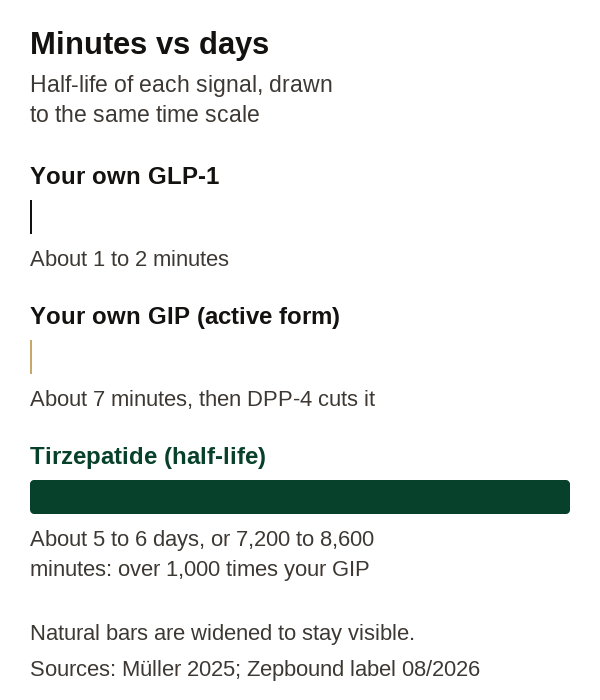
An enzyme called DPP-4 cuts your own active GIP within minutes, giving it a half-life of about 7 minutes. Tirzepatide swaps in an unusual amino acid at two spots and carries a fatty acid chain that clings to albumin, a protein in your blood. Its half-life is about 5 to 6 days, and weekly doses reach steady levels after about 4 weeks.
Five to six days is roughly 7,200 to 8,600 minutes, over 1,000 times longer than your own GIP lasts.
What the SURMOUNT trials show
In SURMOUNT-1, 2,539 adults with obesity, or overweight plus a weight-related condition, and no diabetes took tirzepatide or placebo for 72 weeks, and everyone also followed a reduced-calorie diet with activity counseling. Average weight loss was 15.0% on 5 mg, 19.5% on 10 mg, and 20.9% on 15 mg, against 3.1% on placebo, and results varied from person to person. Eli Lilly, which makes tirzepatide, funded the trial.
In SURMOUNT-5, a head-to-head trial also funded by Lilly, tirzepatide led to more average weight loss than semaglutide, but it compared two different molecules, so it can’t measure how much GIP explains. Our semaglutide vs tirzepatide comparison covers that trial in full.
The GIP puzzle: why switching it on and blocking it both cut weight
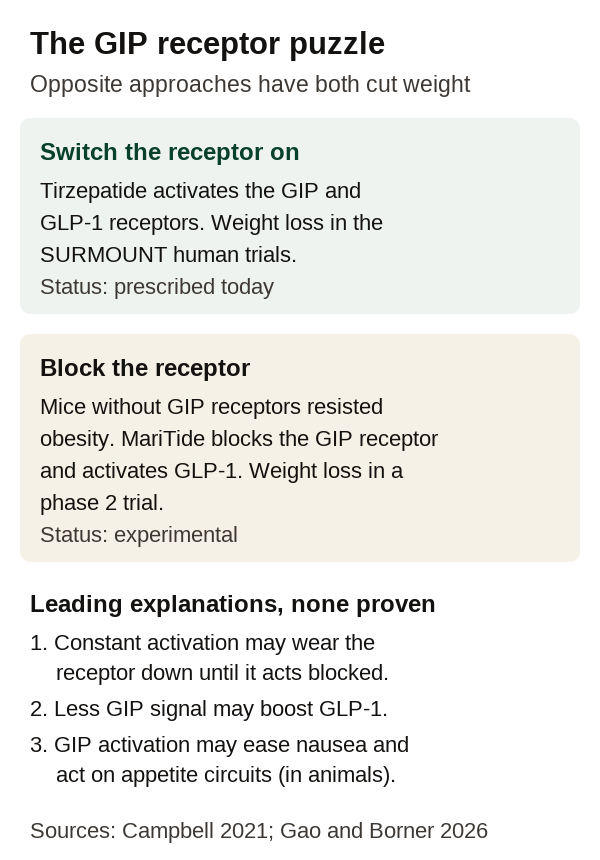
Here is the twist most explainers skip: mice bred without GIP receptors were protected from obesity on a high-fat diet, and in Amgen studies, antibodies that block the GIP receptor curbed weight gain in obese mice and cut weight in obese monkeys. Yet tirzepatide, which switches that receptor on, produces substantial weight loss in people.
Both approaches have reached human trials. MariTide (maridebart cafraglutide), an experimental monthly shot from Amgen that blocks the GIP receptor while activating GLP-1, led to 12.3% to 16.2% average weight loss at 52 weeks against 2.5% on placebo in a 465-person phase 2 obesity group, in a trial Amgen funded. Retatrutide, an experimental weekly shot from Lilly, activates GIP, GLP-1, and glucagon receptors; our guide to what retatrutide is covers it.
Both switching the GIP receptor on and blocking it have cut weight, and researchers have not settled why.
Leading explanations, none proven
Wear-down: constant activation may desensitize the GIP receptor until it behaves as if blocked
Trade-off: less GIP signal may strengthen GLP-1 receptor activity
Calmer stomach: in shrews, switching on GIP receptors blocked vomiting caused by GLP-1 drugs, and in mice and rats it eased signs of nausea, while weight loss held (an animal study co-written by Lilly scientists)
Brain and fat: a 2026 review says GIP activation may recruit appetite-lowering brain circuits, while blocking it may counter GIP’s fat-storing action
A 2021 review said the evidence can’t yet reconcile the two. Either way, tirzepatide’s results come from human trials of the whole medicine, not from any one theory.
Can you activate GIP naturally? Why boosting meal GIP isn’t a weight-loss method
Every meal activates GIP naturally, but eating to raise your own GIP is not a weight-loss method. Your GIP rises after each meal and settles over the next few hours, and each active GIP molecule is broken down within minutes, while tirzepatide keeps both receptors switched on all week. Supplements sold as natural GLP-1 boosters, such as berberine, may nudge the GLP-1 you make but don’t mimic the drug; see GLP-1 supplements.
Fat is a strong trigger. In mice, high-fat feeding drove extra GIP release along with heavy fat gain, and high GIP levels in obesity once earned it the nickname “the obesity hormone.” We found no human trial showing that raising your own GIP through food causes weight loss.
The 3 S check for any GIP claim
Our editorial tool for sorting GIP headlines, built from the sources above. It doesn’t replace medical advice.
Source: is the claim about your own GIP or a medicine? Your GIP rises and falls with every meal; a medicine is built to last days.
Speed: minutes or days? Natural active GIP has a half-life of about 7 minutes; tirzepatide’s is about 5 to 6 days.
Study: mice or people? Much GIP biology, including the mouse work behind “block it to lose weight,” comes from animals. Look for human trials with a placebo group.
Weighing a GIP medicine? Book a weight loss consultation with Dr. Espinet. She evaluates you first, including screening for eating disorders, and tells you if a GLP-1 medicine isn’t right for you.
Who should not take tirzepatide, and when to get help
Tirzepatide carries a boxed warning: it caused thyroid C-cell tumors in rats, and it is not known whether it does in people. It is not for anyone with a personal or family history of medullary thyroid carcinoma (MTC), anyone with multiple endocrine neoplasia syndrome type 2 (MEN 2), or anyone who has had a serious allergic reaction to tirzepatide or its ingredients. Don’t combine it with another tirzepatide product or any GLP-1 medicine, and it isn’t recommended with severe gastroparesis. Stop it and tell your prescriber if you become pregnant.
Tell your prescriber first about pancreas problems, diabetic retinopathy, insulin or sulfonylurea use, breastfeeding, or plans for pregnancy. Before any surgery, procedure, or sedation, tell the surgeon and anesthesia team that you take tirzepatide, because food or liquid can get into your lungs. Birth control pills may work less well: the label advises switching to a non-oral method, or adding a barrier method, for 4 weeks after starting and after each dose increase. Mention any eating disorder too: a 2026 expert consensus says to generally avoid these medicines during an active eating disorder, especially anorexia or restrictive bulimia, and to proceed cautiously after one.
If you notice
What to do
Swelling of your face, lips, tongue, or throat, trouble breathing or swallowing, severe rash or itching, fainting or dizziness, or a very rapid heartbeat
Stop tirzepatide and call 911 or go to an emergency room
Severe stomach pain that won’t go away, with or without nausea or vomiting, sometimes felt through to your back
Stop tirzepatide and call your prescriber right away; it can mean pancreatitis
Barely urinating, very dark urine, dizziness, or a racing heart after vomiting or diarrhea
Severe dehydration is an emergency: go to an emergency room, or call 911 if you become confused or pass out
Nausea, vomiting, or diarrhea that won’t stop
Call your prescriber right away; losing fluids can harm your kidneys
Pain in your upper stomach, fever, yellow skin or eyes, or clay-colored stools
Call your prescriber right away; it can mean gallbladder problems
Dizziness, blurred vision, sweating, shakiness, confusion, slurred speech, or a fast heartbeat if you take insulin or a sulfonylurea
Possible low blood sugar: treat it as your prescriber taught you, then call them. If you can’t treat it yourself, pass out, or have a seizure, someone should call 911
You took too much tirzepatide
Call your prescriber or Poison Help at 1-800-222-1222, or go to an emergency room right away
A lump or swelling in your neck, hoarseness, trouble swallowing, or shortness of breath
Call your prescriber; these can be thyroid tumor signs
Vision changes, if you have type 2 diabetes
Tell your prescriber
If you can’t reach your prescriber quickly about severe stomach pain, fever, or yellow skin, go to an emergency room. This is general information, not medical advice; our tirzepatide side effects guide covers the common effects and what helps.
The next-step hurdle: is a GIP-based medicine right for you?
GIP biology can’t tell you whether tirzepatide or semaglutide suits you better. These questions can:
Do you qualify? Zepbound’s label covers adults with obesity, or overweight plus a weight-related condition, alongside a reduced-calorie diet and more activity
Side effects: in SURMOUNT-5, stomach side effects led with both medicines, mostly mild to moderate and during dose increases
Budget: at MeliOra, tirzepatide runs $230 to $320/month, and semaglutide starts at $150/month
Florida adds its own guardrails. Board of Medicine Rule 64B8-9.012 sets a BMI of 30 or more, a BMI over 27 with a related condition, or body fat of at least 25% for men or 30% for women, and requires an initial evaluation, your written informed consent, and a re-evaluation at least every 3 months. Already on semaglutide? Read about switching from semaglutide to tirzepatide, and for the brand names, see Mounjaro vs Zepbound.
How MeliOra fits: tirzepatide care across Tampa Bay
Dr. Melanie Espinet, a board-certified family medicine physician, prescribes tirzepatide or semaglutide as weekly injections, so ask her which medication you would receive and why. The trial results above describe the tirzepatide Eli Lilly studied and may not reflect results with other tirzepatide products.
Tirzepatide weight loss runs $230 to $320/month, including physician visits, lab work, the medication and supplies, and dose adjustments and check-ins, with no consultation fee. MeliOra is a self-pay practice. If you also want Botox, the MeliOra Reset pairs tirzepatide with Botox every 3 months as one 12-month membership at a set monthly price.
Dr. Espinet comes to your home or office across Hillsborough, Pasco, and Pinellas counties with no travel fee. Elsewhere in Florida, start with a telehealth weight loss visit at the same monthly price.
Frequently asked questions
What does GIP stand for?
GIP stands for glucose-dependent insulinotropic polypeptide. Its older name is gastric inhibitory polypeptide. Both names describe the same 42-amino-acid hormone, made by K cells in the upper small intestine and released after you eat. The newer name reflects its main job: helping the pancreas release insulin when blood sugar is high.
What is the difference between GLP-1 and GIP?
Both are incretin hormones that raise insulin after a meal, but they differ. GIP comes mainly from the upper small intestine, can raise glucagon, and is linked to fat storage. GLP-1 comes from farther down the gut and lowers glucagon. In type 2 diabetes, GIP’s insulin effect weakens while GLP-1’s largely holds.
Is tirzepatide a GIP agonist?
Yes. Tirzepatide’s label calls it a GIP receptor and GLP-1 receptor agonist, and it is built on the GIP sequence. One weekly shot activates both receptors. Its half-life is about 5 to 6 days, compared with about 7 minutes for your own active GIP, so weekly doses keep levels steady.
How do you activate GIP naturally?
Eating does it. Sugars and fats are the main triggers, and some protein drinks add to them. Levels rise sharply within an hour of a meal and stay up for hours, while an enzyme breaks each active GIP molecule down within minutes. Raising your own GIP through food is not a weight-loss method; in mice, high-fat diets raised GIP along with body fat.
Why do GIP blockers and GIP activators both cause weight loss?
Nobody knows for sure. Leading ideas are that constant activation wears the GIP receptor down until it acts blocked, that blocking GIP strengthens GLP-1 signaling, and that GIP activation eases nausea and acts on appetite circuits. Much of this evidence comes from animal studies, and human trials continue.