The short answerNo supplement is a GLP-1 medicine or works like one. Berberine, some probiotics, and fiber may nudge the GLP-1 your gut releases after meals, mostly in lab, animal, and short human studies. Across 23 published berberine trials pooled in 2026, people lost about 0.9 kg (2 lb) more than comparison groups.
“Nature’s Ozempic” is the social media nickname for berberine, and GLP-1 supplements now come as pills, powders, gummies, and probiotics. Ozempic is the popular name for semaglutide; MeliOra prescribes weekly semaglutide and tirzepatide through our physician-led weight loss program and doesn’t offer berberine. This is general information, not medical advice.
Do GLP-1 supplements work?
GLP-1 supplements are products sold to support the GLP-1 hormone your gut makes. None is a GLP-1 medicine, the FDA doesn’t review them before sale, and the best studied, berberine, showed small effects in short trials of mixed quality.
The rules explain why labels say “support.” Under federal law, the FDA has no authority to approve supplements before they’re marketed, and only a drug can legally claim to treat, cure, or prevent a disease. On May 1, 2026, the FDA sent an advisory letter to a seller of two “blood sugar support” supplements over claims that they treat or prevent diabetes.
There’s a second risk: the FDA says many weight loss pills, supplements, and teas are likely to be contaminated with dangerous hidden ingredients. Patches and drops sold as GLP-1 get their own check in our GLP-1 patches guide.
Raise vs mimic: how GLP-1 supplements differ from GLP-1 medicines
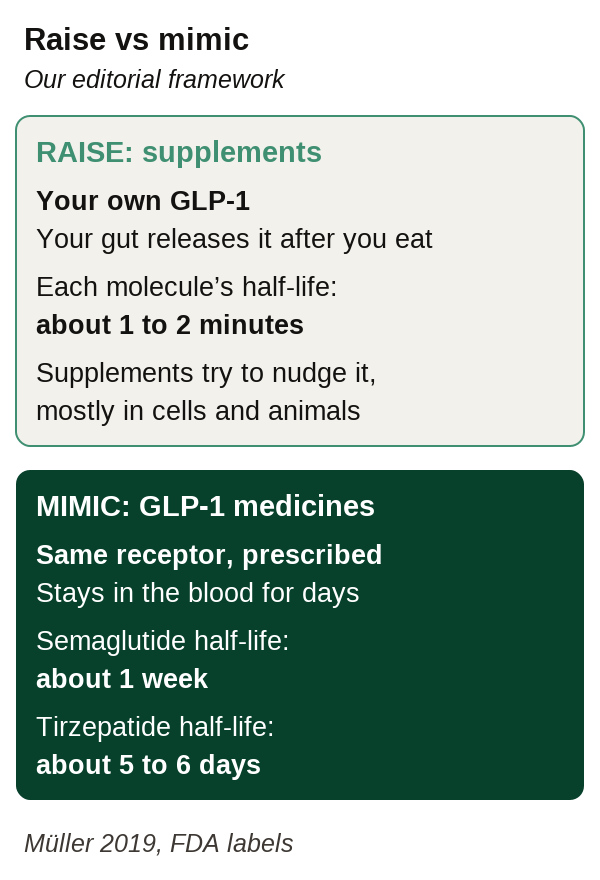
Our editorial framework sorts GLP-1 claims into two kinds. Raise means helping your gut release more of its own GLP-1, or clear it a little more slowly; your gut releases it after you eat, and each molecule is cleared fast, with a half-life of about 1 to 2 minutes. Mimic means a medicine that acts on the same receptor and stays in the blood: semaglutide’s half-life is about 1 week and tirzepatide’s about 5 to 6 days, per their labels.
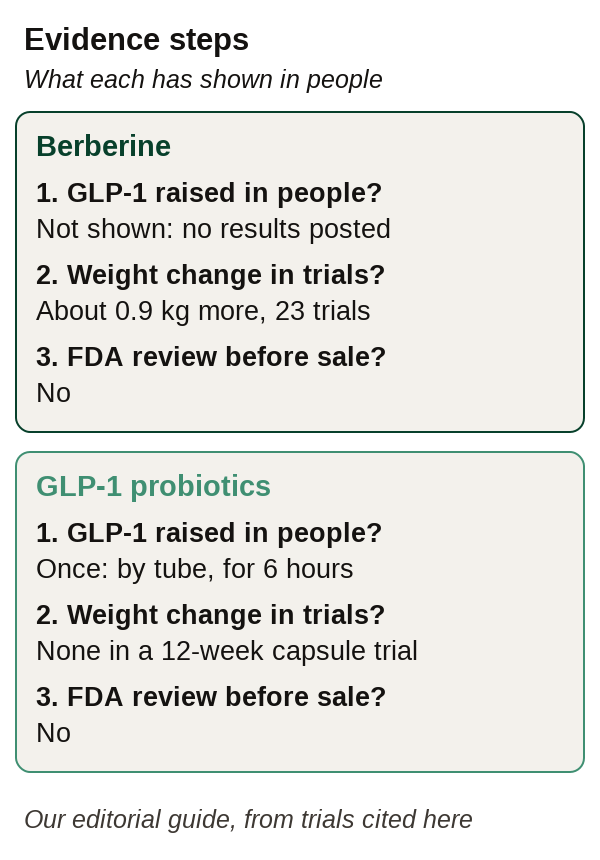
Supplements can only try to raise. For any raise claim, ask three things: raised in whom (cells, animals, or people), by how much, and did weight change in a placebo-controlled trial?
Supplements can only try to raise the GLP-1 your gut releases after meals; a GLP-1 medicine mimics it and lasts all week.
Berberine, “nature’s Ozempic”: raised GLP-1 in cells and animals
Berberine is a plant compound found in goldenseal, barberry, and other plants. In a 2010 study, it boosted GLP-1 release in rats and in human gut cells grown in a lab, and a 2026 review still describes that link as preclinical. The one registered human test we found, in 16 healthy men, finished in April 2023 and hasn’t posted results.
For weight, the largest pooled analysis, published in January 2026, combined 23 published randomized trials: people taking berberine lost about 0.9 kg (2 lb) more than comparison groups, and their BMI fell about 0.5 more. The authors, who reported no competing interests, flagged common weaknesses such as missing blinding and randomization problems. A 2025 analysis of placebo-controlled trials, funded by Chinese medicine research grants, found a similar BMI drop and rated only 2 of its 12 trials at low risk of bias in every area.
Berberine vs Ozempic: why the trials can’t rank them
No trial has compared berberine with semaglutide head to head, so no study can say which works better or by how much. Semaglutide’s weight trials used 2.4 mg, the Wegovy dose; Ozempic is the diabetes brand, sold as a weekly shot or a daily tablet.
Berberine and semaglutide 2.4 mg
Question
Berberine
Semaglutide
Largest evidence
23 published trials, pooled in a 2026 analysis
One 68-week trial of 1,961 adults
Trial length
12 to 20 weeks in the 2025 placebo-controlled analysis
68 weeks
Who took part
Mostly people with conditions such as diabetes, most in Asian countries
Adults with obesity, or overweight plus a related condition, without type 2 diabetes
Funding
Chinese medicine research grants (2025 analysis)
Novo Nordisk (the trial)
Reviewed by the FDA before sale
No, sold as a supplement
Yes, as the brand Wegovy, to reduce excess body weight alongside diet and activity
Because the people, trial lengths, and trial sizes differ, setting the two results side by side would rank them on numbers no trial compared. In the semaglutide trial, everyone also had diet and exercise counseling, and results varied from person to person.
GLP-1 probiotics: a short human signal, no weight data
In a 2026 Danish trial funded by the Novo Nordisk Foundation (one author works for Novo Nordisk), one gut bacterium infused straight into the small intestine of 32 adults with overweight raised GLP-1 and PYY over six hours compared with placebo, but didn’t change the main insulin measure. That was a tube, not a capsule.
In a 12-week trial of a five-strain capsule with inulin, a plant fiber, 76 adults with type 2 diabetes were split into three groups. The full formula lowered after-meal blood sugar compared with placebo by a margin right at the edge of statistical significance, with no change in body weight. GLP-1 wasn’t measured, and every author worked for the company that makes it.
Ask the three raise questions of any GLP-1 supplement: in whom, by how much, and did weight change against placebo.
Fiber pills and powders sold as GLP-1 boosters
Fiber’s GLP-1 link is real but indirect. A 2025 joint advisory from four nutrition and obesity medicine groups explains that gut bacteria ferment fiber into short-chain fatty acids, which prompt your own GLP-1 release. That is a raise effect, and the advisory describes it for fiber in general, not for any one product. For how much to aim for, see fibermaxxing and Oatzempic.
The next-step hurdle: adding a supplement to a GLP-1 medicine
A 2026 interaction review says people on these medicines who add berberine on their own are a group nobody has studied, and names three untested concerns: extra blood sugar lowering, changes in how pills are absorbed at the gut, and nutrient gaps on a smaller appetite.
Florida’s Rule 64B8-9.012 counts any nutritional supplement or herbal treatment a physician uses for medically assisted weight loss as an anti-obesity drug, with the same evaluation, consent, and 3-month re-evaluation rules. Tell your prescriber about every supplement, and see how to stop food noise for what habits can do.
Who should skip GLP-1 supplements, and when to get help
Talk to a physician before any GLP-1 supplement, or skip it, if you:
Are pregnant or breastfeeding. The NIH’s complementary health center says not to use berberine then, or give it to infants: it can cause or worsen jaundice in newborns, which can become life threatening.
Are trying to conceive. Ask your doctor first; the NIH’s complementary health center says berberine may be unsafe in pregnancy.
Take cyclosporine or another transplant drug. Berberine raised cyclosporine levels in kidney transplant recipients.
Take insulin, a sulfonylurea, or metformin. Berberine can add to blood sugar lowering and may change how metformin is handled.
Take other daily medicines. Two weeks of berberine slowed three liver enzymes that clear many common drugs in healthy men.
Have or have had an eating disorder, or restrict food in ways that worry you.
For prescription GLP-1 medicines, ACOG’s October 2026 advisory suggests a stop 1 to 2 months before conception and advises against them in pregnancy and while breastfeeding a preterm baby or a newborn; see tirzepatide, birth control, and pregnancy.
If you take a prescription GLP-1, or a product sold as one, watch for these signs. The rows match our GLP-1 side effects guide, sorted from most to least urgent, plus three for supplements:
Warning sign
What to do
Swelling of the face, lips, tongue, or throat, trouble breathing or swallowing, severe rash or itching, fainting or dizziness, or a very rapid heartbeat
A serious allergic reaction. Stop the medication and call 911 or go to an emergency room
Low blood sugar you can’t treat yourself, passing out, or a seizure, if you take insulin or a sulfonylurea
Someone should call 911
Thoughts of harming yourself
Call or text 988, the Suicide and Crisis Lifeline, right away. If you might act on them or are in immediate danger, call 911
Sudden vision loss in one eye (often noticed on waking), blurred or missing patches of vision, faded or distorted colors, or eyesight that gets worse quickly
Call 911 or go to an emergency room now, and don’t drive yourself. The FDA warns GLP-1s may raise the risk of NAION, a rare optic nerve problem
Sudden pressure, squeezing, or tightness in your chest, especially with a racing heart, sweating, or shortness of breath
Call 911. The FDA warns that many weight loss supplements may contain dangerous hidden ingredients
Yellow skin or eyes in a newborn who also has a fever, has become listless, or isn’t feeding well, if the parent took berberine while pregnant or breastfeeding
An emergency. Go to an emergency room now or call 911. Berberine can cause or worsen newborn jaundice, which can lead to kernicterus, a life-threatening problem
Severe stomach pain that will not go away, sometimes reaching the back, with or without vomiting
Possible pancreatitis. Stop the medication and call your prescriber right away; if you can’t reach them quickly, go to an emergency room, not urgent care
Pain in the upper stomach, fever, yellow skin or eyes, or clay-colored stools
Possible gallbladder problems. Call your prescriber right away; if you can’t reach them quickly, go to an emergency room, not urgent care
Vomiting or diarrhea that will not stop, or not being able to keep fluids down
Dehydration, which can lead to kidney injury. Call your prescriber right away. Go to the emergency room now if you can’t keep fluids down, are barely urinating, your urine is very dark, you feel dizzy or lightheaded, or your heart is racing. Call 911 if you become confused or faint. If you have kidney disease, call at the first sign
You took too much, or took a dose twice
Call your prescriber or Poison Help at 1-800-222-1222, or go to an emergency room right away
Yellow skin or eyes in a newborn whose parent took berberine while pregnant or breastfeeding
Call the baby’s doctor today. Berberine can cause or worsen newborn jaundice
Shakiness, sweating, dizziness, confusion or drowsiness, headache, blurred vision, slurred speech, hunger, or a fast heartbeat
Possible low blood sugar, more likely with insulin or a sulfonylurea. Treat it as your prescriber taught you, then call them
Heart racing or pounding at rest for several minutes
Increased heart rate, which the Wegovy and Saxenda labels say to report. Call your prescriber
A lump or swelling in the neck, hoarseness, trouble swallowing, or shortness of breath
Possible thyroid tumor, the risk behind the labels’ boxed warning. Call your prescriber
Vision changes in someone with type 2 diabetes
Possible worsening of diabetic eye disease. Tell your prescriber
No table covers everything. Bring your supplement bottles to any visit, and report a problem with any product to the FDA’s MedWatch program. For the full picture on prescription medicines, see GLP-1 side effects.
How MeliOra fits: a GLP-1 medicine, prescribed and watched
MeliOra doesn’t offer berberine, GLP-1 patches, or GLP-1 pills. Dr. Melanie Espinet, a board-certified family medicine physician in Lutz, prescribes weekly semaglutide or tirzepatide injections after an evaluation; tell her about every supplement you take. She screens for eating disorders before prescribing, and if support from a dietitian or therapist would help, she discusses it at your consultation. Trial and label figures on this page describe the brand-name products studied, so ask her exactly which medication you would receive.
Semaglutide weight loss starts at $150/month, or $240/month at higher dosing, and tirzepatide weight loss runs $230 to $320/month. Each price includes in-home physician visits, lab work, the medication and supplies, and dose adjustments and check-ins, with no consultation fee.
Dr. Espinet makes house calls across Hillsborough, Pasco, and Pinellas counties with no travel fee. At any house call, including ours, ask how the product was stored on the way and what the plan is for a serious reaction. Anywhere in Florida, telehealth uses video visits at the same monthly price.
Frequently asked questions about GLP-1 supplements
Do GLP-1 supplements actually work?
Not like GLP-1 medicines. Supplements may nudge the GLP-1 your gut releases after meals, mostly shown in cells, animals, and short human studies. The best studied, berberine, averaged about 0.9 kg (2 lb) more weight loss than comparison groups across 23 published trials, many with quality problems.
Is berberine really nature’s Ozempic?
No. “Nature’s Ozempic” is a social media nickname. Berberine raised GLP-1 release in cell and animal studies, but it isn’t a GLP-1 medicine and hasn’t been shown to act like one in people. Its weight effects in placebo-controlled trials were small, and many trials had a high risk of bias.
Which works better for weight loss, berberine or Ozempic?
No trial has compared them, so no study can say which works better. Berberine’s evidence comes from small trials, mostly 12 to 20 weeks long, with frequent quality problems. Semaglutide 2.4 mg, the Wegovy dose, was tested for 68 weeks in 1,961 adults, all with diet and exercise counseling, and results varied.
Do GLP-1 probiotics work?
The evidence is early. A single bacterium infused into the small intestine raised GLP-1 for six hours in a 2026 trial, but that wasn’t a capsule. A 12-week trial of a five-strain capsule in type 2 diabetes improved after-meal blood sugar without changing weight, and didn’t measure GLP-1.
Can I take berberine with semaglutide or tirzepatide?
Ask your prescriber first. A 2026 review says nobody has studied the combination. Berberine can add to blood sugar lowering, slows liver enzymes that clear many medicines, and may change how metformin is handled. It isn’t considered safe in pregnancy or while breastfeeding.
Are GLP-1 supplements safe?
Berberine’s common side effects are stomach upset, nausea, and constipation, and it interacts with several medicines. Supplements aren’t reviewed by the FDA before sale, and the FDA warns that many weight loss products may contain dangerous hidden ingredients. Bring every bottle to your doctor.