The short answerZepbound isn’t used during pregnancy: its August 2026 label says to stop it once a pregnancy is recognized. It can make birth control pills less reliable for 4 weeks after you start and after each dose increase. Its label sets no wait before conceiving; ACOG suggests considering a stop 1 to 2 months ahead, and the semaglutide labels say 2 months.
Zepbound and pregnancy rules below come from the Zepbound label (08/2026), the Wegovy label (06/2026), ACOG’s October 2026 advisory, and a 2026 study. Dr. Espinet prescribes tirzepatide or semaglutide for medical weight loss; label facts describe the brand-name products. Severe pain, heavy bleeding, or trouble breathing now? Get care now; warning signs are below. This is general information, not medical advice.
What the Zepbound label says about pregnancy
The Zepbound label is direct: “Weight loss offers no benefit to a pregnant patient and may cause fetal harm.” It says to stop Zepbound when a pregnancy is recognized, and it notes that appropriate weight gain is still recommended in pregnancy.
Human data are thin. The label says the data with tirzepatide in pregnancy “are insufficient to evaluate for a drug-related risk of major birth defects, miscarriage, or other adverse maternal or fetal outcomes.” In rats, it caused reduced fetal growth and fetal abnormalities, alongside lower food intake and weight in the mothers.
For context, the label puts the U.S. background risk at 2% to 4% for major birth defects and 15% to 20% for miscarriage, higher in the population Zepbound is approved for.
Zepbound (tirzepatide) vs Wegovy (semaglutide)
Label rule
Zepbound
Wegovy
If you become pregnant
Stop when pregnancy is recognized
Stop if you take it for weight loss or heart risk
Before trying to conceive
No waiting period stated
Stop at least 2 months before a planned pregnancy
Birth control pills
Non-oral method or backup for 4 weeks after starting and each dose increase
No pill rule
How long before trying to conceive should you stop?
The U.S. Zepbound label sets no waiting period between your last dose and trying to conceive. ACOG’s October 2026 practice advisory says to consider stopping GLP-1 medicines 1 to 2 months before conception, and the semaglutide labels set 2 months.
The Wegovy label says to “discontinue WEGOVY® in patients at least 2 months before they plan to become pregnant to account for the long half-life of semaglutide,” and Ozempic’s label agrees; the Wegovy label says semaglutide stays in circulation about 5 to 7 weeks after the last dose. Our semaglutide weight loss page gives the same advice.
Tirzepatide clears faster, with a half-life of about 5 to 6 days. ACOG adds that weight regain is common after stopping, so plan eating, activity, and weight checks. Set your stop date with your prescriber and your OB-GYN or midwife.
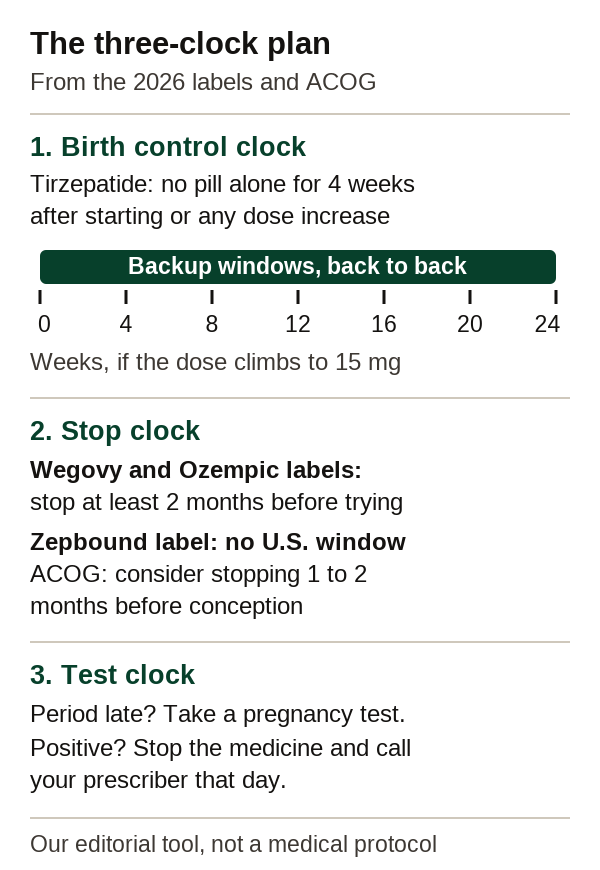
The three-clock plan for pregnancy on a GLP-1
Our editorial tool, not a medical protocol. Each clock is a date to agree on with your prescriber:
Birth control clock: starts when you begin tirzepatide and restarts with each dose increase; 4 weeks without relying on the pill alone.
Stop clock: starts when you decide to try; 1 to 2 months ahead per ACOG, at least 2 months on semaglutide per its label, with reliable birth control until then.
Test clock: runs whenever you could become pregnant. If a period is late, test and tell your prescriber before your next dose; if positive, stop the medicine and call that day.
If you climb all the way to 15 mg on the fastest schedule, the 4-week backup windows run back to back for 24 weeks.
Planning a pregnancy in the next year or two? Book a weight loss consultation and raise it at the first visit, with your birth control.
Zepbound birth control: does tirzepatide affect the pill?
It can. The Zepbound label says: “Advise patients using oral hormonal contraceptives to switch to a non-oral contraceptive method, or add a barrier method of contraception for 4 weeks after initiation with ZEPBOUND and for 4 weeks after each dose escalation.” That covers any hormonal pill, including progestin-only pills.
The cause is slower stomach emptying, which the label says is largest after the first dose and fades over time. In a study, one 5 mg dose cut the peak blood level of the pill’s estrogen by 59% and its total exposure by about 20%. The Mounjaro label, which is also tirzepatide, carries the same rule.
How long the backup windows last
The label starts at 2.5 mg for 4 weeks, then allows 2.5 mg increases at least 4 weeks apart, up to 15 mg. If you climb all the way on that fastest schedule, the windows run back to back for the first 24 weeks; a lower dose means fewer. After a pause, ask whether the window restarts.
Which birth control methods aren’t affected
The label says hormonal contraceptives “that are not administered orally should not be affected.” That includes methods such as a hormonal IUD, the implant, the shot, the patch, and the vaginal ring (our examples; the label doesn’t name them). Barrier methods such as condoms are the label’s backup option.
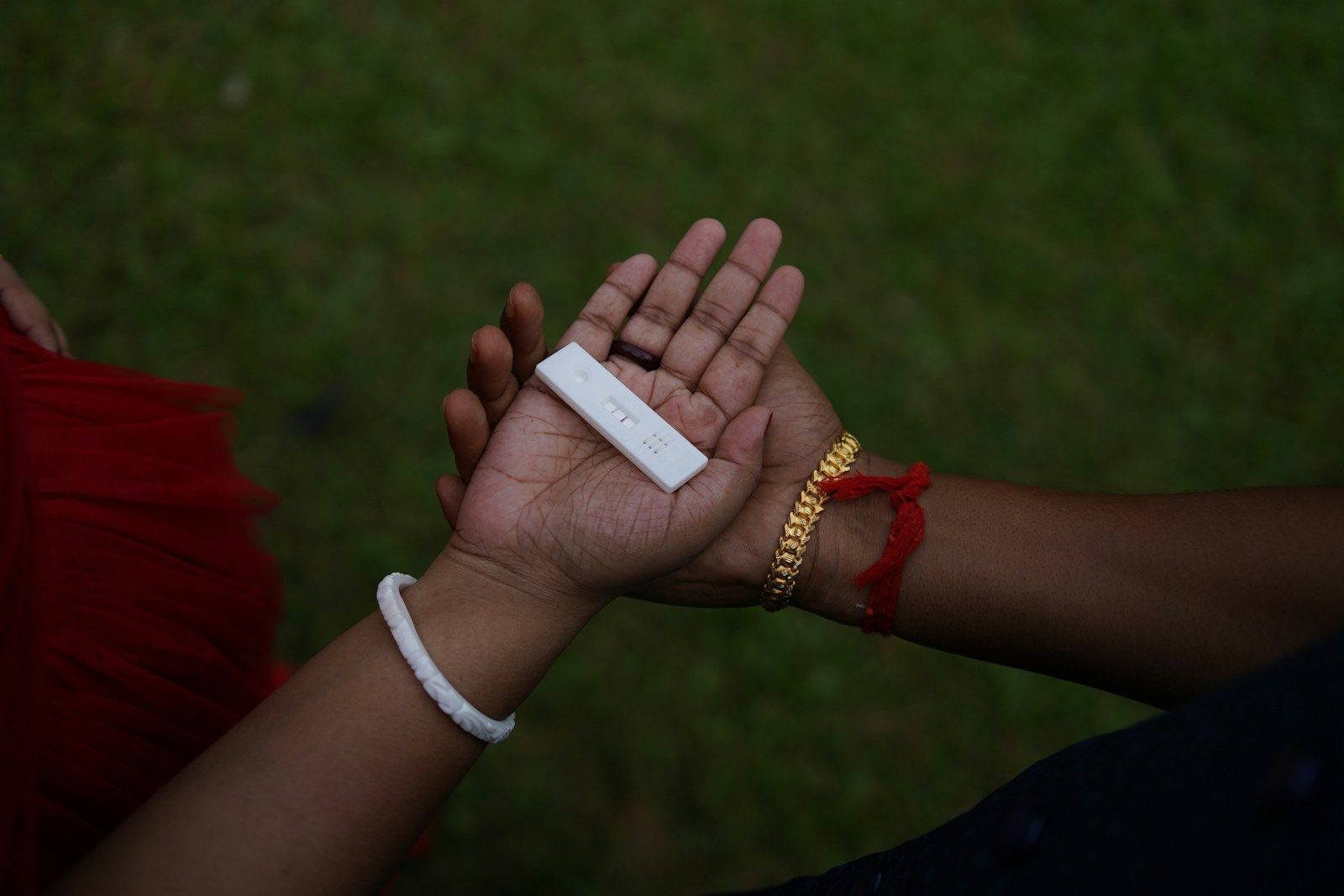
Only the pill packs here are taken by mouth, the one route the Zepbound birth control rule covers. Photo: Reproductive Health Supplies Coalition on Unsplash
Semaglutide differs on paper: the Wegovy label has no pill rule, and the Ozempic label’s study found no dose change needed for pill hormones, though at a steady dose, not right after a dose increase. Our tirzepatide weight loss page gives the same 4-week rule.
Can you get pregnant on Zepbound? Why it happens unexpectedly
Yes, and three things can catch you off guard:
Pill reliability may drop during the 4-week windows above.
Fertility may rise. ACOG’s 2026 advisory says weight loss on these medicines may improve fertility, and the authors of a 2026 study of GLP-1 pregnancies cite anecdotal reports of unplanned pregnancies.
Irregular cycles can mislead. People with PCOS can still ovulate and conceive on their own, as a 2026 opinion article in Human Reproduction notes.
ACOG’s answer is effective birth control on these medicines. Our guide to GLP-1 for PCOS covers what they can and can’t do for PCOS.
Pregnant on Zepbound or semaglutide? What the 2026 data show
If you find out you’re pregnant while taking tirzepatide or semaglutide, stop the medicine and call your prescriber that day; ACOG advises against these medicines for the rest of the pregnancy. Tell your OB-GYN or midwife which medicine you took, the dose, and the date of your last injection.
If you also have type 2 diabetes, ask that day how to keep your blood sugar in range, and don’t stop insulin or other diabetes medicines on your own: the Ozempic and Mounjaro labels warn that poorly controlled diabetes in pregnancy raises the risk of birth defects. Before any procedure with anesthesia or sedation, such as a cesarean, tell the team when you last took a GLP-1; the labels report rare cases of stomach contents reaching the lungs.
If you took Zepbound or Wegovy, its maker’s pregnancy registry asks to hear from you: for Zepbound, 1-844-524-0039 or pregnancyregistry.lilly.com/zepbound; for Wegovy, 1-877-390-2760 or wegovypregnancyregistry.com.
A 2026 study in the Annals of Internal Medicine adds human data. Harvard researchers analyzed health-plan claims for 3,572 U.S. pregnancies in women who had filled a GLP-1 prescription in the 3 months before their last period, comparing those who filled it again in the first trimester with those who stopped.
Outcome
Filled again in early pregnancy vs stopped
Miscarriage, termination, or stillbirth combined
29.7% vs 27.1%; the adjusted range included no difference
Miscarriage
About the same
Elective termination
More common in those who filled again; the authors suggest more unplanned pregnancies, not birth defects, as the likely reason
Major birth defects
An estimated 1.21 times as common, with a range from 17% lower to 82% higher
Baby small for gestational age
An estimated 1.29 times as common, with a range from 18% lower to about double
The authors call this some reassurance after an accidental exposure, not proof of safety: the birth defect and growth estimates were “compatible with both no increased risk and clinically relevant differences in risk.” Fills aren’t doses, cash purchases weren’t captured, and most refilled once, so it says little about later pregnancy. Most took semaglutide (46%) or liraglutide (25%); tirzepatide wasn’t reported separately, and 41% had type 2 diabetes. The authors call stopping before pregnancy a precaution.
The next-step hurdle: breastfeeding and restarting after delivery
Zepbound’s label has one small study: after a single 5 mg dose in 11 breastfeeding women, tirzepatide was undetectable in 164 of 171 milk samples, and the rest added up to less than 0.02% of the dose. There are no data on effects on the baby or on milk supply.
ACOG’s advisory recommends against GLP-1 medicines while breastfeeding a preterm baby or a newborn and says to avoid pill forms; otherwise it supports a shared decision, with your baby’s weight gain watched closely. The Wegovy label also advises against breastfeeding on its tablets and has no data for its injection.
Neither label sets a date to restart after delivery, so decide that with your prescriber and your OB-GYN or midwife, and ask whether the 4-week birth control window applies again. Botox has separate guidance, covered in Botox while pregnant or breastfeeding.
When to call: warning signs during pregnancy on a GLP-1
Sorted by urgency. Pregnancy signs come from the CDC’s urgent maternal warning signs, which apply for a year after delivery too; medicine signs come from the labels.
If you notice
What to do
Trouble breathing or swallowing, chest pain, fainting, a very fast heartbeat, or swelling of your face, lips, tongue, or throat
Call 911, and stop the medicine if it could be an allergic reaction
Thoughts of harming yourself or your baby
Call or text 988 right away; if you are in immediate danger, call 911
During pregnancy: severe belly pain that won’t go away, vaginal bleeding heavier than spotting, fluid leaking, or your baby moving less
Get medical care right away from your OB-GYN, midwife, or an emergency room
During pregnancy or the year after: a headache that won’t go away, vision changes, ongoing dizziness, a fever of 100.4°F or higher, extreme swelling of your hands or face, a swollen painful leg or arm, heavy bleeding after delivery, or overwhelming tiredness
Get medical care right away
Severe stomach pain that won’t go away, sometimes reaching your back, with or without vomiting
Stop the medicine and call your prescriber right away; it can mean pancreatitis
Vomiting so you can’t keep fluids down, or you can’t drink for more than 8 hours
Get medical care right away; losing fluids can harm your kidneys
Shakiness, sweating, or confusion if you take insulin or a sulfonylurea
Possible low blood sugar: treat it as you were taught and call your prescriber; call 911 if you faint or are too confused to treat it
A positive pregnancy test while taking tirzepatide or semaglutide
Stop the medicine and call your prescriber that day
Upper stomach pain, fever, yellow skin or eyes, or clay-colored stools
Call your prescriber right away; if you’re pregnant or have a fever of 100.4°F or higher, get medical care right away
A lump or swelling in your neck, or hoarseness that won’t go away
Call your prescriber; these can be thyroid tumor signs
Heart racing or pounding at rest for several minutes
Tell your prescriber; if you’re pregnant or gave birth in the last year, get medical care right away
No list covers everything. If something feels wrong, call your OB-GYN, midwife, or prescriber, and say if you’re pregnant or were in the last year. Our tirzepatide side effects guide has more.
How MeliOra fits
Dr. Melanie Espinet, a board-certified family medicine physician in Lutz, prescribes tirzepatide or semaglutide as weekly injections for weight management; ask her which medicine you would receive and how these label rules apply. Before you start, tell her about pregnancy plans, breastfeeding, your birth control, and any eating disorder history. Pregnancy and fertility care belong with your OB-GYN, midwife, or fertility specialist.
Tirzepatide weight loss runs $230/month to $320/month, and semaglutide starts at $150/month, or $240/month at higher dosing. Each price includes physician visits, lab work, the medication and supplies, and dose adjustments and check-ins, with no consultation fee. MeliOra is a self-pay practice; who qualifies is covered in how to get a semaglutide prescription.
Dr. Espinet makes house calls across Hillsborough, Pasco, and Pinellas counties with no travel fee, and sees select appointments at the Lutz office. At any house call, including ours, ask how the product was stored on the way and what the plan is for a serious reaction. Elsewhere in Florida, start with a telehealth weight loss visit at the same monthly price.
Frequently asked questions
Does tirzepatide affect birth control?
It can affect birth control pills. The Zepbound label says to switch to a non-oral method or add a barrier method such as condoms for 4 weeks after starting and after each dose increase. It says hormonal methods that aren’t taken by mouth should not be affected. Mounjaro, also tirzepatide, has the same rule.
How long before trying to get pregnant should I stop Zepbound?
The U.S. Zepbound label doesn’t set a waiting period. ACOG’s October 2026 advisory suggests considering a stop 1 to 2 months before conception for GLP-1 medicines, and the semaglutide labels say 2 months. Agree on a date with your prescriber, and use reliable birth control until then.
What happens if I get pregnant on Zepbound?
Stop it and call your prescriber that day, then tell your OB-GYN or midwife. A 2026 study of 3,572 pregnancies found no clear rise in miscarriage with continued GLP-1 use in early pregnancy, but birth defect estimates were too imprecise to rule out a meaningful increase. Lilly’s registry is 1-844-524-0039.
Does Ozempic affect fertility or pregnancy?
Ozempic is semaglutide, and its label says to stop it at least 2 months before a planned pregnancy because it leaves the body slowly. ACOG says weight loss on these medicines may improve fertility, so use effective birth control if you aren’t trying. Semaglutide’s label has no pill rule, though its pill study used a steady dose.
Does Zepbound affect male fertility?
There are no human data on men in the Zepbound label. In rat studies, tirzepatide didn’t affect sperm shape, mating, or fertility. Neither the Zepbound nor the Wegovy label sets a stop window for men, so a man taking tirzepatide who is planning a pregnancy should ask his prescriber.