The short answerZepbound (tirzepatide) is FDA-approved to treat moderate to severe obstructive sleep apnea in adults with obesity. In two year-long trials with diet and activity counseling for everyone, breathing events fell by about 25 to 29 an hour on average, versus about 5 on placebo; results varied. It doesn’t replace CPAP by itself: keep using yours until a repeat sleep study and your sleep physician say otherwise.
Zepbound for sleep apnea became a real option on December 20, 2024, when the FDA added obstructive sleep apnea (OSA) to the Zepbound label and called it “the first drug treatment option for certain patients” with the condition. Below: that label, revised August 2026, and the trials behind it.
A note on our role: Dr. Melanie Espinet prescribes tirzepatide for weight management; our plan is on the tirzepatide weight loss page for Lutz and Tampa. The approval, doses and trial results on this page belong to the Zepbound brand; ask Dr. Espinet which medicine you would receive. Keep your sleep physician in charge of your sleep studies and CPAP. This is general information, not medical advice.
What the Zepbound label says about sleep apnea
The Zepbound label approves tirzepatide, with a reduced-calorie diet and more physical activity, “to treat moderate to severe obstructive sleep apnea (OSA) in adults with obesity.” Severity is set by the apnea-hypopnea index (AHI), the number of times an hour you stop breathing or breathe shallowly in sleep. In the trials, moderate meant an AHI of 15 to 30 and severe meant 30 or more.
Label point
Zepbound for sleep apnea
Approved for
Moderate to severe obstructive sleep apnea in adults with obesity, added December 20, 2024
Used with
A reduced-calorie diet and increased physical activity
Starting dose
2.5 mg once a week for 4 weeks, then 2.5 mg steps at least 4 weeks apart
Maintenance dose for sleep apnea
10 mg or 15 mg once a week. The 5 mg maintenance dose is listed for weight management only
Not recommended with
Any other tirzepatide product or any GLP-1 medicine
The label names no BMI cutoff in the indication, but its trial description lists obesity as a BMI of 30 or more (27 or more in Japan, per the NEJM report) and an AHI of 15 or more. Check whether you’re in a group they didn’t cover:
Diabetes: people with type 1 or type 2 diabetes were excluded
Central or mixed sleep apnea, where the brain doesn’t send the signal to breathe: excluded
Mild sleep apnea, an AHI under 15: not part of the approval
Major jaw or facial structure differences: excluded
Age 65 and older: too few people to tell whether they respond differently
Children: the label says safety and effectiveness aren’t established
Zepbound sleep apnea results: what SURMOUNT-OSA found
The approval rests on SURMOUNT-OSA, two 52-week placebo-controlled trials in 469 adults, published in the New England Journal of Medicine in 2024 and funded by Eli Lilly, Zepbound’s maker. Study 5 enrolled people unable or unwilling to use positive airway pressure (PAP); Study 6 enrolled people already using it. Each took the highest dose they tolerated, 10 or 15 mg. Sleep apnea is more common in men, the NHLBI says; our guide to Ozempic for men covers what else differs.
Placebo and Zepbound, Study 5 and Study 6
At week 52 (label Table 9)
Study 5 placebo
Study 5 Zepbound
Study 6 placebo
Study 6 Zepbound
Average AHI at the start
50.1
52.9
53.1
46.1
Average change in AHI
Down 5.3
Down 25.3
Down 5.5
Down 29.3
AHI cut at least in half
19%
61.2%
23.3%
72.4%
Remission, or mild apnea without daytime sleepiness
15.9%
42.2%
14.3%
50.2%
Body weight change
Down 1.6%
Down 17.7%
Down 2.3%
Down 19.6%
Everyone in both trials also had diet and activity counseling, aiming for 500 fewer calories a day and at least 150 minutes of activity a week, and results varied from person to person. The label reports AHI drops across age, sex, ethnicity, starting BMI, and starting severity.
Halved, not cured: where the group averages ended up
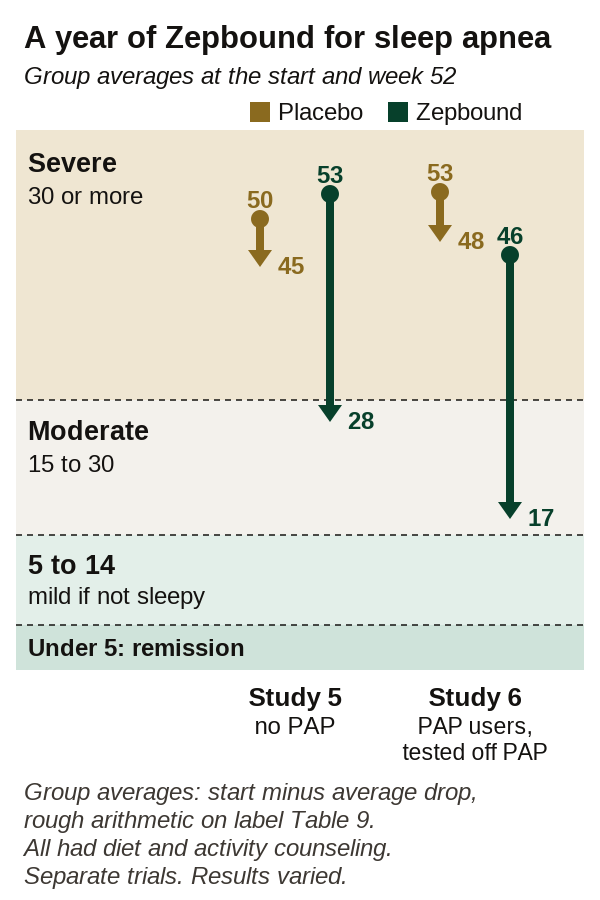
On Zepbound, AHI fell by 50.7% in Study 5 and 58.7% in Study 6 on average, against 3% and 2.5% on placebo. As rough arithmetic on group averages, each Zepbound group’s average drop taken from its average start lands near 28 and 17 events an hour, in the moderate range. Averages hide a wide spread, so that isn’t what happened to a typical person. The label’s own counts: 42.2% and 50.2% on Zepbound reached remission or mild apnea without daytime sleepiness, versus 15.9% and 14.3% on placebo, so about half or more did not.
Group averages only: start minus average drop puts both Zepbound groups near the moderate range, while individual results spread widely.
Does Zepbound work better with CPAP?
These trials can’t show that. People in Study 6 stopped PAP for 7 days before each sleep study, so their AHI was measured without the mask, and the two studies enrolled different people. Study 6’s bigger drop is a cross-trial comparison, not proof that the combination works better.
Does Zepbound replace CPAP?
Not on its own. The label says the sleep apnea trials “did not evaluate the timing or appropriateness of PAP discontinuation” in people who were already using PAP faithfully. People in Study 6 planned to keep using PAP through the trial, pausing only for the week before each sleep study. That pause was a trial step set by the investigators so the test measured breathing without the mask; don’t copy it, and pause CPAP only if your sleep physician tells you to.
No guideline yet says when PAP can stop after weight loss, a 2026 review in Cureus notes, and in studies that withdraw PAP, breathing events return within days. A 2026 meta-analysis of six trials found GLP-1 medicines lowered AHI but did not establish them as substitutes for CPAP. The SURMOUNT-OSA authors add that American Academy of Sleep Medicine guidelines prioritize PAP for people with sleep apnea symptoms.
For some people, enough improvement could change what they need: the trial authors call remission or mild apnea without sleepiness a level where PAP may not be recommended. Only a repeat sleep study can show whether you’re there, and the call belongs to your sleep physician. Don’t stop your CPAP on your own.
The Keep, Add, Retest plan for tirzepatide and sleep apnea
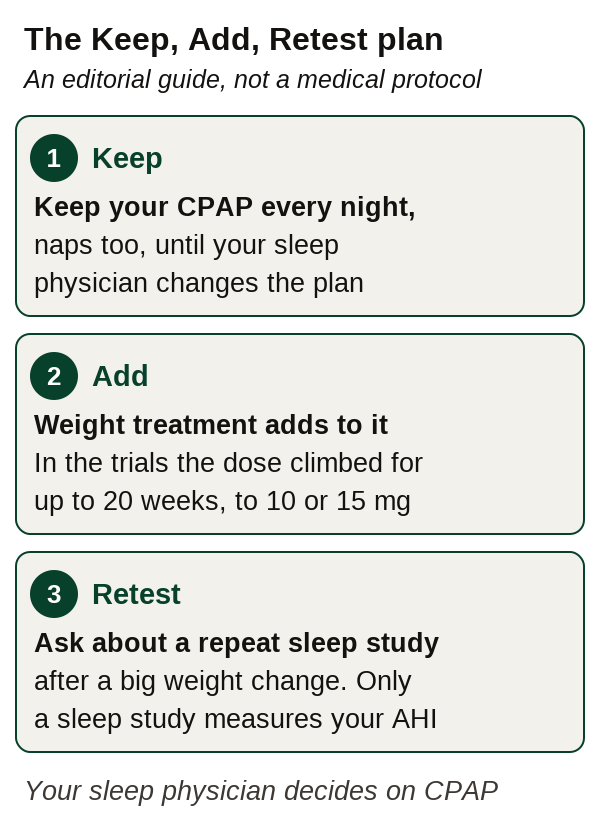
A simple way to hold the pieces together. It’s our editorial guide, not a medical protocol or a MeliOra procedure; your sleep physician sets your sleep apnea plan.
Keep: use your CPAP for all sleep, naps included, as the NHLBI advises, until your sleep physician changes the plan.
Add: weight treatment adds to that care. Tell your sleep physician when you start, and expect a slow climb: the trials took up to 20 weeks to reach 10 or 15 mg.
Retest: ask your sleep physician whether and when to repeat your sleep study. The NHLBI says you may need one if you gain or lose a lot of weight.
Weight treatment is added to sleep apnea care, and a repeat sleep study, not a feeling, shows what changed.
The next-step hurdle: after the weight comes off
Losing weight raises two questions. First, retesting: the NHLBI advises regular checkups to check that treatment is working, and only a sleep study measures AHI. Second, comfort: if your mask or pressure starts to feel wrong, tell your sleep team; the NHLBI notes they can change masks, machines, or pressure settings.
What if you stop tirzepatide?
No trial has measured sleep apnea after stopping tirzepatide. Weight has been measured: in the label’s withdrawal study, where everyone also had diet and activity counseling, people switched to placebo after 36 weeks regained 14% of their body weight over the next year on average, while those who stayed on lost another 5.5%; results varied. Excess weight is a main driver of obstructive sleep apnea, so regain could bring it back. Talk with your prescriber before stopping tirzepatide and with your sleep physician before changing CPAP, and read what happens when you stop a GLP-1.
Sleep apnea and tirzepatide: who needs extra care
Untreated sleep apnea raises the risk of stroke, heart attack, and other serious problems, the NHLBI says, and daytime sleepiness can cause road accidents: don’t drive if you feel tired or sleepy. Loud snoring, pauses in breathing, gasping, or daytime sleepiness are reasons to ask for a sleep study, whether or not you take a weight medicine. In a small trial, short sleep with food freely available raised deep belly fat; see cortisol belly.
Before tirzepatide, tell your prescriber about:
A personal or family history of medullary thyroid carcinoma, or MEN 2: Zepbound isn’t used then (boxed warning)
A past serious allergic reaction to tirzepatide or any Zepbound ingredient: don’t use it
Any planned surgery or sedation: tell the team you have sleep apnea and take tirzepatide, which can let food or liquid reach the lungs under anesthesia
Insulin or a sulfonylurea, which raise the risk of low blood sugar
Pancreas problems, severe stomach problems such as gastroparesis, or diabetic eye disease
Pregnancy plans, and birth control pills, which may work less well for 4 weeks after starting and after each dose increase
Breastfeeding or plans to breastfeed
Any past or current eating disorder
If you could become pregnant: the label says to stop Zepbound once pregnancy is recognized, and ACOG’s October 2026 advisory suggests considering a stop 1 to 2 months before trying to conceive. Our Zepbound and pregnancy guide sets out the timing.
If something feels wrong on tirzepatide, use this table. Its rows come from our tirzepatide side effects guide, with an emergency room option for pancreas and gallbladder signs, a 911 step for severe low blood sugar, and an overdose row added.
Warning sign
What it can mean (Zepbound label and Medication Guide)
Severe stomach pain that will not go away, sometimes reaching the back, with or without vomiting
Possible pancreatitis. Stop tirzepatide and call your provider right away, or go to an emergency room, not urgent care
Upper stomach pain, fever, yellow skin or eyes, or clay-colored stools
Possible gallbladder disease. Inflamed gallbladder was reported in 0.7% on Zepbound vs 0.2% on placebo. Call your provider right away, or go to an emergency room, not urgent care
Vomiting or diarrhea that will not stop, or not being able to keep fluids down
Dehydration, which can lead to kidney injury (0.5% vs 0.2% in the Zepbound trials). Call your provider right away. Severe dehydration is an emergency: go to the emergency room now if you are barely urinating, your urine is very dark, you feel dizzy or lightheaded, or your heart is racing. Call 911 if you become confused or pass out. If you have kidney disease, call at the first sign
Swelling of the face, lips, tongue, or throat, trouble breathing or swallowing, severe rash, or fainting
A serious allergic reaction. Stop tirzepatide and get medical help right away. Call 911 for trouble breathing or swallowing
A lump in the neck, lasting hoarseness, trouble swallowing, or shortness of breath
Possible thyroid tumor, the risk behind the label’s boxed warning
Shakiness, sweating, or confusion, especially with insulin or a sulfonylurea
Low blood sugar
Passing out, a seizure, or being too confused to eat or drink, if you take insulin or a sulfonylurea
Severe low blood sugar. Someone should call 911
Vision changes in someone with type 2 diabetes
Possible worsening of diabetic eye disease
You took too much tirzepatide
Call your provider or Poison Help at 1-800-222-1222, or go to the nearest emergency room right away
New or worsening low mood is worth raising with your doctor, and if you have thoughts of harming yourself, call or text 988 right away.
How MeliOra fits: tirzepatide for weight management
MeliOra Elite Wellness is a physician-led practice in Lutz. Dr. Melanie Espinet, a board-certified Family Medicine physician, prescribes tirzepatide for weight management; ask her which medicine you would receive, and how your weight care and sleep apnea care fit together.
Tirzepatide is $230/month to $320/month. The monthly price includes in-home physician visits, lab work, the medication and supplies, and dose adjustments and check-ins, with no consultation fee. She screens for eating disorders before prescribing, and if support from a dietitian or therapist would help, she discusses it at your consultation.
Dr. Espinet makes house calls across Hillsborough, Pasco, and Pinellas counties with no travel fee, or see her at the Lutz office. At any house call, including ours, ask how the product was stored on the way and what the plan is for a serious reaction. Anywhere in Florida, telehealth weight loss uses video visits, ships the medication to your home, and costs the same each month. When you’re ready, book a weight loss consultation.
Frequently asked questions about Zepbound for sleep apnea
Is Zepbound FDA-approved for sleep apnea?
Yes. Since December 20, 2024, the Zepbound label has included moderate to severe obstructive sleep apnea in adults with obesity, used with a reduced-calorie diet and more physical activity. It doesn’t cover mild or central sleep apnea or children, and the sleep apnea trials excluded people with diabetes.
Does Zepbound replace a CPAP machine?
Not on its own. The label says its sleep apnea trials didn’t evaluate when, or whether, people already using PAP could stop. Some people improve enough that their sleep physician may change the plan, but only a repeat sleep study can show that. Keep using your CPAP until then.
What dose of Zepbound is used for sleep apnea?
The label’s maintenance dose for sleep apnea is 10 mg or 15 mg once a week. Everyone starts at 2.5 mg for 4 weeks, then steps up by 2.5 mg no sooner than every 4 weeks. In the trials, reaching the highest tolerated dose took up to 20 weeks.
How long does Zepbound take to work for sleep apnea?
The trials checked sleep studies at week 20 and week 52, and the label’s main results are at 52 weeks. Results varied from person to person. Don’t judge it by how you feel or change your CPAP early; a repeat sleep study, ordered by your sleep physician, is the real measure.
Can I take Zepbound for mild sleep apnea?
Zepbound’s sleep apnea approval covers moderate to severe obstructive sleep apnea in adults with obesity, which meant an AHI of 15 or more in the trials. Mild sleep apnea isn’t part of it. Some adults qualify under the separate weight management approval; ask your physician which applies to you.
Can MeliOra help if I have sleep apnea?
Dr. Espinet prescribes tirzepatide for weight management, $230/month to $320/month, and can tell you at your visit whether it fits you. Keep your sleep physician in charge of your sleep studies and CPAP, and tell each doctor about every treatment you use.