Cortisol Belly: What Stress Does to Your Waist, and the Signs It’s Not Just Stress
Dr. Melanie Espinet, board-certified Family Medicine physician ·
Stress, short sleep, and sugary drinks are linked to deep belly fat, mostly through how much we eat, so habits come before cortisol pills. Photo: Hanna Pad on Pexels
The short answerCortisol belly is a social media name for belly fat blamed on stress. Studies do link stress, short sleep, and sugary drinks to more deep belly fat, but the links are modest, and in each one, what and how much people ate or drank is part of the story. To lose it, change the whole week (sleep, sugary drinks, exercise, and calories); ab exercises alone don’t spot-reduce it. True cortisol excess, Cushing’s syndrome, most often comes from steroid medicines, is rare otherwise, and brings other signs, such as wide purple stretch marks, a rounder face, easy bruising, and weak muscles.
Below: what research links to stress belly fat, a three-lever audit for your week, the signs of a medical problem, and where physician-led medical weight loss in Lutz fits. This is general information, not medical advice.
What is cortisol belly?
Cortisol belly is a social media term for extra fat around the waist that people blame on cortisol, the stress hormone. It isn’t a medical diagnosis. The medical condition of too much cortisol over a long time is Cushing’s syndrome.
Cortisol itself is essential: the NIDDK says it helps your body respond to stress, maintain blood pressure, regulate blood sugar, and reduce inflammation. The real concern is deep belly fat around the organs. The NHLBI says a waist of more than 35 inches for women or more than 40 inches for men raises the risk of heart disease and type 2 diabetes; measure standing, just above your hipbones, after you breathe out.
In midlife, falling estrogen also moves fat toward the belly; see menopause weight gain.
Is cortisol belly real? What studies show about cortisol and weight gain
Partly. In a 2000 lab study of 59 healthy premenopausal women, those who carried more fat at the waist reported more chronic stress and released more cortisol during their first stress session than women with less waist fat. It was a snapshot, so it can’t show which came first. In 2,527 English adults aged 54 to 87, cortisol measured in hair, a marker of exposure over months, was linked to a larger waist and to obesity that persisted, but the link was weak (a correlation of about 0.08 with waist size).
The marketing is older than TikTok. In 2004 the Federal Trade Commission sued the marketers of CortiSlim, whose ads claimed that elevated cortisol is the underlying cause of weight gain and that the pill caused weight loss “specifically from the abdomen, stomach, and thighs.” The FTC alleged those claims were false or unsubstantiated. The FDA still doesn’t approve supplements before they are sold.
How to get rid of cortisol belly: the Stress, Sleep, Sugar audit
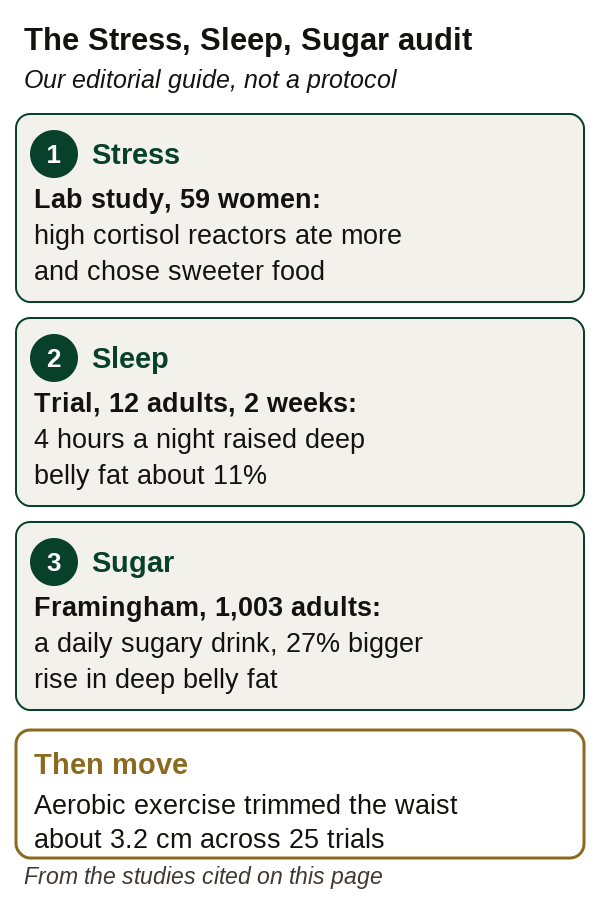
You can’t aim fat loss at your belly. In a 2011 trial of 24 adults, the group assigned to seven abdominal exercises five days a week for six weeks gained core endurance, but their belly fat and waist size didn’t change significantly compared with a group that didn’t exercise. Our audit, an editorial guide built from the studies below and not a MeliOra protocol, checks the three levers research ties to stress belly fat.
1. Stress: watch what it does to eating
In a 2001 lab study of 59 premenopausal women, those whose cortisol rose most under stress ate more calories on the stress day than low reactors did, and ate more sweet food across both days. In one pilot, a stress program alone didn’t shrink waists: in a 2011 NIH and foundation funded trial of 47 women with overweight or obesity, a four-month mindfulness program improved anxiety and eating habits, but on average the groups didn’t differ in abdominal fat, weight, or morning cortisol.
Stress steps from the National Institute of Mental Health
Keep a journal of what triggers your stress
Try a relaxation or mindfulness app, such as deep breathing
Exercise, and eat healthy, regular meals
Stick to a sleep routine
Avoid excess caffeine from coffee or soft drinks
Reach out to friends or family who help you cope well
If stress keeps pushing you toward food, our guide on how to stop food noise has steps for that, starting with an eating disorder check.
2. Sleep: the lever with the clearest test
In a 2022 Mayo Clinic trial supported by the NIH, 12 healthy, nonobese adults, nine of them men, spent two weeks with 4 hours in bed a night and, in a separate stay, two weeks with 9. With short sleep and food freely available, they ate about 308 more calories a day, gained about a pound more, and their deep belly fat area rose about 11%, while it didn’t change with normal sleep. Cortisol didn’t differ between the two conditions, and belly fat kept rising through three days of catch-up sleep. The NHLBI notes that experts recommend 7 to 9 hours a night for adults.
If you snore loudly or wake up gasping, ask a physician about sleep apnea; our page on obstructive sleep apnea and weight explains how the two connect.
3. Sugar: start with the drinks
In the Framingham Heart Study, 1,003 adults had CT scans about six years apart. People who drank at least one sugar-sweetened drink a day had a 27% bigger rise in deep belly fat than people who rarely drank them, even after accounting for weight change; diet soda wasn’t linked. It’s an observational, NHLBI-funded study, so it can’t prove cause, but swapping a daily soda for water is an easy change to test.
Each lever rests on a different kind of study, and what people ate or drank is part of all three findings.
Then the mover: activity and calories
Across 25 trials and 1,686 adults with overweight or obesity, regular aerobic exercise trimmed the waist by about 3.2 cm, a little over an inch, compared with control groups. A 2023 review of 40 trials and 2,190 adults found that both exercise and eating fewer calories reduced deep belly fat compared with controls.
Want a physician to look at the whole picture?Book a visit with Dr. Melanie Espinet, a board-certified family medicine physician, to talk through your weight, sleep, and medications.
Signs your belly fat is not just stress
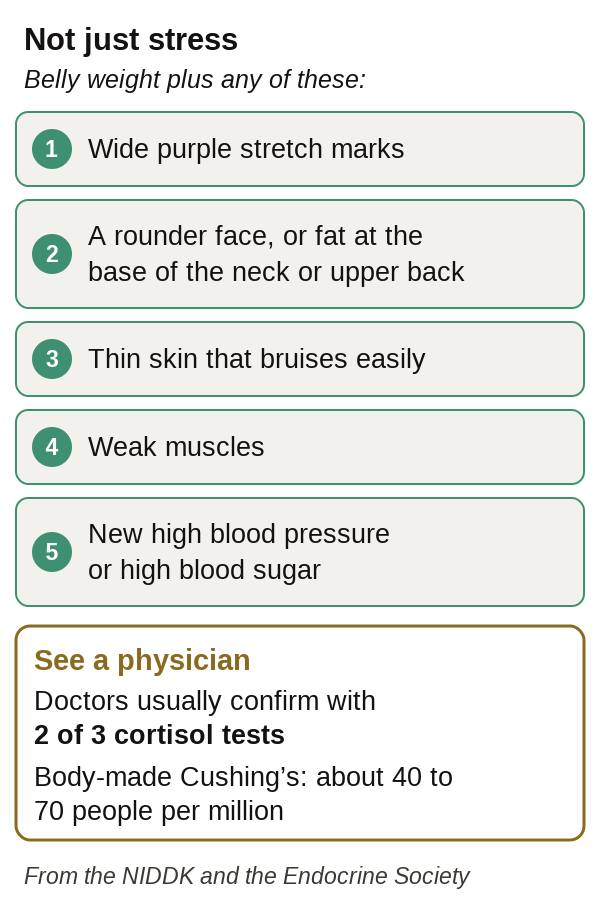
Cushing’s syndrome happens when the body is exposed to too much cortisol for a long time. The most common cause is long-term, high-dose use of cortisol-like medicines called glucocorticoids, such as prednisone, including joint injections. Cushing’s caused by the body itself is rare: estimates range from about 40 to 70 people per million, according to the NIDDK.
The NIDDK and the Endocrine Society list these signs. Any one can have other causes; several together, especially if they’re getting worse over time, is the pattern the Endocrine Society’s guideline says to test:
Weight gain in the belly and upper body, with thin arms and legs
A rounder face, and extra fat at the base of the neck or between the shoulders
Wide purple or purple-red stretch marks on the belly, breasts, hips, or under the arms
Thin, fragile skin that bruises easily
Weak muscles
New or harder-to-control high blood pressure or high blood sugar
In women, extra hair on the face or body, and irregular or stopped periods
Easy bruising, a red, flushed face, weak hip or shoulder muscles, and reddish purple stretch marks wider than 1 cm point toward Cushing’s more than weight gain or blood pressure do, the guideline notes. A rounder face has ordinary causes too; our guide to cortisol face and moon face sorts everyday puffiness from the medical sign.
Belly weight with any of these changes is a reason to see a physician, not to try a stress fix.
How doctors test, and why online cortisol kits can’t settle it
No single test is perfect, so doctors usually confirm Cushing’s syndrome with two of three tests: a 24-hour urine cortisol, a late-night saliva cortisol, or a low-dose dexamethasone suppression test. The Endocrine Society’s guideline advises testing people with several worsening features after ruling out steroid medicines, and sending anyone with an abnormal result to an endocrinologist for a second test. The late-night saliva test is collected at home, but a physician orders it, reads it, and pairs it with a second test. Europe’s endocrinology society goes further for people with excess weight: its 2020 guideline advises cortisol testing only when a physician suspects a hormone disorder.
That’s why a cortisol number from an online kit can’t diagnose or rule out anything by itself. Cortisol normally falls soon after you fall asleep, and in Cushing’s it can rise in cycles, so it may not be high on the day you test. The NIDDK adds that some people have high cortisol on and off without Cushing’s, with depression, anxiety, heavy drinking, high blood sugar, or obesity. Polycystic ovary syndrome can look similar; see PCOS and weight.
If you take a steroid medicine
Don’t stop it on your own because of weight gain. MedlinePlus warns that stopping prednisone suddenly can leave your body without enough natural steroids, and stopping a glucocorticoid you’ve taken for a long time can trigger an adrenal crisis, an emergency. Ask your prescriber about lowering the dose; the NIDDK says doctors taper to the lowest dose that controls the condition.
Who should be careful, and when to see a professional instead
See your primary care physician, not a supplement aisle, if you notice the signs above, if stress or anxiety disrupts daily life or never lets up (the NIMH’s signs that it’s time for help), or if poor sleep has lasted for weeks. Be careful with cortisol supplements: the NCCIH notes rare cases of liver injury linked to ashwagandha, a common pick, and advises avoiding it in pregnancy, while breastfeeding, and with thyroid or autoimmune disorders, and says it may interact with medicines for diabetes, high blood pressure, and thyroid. Our adrenal cocktail guide looks at the viral cortisol drink.
If you notice
What to do
Thoughts of suicide or of harming yourself
Call or text 988 now, or call 911 if you are in danger
Fainting, chest pain, a racing or skipped heartbeat, or confusion, especially after vomiting, using laxatives, or eating very little
Call 911 or go to an emergency room now
Severe weakness, confusion, fainting, vomiting, belly or side pain, or a high fever, especially after suddenly stopping a steroid medicine you took for a long time, or if you have Addison’s disease
Possible adrenal crisis, a medical emergency. Call 911 or go to an emergency room
Belly weight gain with a rounder face, a fatty hump between the shoulders, wide purple stretch marks, easy bruising, or weak muscles
See your physician soon. You may need testing for Cushing’s syndrome and a referral to an endocrinologist
You take prednisone or another steroid medicine and want to stop because of weight gain
Don’t stop on your own. Call your prescriber first
Stress or anxiety that interferes with daily life, makes you avoid things, or never goes away
Talk to your physician or a mental health professional
Bingeing, purging, or restricting, or losing weight on a GLP-1 faster than your prescriber expects (often more than 1 to 2 pounds a week)
See your clinician this week; the 2026 consensus treats fast loss as a possible eating disorder warning sign
How MeliOra fits: a physician for the weight, not a cortisol fix
If the signs above fit, start with your primary care physician, who can refer you to an endocrinologist. If there are no red flags and your weight qualifies for medical treatment, Dr. Melanie Espinet prescribes weekly semaglutide or tirzepatide injections, with sleep, activity, and food still part of the plan. GLP-1 medicines aren’t for everyone: anyone with a personal or family history of medullary thyroid cancer or MEN 2 shouldn’t take them, and our semaglutide side effects guide lists the warning signs. She screens for eating disorders before prescribing, and if support from a dietitian or therapist would help, she discusses it at your consultation.
Semaglutide weight loss starts at $150/month, or $240/month at higher dosing, and tirzepatide weight loss runs $230 to $320/month. Each monthly price includes in-home physician visits, lab work, the medication and supplies, and dose adjustments and check-ins, with no consultation fee.
Dr. Espinet makes house calls across Hillsborough, Pasco, and Pinellas counties with no travel fee, and sees select appointments at the Lutz office. At any house call, including ours, ask how the product was stored on the way and what the plan is for a serious reaction. Anywhere in Florida, telehealth weight loss swaps in-home visits for video visits, ships the medication to your home, and costs the same each month.
Frequently asked questions about cortisol belly
What does a cortisol belly look like?
Online, it usually means a firm, rounded belly with fat that seems stuck despite effort. That shape isn’t specific to cortisol. Belly weight with wide purple stretch marks, a rounder face, a fatty hump between the shoulders, easy bruising, or weak muscles is different, because those can be signs of Cushing’s syndrome and need a physician.
How do you get rid of cortisol belly?
There’s no spot fix: six weeks of ab exercises five days a week didn’t shrink belly fat in one trial. Studies point to the whole week instead: 7 to 9 hours of sleep, fewer sugar-sweetened drinks, regular aerobic exercise, and eating fewer calories. In one pilot, a stress program improved eating habits but didn’t shrink waists on its own.
Is cortisol belly the same as Cushing’s syndrome?
No. Cortisol belly is a social media label for stress-linked belly fat. Cushing’s syndrome is a medical condition caused by too much cortisol over a long time, most often from steroid medicines. When the body makes the excess itself, it is rare, about 40 to 70 people per million, and it brings other signs beyond belly weight.
Can stress alone cause belly fat?
Stress seems to play a part, and eating is part of the story. Women whose cortisol rose most under stress ate more and chose sweeter food in a lab study, and a sleep restriction trial raised deep belly fat with no measured change in cortisol. Studies linking cortisol levels directly to waist size found real but weak associations.
Should I take an at-home cortisol test?
A kit alone can’t diagnose or rule out Cushing’s syndrome. Cortisol changes through the day, can rise in cycles, and runs high at times with depression, anxiety, heavy drinking, or high blood sugar. Doctors confirm Cushing’s with two of three specific tests. If you have the warning signs, see a physician instead.
Does lack of sleep cause belly fat?
In a small 2022 Mayo Clinic trial, two weeks of only 4 hours a night led 12 healthy, nonobese adults to eat about 308 more calories a day, and their deep belly fat rose about 11%. It kept rising through three days of catch-up sleep. The NHLBI notes that experts recommend 7 to 9 hours a night.