The short answerThe adrenal cocktail, also shared as the cortisol cocktail, is orange juice with salt and a potassium source such as coconut water or cream of tartar. We found no study that has tested it. It is pitched for “adrenal fatigue,” which the Endocrine Society says is not a proven medical condition. A glass adds sugar, sodium, and potassium, which matters with kidney disease, diabetes, high blood pressure, or some blood pressure medicines.
If you’re reaching for an adrenal cocktail because you’re worn out every afternoon, the tiredness is real even if the label isn’t. Below: the recipe as it’s shared, what the evidence says, what each ingredient adds, who should skip it, and the signs that point to a medical cause. Our guide to vitamin shots for energy covers the common causes of fatigue and the blood tests that find them. This is general information, not medical advice.
What is an adrenal cocktail?
An adrenal cocktail is a homemade drink of orange juice, a pinch of salt, and a potassium source, usually coconut water or cream of tartar, shared online as support for tired adrenal glands. The cortisol cocktail is the same drink under another name.
The adrenal cocktail recipe, as it’s usually shared
About half a cup of orange juice
About a quarter teaspoon of salt, often sea salt
A potassium source: about half a cup of coconut water, a quarter to half a teaspoon of cream of tartar, or both
Stir and drink
Amounts vary from post to post, so the numbers on this page use those common amounts and USDA nutrient data for table salt. A related salt drink with lemon instead of juice has its own guide: the pink salt trick.
Adrenal cocktail vs cortisol cocktail
The names differ, but the glass is the same. Both are pitched for “adrenal fatigue,” and the Endocrine Society lists the symptoms usually blamed on it: tiredness, trouble falling asleep at night or waking up in the morning, salt and sugar cravings, and needing caffeine to get through the day.
Does the adrenal cocktail work?
We found no study that has tested the drink under either name (PubMed title and abstract search, November 15, 2026). So we found no evidence that it changes cortisol, adrenal gland function, or energy. Each ingredient is ordinary food, so the honest description is a small glass of juice with salt and extra potassium.
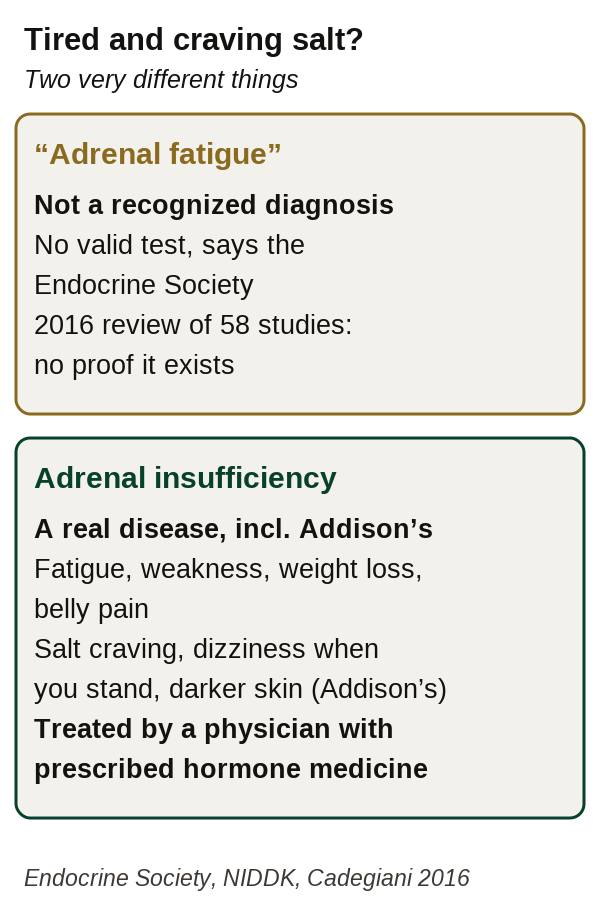
“Adrenal fatigue” isn’t a diagnosis
The Endocrine Society says no scientific proof supports adrenal fatigue as a true medical condition, that no test can detect it, and that the blood and saliva tests sometimes offered for it aren’t backed by good studies. A 2016 systematic review screened 3,470 articles, analyzed 58 studies, found almost systematically conflicting results, and concluded there is no substantiation that adrenal fatigue is a real condition. The review received no funding. The newer papers we found, through November 2026, haven’t changed that.
None of that means your symptoms are imagined. The Endocrine Society’s concern is the opposite: an unproven label can delay the real diagnosis, such as adrenal insufficiency, depression, or obstructive sleep apnea. It also warns that adrenal supplements may not be tested for safety, and that taking adrenal hormones you don’t need can make your own glands stop working, risking a life-threatening adrenal crisis when you stop.
What real adrenal disease looks like
Adrenal insufficiency, including Addison’s disease, is a real condition in which the adrenal glands make too little cortisol. The NIDDK lists long-lasting fatigue, muscle weakness, loss of appetite, weight loss, and belly pain as the most common symptoms, plus nausea, craving salty foods, low blood pressure that drops further when you stand, and, in Addison’s disease, darker skin. Its most common cause overall is stopping steroid medicines suddenly after long use, and doctors treat it with prescribed hormone medicines. The NIDDK’s advice: if you always feel tired, weak, or are losing weight, ask a health care professional whether you might have it.
Salt cravings and tiredness can belong to a real adrenal disease, which needs a physician rather than a drink.
The Pour Test: what each adrenal cocktail ingredient adds
Our editorial tool, not a medical rule: pour the glass one ingredient at a time and ask what it adds and who should ask first. Values are our arithmetic from USDA per-100-gram figures for the common amounts above, rounded.
What it adds, and who should ask first
In the glass
What it adds
Who should ask first
Orange juice, half a cup
About 10 g of sugar, 56 calories, 248 mg of potassium, and 62 mg of vitamin C
Diabetes, or kidney disease
Coconut water, half a cup
About 300 mg of potassium and 126 mg of sodium
Kidney disease, or a medicine that raises potassium
Cream of tartar, a quarter teaspoon (alone or added to coconut water)
About 124 mg of potassium
Kidney disease, or a medicine that raises potassium
Table salt, a quarter teaspoon
About 580 mg of sodium, a quarter of the daily limit
High blood pressure, heart failure, or kidney disease
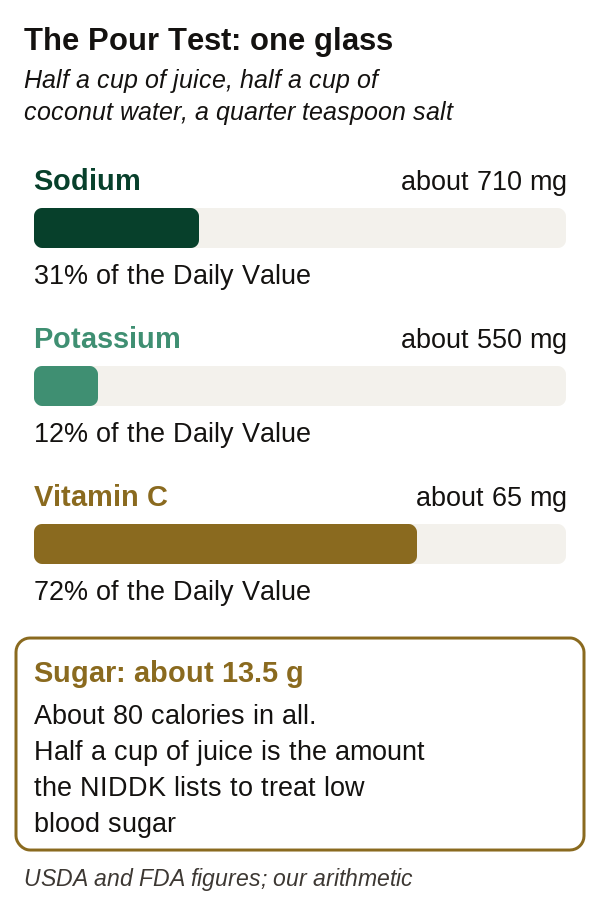
By our arithmetic, made with coconut water, one glass holds about 710 mg of sodium, 31% of the 2,300 mg Daily Value; about 550 mg of potassium, 12% of the 4,700 mg Daily Value; about 65 mg of vitamin C; and about 13.5 g of sugar, at roughly 80 calories. Versions that add a quarter to half a teaspoon of cream of tartar to the coconut water add about 120 to 250 mg more potassium, by our math.
One glass made with coconut water: most of the vitamin C a day calls for, nearly a third of the sodium limit, and fast sugar.
Orange juice: fast sugar
Half a cup of juice is exactly what the NIDDK lists as a quick fix for low blood sugar, because it raises blood sugar fast. If you have diabetes, count it as carbohydrate. If you have kidney disease, the NIDDK says not to use orange juice even to treat a low, because it has a lot of potassium.
Coconut water and cream of tartar: the potassium
Healthy kidneys clear extra potassium. With chronic kidney disease, the NIDDK says, potassium can build up to very high levels and cause heart and muscle problems. MedlinePlus adds Addison’s disease, some blood pressure medicines (ACE inhibitors, ARBs, and spironolactone), and salt substitutes or potassium supplements to the list of causes. Case reports show how it goes wrong: a 78-year-old man with diabetes, heart failure and failing kidneys who took losartan and spironolactone drank 2 to 4 servings of king coconut water almost every day for a week, and his potassium rose high enough to paralyze him before treatment reversed it. Two people who swallowed large amounts of cream of tartar to “clean themselves out” developed life-threatening high potassium; both recovered.
Salt: a quarter of a day’s limit
The FDA says adults should stay under 2,300 mg of sodium a day, about a teaspoon of table salt, while Americans already average about 3,400 mg, and that higher-sodium diets are linked to high blood pressure, a major cause of stroke and heart disease. By our math, a quarter teaspoon adds about 580 mg. The NHLBI’s DASH eating plan notes that 1,500 mg of sodium a day lowers blood pressure even further than 2,300 mg; by our math, one glass made with coconut water holds nearly half of that lower amount.
Tired and not sure why?Book a visit with Dr. Melanie Espinet, a board-certified family medicine physician, to talk through your symptoms, medications, and which blood tests make sense.
Who should skip the adrenal cocktail, and when to see a professional instead
Ask your clinician before drinking one if any of these fit:
Kidney disease of any stage
An ACE inhibitor, an ARB, spironolactone, or another medicine that raises potassium
A salt substitute or potassium supplement you already use
Addison’s disease or adrenal insufficiency: follow the plan your doctor set
High blood pressure or heart failure
Diabetes: the juice counts as fast carbohydrate
See a physician, not a recipe, if tiredness lasts for weeks, or comes with weight loss you didn’t plan, salt cravings, dizziness when you stand, or darker skin. Ongoing fatigue has many treatable causes, from low iron to thyroid problems; if numbness or tingling is part of it, read B12 deficiency symptoms. For stress-related weight, our pair guide on cortisol belly covers the signs of too much cortisol.
After the drink: when to get help now
If you notice
What to do
Severe weakness, confusion, fainting, vomiting, belly or side pain, or a high fever, especially after suddenly stopping a steroid medicine you took for a long time, or if you have Addison’s disease
Possible adrenal crisis, a medical emergency. Call 911 or go to an emergency room
Chest pain, trouble breathing, a slow, weak, or irregular pulse, or sudden collapse, especially with kidney disease or a medicine that raises potassium
Possible dangerously high potassium. Call 911
Palpitations, weakness, or vomiting after potassium-rich drinks, cream of tartar, or a salt substitute
Contact your provider right away; high potassium often causes no symptoms at all
Sudden numbness or weakness of the face, arm, or leg, especially on one side, sudden confusion or trouble speaking, sudden trouble seeing, sudden trouble walking or loss of balance, or a sudden severe headache with no known cause
Possible stroke. Call 911 right away, and don’t drive yourself
With heart failure: weight up more than 2 to 3 pounds in a day or 5 pounds in a week, new swelling in your feet, ankles, or legs, or shortness of breath at rest or lying down
Fluid may be building up. Contact your heart care team today
Tiredness that won’t lift, with weight loss, salt cravings, dizziness when you stand, or darker skin
See your physician soon and ask about adrenal insufficiency
Thoughts of suicide or of harming yourself
Call or text 988 now, or call 911 if you are in danger
After a wellness shot
If you get one of the wellness shots below, these rows match the after-shot guidance on our amino acid injections guide.
After any shot, if you notice
What to do
Chest pain, trouble breathing or swallowing, wheezing, or swelling of the face, eyes, lips, tongue, or throat
Call 911. These can be signs of a severe allergic reaction
Fainting or nearly fainting, confusion, or cold, clammy skin
Call 911
Hives, itching, or a rash with no trouble breathing
A possible allergic reaction. Get medical help right away, and call 911 if it gets worse
Fever, chills, shaking, or vomiting
Call your physician right away; go to the ER if you feel faint or very ill
A shot spot that gets more painful, swollen, red, or warm over the next few days, or drains pus
Call your physician today. These can be signs of a skin infection
Flushing, dizziness, nausea, or a racing heart within minutes to an hour of a shot, especially with itching or hives
This could be a severe allergic reaction. Call 911
Mild nausea or dizziness hours later that doesn’t pass, with no other signs
Contact your physician the same day
How MeliOra fits: wellness shots without adrenal claims
MeliOra doesn’t sell the drink, and we don’t claim any shot supports your adrenal glands, lowers cortisol, treats fatigue, or prevents or treats any illness. Each wellness shot is $30, and the $80 Wellness Boost Package is exactly four shots: Lean Ease, NAD+, Revita Shot, and BLean. Vitamin B12 is also available as a single shot. Research ties extra B12 to more energy only in people whose B12 was low, which a blood test can show. See the full wellness shots menu in Lutz.
Visits can be at your home, your office, or the Lutz office, with no travel fee anywhere in Hillsborough, Pasco, and Pinellas counties. At any house call, including ours, ask how the product was stored on the way and what the plan is for a serious reaction. Tell Dr. Espinet about kidney disease, blood pressure medicines, diabetes, and any adrenal or steroid history.
Frequently asked questions about the adrenal cocktail
What is in an adrenal cocktail?
Most versions mix about half a cup of orange juice, a quarter teaspoon of salt, and a potassium source: about half a cup of coconut water, some cream of tartar, or both. By our math, made with coconut water, a glass holds about 13.5 g of sugar, 710 mg of sodium, and 550 mg of potassium.
Does the adrenal cocktail work?
We found no study that has tested it. We found no evidence it changes cortisol, adrenal function, or energy. It is a small glass of juice, salt, and potassium. If you enjoy it and none of the cautions apply, it is a food choice. If you are tired for weeks, a physician visit is the better next step.
Is the cortisol cocktail the same as the adrenal cocktail?
Yes. Posts use both names for the same basic mix of orange juice, salt, and coconut water or cream of tartar. We found no study of the drink under either name, and neither is a treatment for cortisol or the adrenal glands. The sugar, sodium, and potassium cautions on this page apply to both versions.
Is adrenal fatigue real?
Not as a diagnosis. The Endocrine Society says no scientific proof supports it and no test can detect it, and a 2016 review of 58 studies found no substantiation. The tiredness behind it is real, though, and can come from adrenal insufficiency, depression, sleep apnea, low iron, thyroid problems, and other treatable causes.
Who should not drink an adrenal cocktail?
Ask your clinician first if you have kidney disease, high blood pressure, heart failure, diabetes, or Addison’s disease, or take an ACE inhibitor, an ARB, spironolactone, a salt substitute, or potassium supplements. Never swallow large amounts of cream of tartar: case reports describe life-threatening high potassium from it.
Does the cortisol cocktail lower cortisol?
No study shows that it does; we found no study that has tested the drink at all. Your adrenal glands make cortisol on signals from the brain and pituitary gland, not from juice or salt. If you worry about too much cortisol, watch for real signs such as wide purple stretch marks or a rounder face, and see a physician.