Creatine for Women: What the Trials Show for Strength, Menopause, and GLP-1s
Dr. Melanie Espinet, board-certified Family Medicine physician ·
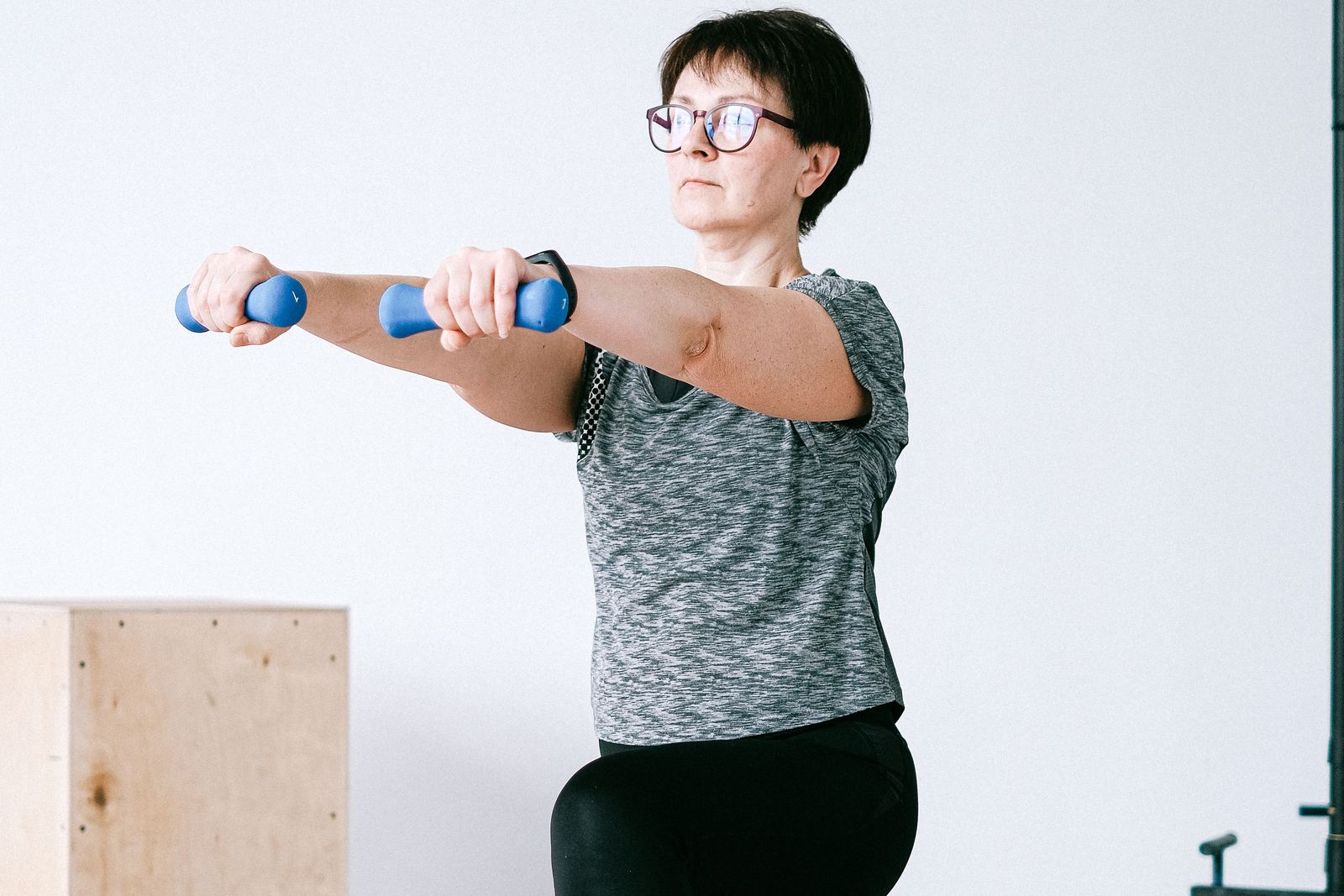
In trials, creatine helped women mainly when it was paired with strength training, with small gains in lean mass and leg strength. Photo: Anna Shvets on Pexels
The short answerCreatine for women works mainly as a partner to strength training. In postmenopausal women, trials found small gains in lean mass and leg strength when 5 grams a day or more was paired with resistance training, but no bone density benefit. Expect about 0.5 to 1 kg of water weight early. No trial has tested it on a GLP-1 yet.
What is creatine, and does it work for women?
Creatine is a compound your body makes and gets from meat and seafood. About 95% of it sits in muscle, where it fuels short, hard efforts like lifting or sprinting. Creatine supplements raise those muscle stores, and most trials used plain creatine monohydrate.
It works in women, with caveats. A 2021 review notes women may start with higher muscle creatine, which could blunt the response, and not every trial in young women found a benefit. A 2025 review found no reason to dose women differently from men. Know who is talking: several authors of these reviews advise AlzChem, a creatine maker, and the society behind them takes creatine company sponsorship.
Creatine has moved beyond the weight room: a 2025 review reports creatine sales rose 120% from 2021 to 2022, with women now major buyers. Below, each claim is sorted by what trials in women found. MeliOra doesn’t offer creatine, and this page isn’t a recommendation to take it; our focus is physician-led weight loss. This is general information, not medical advice.
Creatine benefits for women: what the trials found
Creatine and menopause: muscle yes, bone density no
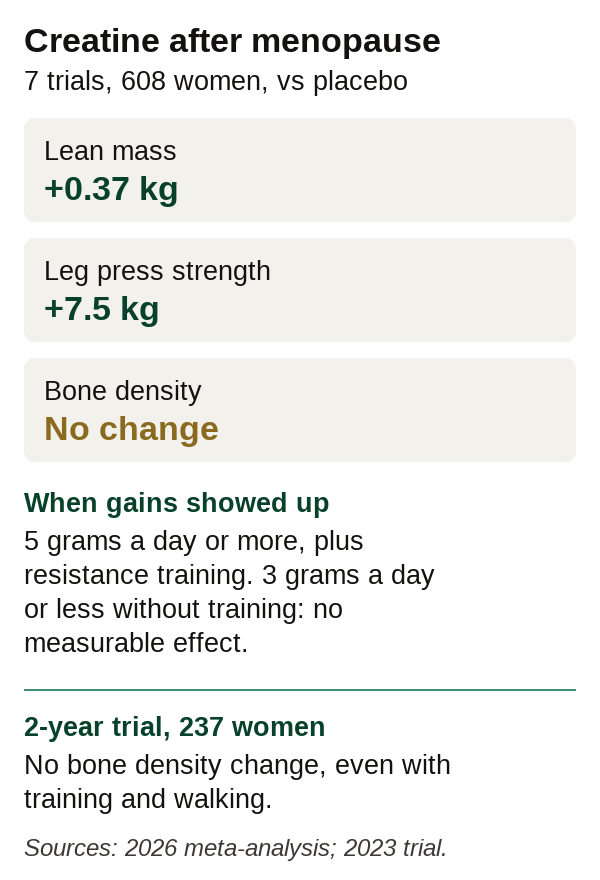
The best data come from women after menopause. A 2026 meta-analysis of 7 randomized trials in 608 postmenopausal women, average age about 62, found creatine added 0.37 kg of lean mass and 7.5 kg on the leg press compared with placebo, pooled across the trials that measured each. Benefits showed up when women took 5 grams a day or more and did resistance training; trials of 3 grams a day or less without training found no measurable effect. Bone density didn’t change. The review had no outside funding, though AlzChem paid part of its publication fee and one author chairs an AlzChem-supported creatine board.
The largest single trial, funded by the Canadian Institutes of Health Research with creatine supplied by AlzChem, gave 237 postmenopausal women creatine or placebo for 2 years alongside resistance training and walking. Creatine didn’t change bone density or bench press and hack squat strength, though a measure of hip bone shape linked to strength held up better, women walked 80 meters slightly faster, and, among those who completed the program, gained a little more lean mass. Muscle loss in midlife is real; our guide to menopause weight gain explains why.
In postmenopausal women, creatine’s gains were small and showed up only with resistance training; bone density didn’t move.
Perimenopause, mood, and the brain: early days
No trial has studied creatine for muscle or bone during the menopause transition itself, the 2026 meta-analysis found. One 8-week trial of 36 perimenopausal and postmenopausal women, from the same research group, tested creatine hydrochloride, a different form, on thinking speed and mood; it’s too small and short to guide anyone. A 2026 trial randomized 51 perimenopausal women to creatine monohydrate or placebo during 6 weeks of strength training, or to a no-training group: thinking speed improved with no difference between groups, and sleep consistency looked better on creatine only in an exploratory analysis. Its senior author advises creatine makers, and a coauthor works for the sleep tracker company whose data were used. Reviews call mood and sleep effects promising, but the studies are small.
Does creatine cause hair loss?
The worry traces to a 2009 study in 20 rugby players whose DHT, a hormone tied to some hair loss, rose on creatine. The first trial to measure hair directly randomized 45 resistance-trained men to 5 grams a day or placebo for 12 weeks and found no change in the hormone DHT or in hair density or thickness. No women were studied, and several authors advise creatine brands. If you’re on a GLP-1 and losing hair, see GLP-1 hair loss.
The Scale, Strength, Safety check before you try creatine
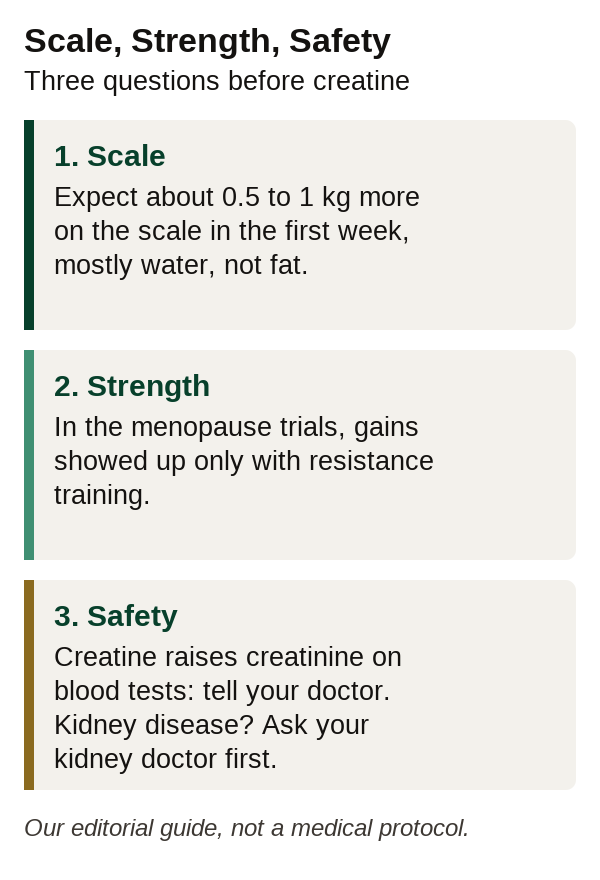
Three questions sort most of the creatine for women hype. It’s our editorial guide, built from the sources on this page, not a medical protocol or a MeliOra procedure.
Scale: can you accept about 0.5 to 1 kg of water weight in the first weeks?
Strength: will you do resistance training at least a few times a week?
Safety: are your kidneys healthy, and will you tell your doctor before your next blood test?
Three questions to answer before trying creatine, whatever your age.
Scale: expect water weight first
Weight gain is the only side effect consistently reported, the 2017 position stand says, with about 0.5 to 1 liter of fluid held in the first days of a high-dose start. The 2026 meta-analysis puts it at about 0.5 to 1 kg, mostly water, in the first week. A high-dose start isn’t required: a 2025 review says 5 grams a day reaches the same muscle stores in 3 to 4 weeks. If you track weight on a GLP-1, a jump in week one may be water, not fat. That water is held inside muscle; in controlled studies, creatine didn’t cause more stomach upset than placebo, the 2017 position stand says, though its preparation was supported by a supplement industry group. Stomach upset after starting any supplement is a reason to stop and call your physician.
Strength: no training, no benefit
In the menopause trials, gains showed up only alongside resistance training, and a 2021 review says creatine alone is unlikely to build much strength. Track what you can lift, carry, or how many times you can rise from a chair, not the scale. Our guide to muscle loss on a GLP-1 has the training and protein basics.
Safety: kidneys, lab tests, and what’s in the tub
In healthy people, recommended doses haven’t harmed the kidneys, and a 2025 meta-analysis found a small rise in creatinine, a blood marker, with no change in filtration rate. That rise can make a kidney test look worse, so tell whoever orders your labs. The safety studies were in mostly healthy people, so if you have kidney disease, ask your kidney doctor first.
The FDA doesn’t approve supplements before they’re sold and can’t test every product. Other forms of creatine haven’t been shown to work better than monohydrate, and NCCIH notes that a maker’s own “verified” or “certified” wording isn’t proof of quality. Independent programs such as NSF Certified for Sport test some products for contaminants and label accuracy, a 2025 review by authors with supplement industry ties notes; a seal says nothing about whether a product works.
No randomized trial has reported on creatine during GLP-1 weight loss, a 2026 paper in Clinical Nutrition notes; its lead author advises AlzChem and holds creatine patents, and he calls the idea a hypothesis. A pilot trial at the University of Saskatchewan is recruiting 40 adults on GLP-1 medicines for 12 weeks of resistance training with creatine or placebo, measuring how often they can rise from a chair in 30 seconds. Its first results are expected after May 2027, as of November 15, 2026.
A 2025 review that lists creatine among supplements for GLP-1 users was written by four employees of GNC, a supplement retailer. What experts already recommend on a GLP-1 is strength training at least three times a week and enough protein; see what to eat on semaglutide. Vomiting or diarrhea on a GLP-1 can dehydrate you, so drink fluids, and tell your prescriber about any supplement you take.
Who should skip creatine, and when to see a professional instead
Talk to your physician first, or skip creatine, if you:
Have kidney disease or reduced kidney function: the safety studies were in mostly healthy people
Are pregnant or breastfeeding: a 2021 review found no human studies of creatine in pregnancy
Take medicines your doctor tracks with kidney blood tests
Have had an allergic reaction to a supplement
See a physician instead of reaching for a supplement if you’re losing strength, falling, losing weight without trying, or worried about your bones. Sorted from most to least urgent, these signs need attention whether or not you take creatine; the dehydration row matches our GLP-1 side effects guide:
Warning sign
What to do
Chest pain, trouble breathing or swallowing, wheezing, or swelling of the face, eyes, lips, tongue, or throat
Call 911. These can be signs of a severe allergic reaction
Vomiting or diarrhea that will not stop, or not being able to keep fluids down
Dehydration, which can lead to kidney injury. Call your prescriber right away. Go to the emergency room now if you can’t keep fluids down, are barely urinating, your urine is very dark, you feel dizzy or lightheaded, or your heart is racing. Call 911 if you become confused or faint. If you have kidney disease, call at the first sign
Dark, red, or cola-colored urine with muscle aching, stiffness, or weakness, especially after hard exercise
Contact your physician right away. These can be signs of rhabdomyolysis, muscle breakdown that can harm the kidneys
Peeing much less than usual or not at all, or new swelling in your legs, ankles, or feet
Contact your physician right away. If you are barely urinating or not urinating at all, go to the emergency room now. These can be signs of a kidney problem
Stomach upset, cramping, or diarrhea after starting a supplement
Stop the supplement and contact your physician
A blood test shows higher creatinine or lower kidney function
Tell the clinician who ordered it that you take creatine, which can raise creatinine without kidney harm
How MeliOra fits
MeliOra doesn’t offer creatine. Dr. Melanie Espinet, a board-certified family medicine physician in Lutz, prescribes weekly semaglutide or tirzepatide for medical weight loss. She screens for eating disorders before prescribing, and if support from a dietitian or therapist would help, she discusses it at your consultation.
She makes house calls across Hillsborough, Pasco, and Pinellas counties with no travel fee. At any house call, including ours, ask how the product was stored on the way and what the plan is for a serious reaction.
Semaglutide starts at $150/month and tirzepatide runs $230 to $320/month, including in-home physician visits, lab work, the medication and supplies, and dose adjustments and check-ins, with no consultation fee. Anywhere in Florida, telehealth weight loss replaces in-home visits with video visits at the same monthly price.
Frequently asked questions about creatine for women
Should women take creatine?
It depends on your goal. Trials in women show small gains in lean mass and strength when creatine is paired with resistance training, and little benefit without it. It didn’t improve bone density after menopause. If you have kidney disease or are pregnant, talk to your physician first. MeliOra doesn’t offer creatine.
How much creatine do women take in studies?
Trials in postmenopausal women used 1 to 5 grams of creatine monohydrate a day or a weight-based dose, sometimes after a short higher-dose start. Benefits showed up at 5 grams a day or more with resistance training. A 2025 review found no reason to dose women differently from men. This isn’t a personal recommendation.
Does creatine make women gain weight?
Often a little at first. The 2017 position stand calls weight gain the only consistently reported side effect, mostly water held in muscle, and a 2026 review puts it at about 0.5 to 1 kg in the first week. Over months, weight changes in menopause trials tracked lean mass, not fat.
Is creatine good for menopause?
For muscle, modestly. A 2026 meta-analysis of 7 trials in 608 postmenopausal women found small gains in lean mass and leg strength with resistance training. Bone density didn’t change, including in a 2-year trial of 237 women. No trial has studied the menopause transition itself for muscle.
Can you take creatine on a GLP-1?
No randomized trial has tested it yet. A 40-person pilot pairing creatine with strength training on GLP-1 medicines is recruiting, with results expected after May 2027. Strength training and enough protein are what experts already recommend. Tell your prescriber about any supplement, and watch for dehydration.
Is creatine bad for your kidneys?
Not at recommended doses in healthy people, according to reviews of the trials. Creatine can raise creatinine, a blood marker, which can make a kidney test look worse even when your kidneys are fine, so tell your doctor. If you already have kidney disease, ask your kidney doctor before taking it.