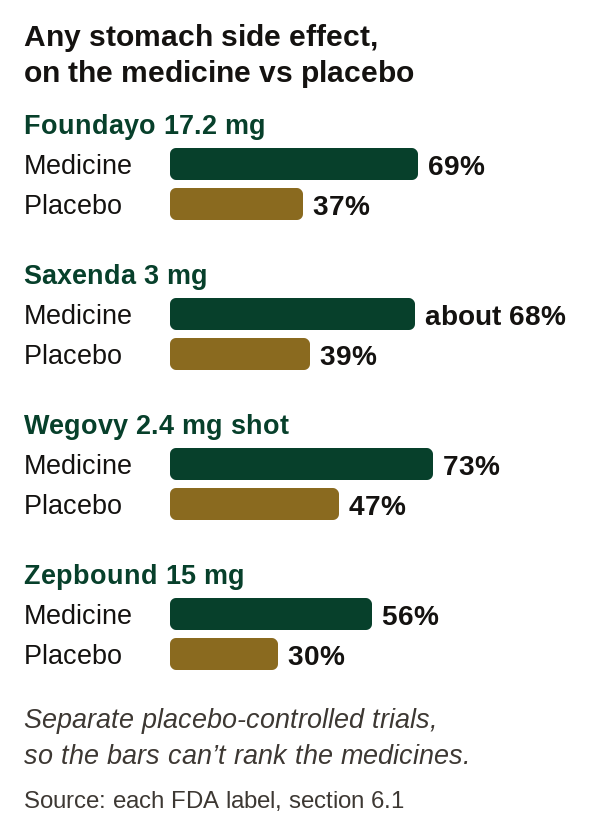
The short answerThe most common GLP-1 side effects are nausea, diarrhea, vomiting, and constipation. On four FDA weight-loss labels, 56% to 73% of people on the medicine reported a stomach side effect, but so did 30% to 47% on placebo. Most started while the dose was going up and eased with time. Trouble breathing needs 911 or an emergency room, and vomiting that stops you keeping fluids down needs the emergency room now. Severe belly pain that won’t go away needs a call to your prescriber right away, or an emergency room, not urgent care, if you can’t reach them.
GLP-1 side effects follow one pattern across the class. This guide reads the four current FDA weight-management labels side by side: Wegovy (semaglutide, June 2026), Zepbound (tirzepatide, August 2026), Saxenda (liraglutide, February 2026), and Foundayo (orforglipron, July 2026). New to the class? Start with what GLP-1 is.
For one drug in depth, see semaglutide side effects or tirzepatide side effects. For Lilly’s daily pill, see orforglipron side effects. Dr. Melanie Espinet prescribes weekly semaglutide or tirzepatide injections for medical weight loss; MeliOra doesn’t offer Saxenda, Foundayo, or any GLP-1 pill, and label facts describe the brand-name products. Severe pain or trouble breathing now? Warning signs are below. This is general information, not medical advice.
The most common GLP-1 side effects, label by label
The most common GLP-1 side effects are digestive, and every label measures them the same way: the share of people reporting each one on the medicine and on placebo in its main pooled weight-loss trials. Below is the highest dose in each pool: Foundayo 17.2 mg daily, Saxenda 3 mg daily, Wegovy 2.4 mg weekly (its newer 7.2 mg dose was tested separately), and Zepbound 15 mg weekly.
Medicine vs placebo, on each label
Side effect
Foundayo
Saxenda
Wegovy
Zepbound
Nausea
35% vs 10%
39.3% vs 13.8%
44% vs 16%
28% vs 8%
Diarrhea
25% vs 11%
20.9% vs 9.9%
30% vs 16%
23% vs 8%
Vomiting
24% vs 4%
15.7% vs 3.9%
24% vs 6%
13% vs 2%
Constipation
24% vs 9%
19.4% vs 8.5%
24% vs 11%
11% vs 5%
Any stomach side effect
69% vs 37%
About 68% vs 39%
73% vs 47%
56% vs 30%
Stopped because of any side effect
10% vs 3%
9.8% vs 4.3%
6.8% vs 3.2%
6.7% vs 3.4%
Read the placebo numbers first: 30% to 47% of people taking no medicine reported a stomach side effect, so not every queasy day is the drug. Everyone in these trials also got reduced-calorie diet and activity counseling, and results varied from person to person. The labels warn that one drug’s trial rates can’t be compared with another’s, so this table can’t rank the four.
On every label, a large share of the placebo group also reported a stomach side effect.
Other side effects on the labels
The labels also list tiredness, dizziness, burping, heartburn, bloating, and gas; Wegovy lists headache (14% vs 10%), but Zepbound’s lists it only as a low blood sugar sign. Shots can cause injection site redness or itching. Tingling or burning skin reached 22% at Wegovy’s newer 7.2 mg dose, against 6% on 2.4 mg and 0.3% on placebo.
Hair loss was more common on the medicine in the Wegovy, Zepbound, and Foundayo trials; see GLP-1 hair loss. Weight loss itself can also bring muscle loss on a GLP-1 and Ozempic face.
GLP-1 nausea and constipation: when they start and how long they last
GLP-1 nausea usually starts early and fades, while constipation can linger. The Wegovy label says stomach side effects were reported most often during dose increases, the Zepbound and Foundayo labels say most nausea, vomiting, and diarrhea happened then and decreased over time, and the Saxenda label says nausea declined as treatment continued. That’s why every label starts low and raises the dose in steps.
A 2022 expert consensus on GLP-1 stomach side effects, funded by Novo Nordisk, adds detail from semaglutide trials. Nausea is most common in the first 4 to 5 weeks and usually clears 8 days or less after it begins. Constipation can start any time in the first 16 weeks and lasted a median of 47 days in people with obesity.
What helps GLP-1 nausea
Eat smaller meals slowly, and stop at the first sense of fullness.
Go easy on large, high-fat, or late meals.
Sip fluids between meals rather than drinking a lot with them.
Try cool or room-temperature foods, which many people find less nauseating than hot, strongly scented dishes.
Cut back on fizzy drinks, alcohol, and sugar alcohols such as sorbitol. Sugarless gum can ease a dry mouth (NIDCR), but chewing gum adds swallowed air and the sugar alcohols in sugar-free gum can add gas (NIDDK), so if burping or bloating is the bigger problem, cut back on gum and sip water instead.
A 2026 nutrition review offers these as practical suggestions, not proven treatments; symptoms that limit eating or drinking need a medical check.
What helps GLP-1 constipation
Drink fluids steadily through the day, since less fluid slows things further.
Add fiber gradually; a sudden jump can worsen bloating and cramps.
Stay active, and ask your prescriber before starting a laxative.
All four labels also list reports from use after approval of severe constipation, including fecal impaction, and intestinal blockage. Call your prescriber promptly if constipation comes with worsening belly pain, swelling, or vomiting.
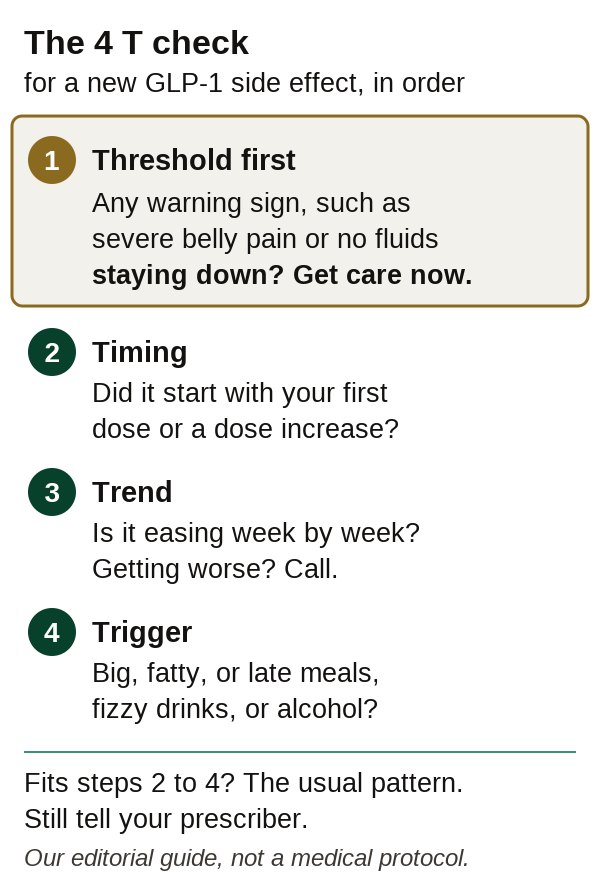
The 4 T check: a usual side effect or a warning sign?
Ask these four questions, in order, when a new symptom shows up. It’s our editorial guide built from the labels and studies above, not a medical protocol.
Threshold first: does it match a warning sign in the table below, such as severe belly pain that won’t go away, vomiting that stops you keeping fluids down, yellow skin, or trouble breathing? If so, stop here and do what that row says.
Timing: did it start within days of your first dose or a dose increase? That’s when the Wegovy, Zepbound, and Foundayo labels say stomach side effects were most common.
Trend: is it easing week by week? Nausea usually clears within about 8 days; constipation can last weeks. Getting worse is a reason to call.
Trigger: does it follow a big, fatty, or late meal, a fizzy drink, or alcohol? Those you can change.
A symptom that fits steps 2 to 4 is the usual pattern; still mention it, because your prescriber can hold or slow the next increase. Anything that doesn’t fit, call your prescriber now.
Ask the threshold question first, so a warning sign never waits behind the other three.
GLP-1 side effects in women
Women made up 59% to 71% of these trials, so the label rates largely describe women. The labels don’t split stomach side effects by sex, and a 2026 review says findings on sex differences aren’t fully consistent. A few differences are clear:
Hair loss: reported by 7.1% of women vs 0.5% of men on Zepbound, 7% vs 0.9% on Foundayo, and 4% vs 0.9% on Wegovy 2.4 mg. The labels tie it to weight loss.
Birth control pills: the Zepbound and Foundayo labels say to switch to a non-oral method or add a barrier method for 4 weeks (Zepbound) or 30 days (Foundayo) after starting and after each dose increase. The Wegovy and Saxenda labels have no such rule.
Pregnancy: for weight loss, all four labels say to stop when a pregnancy is recognized. The Wegovy label also says to stop at least 2 months before a planned pregnancy, and ACOG’s October 2026 advisory suggests considering a stop 1 to 2 months before trying to conceive.
Breastfeeding: ACOG advises against GLP-1s while breastfeeding a preterm baby or a newborn, and against pill forms.
Bones: in Wegovy’s heart outcomes trial, hip and pelvis fractures were more common on the medicine in women, 1% vs 0.2% on placebo.
Serious GLP-1 side effects and who should be careful
All four labels carry a boxed warning about thyroid C-cell tumors seen in rodents with GLP-1 drugs; whether they happen in people isn’t known. None should be used with a personal or family history of medullary thyroid carcinoma (MTC), with MEN 2, or after a serious allergic reaction to the drug.
Tell your prescriber first about past pancreatitis, gallbladder or kidney disease, diabetic eye disease, or severe gastroparesis, and about insulin or a sulfonylurea, which raise the risk of low blood sugar. Before surgery or sedation, tell the team you take a GLP-1: the labels report rare cases of stomach contents reaching the lungs. A 2026 expert consensus says to generally avoid these medicines during an active eating disorder.
The Wegovy, Zepbound, and Saxenda labels removed their warning on suicidal behavior and thoughts in early 2026; new or worsening low mood still deserves a call. On November 9, 2026, the FDA said it is requiring every GLP-1 label to add a warning about NAION, a rare optic nerve problem that can cause sudden, painless vision loss in one eye, sometimes permanently. The four labels above predate that change; European regulators already list NAION as a very rare side effect of semaglutide. Our guide to Ozempic vision loss and NAION covers the numbers and when to call 911.
When to get care: GLP-1 warning signs
Sorted from most to least urgent; the rows match our semaglutide and tirzepatide guides.
Warning sign
What to do
Swelling of the face, lips, tongue, or throat, trouble breathing or swallowing, severe rash or itching, fainting or dizziness, or a very rapid heartbeat
A serious allergic reaction. Stop the medication and call 911 or go to an emergency room
Low blood sugar you can’t treat yourself, passing out, or a seizure, if you take insulin or a sulfonylurea
Someone should call 911
Thoughts of harming yourself
Call or text 988, the Suicide and Crisis Lifeline, right away. If you might act on them or are in immediate danger, call 911
Sudden vision loss in one eye (often noticed on waking), blurred or missing patches of vision, faded or distorted colors, or eyesight that gets worse quickly
Call 911 or go to an emergency room now, and don’t drive yourself. The FDA warns GLP-1s may raise the risk of NAION, a rare optic nerve problem
Severe stomach pain that will not go away, sometimes reaching the back, with or without vomiting
Possible pancreatitis. Stop the medication and call your prescriber right away; if you can’t reach them quickly, go to an emergency room, not urgent care
Pain in the upper stomach, fever, yellow skin or eyes, or clay-colored stools
Possible gallbladder problems. Call your prescriber right away; if you can’t reach them quickly, go to an emergency room, not urgent care
Vomiting or diarrhea that will not stop, or not being able to keep fluids down
Dehydration, which can lead to kidney injury. Call your prescriber right away. Go to the emergency room now if you can’t keep fluids down, are barely urinating, your urine is very dark, you feel dizzy or lightheaded, or your heart is racing. Call 911 if you become confused or faint. If you have kidney disease, call at the first sign
You took too much, or took a dose twice
Call your prescriber or Poison Help at 1-800-222-1222, or go to an emergency room right away
Shakiness, sweating, dizziness, confusion or drowsiness, headache, blurred vision, slurred speech, hunger, or a fast heartbeat
Possible low blood sugar, more likely with insulin or a sulfonylurea. Treat it as your prescriber taught you, then call them
Heart racing or pounding at rest for several minutes
Increased heart rate, which the Wegovy and Saxenda labels say to report. Call your prescriber
A lump or swelling in the neck, hoarseness, trouble swallowing, or shortness of breath
Possible thyroid tumor, the risk behind the labels’ boxed warning. Call your prescriber
Vision changes in someone with type 2 diabetes
Possible worsening of diabetic eye disease. Tell your prescriber
No table covers everything. If something feels wrong, call your prescriber, and tell any emergency team which GLP-1 you take and when you last took it.
The next-step hurdle: when side effects make you want to stop
Stomach side effects were the most common reason people stopped in every label’s trials, yet most people didn’t stop: 6.7% to 10% quit for any side effect at the doses in the table, against 3% to 4.3% on placebo. The labels leave room before that point. Wegovy’s suggests delaying a dose increase by 4 weeks if a step isn’t tolerated, and Zepbound’s suggests a lower maintenance dose.
Stopping doesn’t clear the medicine overnight: the Wegovy label says semaglutide stays in circulation about 5 to 7 weeks after the last dose. See how long tirzepatide stays in your system. If one medicine keeps disagreeing with you, ask about switching rather than adding a second GLP-1, which every label advises against.
How MeliOra fits: GLP-1 care with a physician watching side effects
Dr. Melanie Espinet, a board-certified family medicine physician in Lutz, prescribes weekly semaglutide or tirzepatide injections. She screens for eating disorders before prescribing, and if support from a dietitian or therapist would help, she discusses it at your consultation.
Semaglutide weight loss starts at $150/month, or $240/month at higher dosing, and tirzepatide weight loss runs $230 to $320/month. Each price includes in-home physician visits, lab work, the medication and supplies, and dose adjustments and check-ins, with no consultation fee.
Dr. Espinet makes house calls across Hillsborough, Pasco, and Pinellas counties with no travel fee, and sees select appointments at the Lutz office. At any house call, including ours, ask how the product was stored on the way and what the plan is for a serious reaction. Anywhere in Florida, you can choose telehealth weight loss instead: video visits replace in-home visits, the medication ships to your home, and the monthly price is the same.
Want a physician watching for side effects from your first dose?Book a weight loss consultation with Dr. Espinet. She evaluates you before anything is prescribed.
Frequently asked questions about GLP-1 side effects
What are the most common side effects of GLP-1 medications?
Nausea, diarrhea, vomiting, and constipation are the most common GLP-1 side effects. On four FDA weight-loss labels, nausea was reported by 28% to 44% of people at the doses in the table, against 8% to 16% on placebo. Tiredness, burping, heartburn, and bloating are also common, and headache is on some labels.
How long do GLP-1 side effects last?
Stomach side effects are usually worst in the first weeks and after each dose increase, then ease. A 2022 expert consensus, funded by Novo Nordisk, says nausea usually clears within 8 days of when it begins, while constipation lasted a median of 47 days in people with obesity. Symptoms that worsen need a call to your prescriber; if you can’t keep fluids down, go to the emergency room now.
Why do GLP-1 medicines cause constipation?
GLP-1 medicines slow stomach emptying, and eating and drinking less means less bulk and fluid moving through. Constipation affected 11% to 24% of people at the doses in the table, against 5% to 11% on placebo. Steady fluids, a gradual fiber increase, and activity help; ask your prescriber before taking a laxative.
What are the serious side effects of GLP-1 drugs?
Serious GLP-1 side effects are uncommon but include pancreatitis, gallbladder disease, kidney injury from dehydration, severe allergic reactions, and low blood sugar in people taking insulin or a sulfonylurea. All four weight-loss labels carry a boxed warning about thyroid tumors seen in rodents. Severe belly pain that won’t go away needs a call to your prescriber right away, or an emergency room, not urgent care, if you can’t reach them quickly.
Are GLP-1 side effects worse for women?
The labels don’t split stomach side effects by sex, and most trial participants were women. Hair loss was more common in women, 7.1% versus 0.5% of men on Zepbound. Women taking birth control pills need a backup method for 4 weeks after starting tirzepatide and after each dose increase.