The short answerOzempic vision loss is rare, but it is now an official warning. On November 9, 2026, the FDA required every GLP-1 medicine to warn about NAION, which causes sudden, painless vision loss in one eye that is usually permanent. Sudden vision loss on any GLP-1 means 911 or an emergency room.
Losing vision right now? Stop reading, call 911 or go to an emergency room, and don’t drive yourself. The rest is general information for planning, not medical advice.
Ozempic is Novo Nordisk’s semaglutide for type 2 diabetes and the name most people search. Dr. Melanie Espinet prescribes weekly semaglutide or tirzepatide for medical weight loss, not the Ozempic brand; label facts here describe the brand-name products.
Can Ozempic cause vision loss? What the FDA said on November 9, 2026
Ozempic may raise the risk of NAION, a rare optic nerve condition that causes sudden, painless vision loss in one eye. The FDA calls it a potential increased risk, and on November 9, 2026, it required a warning on every GLP-1 label.
NAION, short for non-arteritic anterior ischemic optic neuropathy, comes from reduced blood flow to the front of the optic nerve, the FDA explains. Cases have been reported with every GLP-1 on the market, so the warning covers the class, from Ozempic and Wegovy to Mounjaro, Zepbound, and the Foundayo pill.
As of November 15, 2026, the Ozempic, Wegovy, Mounjaro, and Zepbound labels we checked (May to August 2026) don’t mention NAION yet. European regulators called it a very rare semaglutide side effect in June 2025, affecting up to 1 in 10,000 people. For the rest of the class, see GLP-1 side effects.
Why NAION vision loss is usually permanent
When the optic nerve loses blood supply, it’s damaged. The American Academy of Ophthalmology says vision lost this way is usually permanent and that no treatment improves it. The FDA adds that once NAION has happened in one eye, the other eye’s risk goes up.
How rare is NAION on Ozempic? The numbers behind the warning
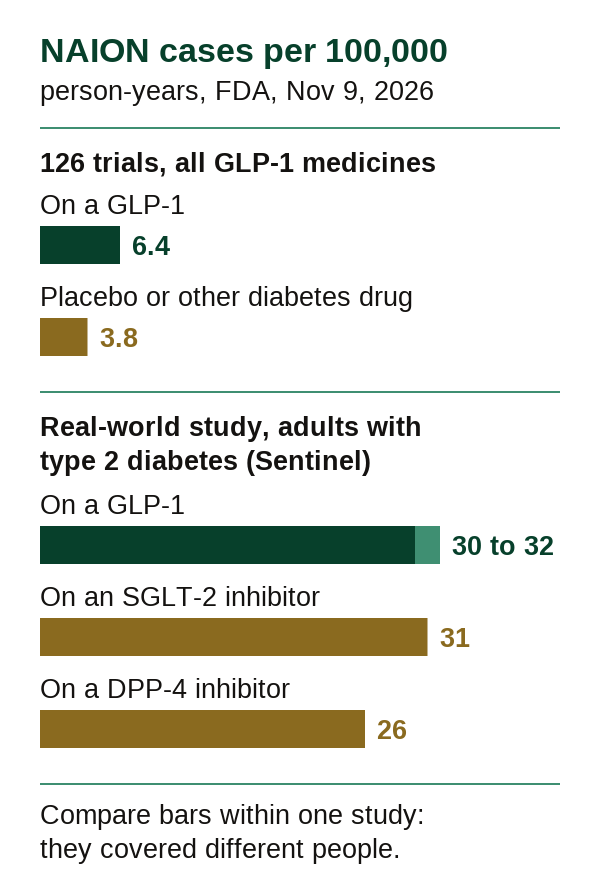
The FDA pooled 126 randomized trials of GLP-1 medicines, covering 134,253 people, and found 15 probable NAION cases: 10 on a GLP-1 and 5 on placebo. That’s 6.4 cases per 100,000 person-years on a GLP-1 against 3.8 on a comparison treatment, or about 2.6 extra cases for every 100,000 people taking one for a year (our arithmetic from just 15 cases, so it’s rough; studies of people with diabetes estimate about 1 extra case per 7,000 to 10,000 a year). The FDA cites a background rate of 2.3 to 10.2 per 100,000 adults over 50 each year.
A second FDA study, of adults with type 2 diabetes in its Sentinel system, found 30 to 32 cases per 100,000 person-years on a GLP-1, 31 on an SGLT-2 inhibitor, and 26 on a DPP-4 inhibitor. The risk wasn’t significantly higher than with SGLT-2 inhibitors (hazard ratio 1.19) but was higher than with DPP-4 inhibitors (1.43).
In both FDA analyses NAION was uncommon, and the gap between groups was a few cases per 100,000 person-years.
Where the concern started
A 2024 JAMA Ophthalmology study, funded in part by Research to Prevent Blindness, reviewed 16,827 patients of one Boston neuro-ophthalmology service and found a higher NAION risk with semaglutide: hazard ratios of 4.28 in type 2 diabetes and 7.64 in overweight or obesity. It couldn’t show cause, and the FDA noted several limitations.
Diabetes versus weight loss: the signal isn’t the same
Later studies show a clearer signal in type 2 diabetes. A 2026 meta-analysis of eight observational studies, funded by Tabriz University of Medical Sciences, found higher NAION risk with semaglutide in diabetes but no statistically significant increase in overweight or obesity (relative effect 1.68, confidence range 0.72 to 3.91). A 2026 Ophthalmology review found a similar pattern.
Not significant isn’t the same as safe: that range runs from lower risk to nearly four times the risk, and the FDA’s warning covers everyone on a GLP-1. In type 2 diabetes, a 2026 PLoS Medicine analysis, some of whose authors have had Novo Nordisk lecture fees, estimated 1 extra case per 7,000 people on semaglutide each year. See semaglutide side effects for the common effects.
The three-word check for Ozempic vision changes: sudden, painless, one eye
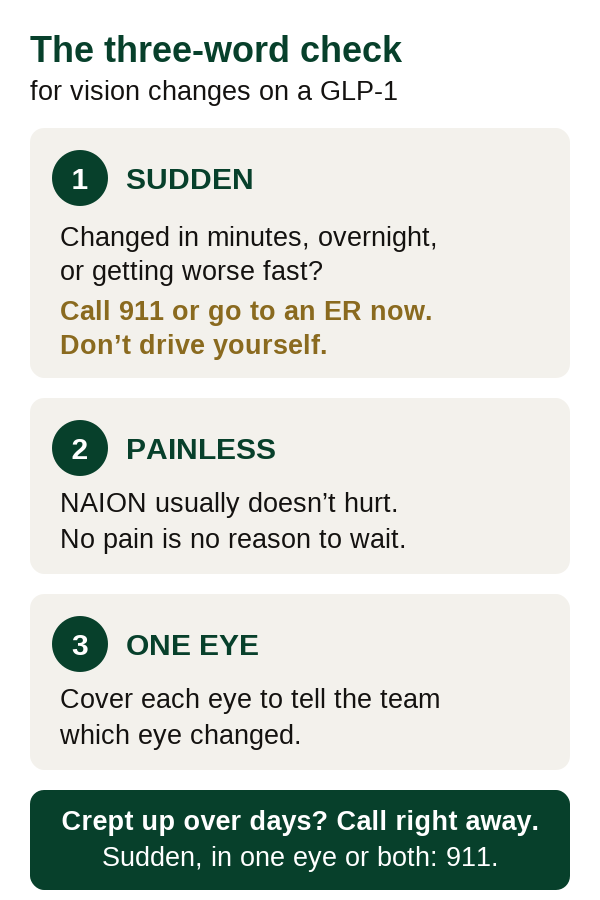
We built a three-word check from the FDA’s list of NAION symptoms (the full list is in the FAQ below). It’s our editorial tool, not a diagnosis, and the first word sets how fast you act.
Sudden. Vision that changed over minutes or overnight, or is getting worse quickly, is an emergency. Call 911 or go to an emergency room now, and don’t drive yourself.
Painless. NAION usually doesn’t hurt, so no pain is no reason to wait. Some people with NAION do have a headache or eye pain, so pain doesn’t rule it out.
One eye. While help is on the way, cover one eye, then the other, so you can tell the team which eye changed.
Sudden trouble seeing in both eyes is just as urgent: MedlinePlus lists it as a stroke sign. Not sure it was sudden? A new blind spot, blurry or dark patch, or faded colors that crept up over hours or days still needs a call to your prescriber or an eye doctor right away, today, because NAION can build over hours to days. The FDA says to contact your health care professional right away for any of these signs; for a sudden change we say emergency room, because some causes of sudden vision loss need same-day treatment.
The first word sets the speed: a sudden change means 911 or an emergency room, and a change that crept up means a call right away, today.
What the emergency team will check
An eye exam can show the swollen optic nerve of NAION. Doctors also look for giant cell arteritis, an inflamed artery that can cause similar loss and that steroids may keep from reaching the other eye, the American Academy of Ophthalmology says. Tell them which GLP-1 you take.
Vision fine, but want to talk through your eye history? If you’ve had NAION, diabetic eye disease, or sleep apnea, tell us about your goals and Dr. Espinet will go over it at your consultation.
Other Ozempic eye problems: diabetic retinopathy and blurry vision
In a 2-year Ozempic trial in people with type 2 diabetes and high heart risk, diabetic retinopathy complications occurred in 3.0% on Ozempic and 1.8% on placebo, more so with existing retinopathy (8.2% vs 5.2%) than without (0.7% vs 0.4%). The label links a rapid improvement in blood sugar to a temporary worsening of retinopathy.
That’s a diabetes issue: in the Wegovy weight trial of adults with type 2 diabetes, retinopathy was reported by 4% on Wegovy and 2.7% on placebo. Blurred vision can also mean low blood sugar, which the Ozempic Medication Guide flags for people also on insulin or a sulfonylurea.
Who, what you notice, and what to do
Eye problem
Who
You notice
What to do
NAION (optic nerve)
Anyone on a GLP-1, though it is rare
Sudden, usually painless vision loss in one eye, often on waking
Call 911 or go to an emergency room now
Diabetic retinopathy getting worse
People with type 2 diabetes, more so with existing retinopathy
Changes in vision during treatment
Tell your prescriber; a new blind spot, dark patch, or color change needs a call right away, and a sudden one follows the first row
Low blood sugar
People also taking insulin or a sulfonylurea
Blurred vision with shakiness, sweating, dizziness, or confusion
Treat it as your prescriber taught you, then call them
If a change is sudden, the first row wins, diabetes or not. The Zepbound and Mounjaro labels carry the same retinopathy caution; see tirzepatide side effects.
Should you stop Ozempic because of NAION? The next-step hurdle
If you’ve had NAION, the FDA says to talk with your health care professional about continuing or stopping, and tells prescribers to consider stopping unless the benefits clearly outweigh the risk. The European Medicines Agency is firmer for semaglutide: stop it if NAION is confirmed.
If your eyes are fine, don’t stop on your own over a headline. Ask whether your risk factors change the math: the FDA lists smoking, diabetes, high blood pressure, sleep apnea, anemia, kidney disease, and a past NAION. Stopping has its own effects; see stopping semaglutide.
Does switching to tirzepatide avoid the risk?
Not by the FDA’s account. Its requirement covers tirzepatide (Mounjaro, Zepbound) and every other GLP-1, and its trial analysis pooled the class, so it can’t rank one medicine as safer for your eyes. See switching from semaglutide to tirzepatide.
Who should be careful about Ozempic eye problems, and when to get help
Tell your prescriber first if you’ve had NAION, diabetic retinopathy, or any FDA risk factor. Semaglutide and tirzepatide, including Ozempic, Wegovy, Mounjaro, and Zepbound, aren’t for anyone with a personal or family history of medullary thyroid carcinoma, or MEN 2. For eye history, see an ophthalmologist; for a sudden change, go to the emergency room.
Sorted from most to least urgent, these rows match our semaglutide guide, plus emergency steps and the FDA’s NAION signs:
Warning sign
What to do
Swelling of the face, lips, tongue, or throat, trouble breathing or swallowing, severe rash or itching, fainting or feeling dizzy, or a very rapid heartbeat
A serious allergic reaction. Stop the medication and call 911 or go to an emergency room
Low blood sugar you can’t treat yourself, passing out, or a seizure, if you take insulin or a sulfonylurea
Someone should call 911
Thoughts of harming yourself
Call or text 988, the Suicide and Crisis Lifeline, right away. If you might act on them or are in immediate danger, call 911
Sudden vision loss in one eye (often noticed on waking), blurred or missing patches of vision, faded or distorted colors, or eyesight that gets worse quickly
Call 911 or go to an emergency room now, and don’t drive yourself. The FDA warns GLP-1s may raise the risk of NAION, a rare optic nerve problem
Severe stomach pain that will not go away, sometimes reaching the back, with or without vomiting
Possible pancreatitis. Stop semaglutide and call your provider right away; if you can’t reach them quickly, go to an emergency room, not urgent care
Pain in the upper stomach, fever, yellow skin or eyes, or clay-colored stools
Possible gallbladder problems. Gallstones were reported in 1.6% on Wegovy injection vs 0.7% on placebo. Call your provider right away; if you can’t reach them quickly, go to an emergency room, not urgent care
Nausea, vomiting, or diarrhea that will not go away, or not being able to keep fluids down
Dehydration, which can lead to kidney problems. Drink fluids and call your provider right away. Severe dehydration is an emergency: go to the emergency room now if you can’t keep fluids down, are barely urinating, your urine is very dark, you feel dizzy or lightheaded, or your heart is racing. Call 911 if you become confused or pass out. If you have kidney disease, call at the first sign
You took too much, or took two doses close together
Call your prescriber or Poison Help at 1-800-222-1222, or go to an emergency room right away
A lump or swelling in the neck, hoarseness, trouble swallowing, or shortness of breath
Possible thyroid tumor, the risk behind the label’s boxed warning. Call your provider
Shakiness, sweating, confusion, blurred vision, or a fast heartbeat in someone with diabetes
Low blood sugar. Treat it as your prescriber taught you, then call them
Heart racing or pounding at rest for several minutes
Increased heart rate, which the Wegovy label says to report. Call your provider
Vision changes in someone with type 2 diabetes
Possible worsening of diabetic eye disease. Tell your provider
No table covers everything. If something feels wrong, call your prescriber, and tell any emergency team which GLP-1 you take and when you last took it. The same habit matters before any procedure; see Ozempic before surgery.
How MeliOra fits: semaglutide or tirzepatide with a physician
Dr. Melanie Espinet, a board-certified family medicine physician in Lutz, prescribes weekly semaglutide or tirzepatide injections; MeliOra doesn’t offer GLP-1 pills. She screens for eating disorders before prescribing, and if support from a dietitian or therapist would help, she discusses it at your consultation. Tell her about any eye history.
Semaglutide weight loss starts at $150/month, or $240/month at higher dosing, and tirzepatide weight loss runs $230 to $320/month. Each price includes in-home physician visits, lab work, the medication and supplies, and dose adjustments and check-ins, with no consultation fee.
Dr. Espinet makes house calls across Hillsborough, Pasco, and Pinellas counties with no travel fee, and sees select appointments at the Lutz office. At any house call, including ours, ask how the product was stored on the way and what the plan is for a serious reaction. Anywhere in Florida, telehealth weight loss works by video for the same monthly price.
Frequently asked questions about Ozempic vision loss
Can Ozempic make you go blind?
Rarely, it may contribute to lasting vision loss in one eye. The FDA links GLP-1 medicines, Ozempic included, to a potential increased risk of NAION, which usually causes permanent loss. In the FDA’s trial analysis, NAION occurred at 6.4 cases per 100,000 person-years on a GLP-1, against 3.8 without one.
What are the symptoms of NAION on Ozempic?
The FDA lists sudden, painless vision loss in one eye, often noticed on waking; blurred or missing areas of vision, such as blind spots or tunnel vision; distorted colors; and blurry or hazy central spots. Sudden: call 911 or go to an emergency room. Crept up over hours or days: call your prescriber or an eye doctor right away.
Do Mounjaro and Zepbound carry the NAION warning too?
Not on their labels yet, but the requirement covers them. The FDA’s November 9, 2026 requirement applies to every GLP-1 medicine, including tirzepatide (Mounjaro, Zepbound), and the FDA says NAION cases have been reported with all marketed products in the class. Its analysis pooled the class, so it doesn’t show any one medicine as safer for your eyes.
Should I stop taking Ozempic because of the NAION warning?
Not on your own if your vision is normal. Talk with your prescriber about your risk factors, such as a past NAION, diabetes, high blood pressure, sleep apnea, smoking, anemia, or kidney disease. If NAION is diagnosed, the FDA says to discuss stopping, and European regulators say semaglutide should be stopped.
Can Ozempic cause blurry vision?
It can, for different reasons. In type 2 diabetes, a fast improvement in blood sugar has been linked to a temporary worsening of diabetic retinopathy. Blurry vision can also signal low blood sugar in people taking insulin or a sulfonylurea. Sudden blurring or a dark patch in one eye could be NAION and needs emergency care.