Ozempic Before Surgery: Do You Stop It, and What to Tell Your Care Team
Dr. Melanie Espinet, board-certified Family Medicine physician ·
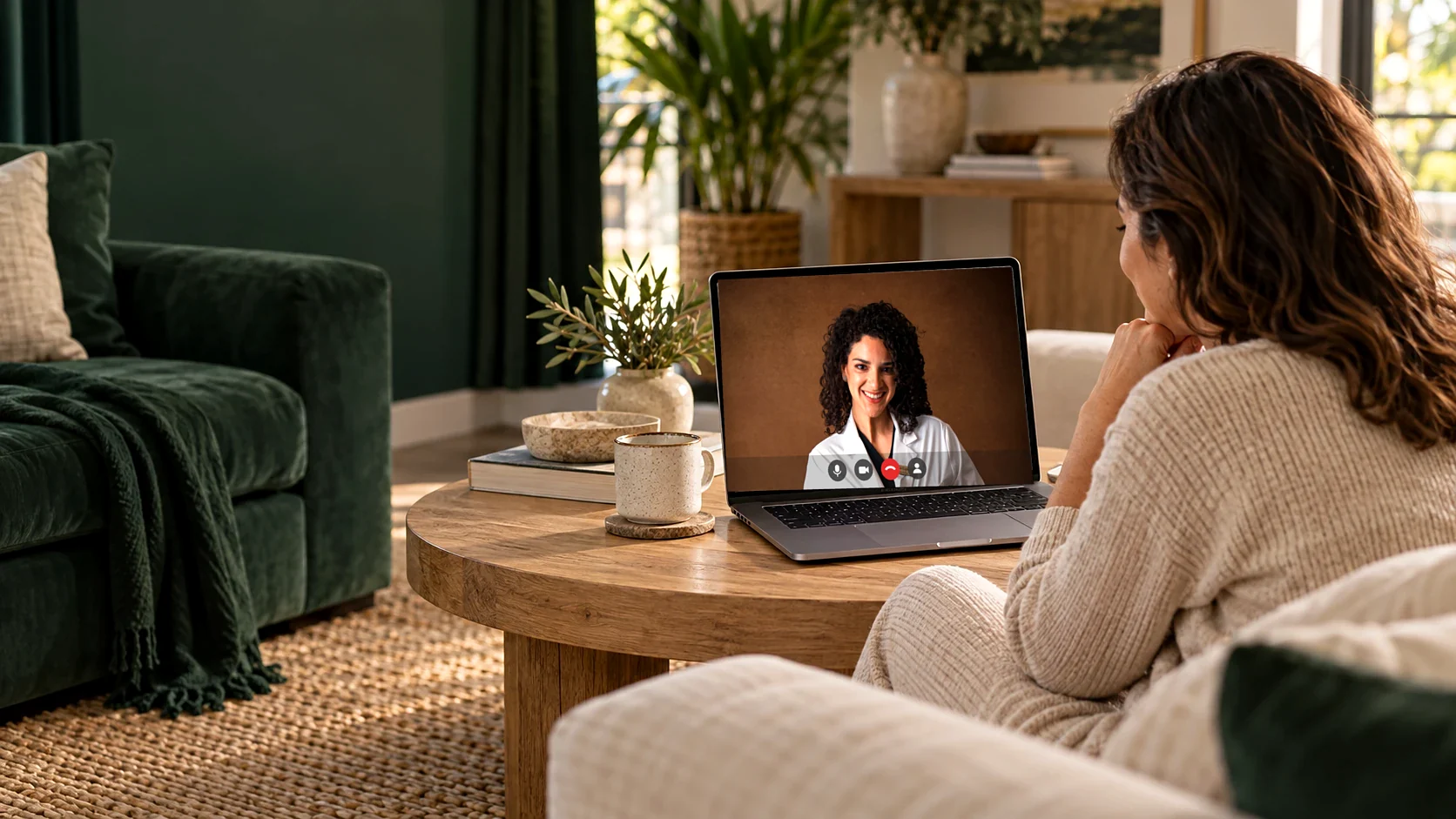
Before any procedure on a GLP-1, tell your surgical team you take it: most people keep taking it, and the team decides if a dose is held. Photo: Ivan S on Pexels
The short answerDon’t stop or skip it on your own, and if your surgical team asks you to hold a dose, follow their plan. 2024 guidance from five societies, anesthesiologists included, says most people can keep taking a GLP-1 like Ozempic before elective surgery; if your stomach risk is higher, your team may hold a weekly shot the week before or ask for 24 hours of liquids.
Ozempic is Novo Nordisk’s semaglutide for type 2 diabetes and the name most people search. Dr. Melanie Espinet prescribes weekly semaglutide or tirzepatide for medical weight loss, not the Ozempic brand, and the same guidance covers every GLP-1. This is general information, not medical advice.
Should you stop Ozempic before surgery? What the 2024 guidance says
Usually not. The 2024 guidance from five societies says a GLP-1 “may be continued pre-operatively in patients without elevated-risk of delayed gastric emptying and aspiration,” and the ASA says that’s most patients. If your risk is raised, your team may hold the dose or switch you to liquids for 24 hours.
The guidance came from the American Society of Anesthesiologists (ASA), the American Gastroenterological Association (AGA), and three surgical and obesity care societies; two authors have been paid by Novo Nordisk to consult or speak. It keeps the ASA’s earlier one-week hold only for people whose team decides a hold is needed.
Holding has risks too, such as high blood sugar in diabetes, and the guidance says holding a GLP-1 only because someone has overweight or obesity could be weight bias. The ASA’s patient page puts it simply: most of the time, you can keep taking it as usual. A 2025 UK consensus from eight societies, some of whose authors have had fees from Novo Nordisk and Eli Lilly, also says to continue these drugs before surgery, with a full risk assessment.
What the Ozempic label says about anesthesia
The Ozempic injection label (May 2026) describes “rare postmarketing reports of pulmonary aspiration,” stomach contents reaching the lungs, in people on GLP-1s under general anesthesia or deep sedation “who had residual gastric contents despite reported adherence to preoperative fasting recommendations.” It says the data can’t yet show whether changing fasting rules or pausing the medicine helps, and asks you to tell your providers before any planned procedure.
Why Ozempic matters to your anesthesia team: food left in the stomach
GLP-1 medicines slow how fast your stomach empties. Under general anesthesia or deep sedation, food still in the stomach can flow back up into the lungs, which the ASA says is dangerous and can be life-threatening. That’s why everyone fasts first, and why your team needs to know you take Ozempic.
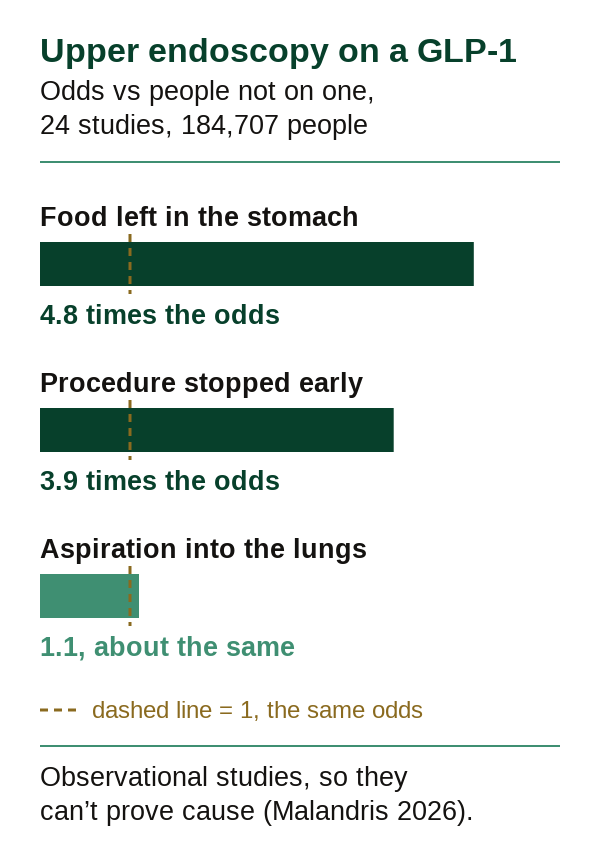
A 2026 meta-analysis of 24 observational studies of upper endoscopy (184,707 people, no conflicts declared) found GLP-1 users had higher odds of food left in the stomach and of the procedure being stopped, but similar odds of aspiration. A 2025 review of 28 studies, some of whose authors had research support from Eli Lilly, reached the same conclusion with low certainty.
In 24 endoscopy studies, GLP-1 users more often had food in the stomach or a stopped procedure, while aspiration odds were about the same.
Our reading: the likelier day-of problem is a postponed or stopped procedure. Aspiration is rare, the evidence on it is low certainty, and the label says no step is proven to lower it, so telling your team early is what gives them room to plan. For nausea or constipation now, see semaglutide side effects.
What raises your risk
The 2024 guidance names five things that raise the chance of a slow stomach and aspiration:
The dose-increase phase, while you’re still stepping up to your maintenance dose
A higher dose
Weekly rather than daily dosing, which includes Ozempic injections (Ozempic tablets are taken daily)
Stomach symptoms: nausea, vomiting, belly pain, indigestion, or constipation
Other conditions that slow the stomach, such as gastroparesis or Parkinson’s disease
The ASA’s patient page adds that if you’re nauseous, vomiting, constipated, in stomach pain, or having trouble breathing, you shouldn’t have surgery until the symptoms are gone. It says the dose-increase phase usually lasts four to eight weeks, and that it’s best to wait until it’s over, and any stomach problems have gone away, before elective surgery.
Tell, ask, plan: three conversations before Ozempic and surgery
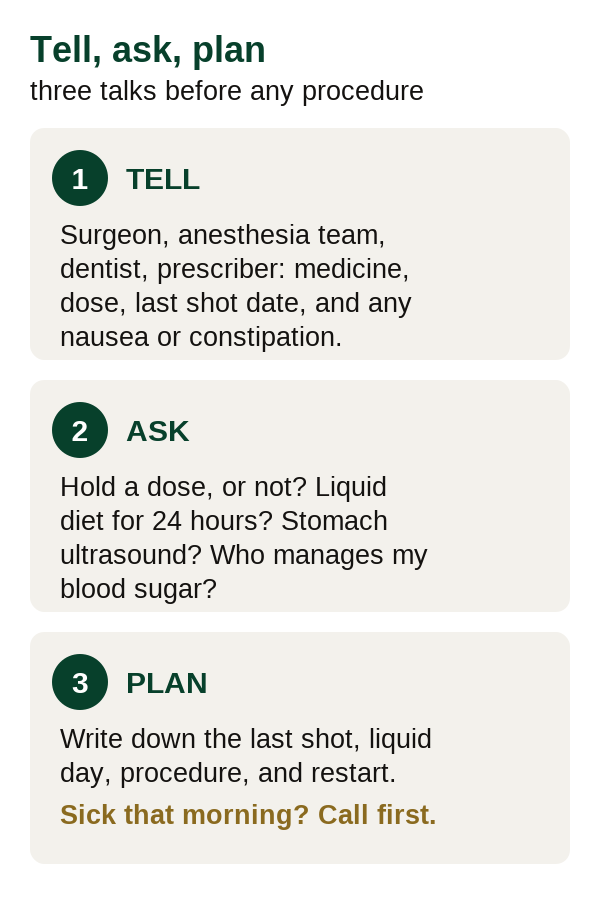
Most advice stops at “tell your doctor.” We break it into three conversations. It’s our editorial checklist, built from the 2024 guidance and the ASA patient page, not a medical protocol; your surgeon and anesthesia team set the actual plan.
Tell: everyone involved in the procedure
Your surgeon, your anesthesia team, your dentist if sedation is planned, and whoever prescribes your GLP-1
The medicine, your dose, your injection day, and the date of your last shot
Whether you’re still stepping up your dose, and any nausea, vomiting, belly pain, or constipation
Any diabetes medicines, especially insulin or a sulfonylurea
Ask: what changes before the day
Should I hold a dose, and if so, which one?
Do I need a liquid diet for 24 hours beforehand?
Will you check my stomach with ultrasound that day?
If my stomach isn’t empty, will we change the anesthesia plan or reschedule?
Who manages my blood sugar and other diabetes medicines while I fast?
Plan: put the dates in writing
Write down your last shot, any liquid-diet day, the procedure, and when to restart. If you wake up that morning with nausea, vomiting, or belly pain, call the surgical team before you leave home.
Three conversations before any procedure on a GLP-1; your surgeon and anesthesia team make the final plan.
Weighing a GLP-1 and an elective procedure? Because the ASA says it’s best to be past the dose-increase phase before elective surgery, the order matters, and a start date may need to wait until after your procedure. Book a weight loss consultation and bring the procedure date, or ask about telehealth anywhere in Florida.
Ozempic before a colonoscopy or endoscopy
The AGA’s 2023 practice update, issued before the 2024 guidance it helped write, says to go ahead as planned if you followed the usual fasting rules (no food for 8 hours, no liquids for 2) and have no nausea, vomiting, indigestion, or bloating, and that a liquid diet the day before is an option instead of stopping the medicine.
Sedation matters too. The ASA explains that full-stomach precautions, which lower aspiration risk, work only with general anesthesia, not the sedation often used for endoscopy, so your team may suggest general anesthesia instead. The AGA notes that rapid-sequence intubation, the airway step used for a full stomach, may not be possible in most outpatient or office endoscopy settings.
Colonoscopy prep on a GLP-1
A colonoscopy already comes with a liquid diet and a bowel prep. A 2026 Cleveland Clinic study of 51,268 people having a colonoscopy found GLP-1 users at normal weight or overweight had 66% higher odds of an inadequate prep, less so at higher weights; its senior author consults for Novo Nordisk. Ask your gastroenterologist whether your prep should change.
Dental work and sedation
The label’s warning is about general anesthesia and deep sedation. Many dental visits use only a numbing shot, but tell your dentist about every medicine anyway, and if sedation is planned, use the same three conversations. For how GLP-1s can affect your mouth, see Ozempic teeth.
Taking Ozempic for diabetes? Don’t stop it on your own
Ozempic treats type 2 diabetes, so stopping it can raise your blood sugar, and high blood sugar raises surgical risk, the ASA notes. The 2024 guidance adds that bridging to another diabetes medicine takes planning and can bring its own risks, such as low blood sugar.
Ask who manages your diabetes medicines while you fast, especially insulin or a sulfonylurea, and which blood sugar readings should prompt a call. Your GLP-1 prescriber, surgeon, and anesthesia team should agree on one plan.
After surgery: restarting Ozempic and other next-step hurdles
The 2024 guidance sets no restart date, so ask before you leave, and don’t make up a held dose before the procedure. For an ordinary missed dose, the Ozempic label allows taking it within 5 days; otherwise, skip it. After 2 or more missed weeks, the Wegovy label restarts at a lower dose to limit stomach side effects.
A held dose doesn’t empty your system: the Ozempic label says semaglutide stays in circulation about 5 weeks after the last dose, and the 2024 guidance says the right length for any hold is unknown. See how long tirzepatide and semaglutide stay in your system.
GLP-1 stomach side effects can overlap with problems after surgery, so report new or worsening belly symptoms. In emergency surgery, the ASA says teams treat everyone as having a full stomach; if you’re awake, tell them you take a GLP-1. Thinking of stopping for good? Read stopping semaglutide first.
Who should be careful, and when to see a professional instead
Your surgeon and anesthesia team decide what happens before a procedure. Call them early if you’re still increasing your dose or have stomach symptoms, gastroparesis, Parkinson’s disease, or diabetes treated with insulin or a sulfonylurea. Semaglutide and tirzepatide, including Ozempic, Wegovy, Mounjaro, and Zepbound, aren’t for anyone with a personal or family history of medullary thyroid carcinoma, or MEN 2.
Sorted from most to least urgent, these rows match our semaglutide guide, plus emergency steps and the FDA’s NAION signs:
Warning sign
What to do
Swelling of the face, lips, tongue, or throat, trouble breathing or swallowing, severe rash or itching, fainting or feeling dizzy, or a very rapid heartbeat
A serious allergic reaction. Stop the medication and call 911 or go to an emergency room
Low blood sugar you can’t treat yourself, passing out, or a seizure, if you take insulin or a sulfonylurea
Someone should call 911
Thoughts of harming yourself
Call or text 988, the Suicide and Crisis Lifeline, right away. If you might act on them or are in immediate danger, call 911
Sudden vision loss in one eye (often noticed on waking), blurred or missing patches of vision, faded or distorted colors, or eyesight that gets worse quickly
Call 911 or go to an emergency room now, and don’t drive yourself. The FDA warns GLP-1s may raise the risk of NAION, a rare optic nerve problem
Severe stomach pain that will not go away, sometimes reaching the back, with or without vomiting
Possible pancreatitis. Stop semaglutide and call your provider right away; if you can’t reach them quickly, go to an emergency room, not urgent care
Pain in the upper stomach, fever, yellow skin or eyes, or clay-colored stools
Possible gallbladder problems. Gallstones were reported in 1.6% on Wegovy injection vs 0.7% on placebo. Call your provider right away; if you can’t reach them quickly, go to an emergency room, not urgent care
Nausea, vomiting, or diarrhea that will not go away, or not being able to keep fluids down
Dehydration, which can lead to kidney problems. Drink fluids and call your provider right away. Severe dehydration is an emergency: go to the emergency room now if you can’t keep fluids down, are barely urinating, your urine is very dark, you feel dizzy or lightheaded, or your heart is racing. Call 911 if you become confused or pass out. If you have kidney disease, call at the first sign
You took too much, or took two doses close together
Call your prescriber or Poison Help at 1-800-222-1222, or go to an emergency room right away
A lump or swelling in the neck, hoarseness, trouble swallowing, or shortness of breath
Possible thyroid tumor, the risk behind the label’s boxed warning. Call your provider
Shakiness, sweating, confusion, blurred vision, or a fast heartbeat in someone with diabetes
Low blood sugar. Treat it as your prescriber taught you, then call them
Heart racing or pounding at rest for several minutes
Increased heart rate, which the Wegovy label says to report. Call your provider
Vision changes in someone with type 2 diabetes
Possible worsening of diabetic eye disease. Tell your provider
No table covers everything. If something feels wrong before or after a procedure, call your prescriber or surgical team, and tell any emergency team which GLP-1 you take and when you last took it. For the new vision warning, see Ozempic vision loss; for tirzepatide, see tirzepatide side effects.
How MeliOra fits: GLP-1 care that plans around your procedures
Dr. Melanie Espinet, a board-certified family medicine physician in Lutz, prescribes weekly semaglutide or tirzepatide injections; MeliOra doesn’t offer GLP-1 pills. She screens for eating disorders before prescribing, and if support from a dietitian or therapist would help, she discusses it at your consultation. Tell her about any planned surgery or procedure.
Semaglutide weight loss starts at $150/month, or $240/month at higher dosing, and tirzepatide weight loss runs $230 to $320/month. Each price includes in-home physician visits, lab work, the medication and supplies, and dose adjustments and check-ins, with no consultation fee.
With telehealth, GLP-1 visits happen by video anywhere in Florida, at the same monthly price.
Dr. Espinet makes house calls across Hillsborough, Pasco, and Pinellas counties with no travel fee, and sees select appointments at the Lutz office. At any house call, including ours, ask how the product was stored on the way and what the plan is for a serious reaction. With telehealth weight loss, video visits replace in-home visits and the medication ships to your home.
Frequently asked questions about Ozempic before surgery
How many days before surgery should I stop Ozempic?
There’s no universal number, and most people don’t stop. Under 2024 guidance, if your care team decides to hold a weekly GLP-1 like Ozempic injections, it suggests holding it the week before surgery (the day of surgery for a daily pill like Ozempic tablets). Your surgeon and anesthesia team make that call, so don’t skip a dose on your own.
Can I take Ozempic before a colonoscopy?
Usually, yes. The AGA says to proceed as planned if you followed the usual fasting rules and have no nausea, vomiting, indigestion, or bloating, and that a liquid diet the day before is an option instead of stopping. Studies also link GLP-1s to more inadequate bowel preps, so ask whether your prep should change.
Do I need to stop Ozempic before dental work?
The label’s warning is about general anesthesia and deep sedation, which a visit with only a numbing shot doesn’t involve. Tell your dentist you take it anyway. If sedation is planned, ask the same questions you would before surgery: whether to hold a dose, whether to follow a liquid diet, and who manages your blood sugar.
What happens if I don’t tell the anesthesiologist I take Ozempic?
They can’t take steps to protect you from aspiration if they don’t know, the ASA says. Those steps include a 24-hour liquid diet, a stomach ultrasound on the day, full-stomach precautions under general anesthesia, or rescheduling. Tell every team, including for colonoscopy and dental sedation, and give the date of your last dose.
When can I restart Ozempic after surgery?
Ask your surgeon and prescriber before you leave, because the 2024 guidance sets no date. Don’t make up a held dose before surgery. After 2 or more missed weeks, the Wegovy label restarts at a lower dose to limit stomach side effects, so don’t jump back to a high dose.