The short answerOzempic butt is a social media nickname for a flatter or saggier bottom after major weight loss on a GLP-1 medicine. It isn’t a diagnosis, and no study we found has measured the buttocks on these drugs. Three layers change: fat, most of what you lose; muscle, part of it; and skin, which may not shrink back. Muscle is the layer you can most influence, but no program can promise to prevent the change.
Ozempic is the popular name; it’s one brand of semaglutide. At MeliOra, Dr. Melanie Espinet prescribes weekly semaglutide and tirzepatide for medical weight loss; label and trial facts below describe the brand-name products studied. Bodies change shape when they lose weight, and nothing here judges yours. This is general information, not medical advice.
What is Ozempic butt?
Ozempic butt is a media nickname for a flatter, smaller, or saggier bottom after large weight loss on a GLP-1 medicine such as semaglutide or tirzepatide. It isn’t a medical diagnosis, and the drug labels don’t list it.
A 2025 plastic surgery review with no outside funding says the public and surgeons coined “Ozempic butt” and “Ozempic body” for lost tissue volume, and that excess skin can get in the way of exercise, intimacy, social life, and clothes that fit. The face version has its own guide: Ozempic face.
Ozempic body changes: is it the drug or the weight loss?
Mostly the weight loss itself, as far as studies can tell. The American Society of Plastic Surgeons (ASPS) says that after any substantial weight loss, from surgery or lifestyle changes, skin and tissues often lack the elasticity to fit the smaller body. We found no study that measured the buttocks. In a 2026 survey of 1,226 weight program patients, people on GLP-1 medicines reported sagging skin more often than people on other weight loss medicines at every level of weight lost, but the authors said their design couldn’t separate a drug effect from how much or how fast people lost; our Ozempic face guide covers that survey.
Body scans show what the scale loses. In a body-scan substudy of the STEP 1 semaglutide trial, funded by Novo Nordisk, 8.3 kg of an average 13.6 kg lost was fat (62%) and 5.3 kg was lean mass (38%), as a 2025 joint advisory summarizes it, and muscle is about half of lean mass. In the SURMOUNT-1 tirzepatide body-scan substudy, funded by Eli Lilly, about 75% of the loss was fat and 25% lean, the same split as placebo. Everyone in both trials also had diet and exercise counseling, and results varied. These were separate trials, so they don’t rank the drugs; our guide to semaglutide muscle loss has the details.
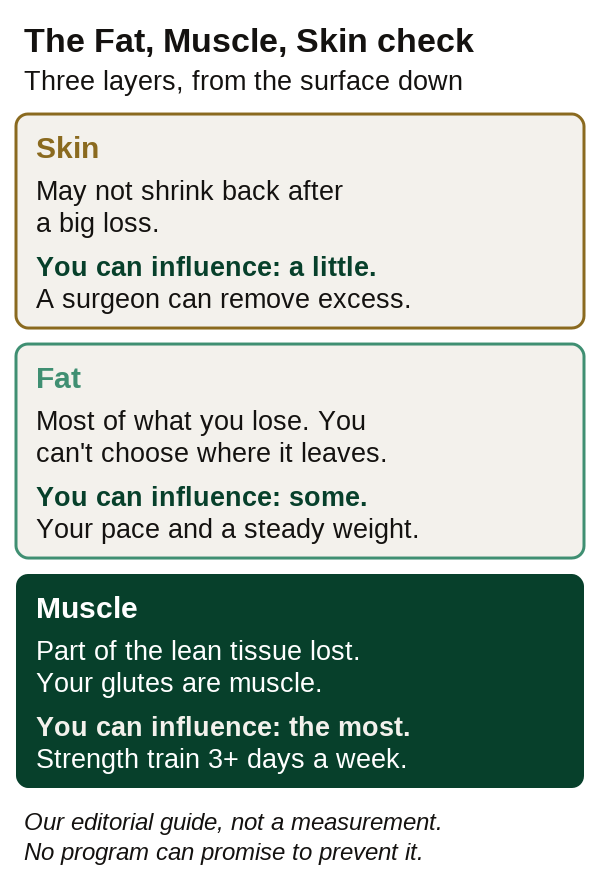
The Fat, Muscle, Skin check: what changed, and what you can still change
Here’s our editorial check. It sorts the change into three layers and asks which one you can still influence. It rests on the sources on this page, not a buttocks study, and it isn’t a MeliOra protocol.
Fat: you can’t choose where it leaves
Fat is most of what you lose, and the ASPS notes that people on a GLP-1 can’t choose where it comes off. What you can shape, with your prescriber, is how much you lose and whether your weight stays steady. Swings matter: the ASPS lists significant weight fluctuations among the contributors to poor skin elasticity, and the joint advisory warns that stopping and restarting a GLP-1 with regain in between may worsen muscle and bone loss. Before you stop, read what happens when you stop semaglutide.
Muscle: the layer you can build
Your glutes are muscle, and muscle responds to training. In a 2026 trial of 120 adults aged 50 to 70 taking tirzepatide, those assigned to supervised strength training three times a week for 40 weeks, with moves such as squats and leg presses, lost about 1.1 kg less lean tissue than those who kept their usual routine and got stronger, while weight loss was similar. Lean tissue still fell in both groups, everyone was told to keep up their protein, and results varied. Eli Lilly supplied the tirzepatide and reviewed the protocol, and several authors have received Lilly speaker fees. The scans measured whole-body and arm and leg lean tissue, not the glutes; an earlier trial in 34 untrained young adults not on a GLP-1 found hip thrusts and back squats grew the glutes similarly on MRI. A 2025 joint advisory from four nutrition and obesity medicine groups recommends strength training at least three times a week while on a GLP-1, plus enough protein; see what to eat on semaglutide.
Skin: what training can’t do
The ASPS says aging, sun damage, pregnancy, big weight swings, and genetics may contribute to poor elasticity and sagging of the abdomen, buttocks, and thighs. Training builds the muscle under the skin, but it doesn’t remove skin. ASPS also notes that liposuction alone works where skin has good elasticity; when skin is loose, a body lift removes the excess. In an October 2026 ASPS article, a member surgeon said that in her experience, skin quality depends more on how much weight was lost than on how.
Fat: talk with your prescriber about your pace, and don’t stop or restart on your own.
Muscle: strength train at least three days a week, include hip moves like squats, and eat enough protein.
Skin: wait until your weight is steady before you judge it, and see a board-certified plastic surgeon if it bothers you.
Of the three layers, muscle is the one you can most influence while you lose weight.
Want a weight loss plan built around keeping muscle?Book a weight loss consultation with Dr. Espinet and bring your questions about pace, protein, and strength work.
Loose skin after weight loss: when a surgeon gets involved
The ASPS says good candidates for body contouring are adults whose weight loss has stabilized, who are healthy enough to heal, who don’t smoke, and who have realistic goals. A 2025 review of 12 semaglutide studies suggests weight levels off after about 8 to 12 months of use, though results varied; its authors urge caution, because in two studies more than half of the lost weight returned after the drug stopped.
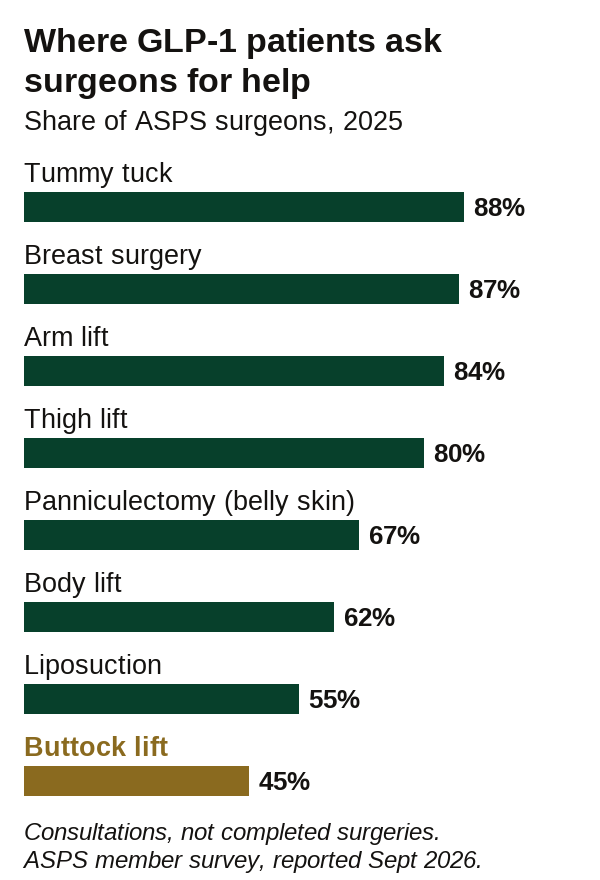
GLP-1 patients are already asking. In the ASPS 2025 member survey, 82% of surgeons reported GLP-1-related consultation requests, and 45% fielded them for a buttock lift. Surgery has real risks; the ASPS lists bleeding, blood clots, infection, poor wound healing, and loose skin that remains. The Wegovy and Zepbound labels also report rare cases of stomach contents reaching the lungs under general anesthesia or deep sedation, so tell your surgeon you take a GLP-1; see Ozempic before surgery.
Surgeons fielded GLP-1 consultations for many body areas in 2025; the buttock lift was one of eight procedures listed.
MeliOra doesn’t offer surgery, skin tightening, fillers, or body contouring. One surgeon quoted by the ASPS said noninvasive and minimally invasive tightening technologies “still leave a lot to be desired.” For loose skin, see a board-certified plastic surgeon once your weight is steady.
Who should be careful, and when to see a professional instead
The joint advisory says eating less protein with a smaller appetite may add to muscle loss and raise the risk of sarcopenia, a loss of muscle mass and strength, particularly if you’re older, in perimenopause or menopause, have lower testosterone, sit most of the day, or don’t strength train; see menopause weight gain. Ask your physician first if you have a heart, joint, or other health condition. Tell your prescriber, at MeliOra Dr. Espinet, about any past or present eating disorder. She screens for eating disorders before prescribing, and if support from a dietitian or therapist would help, she discusses it at your consultation.
When to see someone else
What you notice
Who to see
Loose skin that chafes, or keeps getting irritated or infected
Your doctor for the skin now; a board-certified plastic surgeon about removal once your weight is stable
Getting up from a chair, climbing stairs, or carrying groceries feels harder as you lose weight
Your prescriber. The advisory lists chair-stand and stair-climb tests among the ways clinicians check muscle
You want a strength program but don’t know where to start
An exercise physiologist, physical therapist, or strength trainer, as the advisory suggests
Worry about your body is changing how you eat, such as skipping meals, purging, or exercising to make up for food
Your prescriber or primary doctor, and a therapist or dietitian; you can contact one yourself
Fainting, chest pain, a racing or skipped heartbeat, or confusion after purging or eating very little
Swelling of the face, lips, tongue, or throat, trouble breathing or swallowing, severe rash or itching, fainting or feeling dizzy, or a very rapid heartbeat
A serious allergic reaction. Stop the medication and get medical help right away: call 911 or go to an emergency room
Low blood sugar you can’t treat yourself, passing out, or a seizure, if you take insulin or a sulfonylurea
Someone should call 911
Thoughts of harming yourself
Call or text 988, the Suicide and Crisis Lifeline, right away. If you might act on them or are in immediate danger, call 911
Sudden vision loss or a sudden dark or blurry area in one eye (often noticed on waking), faded or distorted colors, or eyesight that gets worse quickly
Call 911 or go to an emergency room now, and don’t drive yourself. The FDA warns of a possible increased risk of NAION, a rare optic nerve problem, with GLP-1 medicines
Severe stomach pain that will not go away, sometimes reaching the back, with or without vomiting
Possible pancreatitis. Stop the medication and call your provider right away; if you can’t reach them quickly, go to an emergency room, not urgent care
Pain in the upper stomach, fever, yellow skin or eyes, or clay-colored stools
Possible gallbladder problems. Gallstones were reported in 1.6% on Wegovy injection vs 0.7% on placebo. Call your provider right away; if you can’t reach them quickly, go to an emergency room, not urgent care
Nausea, vomiting, or diarrhea that will not go away, or not being able to keep fluids down
Dehydration, which can lead to kidney problems. Drink fluids and call your provider right away. Severe dehydration is an emergency: go to the emergency room now if you can’t keep fluids down, are barely urinating, your urine is very dark, you feel dizzy or lightheaded, or your heart is racing. Call 911 if you become confused or pass out. If you have kidney disease, call at the first sign
You took too much, or took two doses close together
Call your prescriber or Poison Help at 1-800-222-1222, or go to an emergency room right away
A lump or swelling in the neck, hoarseness, trouble swallowing, or shortness of breath
Possible thyroid tumor, the risk behind the label’s boxed warning
Shakiness, sweating, confusion, or a fast heartbeat in someone with diabetes
Low blood sugar
Heart racing or pounding at rest for several minutes
Increased heart rate, which the label says to report
Vision changes in someone with type 2 diabetes
Possible worsening of diabetic eye disease
No list covers everything. If something feels wrong, call your prescriber, and tell any emergency team which GLP-1 you take. A boxed warning about thyroid tumors in rodents rules these medicines out for anyone with a personal or family history of medullary thyroid carcinoma or MEN 2. See GLP-1 side effects for more.
How MeliOra fits: weekly semaglutide or tirzepatide with a physician
Dr. Melanie Espinet, a board-certified family medicine physician, prescribes weekly semaglutide or tirzepatide injections; the monthly price includes in-home physician visits, lab work, the medication and supplies, and dose adjustments and check-ins, with no consultation fee. Bring questions about protein, strength training, and how your body is changing to those check-ins.
Tirzepatide weight loss runs $230 to $320/month, and semaglutide weight loss starts at $150/month, or $240/month at higher dosing. Dr. Espinet makes house calls across Hillsborough, Pasco, and Pinellas counties with no travel fee, and sees select appointments at the Lutz office. At any house call, including ours, ask how the product was stored on the way and what the plan is for a serious reaction. Anywhere in Florida, you can choose telehealth weight loss instead: video visits replace in-home visits, the medication ships to your home, and the monthly price is the same.
Frequently asked questions about Ozempic butt
Can you prevent Ozempic butt?
No method is proven to prevent it, and no program can promise to. Strength training at least three times a week and enough protein can help protect the muscle layer, as a 2025 joint advisory recommends for everyone on a GLP-1. Avoiding big weight swings matters for skin and muscle too.
Does loose skin go away after weight loss?
Often not fully. The American Society of Plastic Surgeons says that after substantial weight loss, skin often lacks the elasticity to fit the smaller body, and aging, sun damage, and weight swings make it worse. Exercise builds muscle underneath but doesn’t remove skin; surgery removes the excess.
Do squats help Ozempic butt?
They help the muscle layer. In a 2026 trial of adults taking tirzepatide, three strength sessions a week that included squats cut lean tissue loss by about 1.1 kg over 40 weeks and built strength, though lean tissue still fell and results varied. Squats can’t remove loose skin.
Does tirzepatide cause Ozempic butt too?
The same changes can follow large weight loss on tirzepatide, the medicine in Mounjaro and Zepbound. Its trial body scans showed most of the weight lost was fat, with some lean mass, and a 2026 trial found strength training reduced lean loss on tirzepatide. No study has compared the two medicines for buttock shape.
How long should I wait for a body lift after a GLP-1?
Until your weight is stable, the American Society of Plastic Surgeons says. A 2025 review suggests weight levels off after about 8 to 12 months of semaglutide, though it varies, and regain after stopping is common. Plan the timing with your surgeon and prescriber, and tell the anesthesia team you take a GLP-1.