The short answerOnly one of the four FDA labels puts headache in its side effect table: Wegovy, at 14% on semaglutide 2.4 mg versus 10% on placebo. Ozempic’s label lists it among reports after approval, and all four Medication Guides list it as a possible low blood sugar sign. Check fluids, food, caffeine, and blood sugar. A sudden, severe headache, or one with weakness, confusion, vision loss, or fever and a stiff neck, needs 911.
“Ozempic headache” is the popular name for headaches that start on semaglutide (the medicine in Ozempic and Wegovy) or tirzepatide (the medicine in Mounjaro and Zepbound). MeliOra prescribes semaglutide and tirzepatide for medical weight loss, never the Ozempic brand, and the label facts below describe the brand-name products. This is general information, not medical advice.
Does Ozempic cause headaches? What the four labels report
Each label sets rates beside placebo and warns against comparing one drug’s trial rates with another’s.
Label and trial group
Headache: medicine vs placebo
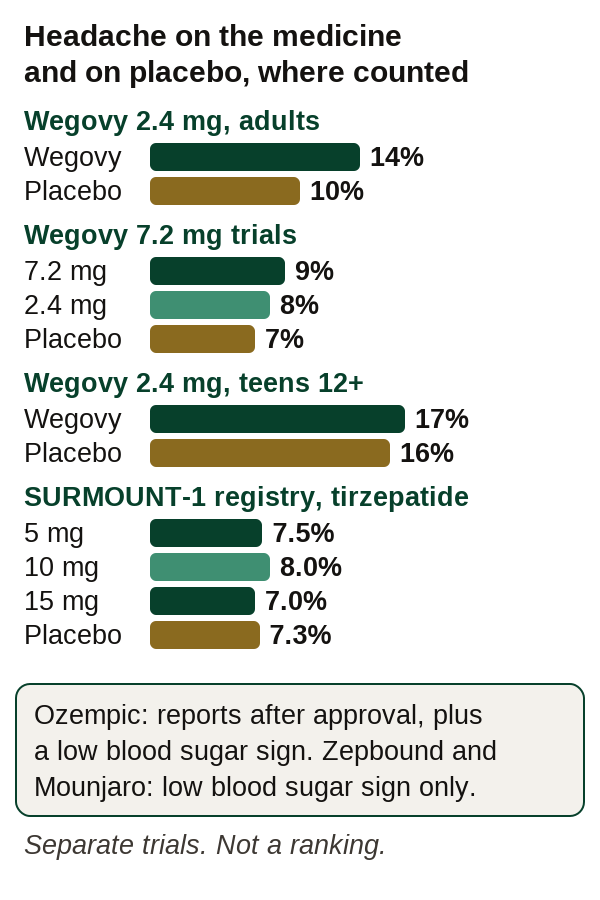
Wegovy 2.4 mg weekly, adults in weight trials (Table 3)
14% vs 10%
Wegovy 7.2 mg weekly trials (Table 4)
9% on 7.2 mg, 8% on 2.4 mg, 7% on placebo
Wegovy 2.4 mg weekly, teens 12 and older (Table 5)
17% vs 16%
Ozempic 0.5 mg or 1 mg, adults with type 2 diabetes
Not listed in the label’s common reactions table; listed among reports after approval, with no rate, and as a possible low blood sugar sign in the Medication Guide
Zepbound 5, 10 or 15 mg, adults in weight trials
Not listed as a side effect; only as a possible low blood sugar sign in the Medication Guide
Mounjaro 5, 10 or 15 mg, adults with type 2 diabetes
Not listed as a side effect; only as a possible low blood sugar sign in the Medication Guide
The twist: the brand in the search term barely lists headache. Where it was counted, placebo groups had headaches too: 10 in 100 adults on placebo in the Wegovy weight trials versus 14 in 100 on the medicine, one of that label’s most common side effects. SURMOUNT-1, one of the Lilly-sponsored trials behind the Zepbound label, registered headache in about 7% on placebo and 7% to 8% on each tirzepatide dose through week 193. Everyone in these weight trials also got diet and activity counseling, and results varied from person to person.
A Novo Nordisk-funded Danish registry study of 189,392 adults starting semaglutide for weight loss found triptan (migraine medicine) use about 7% below its rising pretreatment trend a year later, mostly among existing users. It’s observational, not a reason to take a GLP-1 for headaches. Full lists: semaglutide side effects, tirzepatide side effects, and Mounjaro vs Zepbound.
Where headache was counted, placebo groups reported headaches too, so not every headache on a GLP-1 comes from the medicine. Registry counts are all reported events over up to 193 weeks, not label reaction rates.
Why semaglutide or tirzepatide headaches happen: four things to check
No label explains why, so here are four sourced drivers.
Fluids
All four Medication Guides warn that nausea, vomiting, and diarrhea can dehydrate you and say to drink fluids. MedlinePlus lists headache among the signs of mild to moderate dehydration, with thirst, darker urine, and urinating less. If nausea or burping makes drinking hard, sip still water between meals; our Ozempic burps guide has a meal plan for stomach side effects. If vomiting keeps happening, it can also wear tooth enamel; see Ozempic teeth.
Food and low blood sugar
All four Medication Guides list headache among the possible signs of low blood sugar, a risk that’s higher with insulin or a sulfonylurea. The NIH notes that skipping or delaying meals can drop blood sugar in people on those medicines. Without diabetes it wasn’t tracked systematically, but Zepbound’s trial in adults without diabetes reported a reading below 54 mg/dL in 0.3% versus none on placebo, and the Wegovy label names past weight loss surgery as a risk factor. Tired too? See fatigue on a GLP-1.
Caffeine
If your caffeine habit changed with your appetite, watch for withdrawal. MedlinePlus says stopping regular caffeine suddenly can cause headaches that usually pass in a couple of days, and too much caffeine can cause them too. Our suggestion, not a tested rule: change caffeine gradually. For how much coffee fits on a GLP-1, see Ozempic and coffee.
Blood pressure
Both weight-loss labels report low blood pressure more often on the medicine: 1.3% versus 0.4% on Wegovy (fainting 0.8% versus 0.2%) and 1.6% versus 0.1% on Zepbound, more often with blood pressure medicine or fluid loss. The labels don’t link it to headache. If you take blood pressure medicine and feel dizzy with a headache, tell your prescriber rather than changing the pills yourself.
The dose-week headache log for an Ozempic headache
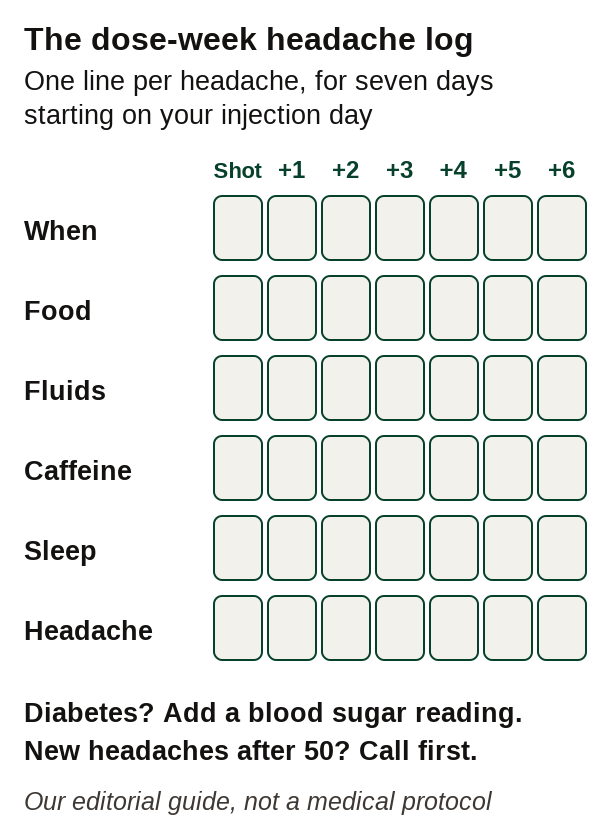
The dose-week log is our editorial guide, not a medical protocol or a MeliOra rule. It builds on the headache diary MedlinePlus recommends and adds what the labels point to: your injection day, fluids, and caffeine. Start on your injection day and keep it for seven days, one line per headache:
When: the time, and days since your last injection.
Food: when you last ate, and any skipped or delayed meal.
Fluids: roughly how many glasses since waking, and any vomiting or diarrhea.
Caffeine: today’s coffee, tea, soda, or energy drinks versus your usual.
Sleep: hours last night.
The headache: where, how long, what you took, and what helped.
With diabetes, add a blood sugar reading at each headache. New headaches after 50? Call before you start the log.
One line per headache for seven days, starting on your injection day, gives your prescriber a pattern instead of a guess.
How to read your week
Low-fluid or vomiting days point to fluids.
Skipped or late meals point to food.
Mornings with less caffeine than usual point to caffeine.
Shakiness, sweating, or a low reading on diabetes medicine points to low blood sugar.
Headaches bunched after an injection or dose increase are a pattern to show your prescriber.
Used pain relievers on 3 or more days? Say so: MedlinePlus warns that can cause rebound headaches. Bring the log to your next visit; don’t wait out the week if a headache worsens or matches a sign below. For steady meals, see what to eat on semaglutide.
Starting semaglutide or tirzepatide? Dr. Espinet’s monthly plans include dose adjustments and check-ins. Book a weight loss consultation, or start by video anywhere in Florida.
Who should be careful, and when to see a professional instead
Serious causes of headache are rare, MedlinePlus notes, but the table below sorts the emergencies. All four labels carry a boxed warning about thyroid C-cell tumors seen in rodents; whether they happen in people isn’t known. None of these medicines should be used with a personal or family history of medullary thyroid carcinoma (MTC), with MEN 2, or after a serious allergic reaction to the drug.
Talk to your prescriber first if any of these apply
You take insulin or a sulfonylurea, which raise the risk of low blood sugar.
You’ve had pancreatitis, gallbladder or kidney disease, a stomach-emptying problem, or weight loss surgery.
You have surgery or sedation coming up; tell the team you take a GLP-1.
You have or have had an eating disorder, or you’re pregnant, planning a pregnancy, or breastfeeding.
With kidney disease or after vomiting, ask which pain reliever fits; the labels warn that dehydration can injure the kidneys. Headaches in pregnancy or after delivery have their own row below. For weight loss, the Wegovy and Zepbound labels say to stop once pregnancy is recognized; ACOG’s October 2026 advisory suggests considering a stop 1 to 2 months before conception. See tirzepatide, birth control, and pregnancy.
When to get care: warning signs
Sorted by urgency; headache rows follow MedlinePlus.
Warning sign
What it can mean and what to do
A sudden, explosive headache, or the worst headache of your life
Call 911 or go to the nearest emergency room. It can mean bleeding in or around the brain
Headache with sudden numbness or weakness of the face, arm, or leg (especially one side), a drooping face, slurred speech or trouble understanding, confusion or memory loss, trouble seeing in one or both eyes, or sudden trouble walking, dizziness, or loss of balance
Possible stroke. Call 911 right away
Headache with fever and a stiff neck, with or without nausea and vomiting
Possible brain infection such as meningitis. Call 911 or go to an emergency room now
Sudden vision loss in one eye (often noticed on waking), blurred or missing patches of vision, faded or distorted colors, or eyesight that gets worse quickly
Call 911 or go to an emergency room now, and don’t drive yourself. The FDA links GLP-1 medicines to NAION, a rare optic nerve problem
Swelling of the face, lips, tongue, or throat, trouble breathing or swallowing, severe rash or itching, fainting or feeling dizzy, or a very fast heartbeat
A serious allergic reaction. Stop the medication and call 911 or go to an emergency room
Low blood sugar you can’t treat yourself, passing out, or a seizure, if you take insulin or a sulfonylurea
Someone should call 911
Thoughts of harming yourself
Call or text 988, the Suicide and Crisis Lifeline, right away. If you might act on them or are in immediate danger, call 911
A first headache ever that disrupts your day, one after a head injury, a severe headache in one red eye, one that keeps getting worse over 24 hours, new headaches if you’re over 50, have had cancer, or have a weakened immune system, or headaches with vision problems or jaw pain when chewing
Seek medical help right away
During pregnancy or up to 6 weeks after delivery: a headache that won’t go away or gets worse, vision changes, or swelling of the hands and face
Possible preeclampsia. Call your OB-GYN or midwife right away
Severe stomach pain that will not go away, sometimes reaching the back, with or without vomiting
Possible pancreatitis. Stop the medication and call your provider right away; if you can’t reach them quickly, go to an emergency room, not urgent care
Pain in the upper stomach, fever, yellow skin or eyes, or clay-colored stools
Possible gallbladder problems. Gallstones were reported in 1.6% on Wegovy injection vs 0.7% on placebo and in 1.1% on Zepbound vs 1%; an inflamed gallbladder in 0.6% vs 0.2% and 0.7% vs 0.2%. Call your provider right away; if you can’t reach them quickly, go to an emergency room, not urgent care
Nausea, vomiting, or diarrhea that will not go away, or not being able to keep fluids down
Dehydration, which can lead to kidney problems. Sip fluids if you can and call your provider right away. Go to the emergency room now if you can’t keep fluids down, are barely urinating, your urine is very dark, you feel dizzy or lightheaded, or your heart is racing. Call 911 if you become confused or pass out. If you have kidney disease, call at the first sign
You took too much, or took a dose twice
Call your provider or Poison Help at 1-800-222-1222, or go to the nearest emergency room right away
Shakiness, sweating, dizziness, confusion or drowsiness, headache, blurred vision, slurred speech, hunger, or a fast heartbeat
Possible low blood sugar, more likely with insulin or a sulfonylurea. Treat it as your prescriber taught you, then call them
Heart racing or pounding at rest for several minutes
Increased heart rate, which the Wegovy label says to report
A lump or swelling in the neck, hoarseness, trouble swallowing, or shortness of breath
Possible thyroid tumor, the risk behind the labels’ boxed warning
Vision changes in someone with type 2 diabetes
Possible worsening of diabetic eye disease
If something feels wrong, call your prescriber, and tell any emergency team which medicine you take.
How MeliOra handles headaches and other GLP-1 side effects
Dr. Melanie Espinet, a board-certified family medicine physician, prescribes weekly semaglutide or tirzepatide injections, not pills. She screens for eating disorders before prescribing, and if support from a dietitian or therapist would help, she discusses it at your consultation.
Semaglutide weight loss starts at $150/month, or $240/month at higher dosing, and tirzepatide weight loss runs $230 to $320/month. Each price includes in-home physician visits, lab work, the medication and supplies, and dose adjustments and check-ins, with no consultation fee. At any house call, including ours, ask how the product was stored on the way and what the plan is for a serious reaction. Anywhere in Florida, telehealth weight loss swaps in-home visits for video visits and ships the medication home at the same monthly price.
Dr. Melanie Espinet prescribes semaglutide and tirzepatide, with dose adjustments and check-ins included in every monthly plan.
Frequently asked questions about Ozempic headache
Does Ozempic cause headaches?
The Ozempic label doesn’t list headache in its common side effects table; it lists it among reports after approval, with no rate, and as a low blood sugar sign in its Medication Guide. Wegovy, the same medicine at higher doses, reports 14% on 2.4 mg versus 10% on placebo.
Why do I get headaches on Mounjaro or tirzepatide?
The Mounjaro and Zepbound labels don’t list headache as a side effect. Their Medication Guides list it as a possible low blood sugar sign, more likely with insulin or a sulfonylurea. Dehydration from nausea or vomiting, missed meals, and caffeine changes are other possible causes.
How long do semaglutide headaches last?
No label reports how long headaches last on semaglutide or tirzepatide. MedlinePlus says caffeine withdrawal headaches usually pass within a couple of days. A headache that keeps getting worse over 24 hours, or any headache with weakness, confusion, or vision changes, needs medical help right away.
What helps a headache on a GLP-1?
Drink fluids steadily, as all four Medication Guides advise, and with insulin or a sulfonylurea, don’t skip or delay meals, as the NIH warns. Keeping caffeine steady is our suggestion. Ask your prescriber which pain reliever fits, especially with kidney disease, and mention pain relievers used 3 or more days a week.
When is a headache on Ozempic an emergency?
Call 911 for a sudden, explosive headache, the worst of your life, or a headache with weakness, numbness, slurred speech, confusion, vision loss, or fever with a stiff neck. During pregnancy or after delivery, a headache that won’t go away needs a call to your OB-GYN or midwife right away.