The short answerOzempic teeth is a social media nickname, not a diagnosis, for dry mouth, worn or sensitive teeth, and new cavities some people report on GLP-1 medicines. No study shows semaglutide or tirzepatide harms teeth directly. But vomiting and reflux are label side effects, and acid and a dry mouth are known enamel risks, so the risk is plausible, and simple habits may lower it.
Ozempic is the popular name; it’s one brand of semaglutide. At MeliOra, Dr. Melanie Espinet prescribes weekly semaglutide and tirzepatide for medical weight loss; label facts below describe the brand-name products studied. This is general information, not medical advice. Swelling in your neck or under your tongue, trouble swallowing or breathing, or severe stomach pain needs care now.
What is Ozempic teeth?
Ozempic teeth is an umbrella term for mouth complaints people link to GLP-1 medicines: dry mouth, a coated tongue, tooth sensitivity, enamel wear, gum irritation, and sudden cavities. It isn’t a diagnosis, and no drug label lists it.
A 2026 dental review by Julia Bijoch, with no outside funding, names three proposed causes: less saliva, acid from vomiting and reflux, and changed eating habits. It grades each claim by the strength of its evidence. The face version of the trend has its own guide: Ozempic face.
Does Ozempic damage teeth? What’s shown and what’s only plausible
No trial has tested it. A 2026 Journal of Dental Research appraisal found no prospective study with a dental outcome in people taking GLP-1s, and a 2026 scoping review of 12 randomized semaglutide trials found that none studied oral or dental outcomes; one trial listed dental caries and one listed dry mouth among its side effects.
Claim
What the evidence shows
GLP-1 medicines cause vomiting and reflux
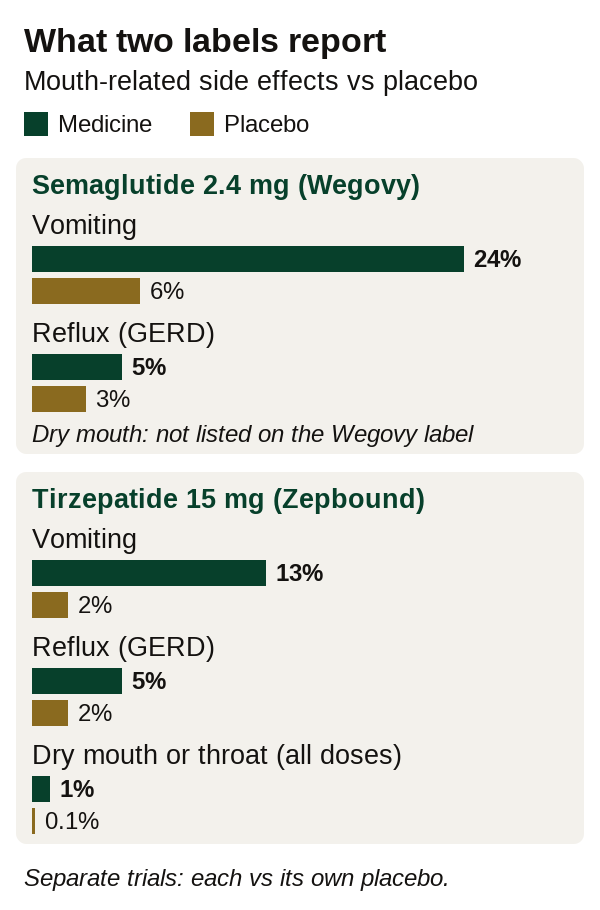
Shown. Wegovy label: vomiting 24% vs 6% on placebo, reflux 5% vs 3%. Zepbound label: vomiting 8% to 13% vs 2%, reflux 4% to 5% vs 2%. Ozempic label: vomiting 5% and 9.2% vs 2.3%
Stomach acid wears away enamel
Shown in general dental research. The ADA says acid from reflux or frequent vomiting can cause lasting erosion. How often it happens on a GLP-1 hasn’t been measured
GLP-1 medicines cause dry mouth
Partly shown. The Zepbound label reports dry mouth or dry throat in 1% vs 0.1% on placebo; the Wegovy, Ozempic, and Mounjaro labels don’t list it. Semaglutide has a reporting signal and a three-patient case series, while a 2026 records study found salivary conditions recorded less often in GLP-1 users
Less saliva raises the risk of decay
Shown in general: saliva carries minerals that help keep teeth strong. The size of any GLP-1 effect is unknown
GLP-1 medicines make teeth fall out
Not shown. In a 2026 health records study of 226,485 users, reflux was the only condition on its list that was more common than in matched non-users
That records study, by Oyewole and Owosho, matched each GLP-1 user with a non-user of the same age and sex; it’s observational, so it can’t prove cause. A 2026 analysis of FDA adverse event reports found a dry mouth signal for semaglutide and vomiting and reflux signals for all five GLP-1 medicines it checked, but such reports can’t show how often anything happens. For the stomach side, see semaglutide side effects and Ozempic burps.
Each medicine is compared only with its own placebo, because the trials were separate.
The Acid, Dry, Skip check: three habits that put teeth at risk
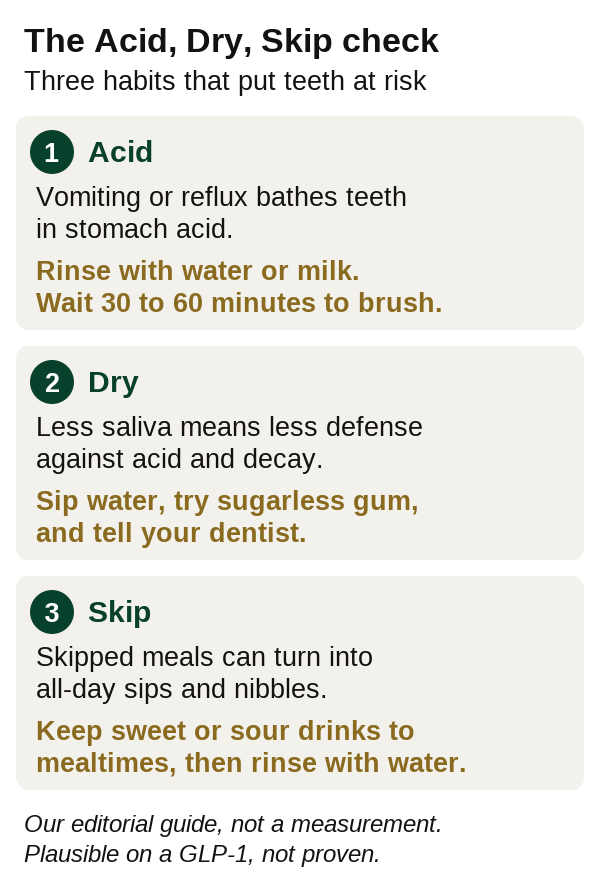
Here’s our editorial check. It rests on the label side effects above and general dental guidance, not a GLP-1 dental trial, and it isn’t a MeliOra protocol.
Acid: vomiting, reflux, and brushing too soon
Vomiting and reflux bring stomach acid into your mouth. The American Dental Association says that acid can dissolve tooth mineral for good, warns against brushing right after vomiting, and advises rinsing with water, a baking soda rinse, or milk instead. The 2026 review suggests waiting 30 to 60 minutes to brush, so you don’t scrub acid-softened enamel. The ADA also names frequent sodas as a main cause of erosion.
Dry: Ozempic dry mouth and less saliva
Saliva protects teeth: the National Institute of Dental and Craniofacial Research (NIDCR) says saliva washes food away and carries calcium and phosphate that help fight decay. The 2026 review proposes that saliva may drop on a GLP-1 because people feel less thirsty and drink less, and vomiting and diarrhea cost fluid, but no trial has measured saliva flow in people taking these medicines.
In a 2023 case series with no outside funding, three women developed severe dry mouth about 4 weeks after starting semaglutide; saliva returned after stopping the drug, a saliva-boosting medicine, or symptom care. A case series can’t show how often this happens. NIDCR suggests plenty of water, sugarless gum, and no tobacco or alcohol. For drinks that suit a smaller appetite, see what to eat on semaglutide.
Skip: skipped meals and all-day sipping
When appetite drops, some people skip meals and sip or nibble all day instead. NIDCR explains that sugars and starches feed mouth bacteria that make acid, and teeth exposed again and again keep losing minerals. The 2026 review flags carbohydrate grazing as a cavity risk, while noting that eating less overall can also mean less sugar, so the net effect varies.
Acid: after vomiting, rinse with water, a baking soda rinse, or milk, and wait 30 to 60 minutes to brush.
Dry: sip water through the day, try sugarless gum, which can ease a dry mouth (NIDCR), and tell your dentist if your mouth stays dry. Chewing gum adds swallowed air and the sugar alcohols in sugar-free gum can add gas (NIDDK), so if burping or bloating is the bigger problem, cut back on gum and sip water instead.
Skip: keep soda, juice, and other sweet or sour sips to mealtimes, then rinse with water.
Tell your dentist you take a GLP-1, and tell your prescriber if vomiting or reflux keeps happening.
Each habit maps to one cause in the 2026 dental review: acid, less saliva, or changed eating.
Fighting nausea or vomiting on a GLP-1? Call the prescriber who manages your dose first, especially if vomiting keeps happening. If you’re still choosing a program, book a weight loss visit with Dr. Espinet; dose adjustments and check-ins are part of the monthly price.
Ozempic and dental work: what to tell your dentist
Tell your dentist the medicine, the dose, and how often you feel sick or vomit. The 2026 review asks dentists to record that at every visit and to check the inner surfaces of the upper teeth, where acid from vomiting shows first. It suggests extra fluoride for people at higher risk, and a note to your prescriber when tooth wear suggests frequent vomiting.
The Wegovy and Zepbound labels report rare cases of stomach contents reaching the lungs under general anesthesia or deep sedation, because these medicines slow stomach emptying, and say to tell your providers before any planned procedure. The review says current society guidance favors weighing each person’s risk over routine stopping. Don’t stop your dose on your own; see Ozempic before surgery for timing.
Who should be careful, and when to see a professional instead
Your teeth face more risk on a GLP-1 if you vomit often, have reflux, take other medicines that dry the mouth, such as antihistamines or decongestants, or have receding gums, which expose roots to decay. Tell your prescriber, at MeliOra Dr. Espinet, about any past or present eating disorder. She screens for eating disorders before prescribing, and if support from a dietitian or therapist would help, she discusses it at your consultation.
When to see your dentist instead
Your dentist, not your weight loss prescriber, treats teeth and gums. These signs come from MedlinePlus and NIDCR:
Mouth sign
Who to see
Swelling under the tongue or in the neck, trouble swallowing or breathing, or drooling, often after a tooth infection
Call 911 or go to an emergency room right away. A spreading mouth infection can block the airway
Tooth pain with a fever, or swelling in your face or jaw
See a dentist today. If you can’t, go to urgent care or an emergency room; MedlinePlus calls a swollen jaw a very serious symptom. Call 911 if the swelling spreads to your neck or under your tongue, or you have trouble swallowing or breathing
A severe toothache, one lasting more than a day or two, or tooth pain with an earache or pain opening your mouth wide
Get care promptly. Your dentist is the right first call for most toothaches
A throbbing toothache that won’t go away, or a bubble or pimple on your gum
Call your dentist. These can be signs of an abscess
Dry mouth that won’t go away, new sensitivity to sweets, hot, or cold, or white spots on your teeth
See your dentist. Early decay can be stopped or reversed before it becomes a cavity
Swelling of the face, lips, tongue, or throat, trouble breathing or swallowing, severe rash or itching, fainting or feeling dizzy, or a very rapid heartbeat
A serious allergic reaction. Stop the medication and get medical help right away: call 911 or go to an emergency room
Low blood sugar you can’t treat yourself, passing out, or a seizure, if you take insulin or a sulfonylurea
Someone should call 911
Thoughts of harming yourself
Call or text 988, the Suicide and Crisis Lifeline, right away. If you might act on them or are in immediate danger, call 911
Sudden vision loss or a sudden dark or blurry area in one eye (often noticed on waking), faded or distorted colors, or eyesight that gets worse quickly
Call 911 or go to an emergency room now, and don’t drive yourself. The FDA warns of a possible increased risk of NAION, a rare optic nerve problem, with GLP-1 medicines
Severe stomach pain that will not go away, sometimes reaching the back, with or without vomiting
Possible pancreatitis. Stop the medication and call your provider right away; if you can’t reach them quickly, go to an emergency room, not urgent care
Pain in the upper stomach, fever, yellow skin or eyes, or clay-colored stools
Possible gallbladder problems. Gallstones were reported in 1.6% on Wegovy injection vs 0.7% on placebo. Call your provider right away; if you can’t reach them quickly, go to an emergency room, not urgent care
Nausea, vomiting, or diarrhea that will not go away, or not being able to keep fluids down
Dehydration, which can lead to kidney problems. Drink fluids and call your provider right away. Severe dehydration is an emergency: go to the emergency room now if you can’t keep fluids down, are barely urinating, your urine is very dark, you feel dizzy or lightheaded, or your heart is racing. Call 911 if you become confused or pass out. If you have kidney disease, call at the first sign
You took too much, or took two doses close together
Call your prescriber or Poison Help at 1-800-222-1222, or go to an emergency room right away
A lump or swelling in the neck, hoarseness, trouble swallowing, or shortness of breath
Possible thyroid tumor, the risk behind the label’s boxed warning
Shakiness, sweating, confusion, or a fast heartbeat in someone with diabetes
Low blood sugar
Heart racing or pounding at rest for several minutes
Increased heart rate, which the label says to report
Vision changes in someone with type 2 diabetes
Possible worsening of diabetic eye disease
No list covers everything. If something feels wrong, call your prescriber, and tell any emergency team which GLP-1 you take. A boxed warning about thyroid tumors in rodents rules these medicines out for anyone with a personal or family history of medullary thyroid carcinoma or MEN 2. See GLP-1 side effects for more.
How MeliOra fits: weekly semaglutide or tirzepatide with a physician
MeliOra doesn’t offer dental care. Dr. Melanie Espinet, a board-certified family medicine physician, prescribes weekly semaglutide or tirzepatide injections; the monthly price includes in-home physician visits, lab work, the medication and supplies, and dose adjustments and check-ins, with no consultation fee. Raise vomiting, reflux, or dry mouth at check-ins.
Semaglutide weight loss starts at $150/month, or $240/month at higher dosing, and tirzepatide weight loss runs $230 to $320/month. Dr. Espinet makes house calls across Hillsborough, Pasco, and Pinellas counties with no travel fee, and sees select appointments at the Lutz office. At any house call, including ours, ask how the product was stored on the way and what the plan is for a serious reaction. Anywhere in Florida, you can choose telehealth weight loss instead: video visits replace in-home visits, the medication ships to your home, and the monthly price is the same.
Frequently asked questions about Ozempic teeth
Does Ozempic ruin your teeth?
No study has shown that semaglutide damages teeth directly, and no trial has measured it. The risk is indirect: vomiting and reflux bring stomach acid to enamel, and a dry mouth leaves teeth less protected. Rinsing after vomiting, waiting to brush, sipping water, and checkups help.
Does Ozempic cause dry mouth?
Possibly. The Ozempic and Wegovy labels don’t list dry mouth, but FDA adverse event reports show a dry mouth signal for semaglutide, and a 2023 case series described three women whose saliva dropped after starting it. A 2026 records study found salivary conditions less often in GLP-1 users. Tell your dentist if it lasts.
Can I get dental work while on Ozempic?
Tell your dentist you take it before any dental work. The labels’ specific warning is about general anesthesia and deep sedation: because these medicines slow stomach emptying, stomach contents have rarely reached the lungs. Don’t stop your dose on your own; your dentist, anesthesia team, and prescriber decide.
Should I brush my teeth right after throwing up?
No. The American Dental Association warns against brushing right after vomiting. Rinse with water, a baking soda rinse, or milk instead, and a 2026 dental review suggests waiting 30 to 60 minutes before brushing, so you don’t scrub softened enamel. If vomiting keeps happening, call your prescriber.
Will my teeth recover if I stop Ozempic?
Dry mouth may ease; in a 2023 case series, saliva returned in all three patients, including the one who stopped. Lost enamel and cavities don’t grow back, so a dentist has to treat them. Early white spots can sometimes be reversed before a cavity forms, which is why an early checkup helps.