The short answerPhentermine is a daily stimulant pill, a Schedule IV controlled substance labeled for a few weeks. Semaglutide is usually a weekly GLP-1 injection labeled for long-term weight management. No trial compares them head to head, but the American College of Physicians’ 2026 guideline names semaglutide and tirzepatide first-line and doesn’t list phentermine alone.
Phentermine vs semaglutide usually comes up after someone has taken or been offered phentermine and wonders whether a GLP-1 shot would serve them better. MeliOra’s own care uses weekly injections, explained on our medical weight loss page.
Phentermine vs semaglutide at a glance
Phentermine compared with semaglutide
What the labels say
Phentermine
Semaglutide
What it is
A stimulant related to amphetamine
A GLP-1 receptor agonist that mimics a gut hormone regulating appetite
How you take it
A pill, usually once each morning, never late in the evening
One injection a week, or a daily tablet
How long it’s labeled for
Short-term, “a few weeks”
Long-term weight reduction and maintenance
Controlled substance
Yes, Schedule IV, with a warning about abuse and dependence
No
Main side effects
Fast heartbeat, higher blood pressure, restlessness, insomnia, dry mouth
Nausea, diarrhea, vomiting, constipation
With heart disease
Ruled out with a history of heart disease or stroke
The Wegovy label adds lower heart attack and stroke risk in adults with heart disease and excess weight
Plain phentermine vs Qsymia
Qsymia pairs up to 15 mg of phentermine, half the amount in a usual 37.5 mg tablet, with topiramate in one capsule, and unlike plain phentermine it’s labeled for long-term use. It’s also Schedule IV, and because topiramate can cause birth defects, it’s sold only through certified pharmacies, with monthly pregnancy tests for anyone who can become pregnant. In its 56-week trials, the top dose averaged 10.9% and 9.8% loss, against 1.6% and 1.2% on placebo.
Which leads to more weight loss? No head-to-head trial exists
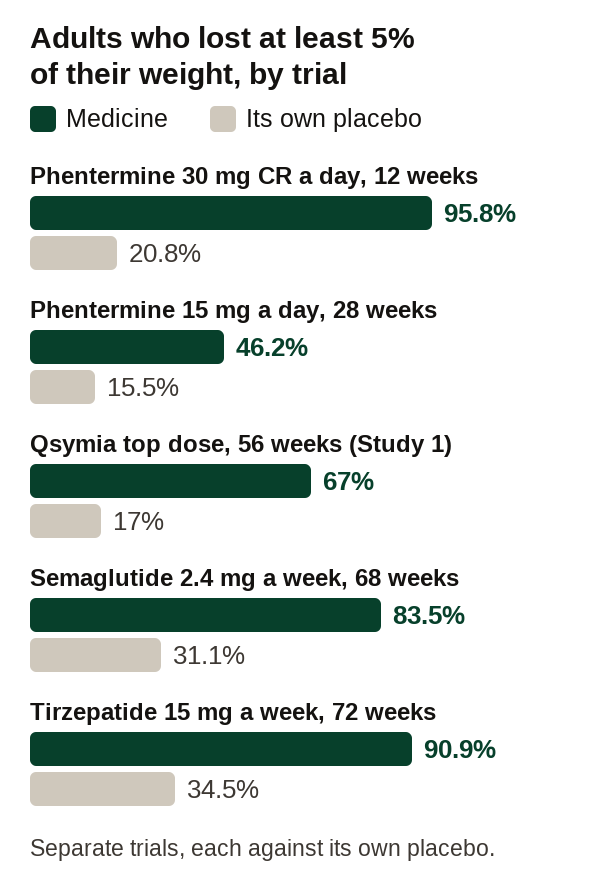
No trial has tested phentermine against semaglutide directly, so any comparison sets separate trials side by side. The fairest shared number is the share of adults who lost at least 5% of their weight, which each trial below reports against its own placebo.
Each pair is its own trial, with different lengths and people, so compare each medicine with its own placebo, not the bars with each other.
Full-dose phentermine data are short: in a 12-week trial of 74 Korean adults, a 30 mg controlled-release capsule led to 8.1 kg average loss against 1.7 kg on placebo. Phentermine 15 mg, half the usual dose, ran 28 weeks. Semaglutide 2.4 mg ran 68 weeks, with 14.9% average loss against 2.4% on placebo.
What the 2026 guidelines say
The American College of Physicians’ 2026 guideline suggests semaglutide and tirzepatide as first-line weight loss medicines for adults with obesity and phentermine with topiramate as second-line; phentermine alone isn’t on its list. A joint 2026 statement from three obesity medicine groups gives semaglutide and tirzepatide strong recommendations and phentermine a conditional one. No randomized trial has yet reported phentermine’s long-term benefits and risks; LEAP, a 24-month trial of 870 adults, finished in September 2026 without published results. Tirzepatide, the other weekly option, also acts on GIP; see semaglutide vs tirzepatide.
How each one works: a stimulant vs a gut hormone
Phentermine is a sympathomimetic amine, chemically related to amphetamine. It’s called an appetite suppressant, though its label says it hasn’t been established that appetite suppression is its main action.
Semaglutide copies GLP-1, a hormone that helps regulate appetite and how much you eat. It acts on appetite areas of the brain and slows stomach emptying. It’s labeled for long-term use, and weight can return after stopping, as our guide to stopping semaglutide explains.
Side effects: what organ is phentermine hard on?
Phentermine’s main strain is on the heart and blood vessels. Its label lists palpitations, a fast heartbeat, higher blood pressure and heart or brain blood-flow events, plus rare heart valve disease and primary pulmonary hypertension, a serious lung blood-pressure disorder. The kidneys clear it, so the label caps the dose at 15 mg a day with severe kidney disease and says to avoid it with kidney failure or dialysis. It can also cause restlessness, insomnia, dry mouth and headache, and can impair driving.
Semaglutide’s side effects are mostly digestive. In the Wegovy trials, nausea affected 44% of adults (16% on placebo), diarrhea 30% (16%), vomiting 24% (6%) and constipation 24% (11%). Headache was reported by 14% (10% on placebo), and our Ozempic headache guide covers the usual causes. It raised resting heart rate by 1 to 4 beats a minute on average. Rarer risks include pancreatitis, gallbladder disease and dehydration, and it carries a boxed warning about thyroid tumors; our semaglutide side effects guide covers each one.
Why some doctors hesitate to prescribe phentermine
Its label covers “a few weeks,” while weight usually needs a longer plan.
It’s a Schedule IV controlled stimulant with a warning about abuse and dependence.
Tolerance builds within weeks, and the label says to stop it then, not push the dose higher.
It’s ruled out with heart disease, a past stroke, an irregular heartbeat or uncontrolled blood pressure.
No randomized trial has yet reported its long-term safety.
The Weeks-or-Years test: which one fits you?
Our editorial tool, built from the labels; not a medical evaluation.
1. How long will you need help?
If you expect to need medicine for a year or longer, a long-term option such as Qsymia or one of the weight loss injections fits that plan.
2. How are your heart, blood pressure and sleep?
Heart disease, a past stroke, an irregular heartbeat, uncontrolled blood pressure, an overactive thyroid, glaucoma or agitation rule phentermine out, and it can cause restlessness and insomnia. None of those rule semaglutide out, though it raises resting heart rate, so a rhythm problem still needs a careful talk.
3. How is your stomach?
Semaglutide’s side effects are digestive, so pancreatitis, gallbladder disease or severe gastroparesis (very slow stomach emptying) need a careful talk first.
4. What else do you take, and are you planning a pregnancy?
Phentermine can’t be taken within 14 days of an MAOI antidepressant, its label advises against pairing it with SSRI antidepressants or other weight loss products and warns about alcohol, and both medicines can change insulin or diabetes-pill needs. Neither is for pregnancy: phentermine is contraindicated, and the semaglutide label says to stop at least 2 months before a planned pregnancy.
5. What can you spend, and how do you feel about needles?
Phentermine’s low cost is a big part of its appeal; a GLP-1 is a monthly cost for as long as you take it. If needles are a dealbreaker, Qsymia and the GLP-1 tablets in our Wegovy pill vs injection guide are pills, as is Lilly’s Foundayo, though MeliOra’s GLP-1 care uses weekly injections. Our guide to Foundayo vs the Wegovy pill compares those two GLP-1 tablets.
If a long-term weekly option fits your answers, book a weight loss consultation with Dr. Espinet. She prescribes semaglutide or tirzepatide and tells you if a GLP-1 isn’t right for you.
Who should not take either one, and when to get help
Phentermine’s label rules it out with a history of heart disease (coronary artery disease, stroke, arrhythmia, heart failure or uncontrolled high blood pressure), an MAOI in the past 14 days, an overactive thyroid, glaucoma, agitated states, a history of drug abuse, pregnancy, nursing, or an allergy to stimulant drugs, and it isn’t recommended for anyone 16 or younger.
Semaglutide isn’t for anyone with a personal or family history of medullary thyroid carcinoma (MTC) or multiple endocrine neoplasia type 2 (MEN 2), or a serious allergy to it. Tell your prescriber about pancreatitis, gallbladder or kidney problems, diabetic eye disease, insulin or sulfonylurea use, breastfeeding, and planned surgery. Mention any eating disorder: a 2026 expert consensus says to generally avoid GLP-1 medicines during an active one and to take care after one.
If you notice
What to do
Chest pain or pressure, fainting, sudden weakness or numbness, trouble speaking, or a sudden severe headache
Call 911
Swelling of the face, lips, tongue, or throat, trouble breathing or swallowing, or a severe rash
Call 911 or go to an emergency room
New shortness of breath, exercise getting harder, or swelling in your legs or ankles on phentermine
Stop it and get checked today; the label warns of pulmonary hypertension
A racing or pounding heartbeat at rest that lasts several minutes, or high blood pressure readings or agitation on phentermine
Call your prescriber right away
Severe stomach pain that won’t go away, sometimes reaching your back
Stop semaglutide and call your prescriber right away; it can mean pancreatitis
Vomiting or diarrhea that won’t stop
Call your prescriber right away; losing fluids can harm the kidneys
Upper stomach pain, fever, yellow skin or eyes, or clay-colored stools
Call your prescriber; it can mean gallbladder problems
A lump or swelling in your neck, hoarseness, trouble swallowing, or shortness of breath; or vision changes with type 2 diabetes
Call your prescriber; these can be thyroid tumor or diabetic eye warning signs
Shakiness, sweating, or confusion if you also take insulin or a sulfonylurea
Possible low blood sugar: treat it as taught, then call your prescriber
Deep low mood or thoughts of self-harm, including after stopping phentermine or on Qsymia
Call or text 988; call 911 if you might act on them
Sudden eye pain, redness, or blurred vision on Qsymia
Get emergency care; its label warns of sudden glaucoma
Severe side or back pain, blood in your urine, fever with little sweating, or a possible pregnancy on Qsymia
Call your prescriber right away; stop Qsymia if you might be pregnant
If you can’t reach your prescriber quickly about severe stomach pain, fever, or yellow skin, go to urgent care or an emergency room. This is general information, not medical advice.
Florida’s rule for any weight loss prescription (64B8-9.012)
Florida Board of Medicine Rule 64B8-9.012 covers any drug, supplement, or herbal treatment used for medical weight loss, so it applies to phentermine and semaglutide alike. Under it, a prescribing physician must:
Confirm a BMI of 30 or more, over 27 with at least one weight-related condition, or high measured body fat (25% for men, 30% for women).
Make sure you have an initial evaluation first: a physical exam, a full history, and tests related to weight loss treatment.
Get your written informed consent, covering benefits and risks, before prescribing.
Make sure you’re re-evaluated at least once every 3 months.
Give you a copy of Florida’s Weight-Loss Consumer Bill of Rights.
The rule also treats weight loss ads as misleading if they promise specific results, raise unreasonable expectations, claim rapid, dramatic, incredible, or safe weight loss, or suggest diet and exercise aren’t needed or that weight loss is effortless. Both labels pair the medicine with a reduced-calorie diet and more activity. For the visit itself, see how to get a semaglutide prescription.
The next-step hurdle: switching from phentermine to a GLP-1
Neither label gives a schedule for moving from phentermine to semaglutide, so your prescriber sets the timing. Phentermine’s label advises against combining it with other weight loss drugs, and semaglutide’s label advises against pairing it with another GLP-1.
Bring an honest history: how long you took phentermine, the dose, and how stopping felt. The label warns that stopping abruptly after long, high-dose use can bring extreme fatigue and depression. On Qsymia, the label says to taper the top dose over at least a week, because stopping suddenly can trigger a seizure.
Semaglutide then starts low: the Wegovy label begins at 0.25 mg a week and steps up every 4 weeks to the usual 2.4 mg dose from week 17.
How MeliOra fits: weekly GLP-1 care across Tampa Bay
MeliOra Elite Wellness offers physician-led weight loss built on weekly injections. Dr. Melanie Espinet, a board-certified family medicine physician, prescribes semaglutide or tirzepatide, so ask her which medication you would receive. MeliOra does not prescribe phentermine or Qsymia; if you take either or another weight loss medicine, tell her at your first visit. Trial results describe the brand-name products studied and may not reflect other semaglutide products.
Semaglutide weight loss starts at $150/month, or $240/month at higher dosing, and tirzepatide weight loss runs $230/month to $320/month. Each price includes physician visits, lab work, the medication and supplies, and dose adjustments and check-ins, with no consultation fee. MeliOra is a self-pay practice.
Dr. Espinet comes to your home or office across Hillsborough, Pasco, and Pinellas counties with no travel fee. Elsewhere in Florida, start with a telehealth weight loss visit at the same monthly price.
Frequently asked questions
Is semaglutide better than phentermine for weight loss?
For long-term weight loss, the evidence favors semaglutide, though no trial compares them directly. Semaglutide is labeled for long-term use and led to 14.9% average loss over 68 weeks, against 2.4% on placebo. Phentermine is labeled for a few weeks, and the 2026 American College of Physicians guideline doesn’t list it alone.
What organ is phentermine hard on?
Mainly the heart and blood vessels. Phentermine’s label lists a fast heartbeat, palpitations, higher blood pressure, and rare heart valve disease and pulmonary hypertension, and it isn’t for anyone with heart disease or a past stroke. The kidneys clear it, so severe kidney disease lowers the maximum dose, and kidney failure rules it out.
Why don’t doctors like to prescribe phentermine?
Some doctors hesitate because phentermine is a Schedule IV controlled stimulant labeled for only a few weeks, tolerance builds quickly, and its heart risks rule out many patients. No randomized trial has yet reported its long-term safety.
Can you take phentermine and semaglutide together?
Not as a routine plan. Phentermine’s label advises against combining it with other weight loss drugs because the safety of combinations hasn’t been established. In one small 12-week trial, adding phentermine to liraglutide, an older GLP-1, added little weight loss. Ask your prescriber before overlapping any two weight loss medicines.
What is the most effective weight loss pill?
No pill wins for everyone, and the trials differ. On their labels, the 25 mg Wegovy pill led to 13.6% average loss at 64 weeks, Foundayo’s top dose 11.1% at 72 weeks, and Qsymia’s top dose 10.9% at 56 weeks, against 2.4%, 2.1%, and 1.6% on placebo. MeliOra doesn’t prescribe GLP-1 pills.
Can I switch from phentermine to semaglutide?
Yes, with a prescriber setting the timing, since neither label gives a schedule for the switch. Semaglutide then starts at a low weekly dose that rises every 4 weeks.