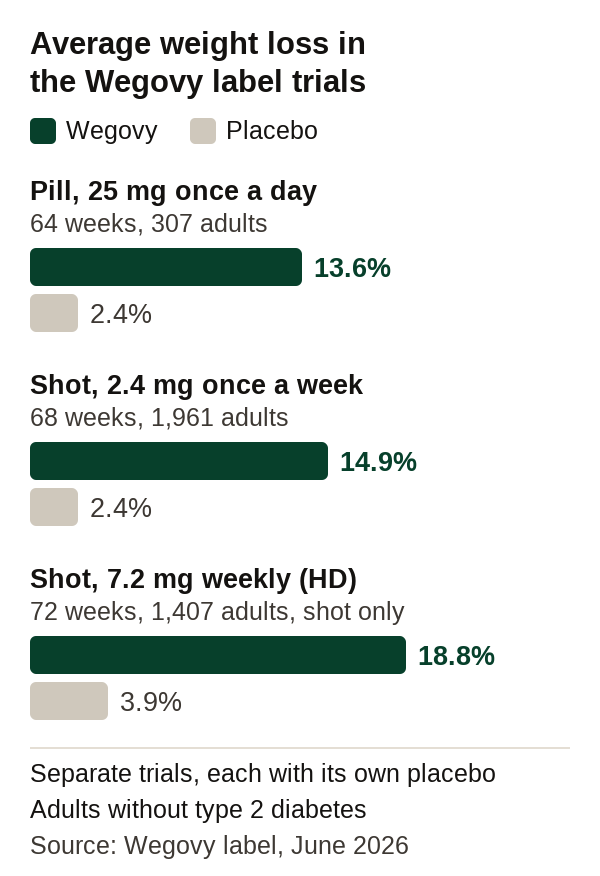
The short answerThe Wegovy pill and the Wegovy injection are the same medicine, semaglutide, in two forms. In separate trials, the 25 mg daily pill led to 13.6% average weight loss and the 2.4 mg weekly shot to 14.9%, each against 2.4% on placebo. The real differences: the pill’s morning routine, the shot’s 7.2 mg option, and price.
Wegovy pill vs injection became a real choice in December 2025, when the FDA added a once-daily tablet to the Wegovy label beside the weekly shot. We compare them using the June 2026 Wegovy prescribing information, which covers both. One disclosure: MeliOra’s own GLP-1 care uses weekly injections, and we do not prescribe GLP-1 pills. Our medical weight loss page explains that care.
Wegovy pill vs injection at a glance
Wegovy pill compared with the injection
What the label says
Wegovy pill
Wegovy injection
Active medicine
Semaglutide, plus an absorption enhancer called SNAC
Semaglutide in a single-dose pen or syringe, or a 4-dose FlexTouch pen
How often
Once a day
Once a week, on the same day
Food and timing
Morning, empty stomach, up to 4 oz of plain water, then a 30-minute wait
Any time, with or without meals
Usual full dose
25 mg a day
2.4 mg a week, or 7.2 mg for some adults
Weight loss vs placebo in its trial
13.6% vs 2.4% at 64 weeks
14.9% vs 2.4% at 68 weeks on 2.4 mg
Self-pay price from Novo, Nov 2026
$149 to $299 a month
$349 a month, $399 for 7.2 mg
Both forms share a boxed warning about thyroid tumors: neither is for anyone with a personal or family history of medullary thyroid carcinoma (MTC), or with multiple endocrine neoplasia syndrome type 2 (MEN 2). Both are labeled to lower heart attack and stroke risk in adults with heart disease and excess weight; only the injection is labeled for MASH, a scarring fatty liver disease. For the other semaglutide brands, see Wegovy vs Ozempic; for an older non-GLP-1 pill, see how phentermine compares.
Is the Wegovy pill as effective as the injection?
In adults without type 2 diabetes, the Wegovy pill and the Wegovy injection produced similar average weight loss in their own placebo-controlled trials, but the label includes no trial that compares the two forms directly.
Adults on the 25 mg pill lost 13.6% of their body weight on average at 64 weeks, against 2.4% on placebo. Adults on the 2.4 mg shot lost 14.9% at 68 weeks, also against 2.4% on placebo.
The trials differed in length and size (307 adults for the pill, 1,961 for the shot), so the small gap can’t rank the two forms. A 2026 indirect comparison funded by Novo Nordisk, which makes both, put the shot about 1 percentage point ahead, with a margin of error that included no difference, and called the forms comparable.
Each bar pair comes from a separate trial, so compare each form with its own placebo, not the bars with each other.
Type 2 diabetes changes the picture
Both trials above left out people with type 2 diabetes. Without diabetes, the label predicts that blood levels on the 25 mg pill match the 2.4 mg shot on average, though they vary more between people. With type 2 diabetes, average levels on the pill run lower (about 44 vs 68 nmol/L), the pill hasn’t been studied for weight loss, and the label suggests the injection if the pill isn’t working. Results build over months either way, as our semaglutide weight loss timeline shows.
Where the shot pulls ahead: the 7.2 mg dose
The injection has a dose the pill doesn’t: Wegovy HD, 7.2 mg once a week, for adults who have handled 2.4 mg for at least 4 weeks and need more weight loss. In a 72-week trial in adults without diabetes, 7.2 mg led to 18.8% average weight loss, against 15.5% on 2.4 mg and 3.9% on placebo. Across the two 72-week trials of 7.2 mg, side effects were more common: nausea in 39% (35% on 2.4 mg, 13% on placebo), vomiting in 22% (16% and 6%), and tingling or burning skin in 22% (6% and 0.3%).
How you take each one: the pill’s morning rule vs the weekly shot
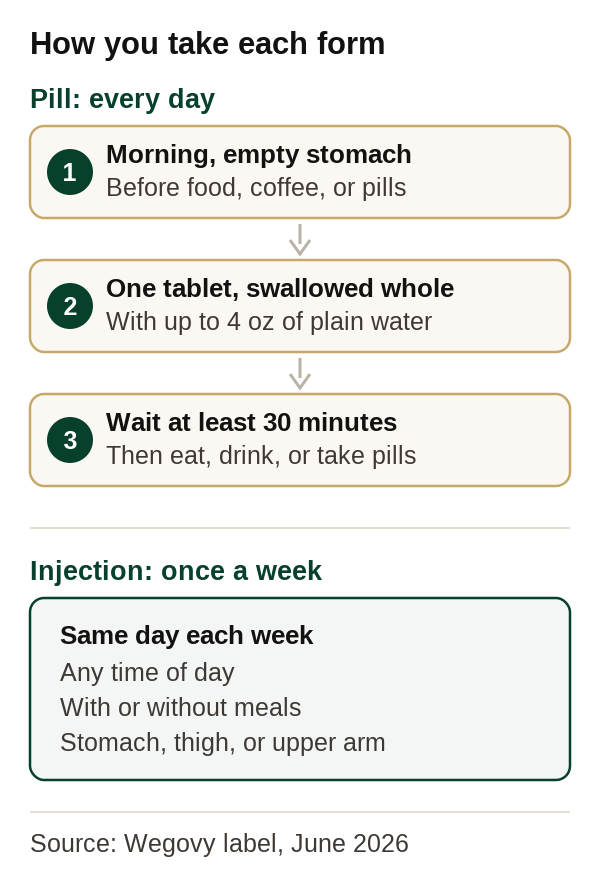
The pill’s routine is strict because the stomach absorbs very little of each tablet. The label’s steps:
Take it in the morning, on an empty stomach.
Swallow one tablet whole with up to 4 ounces of plain water, and no other drink.
Wait at least 30 minutes before you eat, drink anything else, or take other pills.
Never take more than one tablet a day.
The shot asks less of your day: one dose under the skin of the stomach, thigh, or upper arm, on the same day each week, at any time, with or without food. Never share a pen, even with a new needle.
The pill’s 30-minute wait happens every morning; the shot’s routine happens once a week.
Morning medicines and absorption
Wegovy slows stomach emptying, so it can change how other pills are absorbed. In a study with the semaglutide tablet, exposure to levothyroxine, a common thyroid medicine, rose 33%. That was measured with the tablet, but the label advises extra monitoring of medicines that need careful dosing with either form. If you take thyroid medicine or several morning pills, ask your prescriber how they would fit.
Storing each form in Florida heat
Heat is the shared risk in Tampa Bay. Single-dose pens belong in the refrigerator; before the cap comes off, one can stay out at 46°F to 86°F for up to 28 days. A FlexTouch pen, once in use, keeps up to 56 days at 59°F to 86°F or in the fridge. The Wegovy FlexTouch leaflet prints a narrower in-use range, 68°F to 77°F, than its label’s 59°F to 86°F, so plan around the narrower one. The label says to throw away any pen exposed to more than 86°F. Tablets stay at room temperature in the original closed bottle, somewhere dry. Neither belongs in a parked car. Taking a pen on a trip? See traveling with Ozempic for carry-on and time zone tips.
The 5 M check: which Wegovy form fits you?
Our editorial tool, built from the label’s facts. It doesn’t replace a medical evaluation.
1. Mornings
Can you take a tablet on an empty stomach and wait 30 minutes before coffee, breakfast, or other pills, every day? If not, the weekly shot has no food rule. For coffee on the weekly shot, see Ozempic and coffee.
2. Medicines
Have type 2 diabetes? The pill wasn’t studied for weight loss in diabetes, so ask whether the injection fits better. Take levothyroxine or other carefully dosed medicines? Either form needs monitoring, and the pill adds a timing rule.
3. Milestones
Breastfeeding or under 18? The pill isn’t recommended while breastfeeding and is labeled for adults only. Planning a pregnancy? With either form, the label says to stop at least 2 months before.
4. Maximum dose
Might you need the strongest option? Only the injection goes up to 7.2 mg.
5. Money
Self-pay pill prices start lower than the pen, and insurance can change that.
If a weekly injection fits your answers, book a weight loss consultation with Dr. Espinet. She prescribes semaglutide or tirzepatide, tells you if a GLP-1 isn’t right for you, and explains your medication at your visit.
Wegovy pill vs injection cost without insurance
At Novo Nordisk’s November 2026 self-pay prices, for local pharmacy pickup with Novo’s savings offer or NovoCare home delivery, the Wegovy pill costs $149 to $299 a month by dose, and the pen costs $349, or $399 for the 7.2 mg HD pen. Novo’s month is one 30-tablet bottle or one box of 4 weekly pens.
Dose
Novo self-pay price a month
Pill 1.5 mg (days 1 to 30)
$149
Pill 4 mg (days 31 to 60)
$199
Pill 9 mg (days 61 to 90)
$299
Pill 25 mg (usual full dose)
$299
Pen, any dose up to 2.4 mg
$349
HD pen, 7.2 mg
$399
Over about a year on the label’s dose steps, that is $3,338 for the pill (12 bottles, 360 days) and $4,537 for the pen (13 boxes, 52 weeks). That is our arithmetic from Novo’s price guide, not a quote.
With commercial insurance, Novo’s copay offer lists either form as low as $25 a month at a local pharmacy, with savings capped at $100 a month; government plans are excluded. Novo lists $50 a month for eligible Medicare patients through the Medicare GLP-1 Bridge program, with eligibility set by Medicare. Terms change, so check NovoCare first.
Who should not take either form, and when to get help
Beyond the thyroid warning above, neither form is for anyone who has had a serious allergic reaction to semaglutide or any of its ingredients. Stop if you become pregnant. Don’t combine Wegovy with any other GLP-1 medicine, and it isn’t recommended with severe gastroparesis, very slow stomach emptying.
Tell your prescriber first about pancreatitis, gallbladder disease, kidney problems, diabetic eye disease, insulin or sulfonylurea use, or planned surgery, since inhaling stomach contents during anesthesia has been reported with GLP-1 medicines. Mention any eating disorder too: a 2026 expert consensus says to generally avoid these medicines during an active eating disorder and to proceed cautiously after one.
Warning sign
What to do
Swelling of the face, lips, tongue, or throat, trouble breathing or swallowing, severe rash or itching, fainting or dizziness, or a very rapid heartbeat
A serious allergic reaction. Stop the medication and call 911 or go to an emergency room
Low blood sugar you can’t treat yourself, passing out, or a seizure, if you take insulin or a sulfonylurea
Someone should call 911
Thoughts of harming yourself
Call or text 988, the Suicide and Crisis Lifeline, right away. If you might act on them or are in immediate danger, call 911
Sudden vision loss in one eye (often noticed on waking), blurred or missing patches of vision, faded or distorted colors, or eyesight that gets worse quickly
Call 911 or go to an emergency room now, and don’t drive yourself. The FDA warns GLP-1s may raise the risk of NAION, a rare optic nerve problem
Severe stomach pain that will not go away, sometimes reaching the back, with or without vomiting
Possible pancreatitis. Stop the medication and call your prescriber right away; if you can’t reach them quickly, go to an emergency room, not urgent care
Pain in the upper stomach, fever, yellow skin or eyes, or clay-colored stools
Possible gallbladder problems. Call your prescriber right away; if you can’t reach them quickly, go to an emergency room, not urgent care
Vomiting or diarrhea that will not stop, or not being able to keep fluids down
Dehydration, which can lead to kidney injury. Call your prescriber right away. Go to the emergency room now if you can’t keep fluids down, are barely urinating, your urine is very dark, you feel dizzy or lightheaded, or your heart is racing. Call 911 if you become confused or faint. If you have kidney disease, call at the first sign
You took too much, or took a dose twice
Call your prescriber or Poison Help at 1-800-222-1222, or go to an emergency room right away
Shakiness, sweating, dizziness, confusion or drowsiness, headache, blurred vision, slurred speech, hunger, or a fast heartbeat
Possible low blood sugar, more likely with insulin or a sulfonylurea. Treat it as your prescriber taught you, then call them
Heart racing or pounding at rest for several minutes
Increased heart rate, which the Wegovy and Saxenda labels say to report. Call your prescriber
A lump or swelling in the neck, hoarseness, trouble swallowing, or shortness of breath
Possible thyroid tumor, the risk behind the labels’ boxed warning. Call your prescriber
Vision changes in someone with type 2 diabetes
Possible worsening of diabetic eye disease. Tell your prescriber
If you can’t reach your prescriber quickly about severe stomach pain, fever, or yellow skin, go to an emergency room, not urgent care. This is general information, not medical advice; our semaglutide side effects guide covers every warning sign.
The next-step hurdle: your first 3 to 4 months on either form
The dose climb is when stomach side effects are most likely:
Pill: 1.5 mg for days 1 to 30, 4 mg for days 31 to 60, 9 mg for days 61 to 90, then 25 mg
Shot: 0.25 mg, 0.5 mg, 1 mg, and 1.7 mg for 4 weeks each, then the full dose from week 17
If a step doesn’t agree with you, the label lets your prescriber delay the next one. Don’t raise, skip, or double doses on your own. If burping is the problem, our Ozempic burps guide has meal changes to test while you talk to your prescriber.
Missed doses work differently
Missed a pill? Skip it and take the next one tomorrow. Missed a shot? Take it if your next dose is more than 2 days away; otherwise skip it and keep your usual day. After 2 or more missed shots in a row, the label says to restart at a lower dose, so call your prescriber.
Switching between the pill and the shot
The label allows both directions. From the 2.4 mg shot, start the 25 mg pill one week after your last injection. From the 25 mg pill, start the 2.4 mg shot the next day, or 1.7 mg if the pill didn’t agree with you. Changing medicines is a separate decision, covered in switching from semaglutide to tirzepatide, and coming off treatment needs its own plan, as our guide to stopping semaglutide explains.
How MeliOra fits: weekly injections, physician-led, across Tampa Bay
MeliOra Elite Wellness does not prescribe the Wegovy pill or any GLP-1 pill. Dr. Melanie Espinet, a board-certified family medicine physician, prescribes semaglutide or tirzepatide as weekly injections, so ask her which medication you would receive. The trial results above describe the brand-name Wegovy products studied and may not reflect results with other semaglutide products.
Semaglutide weight loss starts at $150/month, or $240/month at higher dosing, and tirzepatide weight loss runs $230/month to $320/month. Each price includes physician visits, lab work, the medication and supplies, and dose adjustments and check-ins, with no consultation fee. MeliOra is a self-pay practice.
Dr. Espinet comes to your home or office across Hillsborough, Pasco, and Pinellas counties with no travel fee. Elsewhere in Florida, start with a telehealth weight loss visit at the same monthly price.
Frequently asked questions
Is the Wegovy pill as effective as the injection?
For adults without type 2 diabetes, close, on average. In separate trials on the Wegovy label, adults lost 13.6% of their body weight on the 25 mg daily pill and 14.9% on the 2.4 mg weekly shot, each against 2.4% on placebo. No trial compares them directly, and only the shot offers a 7.2 mg dose.
Can you switch from the Wegovy shot to the pill?
Yes, the label allows it. Adults on the 2.4 mg Wegovy shot can start the 25 mg pill one week after their last injection. Going the other way, the shot starts the day after the last tablet. Your prescriber chooses the dose, especially if the pill caused side effects.
Does the Wegovy pill have fewer side effects than the shot?
Not according to the label, which says the common side effects of the 25 mg pill were similar to the 2.4 mg shot, led by nausea, diarrhea, vomiting, and constipation. About 7% stopped the pill for side effects versus about 6% on placebo; in the shot trials it was 6.8% versus 3.2%.
Why is the Wegovy pill dose so much higher than the shot?
Because the stomach absorbs very little of it. The label estimates that about 1% to 2% of the semaglutide in a tablet reaches the bloodstream, compared with 89% from a shot. That is why the full pill dose is 25 mg a day while the usual shot dose is 2.4 mg a week.
Does MeliOra prescribe the Wegovy pill?
No. MeliOra does not prescribe GLP-1 pills. Dr. Espinet prescribes semaglutide or tirzepatide as weekly injections, with house calls across Tampa Bay, select appointments at the Lutz office, and telehealth visits anywhere in Florida. At any house call, including ours, ask how the product was stored on the way and what the plan is for a serious reaction. Ask her at your visit which medication you would receive and why.