The short answerFor most adults, yes. No Ozempic label lists an interaction with coffee or caffeine, and the weekly shot can be taken with or without meals. Ozempic tablets differ: water only with the tablet, then wait at least 30 minutes before coffee. The catch is overlap: too much caffeine and semaglutide can both bring nausea, headache, and a faster heartbeat. Stay within the 400 mg a day the FDA cites, drink it with food, and watch the sugar.
Ozempic is the brand most people search, so we use the name here. It’s semaglutide for type 2 diabetes, as a weekly shot or a daily tablet; Wegovy is semaglutide for weight. MeliOra prescribes weekly semaglutide or tirzepatide, not these brands; see semaglutide weight loss in Lutz. Label facts describe the brand-name products. This is general information, not medical advice.
Can you drink coffee on Ozempic?
Yes, for most adults. The prescribing information for the weekly Ozempic, Wegovy, Zepbound, and Mounjaro shots never mentions coffee or caffeine, and each says the shot can be taken any time of day, with or without meals. Tablets are the exception; see the tablet rule below.
Ozempic’s drug interaction section names two things: insulin or a sulfonylurea, which raise the risk of low blood sugar, and oral medicines, because semaglutide slows how fast the stomach empties. In the label’s studies, semaglutide didn’t change pill absorption to any clinically relevant degree, but the label still advises caution with oral medicines. The real issue is overlap.
Caffeine and semaglutide: the overlap problem
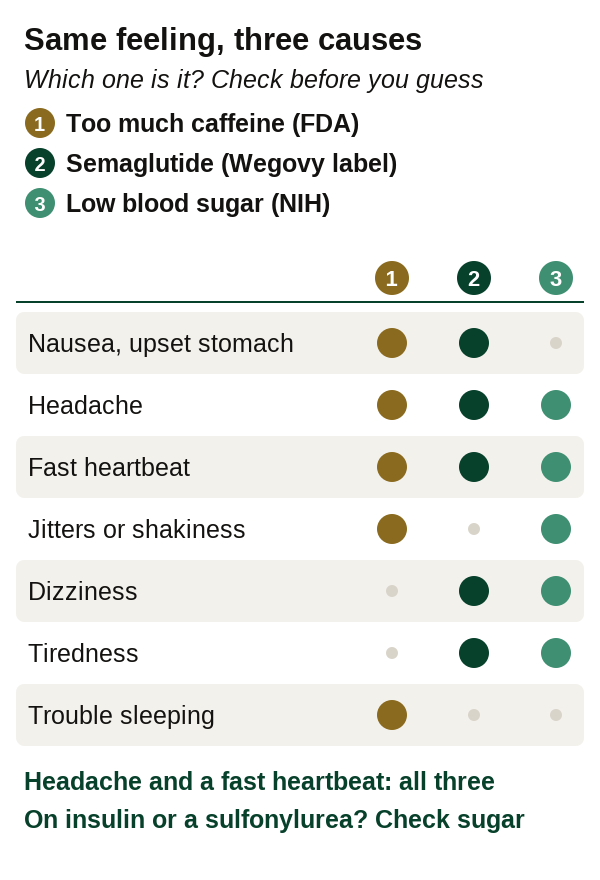
The FDA’s signs of too much caffeine include a faster heart rate, palpitations, higher blood pressure, trouble sleeping, anxiety, jitters, an upset stomach, nausea, and headache. Several are semaglutide side effects too. In the Wegovy 2.4 mg trials, nausea affected 44% versus 16% on placebo, headache 14% versus 10%, and indigestion 9% versus 3%, and resting heart rate rose 1 to 4 beats per minute more than on placebo, on average. With insulin or a sulfonylurea, the NIH’s low blood sugar signs add shaky or jittery, a fast heartbeat, and headache.
Our suggestion, not a tested rule: when new nausea, jitters, or a pounding heart show up, note how much caffeine you had and when, and if you use insulin or a sulfonylurea, check your blood sugar before blaming the coffee. The full picture is in semaglutide side effects.
Headache and a fast heartbeat can come from caffeine, semaglutide, or low blood sugar, so check before you guess.
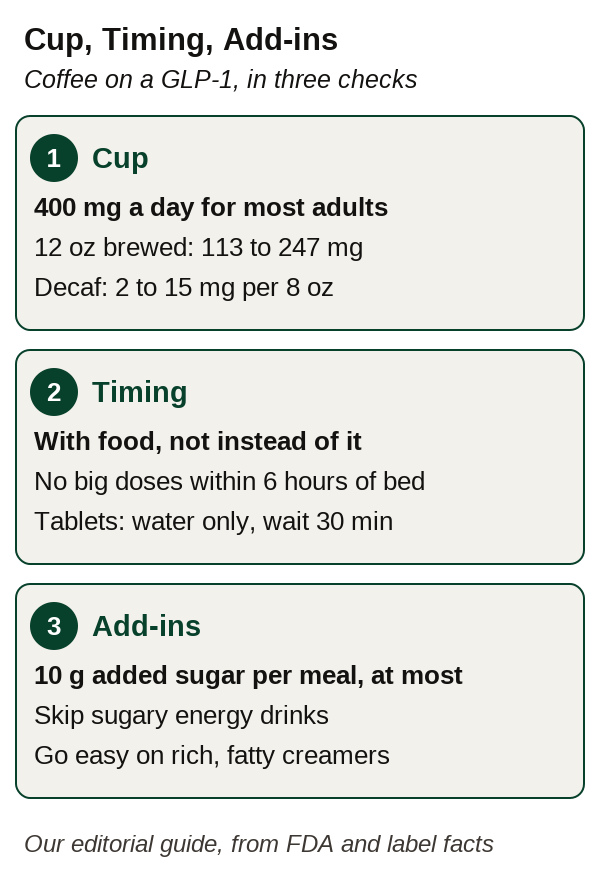
The Cup, Timing, Add-ins check for coffee on a GLP-1
Three questions for your coffee habit on semaglutide or tirzepatide. It’s our editorial guide, built from FDA and label facts, not a medical protocol or a MeliOra rule.
1. Cup: count milligrams, not mugs
For most adults, the FDA cites 400 mg of caffeine a day, about two to three 12-ounce cups of coffee, as an amount not generally linked to negative effects. Cups vary: a 12-ounce brewed coffee holds 113 to 247 mg, and an 8-ounce decaf still has 2 to 15 mg. The FDA warns that about 1,200 mg taken quickly, less than half a teaspoon of pure caffeine, can cause seizures. Sensitivity varies, and some conditions and medicines lower your limit.
2. Timing: with food, and not too late
If coffee has become your breakfast since your appetite dropped, note this: the 2025 nutrition advisory says nausea often comes in the morning or after long stretches without eating, and suggests a small breakfast, then small meals every 3 to 4 hours. With insulin or a sulfonylurea, the NIH warns that skipped or delayed meals can drop blood sugar. At night, a 2013 trial found 400 mg of caffeine disrupted sleep even 6 hours before bed; its authors suggest avoiding substantial caffeine for at least 6 hours before bedtime. The weekly shot itself has no coffee rule.
If you take a semaglutide tablet
The January 2026 label for Rybelsus and Ozempic tablets says to take one on an empty stomach in the morning with up to 4 ounces of plain water and no other liquids, then wait at least 30 minutes before eating, drinking anything else, or taking other pills. The Wegovy tablet has the same rule. Foundayo, Lilly’s daily pill, can be taken with or without food. MeliOra doesn’t prescribe GLP-1 pills; see Wegovy pill vs injection.
3. Add-ins: where the sugar hides
The Dietary Guidelines for 2025 to 2030 say to avoid sugar-sweetened drinks, including energy drinks, and that one meal should have no more than 10 grams of added sugars; a sweetened coffee counts against that. Check the Added Sugars line on bottled coffees and creamers. The guidelines also suggest limiting low-calorie sweeteners, and the advisory suggests avoiding fatty foods in the first few days of treatment.
Viral “coffee loophole” recipes promise more; our look at the pink salt trick and the coffee loophole found no trial behind them. In a 2026 study in obese mice, adding caffeine didn’t increase semaglutide’s weight loss, and no human study shows coffee boosts it.
Run your coffee habit through three checks: how much caffeine, when you drink it, and what goes in it.
Is coffee making semaglutide hard to stick with?Book a weight loss consultation with Dr. Espinet, in person in Tampa Bay or by video anywhere in Florida.
Does coffee make Ozempic side effects worse?
We found no trial of coffee in people taking semaglutide or tirzepatide (PubMed search, November 15, 2026), so these answers rest on general coffee studies and the labels.
Nausea, indigestion, and heartburn
Indigestion (9% vs 3%) and reflux disease (5% vs 3%) were more common on Wegovy 2.4 mg than on placebo. Coffee may add to heartburn: in an NIH-supported observational study of 48,308 women, those drinking more than six servings a day were more likely to develop weekly reflux symptoms than non-drinkers, with or without caffeine, and tea and soda looked similar. Swapping two daily servings for water was linked to slightly lower risk. For a one-week meal test, see our Ozempic burps and heartburn guide.
Constipation
Constipation affected 24% on Wegovy 2.4 mg versus 11% on placebo. Coffee nudges the bowel in some people: in a 1990 study of 99 young adults, 29% said coffee made them want to go; in pressure tests, the lower colon of those who felt it became more active within 4 minutes of regular or decaf coffee. It’s a small, old study, not a treatment plan.
Fluids and dehydration
Coffee counts toward fluids for regular drinkers. In a 2014 trial in 50 men who drank coffee daily, four 200-milliliter cups a day (about 7 ounces each) hydrated about as well as water; the Institute for Scientific Information on Coffee funded it. That doesn’t cover vomiting or diarrhea, which the semaglutide labels say can cause dehydration and kidney problems; use the table below.
Headaches and sleep
Too much caffeine can cause headaches, and cutting back suddenly brings withdrawal, which the FDA calls unpleasant but not dangerous. If your intake changed, see our Ozempic headache guide. Tiredness was reported by 11% on Wegovy 2.4 mg versus 5% on placebo; our guide to fatigue on a GLP-1 suggests protecting sleep instead of adding caffeine.
The next-step hurdle: when coffee loses its appeal
In a 2024 analysis of Reddit discussions about GLP-1 medicines, 216 comments mentioned coffee or caffeine: 48 described stopping, 29 cutting back, 76 no change, and none drinking more. That’s social media, not a trial, and one author reported educational grants from Eli Lilly UK.
If your cup shrinks, taper rather than stopping cold; the FDA says it’s best to cut back gradually. And if coffee was your breakfast, replace it with food, protein first; see what to eat on semaglutide.
Who should be careful, and when to see a professional instead
Ask your prescriber about your caffeine limit if you:
Take insulin or a sulfonylurea: jitters, sweating, or a pounding heart may be low blood sugar, not coffee
Have a heart rhythm problem or high blood pressure: too much caffeine can worsen both
Have worsening reflux, anxiety, or trouble sleeping
Have kidney disease: call at the first sign of dehydration
Use energy drinks, pre-workout powders, or caffeine pills
Pregnant, trying to conceive, or breastfeeding? The FDA suggests asking your provider about caffeine. For the medicine, ACOG’s October 2026 advisory suggests considering stopping a GLP-1 1 to 2 months before conception (the semaglutide labels say at least 2 months), advises against use during pregnancy, and recommends against it while breastfeeding a preterm baby or newborn; see tirzepatide, birth control, and pregnancy.
Coffee can’t explain away a warning sign. Sorted from most to least urgent, these rows match our GLP-1 side effects guide, plus one caffeine row:
Warning sign
What to do
Swelling of the face, lips, tongue, or throat, trouble breathing or swallowing, severe rash or itching, fainting or dizziness, or a very rapid heartbeat
A serious allergic reaction. Stop the medication and call 911 or go to an emergency room
A seizure, fainting, or a racing heartbeat that won’t slow down after a lot of caffeine, such as pure caffeine powder, pills, or several energy drinks
Call 911. The FDA says toxic effects like seizures can follow about 1,200 mg of caffeine taken quickly. If you swallowed a large amount and feel fine so far, call Poison Help at 1-800-222-1222
Low blood sugar you can’t treat yourself, passing out, or a seizure, if you take insulin or a sulfonylurea
Someone should call 911
Thoughts of harming yourself
Call or text 988, the Suicide and Crisis Lifeline, right away. If you might act on them or are in immediate danger, call 911
Sudden vision loss in one eye (often noticed on waking), blurred or missing patches of vision, faded or distorted colors, or eyesight that gets worse quickly
Call 911 or go to an emergency room now, and don’t drive yourself. The FDA warns GLP-1s may raise the risk of NAION, a rare optic nerve problem
Severe stomach pain that will not go away, sometimes reaching the back, with or without vomiting
Possible pancreatitis. Stop the medication and call your prescriber right away; if you can’t reach them quickly, go to an emergency room, not urgent care
Pain in the upper stomach, fever, yellow skin or eyes, or clay-colored stools
Possible gallbladder problems. Call your prescriber right away; if you can’t reach them quickly, go to an emergency room, not urgent care
Vomiting or diarrhea that will not stop, or not being able to keep fluids down
Dehydration, which can lead to kidney injury. Call your prescriber right away. Go to the emergency room now if you can’t keep fluids down, are barely urinating, your urine is very dark, you feel dizzy or lightheaded, or your heart is racing. Call 911 if you become confused or faint. If you have kidney disease, call at the first sign
You took too much, or took a dose twice
Call your prescriber or Poison Help at 1-800-222-1222, or go to an emergency room right away
Shakiness, sweating, dizziness, confusion or drowsiness, headache, blurred vision, slurred speech, hunger, or a fast heartbeat
Possible low blood sugar, more likely with insulin or a sulfonylurea. Treat it as your prescriber taught you, then call them
Heart racing or pounding at rest for several minutes
Increased heart rate, which the Wegovy and Saxenda labels say to report. Call your prescriber
A lump or swelling in the neck, hoarseness, trouble swallowing, or shortness of breath
Possible thyroid tumor, the risk behind the labels’ boxed warning. Call your prescriber
Vision changes in someone with type 2 diabetes
Possible worsening of diabetic eye disease. Tell your prescriber
If something feels wrong, call your prescriber, and tell any emergency team which GLP-1 you take and when you last took it. A boxed warning about thyroid tumors in rodents rules these medicines out for anyone with a personal or family history of medullary thyroid carcinoma or MEN 2. See GLP-1 side effects for more.
How MeliOra fits: weekly semaglutide or tirzepatide with a physician
Dr. Melanie Espinet, a board-certified family medicine physician, prescribes weekly semaglutide or tirzepatide injections; bring your coffee questions to your check-ins. Semaglutide weight loss starts at $150/month, or $240/month at higher dosing, and tirzepatide weight loss runs $230 to $320/month. Each monthly price includes in-home physician visits, lab work, the medication and supplies, and dose adjustments and check-ins, with no consultation fee.
She makes house calls across Hillsborough, Pasco, and Pinellas counties with no travel fee, and sees select appointments at the Lutz office. At any house call, including ours, ask how the product was stored on the way and what the plan is for a serious reaction. Anywhere in Florida, you can choose telehealth weight loss instead: video visits replace in-home visits, the medication ships to your home, and the monthly price is the same.
Frequently asked questions about Ozempic and coffee
Can you drink coffee on Ozempic?
Yes, for most adults. No Ozempic label lists an interaction with coffee or caffeine, and the weekly shot can be taken with or without meals. If you take Ozempic tablets, have only water with the tablet and wait at least 30 minutes before coffee. Stay within the FDA’s 400 mg a day and notice whether coffee worsens nausea or heartburn.
Does caffeine interact with semaglutide?
No interaction is listed. Ozempic’s drug interaction section covers insulin or a sulfonylurea and oral medicines, because semaglutide slows stomach emptying; semaglutide tablets need water only and a 30-minute wait. Caffeine and semaglutide can cause some of the same symptoms, though, including nausea, headache, and a faster heartbeat, so too much coffee can feel like a side effect.
Can coffee make Ozempic nausea worse?
It can for some people. The FDA lists nausea and an upset stomach among the signs of too much caffeine, and nausea is semaglutide’s most common side effect. Our suggestion, not a tested rule: try a smaller cup with food for a week and note whether the nausea eases.
How long after an Ozempic tablet can I drink coffee?
At least 30 minutes. The label for Rybelsus and Ozempic tablets says to take the tablet on an empty stomach with up to 4 ounces of plain water, then wait at least 30 minutes before eating, drinking, or taking other pills. The weekly shot has no such rule; MeliOra prescribes shots, not tablets.
Is decaf better on Ozempic?
Decaf cuts caffeine to about 2 to 15 mg per 8-ounce cup, which may help if coffee makes you jittery, keeps you up, or speeds your heart. It may not fix heartburn: in a large study of women, reflux risk with heavy coffee drinking looked similar with or without caffeine.
Can I drink coffee on tirzepatide?
Yes, the same approach applies. The Zepbound and Mounjaro labels don’t mention coffee or caffeine, and the weekly shot can be taken with or without meals. Watch the same overlaps: nausea, an upset stomach, and, with insulin or a sulfonylurea, low blood sugar that can feel like coffee jitters.