The short answerFatigue is a listed side effect of both medicines. On the Zepbound label, 5% to 7% of adults on tirzepatide reported it versus 3% on placebo; on the Wegovy label, 11% on semaglutide 2.4 mg versus 5% on placebo. Neither label names a cause, so the useful question is what’s draining you: too little food, too little fluid, low blood sugar, poor sleep, or something separate such as anemia, low B12, a thyroid problem or depression.
Searches for Ozempic or Mounjaro tiredness use popular brand names; MeliOra prescribes semaglutide and tirzepatide, and label facts here describe the brand-name products. Thoughts of harming yourself? Call or text 988 now. Fainting or chest pain? Call 911. Other warning signs are in the table below.
How common is fatigue on tirzepatide and semaglutide?
In these labels, it means tiredness reported during the trials and counted against a placebo group. Zepbound’s count also includes weakness, lethargy and malaise; Wegovy’s includes weakness.
Label and trials
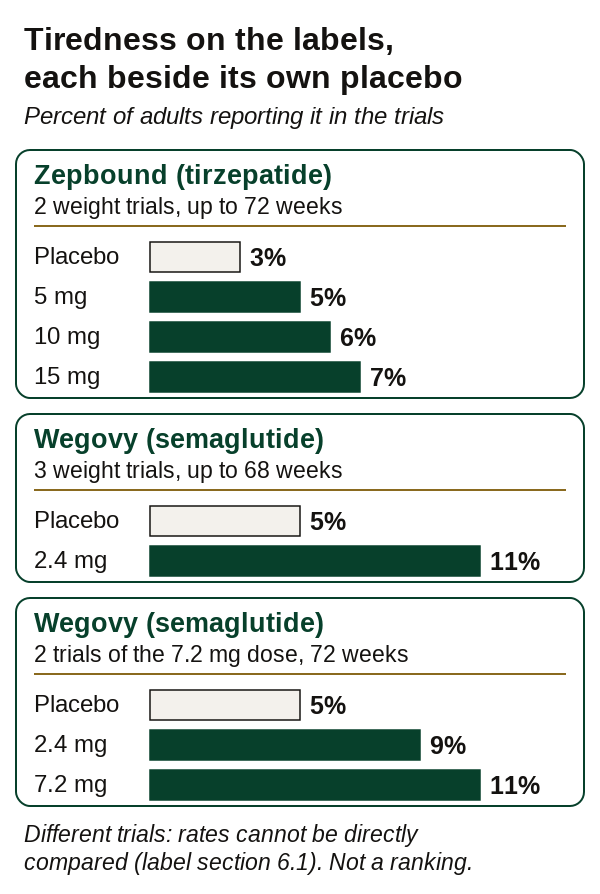
Reported tiredness, medicine vs placebo
Zepbound (tirzepatide), 2 weight trials, up to 72 weeks
5 mg: 5%; 10 mg: 6%; 15 mg: 7%; placebo: 3%
Wegovy (semaglutide), 3 weight trials, up to 68 weeks
2.4 mg: 11%; placebo: 5%
Wegovy, 2 trials of the 7.2 mg dose, 72 weeks
7.2 mg: 11%; 2.4 mg: 9%; placebo: 5%
Ozempic (semaglutide), type 2 diabetes
Listed among other reactions above 0.4%; no rate given
Mounjaro (tirzepatide), type 2 diabetes
Not in its common reactions table; 10% in a heart trial against another diabetes drug, not placebo
Read the rows with care. Every label says rates from one drug’s trials can’t be directly compared with another’s; even the same 2.4 mg semaglutide dose landed at 11% in one pool and 9% in another. And 3% to 5% of people felt worn out on placebo.
SURMOUNT-5, a head-to-head trial in adults without diabetes (funded by Eli Lilly, no placebo group), recorded tiredness in 39 of 374 people on tirzepatide (10.4%) and 46 of 376 on semaglutide (12.2%) over 72 weeks. Lilly said the study wasn’t powered to compare safety, so that gap doesn’t show one medicine tires people more. Our GLP-1 side effects guide sets the common stomach side effects beside their placebo groups.
Each medicine bar sits beside its own placebo bar; these are different trials, not a ranking.
Why am I so tired on semaglutide or tirzepatide? The Tired Triage
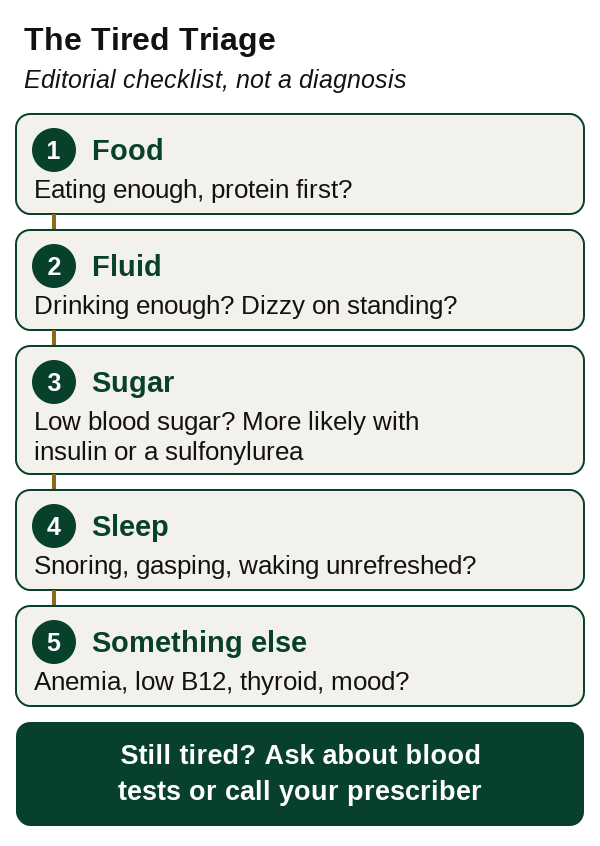
The Tired Triage is our editorial checklist to work through before you talk with your prescriber, not a diagnosis or a MeliOra protocol. Take the five checks in order; the last one ends in lab work or a call.
Work down the five checks; if none explains it, the next step is lab work or a call.
1. Food: are you eating enough, and enough protein?
Appetite drops on these medicines, and some people slide into one small meal a day. A 2026 review notes that tiredness, lower activity and reduced function may follow if energy and protein intake fall too far. A 2025 joint advisory from four medical and nutrition societies, funded by the NIH, lists “fatigue beyond expected levels” among signs of a true nutrient deficiency. Eat at regular times even when you aren’t hungry, and put protein first. Our guide to what to eat on semaglutide or tirzepatide has a sample day, and muscle loss on a GLP-1 covers protein.
2. Fluid: are you drinking enough?
Both Medication Guides warn that diarrhea, nausea and vomiting can dehydrate you, and the same review calls low fluid intake a common but underrecognized contributor to nausea, tiredness and constipation. For adding fiber safely, see our fibermaxxing guide. Low blood pressure was reported in 1.6% on Zepbound vs 0.1% on placebo and 1.3% on Wegovy vs 0.4%, more often with blood pressure medicine and sometimes alongside stomach side effects and dehydration. Dizziness was reported by 4% to 5% on Zepbound vs 2%, and 8% on Wegovy 2.4 mg vs 4%; fainting by 0.8% on Wegovy vs 0.2% (Zepbound gives no fainting rate). Sip through the day, and tell your prescriber if you feel lightheaded when you stand. Headaches can share the cause; see headaches on a GLP-1.
3. Sugar: could it be low blood sugar?
Low blood sugar is more likely with insulin or a sulfonylurea, both labels say, but it isn’t limited to diabetes. Neither weight program systematically tracked lows in people without diabetes, but the Zepbound label reports glucose under 54 mg/dL in 0.3% in one such trial vs none on placebo, and the Wegovy label reports 3 serious lows vs 1 on placebo in a heart trial, more often after bariatric surgery (2 of 87 vs 0 of 97). The Medication Guides list weakness, confusion or drowsiness, and mood changes among the signs, and the NIDDK says lows during sleep can leave you tired, irritable or confused after waking. If you use a glucose meter, check when you feel drained.
4. Sleep: is something cutting your sleep short?
MedlinePlus lists sleep disorders, including insomnia and obstructive sleep apnea, among possible causes of tiredness. Loud snoring, gasping, or waking unrefreshed deserves a sleep evaluation; the Zepbound label also covers moderate to severe sleep apnea in adults with obesity, as our Zepbound for sleep apnea guide explains. More caffeine isn’t the answer: MedlinePlus says stimulants, caffeine included, don’t treat tiredness and can make it worse when stopped. If you lean on coffee, Ozempic and coffee covers caffeine and sleep.
5. Something else: anemia, B12, thyroid or mood?
If the first four checks don’t explain it, MedlinePlus lists anemia, iron deficiency, an underactive or overactive thyroid, depression and some medicines among possible causes. Three stand out:
Low B12: metformin’s label says it may lower B12 and advises a check every 2 to 3 years.
Thyroid: an underactive thyroid can bring tiredness, feeling cold, constipation and dry skin.
Mood: depression can show up as tiredness and lack of energy.
On mood: both weight-management labels list their “Suicidal Behavior and Ideation” warning as removed in February 2026, and neither label now mentions depression. Low mood still deserves attention. If you have thoughts of harming yourself, call or text 988, the Suicide and Crisis Lifeline.
A 2026 review flags iron and B12 among nutrients to watch on these medicines, while noting most changes reported so far are subclinical, and a Lilly-funded analysis of the SURMOUNT-1 to 4 trials says vitamin and mineral levels weren’t routinely measured. Ask about blood tests; MedlinePlus lists anemia, diabetes, kidney, liver and thyroid tests as tests that may be ordered. Our B12 deficiency symptoms guide covers who should be tested.
Still tired after the five checks? Talk with your prescriber. New to MeliOra? Book a weight loss consultation with Dr. Espinet; lab work is included in the monthly price.
What helps tirzepatide fatigue and semaglutide fatigue
Start with the basics, then the dose:
Eat at regular times, in smaller portions, protein first.
Sip fluids all day, and more when you’re vomiting or have diarrhea.
Move a little each day; MedlinePlus lists regular exercise among home steps.
Protect your sleep instead of adding caffeine.
Tell your prescriber before your next dose step if you’re wiped out.
Dose changes are your prescriber’s call: the Wegovy label suggests delaying a step by 4 weeks if a dose isn’t tolerated, and the Zepbound label suggests a lower maintenance dose if a higher one isn’t tolerated. Don’t skip or stretch doses on your own; your prescriber can review whether semaglutide or tirzepatide at a different dose fits you better. Extra B12 helps only when low B12 is the cause, so test first.
Who should be careful, and when to see a professional instead
Tiredness with these signs isn’t wait-and-see. Neither medicine is for anyone with a personal or family history of medullary thyroid carcinoma, or MEN 2. These warning signs match our tirzepatide side effects and semaglutide side effects guides, with emergency rows added first.
Warning sign
What to do
Fainting, or chest pain or pressure, alone or with a pounding or irregular heartbeat
Call 911
Tiredness with confusion or dizziness, blurred vision, little or no urine, or new swelling and weight gain
Call your prescriber right away
Swelling of the face, lips, tongue, or throat, trouble breathing or swallowing, severe rash or itching, fainting or dizziness, or a very rapid heartbeat
A serious allergic reaction. Stop the medicine and call 911 or go to an emergency room
Low blood sugar you can’t treat yourself, passing out, or a seizure
Someone should call 911
Thoughts of harming yourself
Call or text 988, the Suicide and Crisis Lifeline, right away. If you might act on them or are in immediate danger, call 911
Sudden vision loss in one eye (often noticed on waking), blurred or missing patches of vision, faded or distorted colors, or eyesight that gets worse quickly
Call 911 or go to an emergency room now, and don’t drive yourself. The FDA warns GLP-1s may raise the risk of NAION, a rare optic nerve problem
Severe stomach pain that will not go away, sometimes reaching the back, with or without vomiting
Possible pancreatitis. Stop the medicine and call your prescriber right away; if you can’t reach them quickly, go to an emergency room, not urgent care
Upper stomach pain, fever, yellow skin or eyes, or clay-colored stools
Possible gallbladder disease. Inflamed gallbladder was reported in 0.7% on Zepbound and 0.6% on Wegovy injection, vs 0.2% on placebo in each. Call your prescriber right away; if you can’t reach them quickly, go to an emergency room, not urgent care
Vomiting or diarrhea that will not stop, or not being able to keep fluids down
Dehydration, which can lead to kidney injury (0.5% vs 0.2% in the Zepbound trials). Call your prescriber right away. Go to the emergency room now if you can’t keep fluids down, are barely urinating, your urine is very dark, you feel dizzy or lightheaded, or your heart is racing. Call 911 if you become confused or faint. If you have kidney disease, call at the first sign
You took too much, or took two doses close together
Call your prescriber or Poison Help at 1-800-222-1222, or go to an emergency room right away
Shakiness, sweating, dizziness, confusion or drowsiness, headache, blurred vision, slurred speech, hunger, or a fast heartbeat
Possible low blood sugar, more likely with insulin or a sulfonylurea. Treat it as your prescriber taught you, then call them
Heart racing or pounding at rest for several minutes
Increased heart rate, which the Wegovy label says to report. Call your prescriber
A lump in the neck, lasting hoarseness, trouble swallowing, or shortness of breath
Possible thyroid tumor, the risk behind the label’s boxed warning. Call your prescriber
Vision changes in someone with type 2 diabetes
Possible worsening of diabetic eye disease. Tell your prescriber
One rare risk sits outside the labels: a 2026 review found six published cases of thiamine (vitamin B1) deficiency affecting the brain after semaglutide and notes reports with tirzepatide too; all followed long stretches of stomach symptoms and major weight loss, and four began with weakness. Confusion, unsteady walking or unusual eye movements after weeks of vomiting or eating very little need an emergency room now. For tiredness with a fever or regular night sweats, book a visit soon.
How MeliOra checks tiredness on a GLP-1
Dr. Melanie Espinet, a board-certified family medicine physician, prescribes weekly semaglutide and tirzepatide and adjusts your dose as you go. Lab work is included in your monthly price, so raise tiredness at a check-in and ask which tests fit. She screens for eating disorders before prescribing, and if support from a dietitian or therapist would help, she discusses it at your consultation.
Semaglutide starts at $150 a month ($240 for higher dosing) and tirzepatide runs $230 to $320. Each price includes in-home physician visits, lab work, medication and supplies, dose adjustments and check-ins, with no consultation fee; see how medical weight loss at MeliOra works. House calls cover Hillsborough, Pasco and Pinellas counties with no travel fee. At any house call, including ours, ask how the product was stored on the way and what the plan is for a serious reaction. Anywhere in Florida, telehealth weight loss offers video visits at the same monthly price.
Dr. Melanie Espinet prescribes and monitors semaglutide and tirzepatide at MeliOra.
Frequently asked questions about GLP-1 fatigue
Is feeling tired on tirzepatide common?
It is a listed side effect. On the Zepbound label, tiredness, a category that also counts weakness, lethargy and malaise, was reported by 5% to 7% of adults on tirzepatide versus 3% on placebo. Eating or drinking too little, low blood pressure and low blood sugar can add to it, so mention it at your next check-in.
Does semaglutide cause fatigue?
It can. On the Wegovy label, tiredness and weakness were reported by 11% of adults on 2.4 mg versus 5% on placebo in the main weight trials. Ozempic’s label lists it among less common reactions without a rate. Too little food or fluid and low blood sugar are worth ruling out first.
Why am I so tired on semaglutide?
Common reasons are eating too little, especially protein, drinking too little, low blood sugar (more likely with insulin or a sulfonylurea), and poor sleep. If those don’t explain it, ask about blood tests for anemia, B12 and thyroid problems, and mention low mood, since depression can show up as tiredness.
How long does tiredness on a GLP-1 last?
The labels don’t track how long it lasts. Stomach side effects are most common while the dose is climbing, and the Zepbound label says they decreased over time; in our view, tiredness from eating less often eases with them. Tiredness that doesn’t improve, or gets worse, deserves a call.
Will a B12 shot fix GLP-1 tiredness?
Not unless low B12 is the cause. B12 deficiency can cause tiredness, and people taking metformin have a known risk, but extra B12 won’t fix tiredness from too little food, fluid or sleep. Ask for a blood test first, and decide on any treatment with your physician.
Is Ozempic fatigue or Mounjaro tiredness different?
Ozempic is semaglutide and Mounjaro is tirzepatide, both labeled for type 2 diabetes. Ozempic’s label lists tiredness without a rate; Mounjaro’s placebo table doesn’t include it, but 10% reported it in a heart trial against another diabetes drug. MeliOra prescribes semaglutide and tirzepatide, and the same five checks apply.
When is tiredness on a GLP-1 an emergency?
Call 911 for fainting, chest pain or pressure, or severe low blood sugar you can’t treat. Call 911 or go to an emergency room for sudden vision loss, or for confusion after weeks of vomiting. For thoughts of harming yourself, call or text 988 right away.