The short answerFibermaxxing is the social media push to eat more fiber, enough to reach or beat the daily goal. Food labels use a Daily Value of 28 grams, and most U.S. adults fall short. Ramp up slowly, drink more fluids, space fiber supplements from pills, and go gently on a GLP-1.
It’s one of the friendlier diet trends: most people need more fiber, not less. The catch is speed. This is general information, not medical advice; for weight concerns beyond diet, see medical weight loss in Lutz.
What is fibermaxxing?
Fibermaxxing is a TikTok trend of deliberately raising your fiber intake to reach or exceed the recommended daily amount, and encouraging others to do the same. Unlike the gelatin trick, it rests on a nutrient most people already lack.
Fiber is a carbohydrate in plant foods that your body doesn’t digest. Soluble fiber turns to gel during digestion and helps lower cholesterol; insoluble fiber, in wheat bran, vegetables, and whole grains, adds bulk to stool.
How much fiber per day do you need?
The number on food labels is 28 grams a day, the FDA’s Daily Value for dietary fiber. The current Dietary Guidelines for Americans, 2025 to 2030, set no gram target; they say to prioritize fiber-rich whole grains. The previous 2020 to 2025 edition set goals of 14 grams per 1,000 calories, which work out to:
Adults (2020 to 2025 Dietary Guidelines)
Daily fiber goal
Women 19 to 30
28 g
Women 31 to 50
25 g
Women 51 and older
22 g
Men 19 to 30
34 g
Men 31 to 50
31 g
Men 51 and older
28 g
That edition found more than 90% of women and 97% of men fell short. The science report behind the 2025 to 2030 Guidelines cites an umbrella review linking higher fiber with lower risk of early death, colorectal cancer, type 2 diabetes, and coronary heart disease, with an optimal intake of 25 to 29 grams a day. One glass of oatzempic holds about 4 grams.
Can you eat too much fiber?
No official upper limit has been set, a 2011 review notes. A dietitian quoted by CNBC put the line around 70 grams a day. The bigger risk is speed: “It is possible to do too much too soon.”
Fiber for weight loss: what the evidence shows
Fiber helps, modestly. In a 2020 meta-analysis of 62 trials with 3,877 people, adding viscous fiber, the thick, gel-forming kind in oats and psyllium, to a usual diet lowered body weight by 0.33 kg on average, about three-quarters of a pound. The authors rated the evidence moderate; listed funders include Diabetes Canada.
In a later analysis of 345 adults from POUNDS Lost, an NIH-funded trial of calorie-reduced diets, fiber intake over the first 6 months was the strongest predictor of weight loss, and higher-fiber eaters stuck to their diets better. Fiber wasn’t randomized, so this shows a link, not proof.
Fiber isn’t a GLP-1 medicine, either. Gut bacteria ferment fiber into short-chain fatty acids that prompt your own GLP-1 release, a 2025 nutrition advisory notes, but your own GLP-1 has a half-life of about 1 to 2 minutes. Our guide to GLP-1 supplements covers berberine and other products sold as GLP-1 boosters.
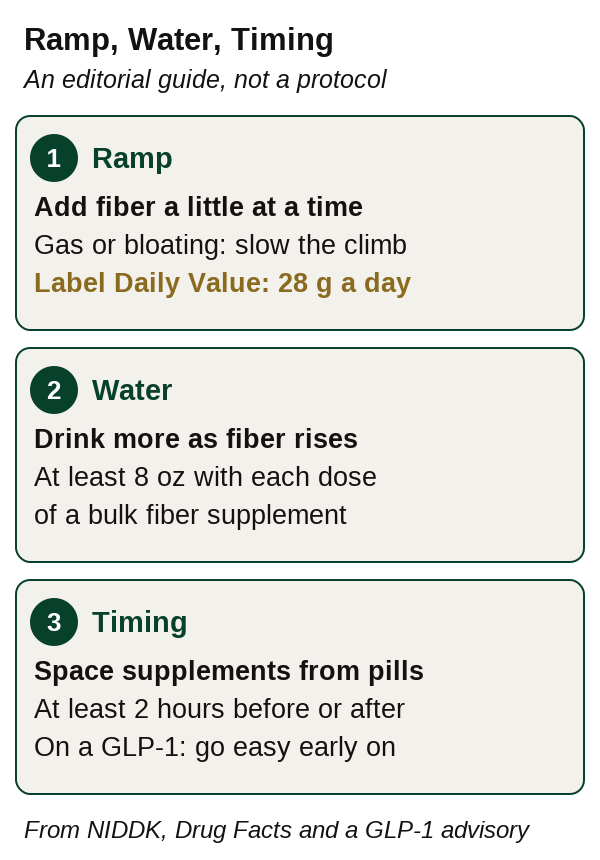
The Ramp, Water, Timing method for fibermaxxing
Our editorial method, built from NIDDK advice, a psyllium Drug Facts label, and a 2025 GLP-1 nutrition advisory. It isn’t a medical protocol or a MeliOra rule.
Ramp: add fiber a little at a time
The NIDDK advises adding fiber “a little at a time so your body gets used to the change.” A psyllium label tells new users to start with one serving a day and increase gradually, and warns of minor bloating and changes in bowel habits as the body adjusts. Our suggestion: add one new high-fiber food at a time and let your gut settle before the next.
Water: drink more as fiber rises
The NIDDK says to drink plenty of liquids to help fiber work better. For bulk fiber laxatives such as psyllium, federal rules require labels to direct at least 8 ounces, a full glass, of fluid per dose and to warn that too little fluid can make it swell and block the throat.
Timing: space supplements from pills
Bulk fibers like psyllium may affect how well other medicines work, so the label says to take it at least 2 hours before or after a prescription medicine taken by mouth. On a GLP-1, the 2025 advisory suggests going easy on fatty or high-fiber foods in the first few days of treatment to ease nausea, and increasing fiber from food gradually for constipation. Our suggestion: spread fiber across your meals instead of loading one.
Three checks for more fiber without the bloat: climb slowly, drink as you go, and keep supplements away from your pills.
On a GLP-1, or thinking about one? Fiber and fluids matter more when your stomach empties slowly. Book a weight loss consultation with Dr. Espinet.
Fiber on a GLP-1: why slower beats more
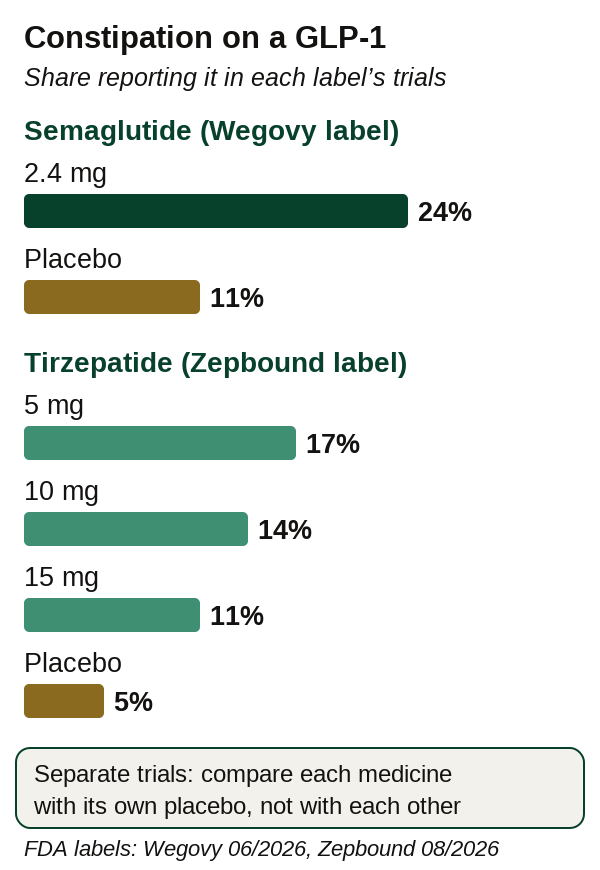
GLP-1 medicines slow how fast your stomach empties, and constipation is common. The Wegovy label reports it in 24% of adults on semaglutide 2.4 mg vs 11% on placebo, and the Zepbound label in 11% to 17% on tirzepatide, depending on the dose, vs 5% on placebo. These are separate trials, so compare each medicine with its own placebo.
Constipation was more common on each GLP-1 than on its placebo, one reason fiber on a GLP-1 needs a slow ramp and steady fluids.
A 2025 joint advisory from four medical and nutrition groups encourages fluids and fiber from foods for constipation, increased gradually, with prunes or other dried fruit as an example, and says fiber supplements may also help. It adds that thin, watery foods, such as many fruits and vegetables, tend to leave the stomach faster, while foods high in protein or fat slow it further. Since approval, both labels list reports of intestinal blockage and of severe constipation, including fecal impaction. Our suggestion: if a full glass of fluid is hard to finish on a GLP-1, get fiber from food or ask your prescriber before using a fiber powder.
A 2025 case report described a 65-year-old woman on semaglutide 0.5 mg weekly for about six months, eating her usual salad and bread, whose small bowel was blocked by a ball of plant fiber, a phytobezoar, that needed surgery. One case can’t prove cause; the authors list high-fiber diets and a slowed gut as bezoar risk factors. See what to eat on semaglutide and semaglutide constipation for more.
Who shouldn’t fibermaxx, and when to see a professional instead
Ask your clinician before a big fiber push if you:
Have gastroparesis: the NIDDK advises avoiding high-fiber foods
Have Crohn’s disease or another inflammatory bowel disease: after a flare, too much fiber may make symptoms worse, and with a narrowed bowel a low-residue diet may be advised
Have had a bowel blockage or stomach surgery, or a condition that slows your gut, such as diabetes or an underactive thyroid
Have trouble swallowing: don’t take bulk fiber supplements
Have a sudden change in bowel habits that has lasted 2 weeks, or belly pain, nausea, or vomiting: the psyllium label says to ask a doctor before using it
Have an eating disorder now or in the past
See a clinician instead of adding more fiber if your bowel habits suddenly change for 2 weeks or more, if constipation lasts more than 7 days on a fiber laxative, or if you see rectal bleeding; the psyllium label says these may be signs of a serious condition. If restricting or bingeing is part of the picture, start with how to stop food noise, or call the ANAD helpline, 1-888-375-7767.
After adding fiber, if you notice
What to do
Thoughts of suicide or of harming yourself
Call or text 988 now, or call 911 if you are in danger
Chest pain, vomiting, or trouble swallowing or breathing after taking a fiber supplement
Get emergency care now: call 911 or go to an emergency room. Fiber taken without enough fluid can swell and block the throat
Fainting, chest pain, a racing or skipped heartbeat, or confusion, especially after vomiting, using laxatives, or eating very little
Call 911 or go to an emergency room now
Belly pain with swelling that doesn’t go away, vomiting that keeps coming back, or not passing stool or gas
Possible bowel blockage. Go to an emergency room now, not urgent care
Rectal bleeding, or constipation lasting more than 7 days while using a fiber laxative
Stop the supplement and call your doctor; the label says these may be signs of a serious condition
Bingeing, purging, or restricting, or losing weight on a GLP-1 faster than your prescriber expects (often more than 1 to 2 pounds a week)
See your clinician this week; the 2026 consensus treats fast loss as a possible eating disorder warning sign
Gas, bloating, or mild cramps, with no warning signs above
Slow the ramp, keep up your fluids, and mention it at your next visit
If you take semaglutide or tirzepatide, these rows match our GLP-1 side effects guide, most urgent first, including the NAION vision warning the FDA said on November 9, 2026, that every GLP-1 label must add:
Warning sign
What to do
Swelling of the face, lips, tongue, or throat, trouble breathing or swallowing, severe rash or itching, fainting or dizziness, or a very rapid heartbeat
A serious allergic reaction. Stop the medication and call 911 or go to an emergency room
Low blood sugar you can’t treat yourself, passing out, or a seizure, if you take insulin or a sulfonylurea
Someone should call 911
Thoughts of harming yourself
Call or text 988, the Suicide and Crisis Lifeline, right away. If you might act on them or are in immediate danger, call 911
Sudden vision loss in one eye (often noticed on waking), blurred or missing patches of vision, faded or distorted colors, or eyesight that gets worse quickly
Call 911 or go to an emergency room now, and don’t drive yourself. The FDA warns GLP-1s may raise the risk of NAION, a rare optic nerve problem
Severe stomach pain that will not go away, sometimes reaching the back, with or without vomiting
Possible pancreatitis. Stop the medication and call your prescriber right away; if you can’t reach them quickly, go to an emergency room, not urgent care
Pain in the upper stomach, fever, yellow skin or eyes, or clay-colored stools
Possible gallbladder problems. Call your prescriber right away; if you can’t reach them quickly, go to an emergency room, not urgent care
Vomiting or diarrhea that will not stop, or not being able to keep fluids down
Dehydration, which can lead to kidney injury. Call your prescriber right away. Go to the emergency room now if you can’t keep fluids down, are barely urinating, your urine is very dark, you feel dizzy or lightheaded, or your heart is racing. Call 911 if you become confused or faint. If you have kidney disease, call at the first sign
You took too much, or took a dose twice
Call your prescriber or Poison Help at 1-800-222-1222, or go to an emergency room right away
Shakiness, sweating, dizziness, confusion or drowsiness, headache, blurred vision, slurred speech, hunger, or a fast heartbeat
Possible low blood sugar, more likely with insulin or a sulfonylurea. Treat it as your prescriber taught you, then call them
Heart racing or pounding at rest for several minutes
Increased heart rate, which the Wegovy and Saxenda labels say to report. Call your prescriber
A lump or swelling in the neck, hoarseness, trouble swallowing, or shortness of breath
Possible thyroid tumor, the risk behind the labels’ boxed warning. Call your prescriber
Vision changes in someone with type 2 diabetes
Possible worsening of diabetic eye disease. Tell your prescriber
No table covers everything. If something feels wrong, call your prescriber, and tell any emergency team which GLP-1 you take and when you last took it.
How MeliOra fits: physician-led GLP-1 care
Dr. Melanie Espinet, a board-certified family medicine physician in Lutz, prescribes weekly semaglutide or tirzepatide injections. She screens for eating disorders before prescribing, and if support from a dietitian or therapist would help, she discusses it at your consultation.
Semaglutide weight loss starts at $150/month, or $240/month at higher dosing, and tirzepatide weight loss runs $230 to $320/month. Each price includes in-home physician visits, lab work, the medication and supplies, and dose adjustments and check-ins, with no consultation fee.
Dr. Espinet makes house calls across Hillsborough, Pasco, and Pinellas counties with no travel fee, and sees select appointments at the Lutz office. At any house call, including ours, ask how the product was stored on the way and what the plan is for a serious reaction. Anywhere in Florida, telehealth weight loss replaces in-home visits with video visits at the same monthly price, with the medication shipped home.
Frequently asked questions about fibermaxxing
What is fibermaxxing?
Fibermaxxing is a social media trend of deliberately eating more fiber, from beans, whole grains, fruit, and vegetables, to reach or exceed the recommended daily amount. Most adults fall short, so the idea is sound. The risk is going too fast or skipping fluids.
How much fiber per day do you need?
Food labels use a Daily Value of 28 grams. The current 2025 to 2030 Dietary Guidelines set no gram target. The 2020 to 2025 edition set 14 grams per 1,000 calories: about 22 to 28 grams for women and 28 to 34 grams for men, depending on age.
Does fiber help you lose weight?
Modestly. In a 2020 analysis of 62 trials, adding viscous fiber to a usual diet lowered weight by about three-quarters of a pound on average. In one large diet trial, people who ate more fiber lost more weight and stuck to their diets better, a link rather than proof.
Can you eat too much fiber?
No official upper limit exists, but very high intakes may reduce absorption of some minerals, and adding fiber fast can bring gas, bloating, and cramps. A dietitian quoted by CNBC suggested most people stay under about 70 grams a day. Gastroparesis or a narrowed bowel calls for less.
Is fiber good on a GLP-1 like semaglutide?
Yes, added gradually with plenty of fluids. Constipation is common on GLP-1 medicines, and a 2025 nutrition advisory encourages fiber from foods, increased slowly, while going easy on high-fiber foods in the first few days of treatment. Severe belly pain, swelling, or vomiting needs care right away.
Are fiber supplements as good as fiber from food?
Food brings fiber along with other nutrients, and the dietitian CNBC quoted prefers food. The FDA counts some isolated fibers, such as psyllium and beta-glucan, as dietary fiber on labels. With a bulk fiber supplement such as psyllium, take each dose with at least 8 ounces of fluid, 2 hours from pills.