The short answerMetformin and Ozempic do different jobs. Metformin is a low-cost pill labeled only to lower blood sugar in type 2 diabetes, with a small effect on weight. Ozempic is semaglutide, a weekly shot or daily tablet labeled for type 2 diabetes and, in some adults, heart protection (the shot also covers kidney protection); Wegovy is the semaglutide brand for weight loss. No trial has compared them head to head for weight, and many people take both.
Metformin vs Ozempic often comes up when someone on metformin wonders if a GLP-1 shot would do more. Ozempic is the popular name; Dr. Melanie Espinet prescribes weekly semaglutide or tirzepatide for medical weight loss, and label facts here describe the brand-name products.
Metformin vs Ozempic at a glance
Metformin compared with Ozempic
What the labels say
Metformin
Ozempic
How you take it
By mouth, once to three times a day with meals
One injection a week, or one tablet a day (Ozempic tablets)
Labeled uses
Blood sugar in type 2 diabetes, ages 10 and up
Blood sugar in adults with type 2 diabetes, plus heart protection in some of them; the shot also covers kidney protection
Labeled for weight loss
No
No; Wegovy, the same medicine at higher doses, is
Boxed warning
Lactic acidosis, rare but serious and sometimes fatal
Thyroid C-cell tumors in rodents; unknown whether it causes them in people
What is metformin?
Metformin is a prescription pill for type 2 diabetes. It lowers blood sugar by cutting the sugar your liver makes and helping your body respond to its own insulin. The American Diabetes Association calls it effective, safe and inexpensive, and says it reduces the risk of small blood vessel damage, heart events and death.
What is Ozempic?
Ozempic is a weekly injection of semaglutide, which acts like GLP-1, a gut hormone that helps lower blood sugar after meals, slows stomach emptying and acts on appetite areas of the brain. Its label covers type 2 diabetes; our Wegovy vs Ozempic guide explains how the two semaglutide brands differ. Ozempic also comes as a once-daily tablet, sold under one label with Rybelsus; the Ozempic numbers on this page come from the weekly shot, and MeliOra doesn’t prescribe GLP-1 pills.
Metformin vs Ozempic for weight loss: what each trial showed
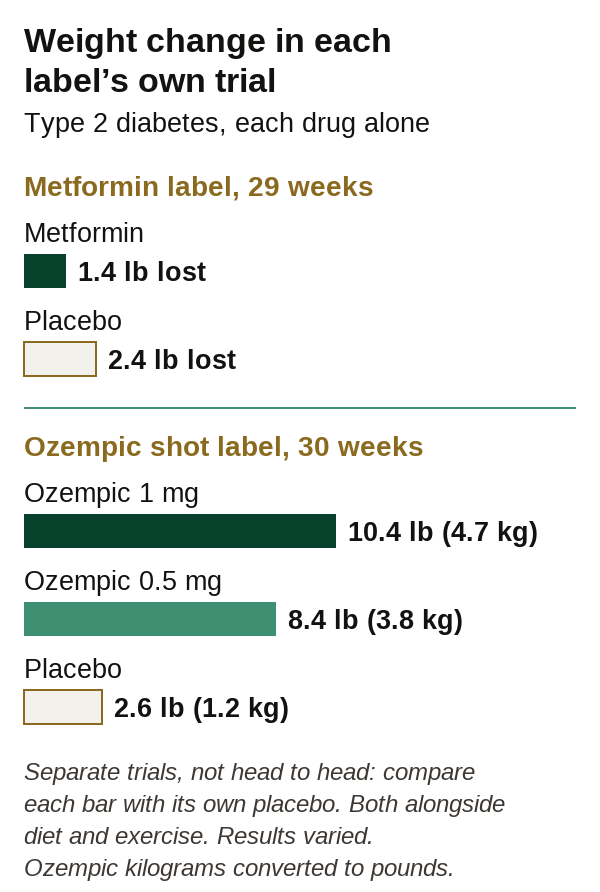
Neither label covers weight loss, so comparisons set separate trials side by side. The fairest match is each label’s own placebo-controlled trial of the drug alone in type 2 diabetes, both about 30 weeks long.
Each panel is its own trial, so compare each medicine with its own placebo, not the panels with each other.
On the metformin label, people lost an average of 1.4 lb over 29 weeks while the placebo group lost 2.4 lb. On the Ozempic label, the 1 mg dose averaged 4.7 kg (about 10.4 lb) over 30 weeks, against 1.2 kg on placebo. Both labels pair the medicine with diet and exercise; in these trials, diet (for Ozempic, diet and exercise) alone hadn’t controlled people’s diabetes, and results varied.
Metformin for weight loss: about 2% in the largest trial
The biggest metformin weight data come from the Diabetes Prevention Program, which gave 3,234 adults with prediabetes metformin 850 mg twice a day, placebo, or an intensive lifestyle program. Everyone got standard lifestyle advice. During the trial, the metformin group lost 2.06% of body weight on average, against 0.02% on placebo, and kept about 2% off in long-term follow-up.
After one year, 28.5% of the metformin group had lost at least 5%, about twice the share on placebo, and, in a later analysis, that group held an average of 6.2% off in years 6 to 15. The National Institutes of Health funded it; drug companies added support and supplied the metformin.
Semaglutide for weight loss: the Wegovy trials
Semaglutide’s weight results come from Wegovy, whose usual 2.4 mg weekly dose sits above Ozempic’s top dose of 2 mg. In 68-week trials where everyone also had diet and exercise counseling, adults without diabetes lost 14.9% on average against 2.4% on placebo, and adults with type 2 diabetes lost 9.6% against 3.4%. Novo Nordisk, which makes Ozempic and Wegovy, ran these trials and the Ozempic one above. Results varied; our semaglutide weight loss page covers treatment.
The Different Jobs check: match the medicine to your goal
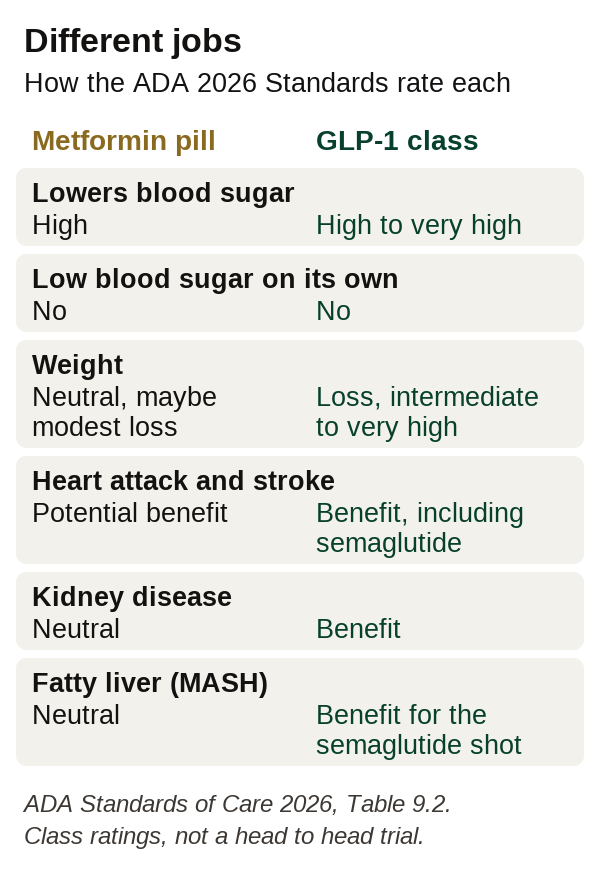
Which is better depends on the job. The Different Jobs check is our editorial tool, built from the labels and the ADA’s 2026 Standards of Care, not a medical evaluation: start with your goal, then see which medicine’s label or guideline covers it.
The American Diabetes Association rates the two classes differently on every job but one: neither causes low blood sugar on its own.
1. Lowering blood sugar in type 2 diabetes
Both are labeled for this job. The ADA rates metformin’s glucose lowering as high and GLP-1 medicines as high to very high, and notes metformin has historically been first-line. It rates the risk of low blood sugar on its own as no for both.
2. Losing weight without diabetes
Neither metformin nor Ozempic is labeled for this; Wegovy is. In type 2 diabetes, the ADA calls metformin weight neutral, with potential for modest loss, and rates GLP-1 weight loss as intermediate to very high. Without diabetes, the evidence is the prevention trial and the Wegovy trials above.
3. Protecting the heart and kidneys
The Ozempic shot is labeled to lower heart attack, stroke and heart death risk in adults with type 2 diabetes and heart disease, and to slow kidney decline in those with kidney disease; the tablet covers heart risk only. The metformin label cites no conclusive heart benefit; the ADA lists a potential one.
4. Prediabetes, PCOS, or fatty liver
In the prevention trial, metformin cut new diabetes cases by 31% against placebo, and the lifestyle program by 58%. For PCOS, the 2023 international guideline speaks more firmly about metformin; see GLP-1 for PCOS. For fatty liver, liver specialists’ AASLD guidance says metformin doesn’t improve MASH damage; see Wegovy for fatty liver.
If weight is your main goal,book a weight loss consultation with Dr. Espinet. She prescribes weekly semaglutide or tirzepatide and tells you if a GLP-1 isn’t right for you.
Metformin and Ozempic together
Taking metformin and Ozempic together is common: in one 56-week Ozempic trial, 94% of people were already on metformin. The Ozempic shot’s label found no meaningful change in metformin levels and calls for no dose change. Low blood sugar becomes a risk mainly when insulin or a sulfonylurea is added.
Stomach side effects can stack
Both upset the stomach, and the ADA says a slow dose climb helps with each. The labels warn that rates from different drugs’ trials can’t be directly compared.
Rate vs each label’s own placebo
Side effect
Metformin
Ozempic 1 mg
Diarrhea
53% vs 12%
8.8% vs 1.9%
Nausea
26% vs 8%, counted with vomiting
20.3% vs 6.1%
Vomiting
Counted with nausea
9.2% vs 2.3%
The two labels also flag the same danger from different sides: semaglutide’s warns that fluid loss can injure the kidneys, and metformin’s says dehydration from vomiting or diarrhea raises the risk of lactic acidosis. If vomiting or diarrhea won’t stop while you take both, call your prescriber right away, and if you can’t keep fluids down, go to the emergency room now.
Vitamin B12, scans, and surgery
In metformin trials, about 7% of people saw a normal B12 level fall below normal, and the label advises a B12 check every 2 to 3 years; see our B12 deficiency symptoms guide. You may need to pause metformin for some contrast scans and surgery, and semaglutide carries an anesthesia warning; see Ozempic before surgery.
Who should be careful, and when to get help
Metformin isn’t for anyone with severe kidney disease (eGFR below 30), metabolic acidosis, or a metformin allergy, and its label says to avoid it with liver disease. Semaglutide isn’t for anyone with a personal or family history of medullary thyroid carcinoma or MEN 2, or a serious allergy to it. Metformin’s boxed warning says lactic acidosis after approval has caused death, dangerously low body temperature and blood pressure, and slow heart rhythms that resist treatment. Also mention pancreatitis, gallbladder disease, diabetic eye disease, a past NAION or sudden vision loss in one eye, heart failure, heavy drinking, topiramate (including in Qsymia), being 65 or older, and insulin or a sulfonylurea.
Metformin can restart ovulation in some women who weren’t ovulating, so an unplanned pregnancy is possible. The Ozempic and Wegovy labels say to stop semaglutide at least 2 months before a planned pregnancy, and ACOG’s October 2026 advisory suggests considering a stop 1 to 2 months before conception and advises against GLP-1s during pregnancy and while breastfeeding a preterm baby or newborn. See GLP-1s, birth control, and pregnancy.
Sorted by urgency, these rows match our semaglutide side effects guide, plus emergency steps and metformin’s lactic acidosis signs:
Warning sign
What to do
Swelling of the face, lips, tongue, or throat, trouble breathing or swallowing, severe rash or itching, fainting or feeling dizzy, or a very rapid heartbeat
A serious allergic reaction. Stop the medication and get medical help right away: call 911 or go to an emergency room
Low blood sugar you can’t treat yourself, passing out, or a seizure, if you take insulin or a sulfonylurea
Someone should call 911
Thoughts of harming yourself
Call or text 988, the Suicide and Crisis Lifeline, right away. If you might act on them or are in immediate danger, call 911
Sudden vision loss in one eye (often noticed on waking), blurred or missing patches of vision, faded or distorted colors, or eyesight that gets worse quickly
Call 911 or go to an emergency room now, and don’t drive yourself. The FDA warns GLP-1s may raise the risk of NAION, a rare optic nerve problem
On metformin: feeling very weak or tired, unusual muscle pain, trouble breathing, unusual sleepiness, stomach pain with nausea, vomiting or diarrhea, feeling cold in your arms and legs, dizziness, or a slow or irregular heartbeat
Possible lactic acidosis, which the label calls a medical emergency that must be treated in a hospital. Stop metformin and call your prescriber right away; if you can’t reach them at once, go to an emergency room now
Severe stomach pain that will not go away, sometimes reaching the back, with or without vomiting
Possible pancreatitis. Stop semaglutide and call your provider right away; if you can’t reach them quickly, go to an emergency room, not urgent care
Pain in the upper stomach, fever, yellow skin or eyes, or clay-colored stools
Possible gallbladder problems. Gallstones were reported in 1.6% on Wegovy injection vs 0.7% on placebo. Call your provider right away; if you can’t reach them quickly, go to an emergency room, not urgent care
Nausea, vomiting, or diarrhea that will not go away, or not being able to keep fluids down
Dehydration, which can lead to kidney problems. Drink fluids and call your provider right away. Severe dehydration is an emergency: go to the emergency room now if you can’t keep fluids down, are barely urinating, your urine is very dark, you feel dizzy or lightheaded, or your heart is racing. Call 911 if you become confused or pass out. If you have kidney disease, call at the first sign
Stomach problems that are severe or will not go away, including severe constipation with worsening belly pain or swelling
Severe stomach problems, which the label says to report. Call your prescriber right away
You took too much semaglutide or metformin, or took a dose twice
Call your prescriber or Poison Help at 1-800-222-1222, or go to an emergency room right away
Shakiness, sweating, confusion, or a fast heartbeat in someone with diabetes
Low blood sugar. Treat it as your prescriber taught you, then call them
Heart racing or pounding at rest for several minutes
Increased heart rate, which the label says to report. Call your prescriber
A lump or swelling in the neck, hoarseness, trouble swallowing, or shortness of breath
Possible thyroid tumor, the risk behind the label’s boxed warning. Call your prescriber
Vision changes in someone with type 2 diabetes
Possible worsening of diabetic eye disease. Tell your prescriber
When to see a professional instead
With type 2 diabetes, don’t stop metformin or swap it for a GLP-1 on your own; the doctor who manages your diabetes should make that change. See them too for high blood sugar readings, new tingling or numbness, or an eGFR below 45 on metformin.
How MeliOra fits: weekly semaglutide or tirzepatide for weight
Dr. Melanie Espinet, a board-certified family medicine physician in Lutz, prescribes weekly semaglutide or tirzepatide injections for weight loss. She screens for eating disorders before prescribing, and if support from a dietitian or therapist would help, she discusses it at your consultation. Tell her about every medicine you take, including metformin.
Semaglutide weight loss starts at $150/month, or $240/month at higher dosing, and tirzepatide weight loss runs $230 to $320/month. Each monthly price includes in-home physician visits, lab work, the medication and supplies, and dose adjustments and check-ins, with no consultation fee.
Dr. Espinet makes house calls across Hillsborough, Pasco, and Pinellas counties with no travel fee, and sees select appointments at the Lutz office. At any house call, including ours, ask how the product was stored on the way and what the plan is for a serious reaction. Anywhere in Florida, telehealth weight loss uses video visits and ships the medication to you, at the same monthly price.
Frequently asked questions about metformin vs Ozempic
Is metformin or Ozempic better for weight loss?
No trial has compared them head to head for weight, so neither can be ranked from trial data. In prediabetes, metformin averaged about 2% loss against almost none on placebo. At Wegovy doses, with diet and exercise counseling, semaglutide averaged 14.9% without diabetes and 9.6% with type 2 diabetes, against 2.4% and 3.4% on placebo. Results varied.
Can you take metformin and Ozempic together?
Yes, and many people do. Most Ozempic diabetes trials added it to metformin, and the Ozempic label calls for no metformin dose change. Both can upset the stomach, so side effects may add up. Low blood sugar is mainly a risk if you also take insulin or a sulfonylurea.
Does metformin help you lose weight if you don’t have diabetes?
Modestly. In the Diabetes Prevention Program, adults with prediabetes on metformin lost about 2% of their weight on average, against almost none on placebo. About 28.5% lost at least 5% in the first year. Metformin isn’t labeled for weight loss, and its label covers only type 2 diabetes.
Is Ozempic approved for weight loss?
No. The Ozempic shot and tablet are labeled for blood sugar in adults with type 2 diabetes, plus heart protection in some of them. Wegovy, also semaglutide, is the brand labeled for long-term weight management, usually at 2.4 mg a week, in adults with obesity, or overweight with a weight-related condition, and in teens 12 and older with obesity.
Can I switch from metformin to Ozempic?
Only with the doctor who manages your diabetes. Many people add a GLP-1 to metformin rather than replacing it, and the choice depends on your blood sugar, heart and kidney health, weight goals, side effects, and cost. Stopping metformin on your own can let your blood sugar rise.