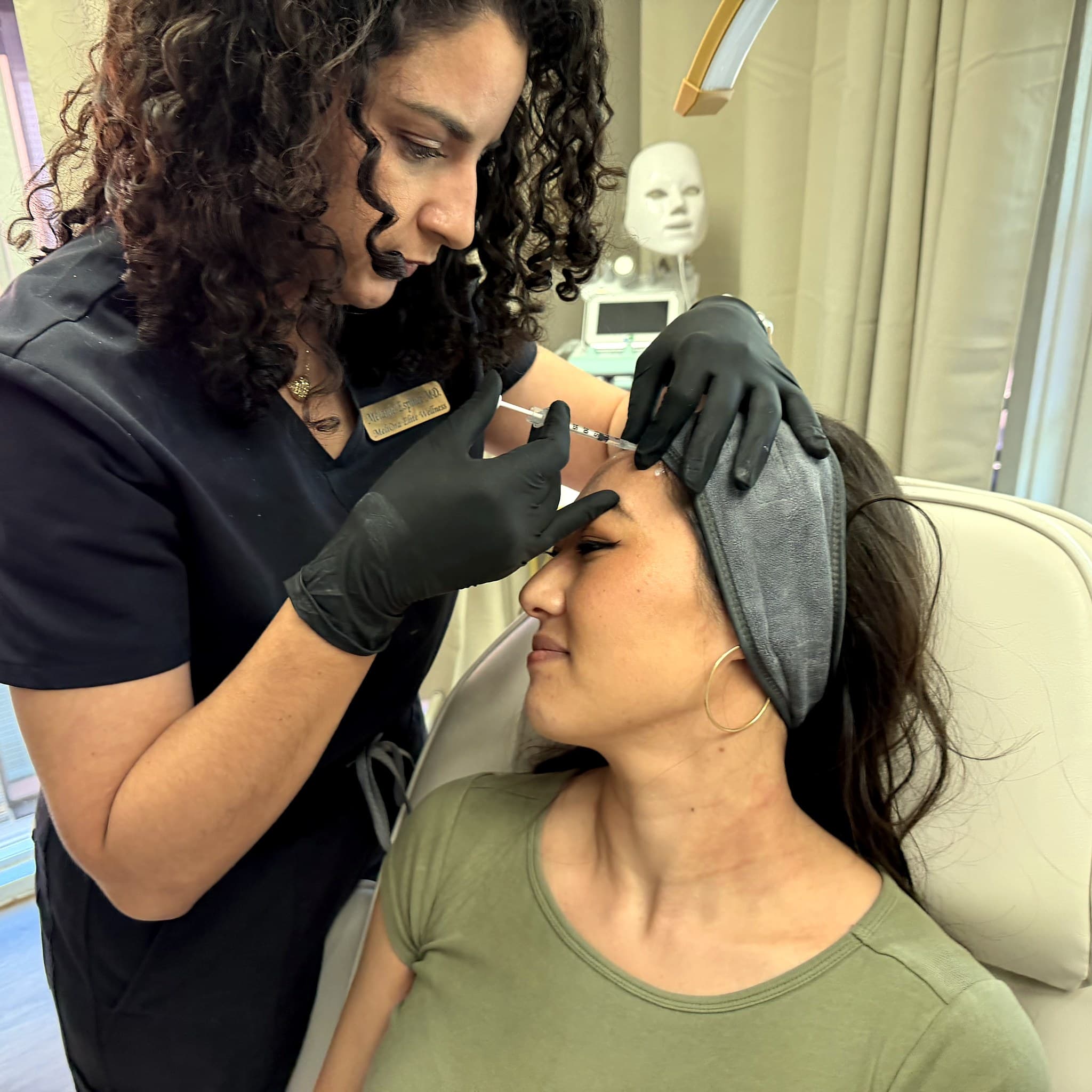
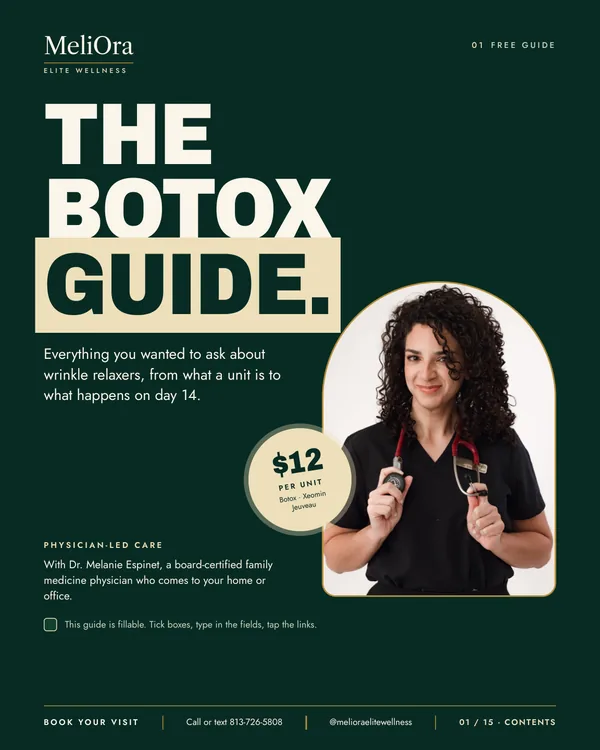
The short answerMost Botox side effects are mild and short-lived: a small bruise, redness, swelling, or tenderness where the needle went in, and sometimes a headache. Less often, a brow or eyelid droops for a few weeks. Rarely, the effect spreads beyond the treated area, which is why the labels for our Botox brands, Jeuveau and Xeomin, carry a boxed warning: trouble swallowing, speaking, or breathing needs medical care right away.
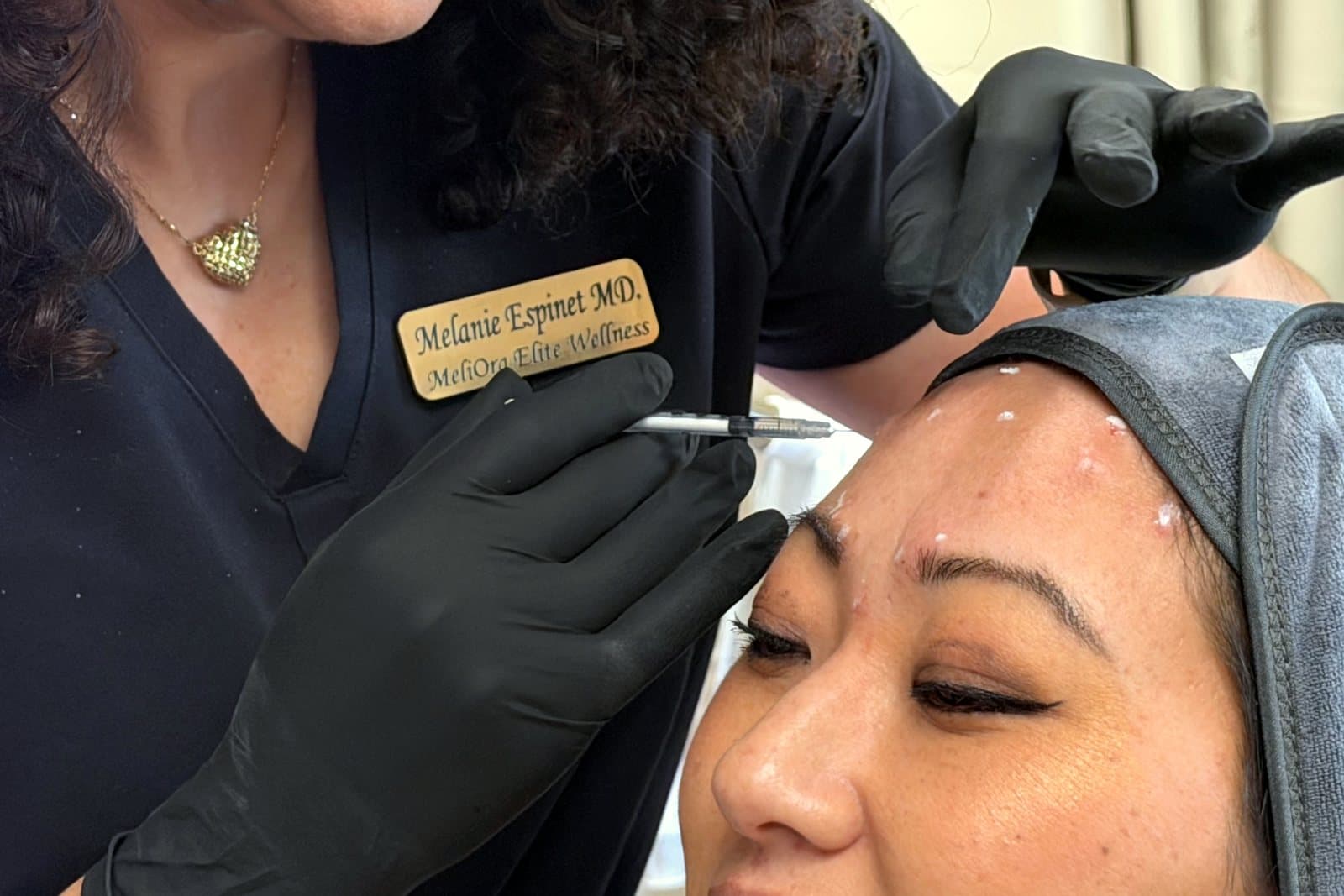
Botox side effects are the first thing many people look up before a first appointment. This guide covers what the FDA labels for our Botox brands, Jeuveau and Xeomin, actually report, which reactions are common and which are rare, and what is known about repeat treatment over the years. It comes from MeliOra, where board-certified physician Dr. Melanie Espinet performs every Botox treatment in Lutz and across Tampa Bay herself.
Common Botox side effects
Botox softens lines by relaxing the muscles that crease the skin. The Jeuveau label says most side effects appear within the first week and are generally temporary, though some can last several months or longer, and that pain, tenderness, swelling, redness, and bruising can come with the injection itself. The American Academy of Dermatology (AAD) says side effects, when they happen, tend to be mild and temporary.
- Redness, tenderness, or soreness where the needle went in
- A small bruise, which the AAD says lasts about a week when it happens
- Mild swelling, often as small raised bumps at the injection points that settle on their own. Eyelid swelling is uncommon: the Xeomin frown-line trials reported it in 0.4% of treated people
- A headache, usually mild
- Feeling lightheaded or faint from needle nerves, which the Jeuveau label notes can happen with injections
| When | What you might notice |
|---|
| Minutes to hours | Small bumps, redness, or tenderness at the injection points, and rarely lightheadedness from needle nerves |
|---|
| First few days | A bruise (about a week to fade), mild swelling, or a headache |
|---|
| First week | The window when most side effects appear, according to the Jeuveau label |
|---|
| About 3 to 14 days | The usual window for a droopy eyelid, if one happens, according to published reviews |
|---|
| Hours to weeks | The rare signs of toxin spread named in the boxed warning. Get medical care right away |
|---|
What the FDA labels for Jeuveau and Xeomin report
Each label compares side effects in treated people with those given a placebo injection without the active drug, which shows what the product itself adds. Here is what the labels for our Botox brands report for cosmetic use, as printed.
| Side effect and trial group | Rate on the FDA label |
|---|
| Headache, Jeuveau frown-line trials (492 treated) | 12% with Jeuveau, 13% with placebo |
|---|
| Drooping eyelid (eyelid ptosis), Jeuveau frown-line trials | 2% with Jeuveau, 0% with placebo |
|---|
| Upper respiratory infection, Jeuveau frown-line trials | 3% with Jeuveau, 1% with placebo |
|---|
| Higher white blood cell count, Jeuveau frown-line trials | 1% with Jeuveau, 0% with placebo |
|---|
| Headache, Xeomin frown-line trials (535 treated) | 5% with Xeomin, 2% with placebo |
|---|
| Any side effect, Xeomin upper facial lines trials (545 treated, up to 64 units) | 11% with Xeomin, 8% with placebo |
|---|
| Injection site bruising, Xeomin upper facial lines trials | 2% with Xeomin, 1% with placebo |
|---|
| Drooping brow (brow ptosis), Xeomin upper facial lines trials | 0.7%, more often than with placebo |
|---|
Two things stand out. First, headache was about as common with placebo as with Jeuveau in its trials, so not every headache after treatment comes from the product. Second, in the Xeomin repeat-treatment trials, where people had up to three rounds, side effects were reported in 17% of people. The most common was a small pocket of blood under the skin at an injection point (8%), followed by headache (3%), bruising (3%), and a drooping brow (1%). The label says these tended to become less frequent with later treatments.
Headache after Botox: how common, and what helps
Beyond the trial rates in the table above, the Xeomin open-label repeat-dose trials reported headache in 7% of people, the most common side effect there. The AAD describes a mild headache after treatment as uncommon.
Most are mild and pass on their own. A 2021 review notes that a headache after toxin treatment can be treated with ordinary pain relievers. Ask Dr. Espinet which one suits you, because some over-the-counter pain medicines can make bruising more likely. Call her if a headache is severe, keeps getting worse, or comes with vision changes, trouble swallowing, or weakness.
Bruising and swelling after Botox
Bruising after Botox comes from the injection itself: the needle can nick a tiny blood vessel under the skin. When a bruise happens, the AAD says it lasts about a week. Swelling is usually limited to the small bumps at the injection points, which settle on their own.
A 2016 international consensus of plastic surgeons and dermatologists says a brief cold pack after treatment can help limit swelling and bruising. It also notes that blood thinners, anti-inflammatory pain relievers, and fish oil can make bruising more likely, though taking them doesn’t rule out treatment. Never stop a prescribed medicine on your own. See what to avoid before Botox for prep, our Botox and alcohol guide for drinking, and the Botox aftercare guide for the first 24 hours.
Droopy eyelid or heavy brow
Less often, product reaches a muscle next to the one being treated. Near the eyes, that can lower the upper eyelid (eyelid ptosis) or make a brow sit lower and feel heavy (brow ptosis). The label rates are in the table above, and both are low. It is temporary and fades as the product wears off. Our guide to a droopy eyelid after Botox covers why it happens, how long it lasts, and what can help.
Rare but serious: the boxed warning
The labels for both of our Botox brands carry a boxed warning, and it applies to all botulinum toxin products. It says the toxin’s effect may spread from the injection area and cause symptoms of botulism hours to weeks after treatment, and that swallowing and breathing problems can be life threatening, with deaths reported.
Context matters. The Xeomin label says the risk is probably greatest in children treated for spasticity, a medical use, not a cosmetic one. The same label allows up to 400 units for an adult’s arm spasticity, while its most for the whole upper face in one cosmetic session is 64 units. The AAD states that when dermatologists use botulinum toxin to treat signs of aging, problems breathing or swallowing have never been reported. Rare is not never, though, so know the signs.
| If you notice | What to do |
|---|
| Trouble swallowing, speaking, or breathing | Call 911 or get emergency care right away |
|---|
| Weakness all over the body, double vision, or blurred vision | Get medical care right away, and don’t drive |
|---|
| Hoarseness, trouble saying words clearly, or loss of bladder control | Get medical care right away |
|---|
| Hives, itching, rash, wheezing, swelling, or feeling faint | A possible allergic reaction. Get medical help right away |
|---|
| Eye dryness, irritation, light sensitivity, or vision changes | Tell Dr. Espinet. The Jeuveau label notes toxins can reduce tears and blinking |
|---|
| A drooping eyelid or heavy brow on its own | Call or text Dr. Espinet, and don’t drive if it affects your vision |
|---|
Other reactions reported after Xeomin reached the market include flu-like symptoms, nausea, muscle aches, and local allergic skin reactions. Because those reports are voluntary, the label notes that their true frequency can’t be reliably estimated.
Is Botox safe?
For most healthy adults, Botox for expression lines rests on a broad body of research, and a 2016 global consensus of plastic surgeons and dermatologists described botulinum toxin type A as having excellent safety and tolerability. Safety still depends on three things you can check:
- Who injects. The Jeuveau label says the person giving it must understand the anatomy of the area, and published reviews link droopy eyelids to less experienced injectors
- What is in the syringe. The AAD warns that toxin products sold without a medical license have caused serious complications, including long-term muscle paralysis and permanent eye damage
- Your health history. Some people should not be treated, and others need extra caution, as listed below
Who should not get Botox, or should talk it through first
- Anyone allergic to a botulinum toxin product or its ingredients, or with a skin infection where they would be treated. These are the labels’ contraindications
- People with a nerve or muscle disease such as ALS, myasthenia gravis, or Lambert-Eaton syndrome
- Anyone with trouble swallowing or breathing, or a breathing problem such as asthma or emphysema
- People with heart disease. The Jeuveau label notes reports of heart rhythm problems and heart attacks after botulinum toxins, some in people with existing heart disease
- Anyone with drooping eyelids, past eye or face surgery, or side effects from a past toxin treatment
- People who recently had an antibiotic by injection or inhalation, take muscle relaxants or allergy, cold, or sleep medicines, or had another botulinum toxin in the last four months
Treatment is generally postponed during pregnancy and breastfeeding, because safety hasn’t been established for those times. If either applies to you, read Botox while pregnant or breastfeeding before booking.
Long-term Botox side effects: what repeat treatment shows
Many people repeat Botox for years, so here is what the evidence shows, and where it stops.
- Repeat treatment. In the Jeuveau label’s one-year repeat-dose trials, 922 people had a median of three treatments, and side effects looked similar to single treatments. In the Xeomin repeat-dose trials, side effects tended to become less frequent with later treatments
- Antibodies. Any botulinum toxin can trigger antibodies that make later treatments work less well. In Jeuveau studies of 1,414 people, 2 had antibodies before treatment and 2 developed them
- Muscle thinning. The AAD notes that with repeat treatment the muscle may thin, which can make results last longer. The 2016 consensus cautions that repeated high doses in some muscles may cause atrophy and volume loss, and it recommends lower doses for the upper face
- Spacing. Both labels say not to retreat more often than every three months
What the evidence doesn’t show: the repeat-treatment trials on these labels covered a few rounds of treatment, about a year in Jeuveau’s case. What we know about decades of use comes mainly from clinical experience and long-term reviews, not placebo-controlled trials. That is a good reason to keep doses sensible and keep a record of every treatment. For how long each round lasts, see how long Botox lasts.
How MeliOra keeps side effects low
At MeliOra, Botox with Jeuveau or Xeomin is given by Dr. Melanie Espinet, a board-certified physician, at your home or office across Tampa Bay, or at our Lutz office for select appointments. She reviews your health history and medications first, watches how your face moves, and doses conservatively for a rested look rather than a frozen one. You agree on the product, areas, units, and total before anything begins, at $12/unit with either brand. For typical doses by area, see how many units of Botox you need.
She records your product and units so your next visit builds on real data, and she reviews the warning signs with you before treatment. If something seems off, such as a bruise, a headache, or a result that looks uneven, contact her directly. When you are ready, book a Botox visit. There is no travel fee anywhere in our service area.
Frequently asked questions
What are the most common side effects of Botox?
The most common side effects of Botox are mild reactions where the needle went in: redness, small bumps, tenderness, swelling, or a bruise, and sometimes a headache. They are usually short-lived, and a bruise lasts about a week. In the Xeomin upper facial lines trials, bruising at the injection site was the one side effect seen in at least 1% of people and more often than with placebo.
Is Botox safe?
For most healthy adults, yes: a 2016 global consensus of plastic surgeons and dermatologists described botulinum toxin type A as having excellent safety and tolerability. Choose a trained medical injector and a genuine product, tell them about any nerve, muscle, breathing, or swallowing problems, and get care right away if trouble swallowing, speaking, or breathing ever appears.
Is it normal to get a headache after Botox?
Yes, a mild headache after Botox can happen, and it usually passes on its own. The Jeuveau label reports headache in 12% of treated people versus 13% on placebo, and the Xeomin label reports 5% versus 2% in its frown-line trials. Call your physician if a headache is severe or comes with vision changes, weakness, or trouble swallowing.
How long does bruising last after Botox?
A bruise after Botox usually lasts about a week, according to the American Academy of Dermatology. A cold pack right after treatment can help limit it, and blood thinners, anti-inflammatory pain relievers, and fish oil can make bruising more likely.
How long does swelling last after Botox?
Swelling after Botox is usually mild and short-lived, and it is mostly limited to small bumps where the needle went in that settle on their own. A brief cold pack after treatment can help limit it. Puffiness that lasts, spreads, or comes with itching, hives, or trouble breathing could be an allergic reaction and needs prompt medical care.
Can Botox side effects show up weeks later?
Yes, some can. A droopy eyelid usually appears 3 to 14 days after treatment, and the boxed warning says rare symptoms of toxin spread can appear hours to weeks later. Trouble swallowing, speaking, or breathing at any point needs emergency care.
Are there long-term side effects of Botox?
Most Botox side effects are temporary and fade as the product wears off. With years of repeat treatment, the treated muscle may thin, and antibodies can make treatment less effective in a small number of people. Both FDA labels say not to retreat more often than every three months.
Who should not get Botox?
You should not get Botox if you are allergic to any botulinum toxin product or have a skin infection where you would be treated. People with nerve or muscle diseases such as myasthenia gravis or ALS, or with swallowing or breathing problems, need to talk it through with a physician first, and treatment is usually postponed during pregnancy and breastfeeding.
Related Services
Sources & References
Ready to take the next step?
Serving Lutz, Wesley Chapel, Land O'Lakes, Carrollwood, New Tampa & greater Tampa Bay.
Book Your Consultation