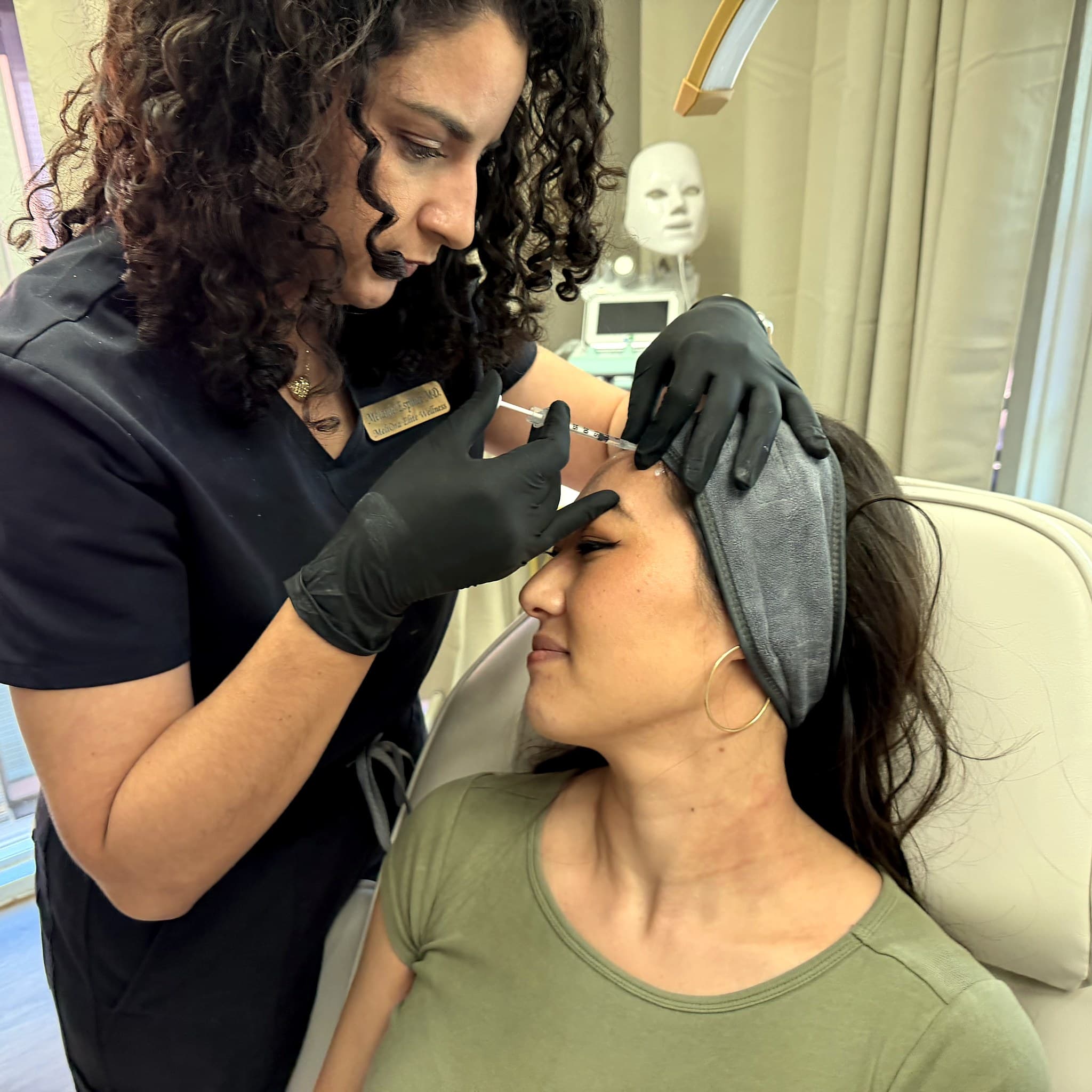
The short answerA droopy eyelid after Botox happens when a small amount of product reaches the muscle that lifts the upper lid, or when a relaxed forehead lets the brow sit lower. It is uncommon and temporary: published reviews describe it starting 3 to 14 days after treatment, often improving within 3 to 4 weeks, and resolving on its own within about three months as the product wears off. Call your injector, who can tell which kind of droop it is and whether prescription eye drops make sense for you.
Noticing one eyelid sitting lower than the other a week after Botox is unsettling, and a droopy eyelid after Botox is one of the most searched worries about treatment. The reassuring part is that it isn’t permanent. This guide comes from MeliOra, where board-certified physician Dr. Melanie Espinet performs every Botox treatment in Lutz and across Tampa Bay herself. It covers the difference between a droopy lid and a heavy brow, why each happens, how long it lasts, and what your physician may suggest. For every other reaction, see our guide to Botox side effects.
Droopy eyelid after Botox: eyelid ptosis or a heavy brow?
People say “droopy eyelid” for two different things, and the difference matters because the cause and the options differ. Eyelid ptosis means the upper lid itself sits lower over the eye. Brow ptosis, often felt as a heavy brow, means the eyebrow sits lower while the lid muscle works normally.
| Eyelid ptosis | Heavy brow (brow ptosis) |
|---|
| The edge of the upper eyelid sits lower over the eye | The eyebrow sits lower than it did before treatment |
| The levator, the muscle that lifts the lid, is weakened | The frontalis, the main muscle that raises the brows, is relaxed too much |
| Most often follows treatment of the frown lines between the brows | Usually linked to forehead treatment, especially injections low on the forehead |
| Prescription eye drops may lift the lid about 1 to 2 mm while it wears off | Fades as the forehead muscle recovers. Eyelid drops act on a lid muscle, not the brow |
Why does an eyelid droop after Botox?
Botox relaxes the muscle it reaches by blocking the nerve signal that tells it to contract. The upper eyelid is lifted mainly by the levator palpebrae superioris, a muscle that runs back along the roof of the eye socket. A thin sheet of tissue, the orbital septum, separates it from the brow muscles being treated. Reviews describe weak points in that barrier, around the small nerves and vessels that pass through near the brow, where toxin can travel to the levator. If enough reaches it, the lid lifts less.
It most often follows treatment of the frown lines, which sit close to the eye socket. Published reviews link it to:
- Injections placed too close to the bony rim above the eye, or near the middle of the brow
- Higher doses or larger volumes of fluid, which can spread farther
- Rubbing or massaging the treated area in the first few hours
- Anatomy: some people have a small opening in the brow bone that gives toxin a shorter path into the eye socket
- History: a past droop, Bell’s palsy, earlier face surgery, or a nerve or muscle condition such as myasthenia gravis
That is why the FDA labels for our Botox brands, Jeuveau and Xeomin, spell out placement rules to reduce ptosis. They say to keep injections away from the lid-lifting muscle and to place injections into the corrugator, the main frown muscle, at least 1 centimeter above the bony ridge over the eye. The Jeuveau label adds that the dose and volume should be accurate and kept as low as practical.
Heavy brow after Botox: why the brow can sit lower
The frontalis, the broad forehead muscle that makes horizontal lines, is the primary muscle that raises your eyebrows. The muscles behind the 11 lines pull the brows down and inward, as the Jeuveau label describes. If the forehead is relaxed too much, or too low, the muscles pulling down win, and the brow drops.
The Xeomin label addresses this directly. It pairs forehead treatment with frown-line treatment to minimize the potential for brow ptosis, and places forehead injections at least 2 centimeters above the rim of the eye socket. A 2020 study of forehead movement in 27 volunteers points the same way: injecting the upper forehead may lower the risk of a dropped brow. A lid or brow that already droops, or extra upper eyelid skin, also calls for care, and both labels urge caution in those cases. If your goal is the opposite, see our guide to the Botox brow lift, and for forehead dosing, forehead Botox.
How common is eyelid ptosis after Botox?
It is uncommon. The FDA labels for our Botox brands report, as printed:
- Jeuveau, frown-line trials: eyelid ptosis in 2% of treated people and 0% of people given placebo
- Xeomin, upper facial lines trials with up to 64 units: brow ptosis in 0.7%, more often than with placebo
- Xeomin, repeat-treatment trials for upper facial lines: brow ptosis in 1%, with side effects tending to fall with later treatments
- Xeomin, frown-line trials: facial muscle weakness (facial paresis) in 0.7%, and a drooping brow in less than 1% of people in the open-label repeat trials
Published reviews add that eyelid ptosis is less common with experienced injectors, and that rates appear to have fallen over the years as injectors have gained experience.
How long does a droopy eyelid from Botox last?
A droopy eyelid from Botox is temporary. It lasts only as long as the product’s effect on that muscle, and it resolves on its own as the effect wears off. Published reviews describe this pattern:
| Time after treatment | What usually happens |
|---|
| Days 3 to 14 | A droop, if it happens, usually shows up here. It may start as heaviness that gets worse as the day goes on |
|---|
| Weeks 3 to 4 | Many cases are improving or have resolved |
|---|
| Up to about 3 months | Slower cases resolve as the product wears off |
|---|
A heavy brow comes from relaxing the forehead muscle, so it follows the same clock as the rest of your result. The Xeomin label puts the typical duration of a treatment’s effect at up to 12 to 16 weeks. Our guide to how long Botox lasts covers that timeline in more detail.
Botox eyelid droop fix: what can help while it wears off
No treatment undoes the toxin’s effect on the nerve endings. The options below work around it while it fades, and what, if anything, to use is your physician’s call after an exam. Published reviews describe:
- Prescription eye drops for eyelid ptosis. Drops such as oxymetazoline or apraclonidine stimulate a small helper muscle in the lid, Müller’s muscle, and can lift it about 1 to 2 mm. An oxymetazoline 0.1% drop is FDA-approved for acquired drooping of the upper eyelid in adults, and apraclonidine is a glaucoma drop used off-label. Both have side effects, and some drops of this kind are not suitable for people with certain types of glaucoma
- Watchful waiting. A mild droop that doesn’t affect your vision often just needs time
- Other approaches. Reviews also mention eyelid exercises and vibration, and, for stubborn cases, a specialist injection technique in the lid itself. The evidence for these is limited
One claim worth skipping: social media posts say an injection of bacteriostatic saline reverses a toxin-related brow droop. A 2025 computer-modelling study concluded that it does not reverse the toxin’s action and that the claim isn’t supported. Skip home remedies, and don’t get extra injections from anyone other than your treating physician. For a heavy brow, eyelid drops aren’t designed to help, so your physician will tell you whether anything else fits your case.
When a droopy eyelid needs urgent care
A droopy eyelid on its own, starting days after treatment near the brows, is the expected pattern of this side effect. Get medical care right away if drooping eyelids come with any of these, which the labels for our Botox brands list among the signs of toxin spread:
- Double vision or blurred vision
- Muscle weakness beyond the treated area
- Hoarseness, a change in your voice, or trouble saying words clearly
- Trouble swallowing or breathing
For trouble swallowing or breathing, call 911. Both labels also say that if you have blurred vision, muscle weakness, or drooping eyelids, you should avoid driving or other hazardous activities. Eye dryness, irritation, light sensitivity, or vision changes are worth reporting too, since the Jeuveau label notes that toxins can reduce tear production and blinking.
How to lower the risk at your next Botox visit
- Tell your injector about any past droop, including the product, the units, and where it was injected
- Mention drooping lids or brows, Bell’s palsy, eye or face surgery, or any nerve or muscle condition
- Stay upright and keep your hands off the treated areas for the first 4 hours, and don’t rub or massage them for 24 hours
- Take a photo before treatment. Reviews estimate that about 90% of people have some brow asymmetry, so a baseline photo shows what changed and what was already there
A past droop doesn’t mean it will happen again, but it is a known risk factor, so it should shape your next plan. Our Botox aftercare guide has the full before and after checklist.
How MeliOra plans around eyelid and brow droop
At MeliOra, every Botox treatment with Jeuveau or Xeomin is performed by Dr. Melanie Espinet, a board-certified physician, at your home or office across Tampa Bay, or at our Lutz office for select appointments. Before treatment she reviews your history, then asks you to frown, raise your brows, and smile so she can plan placement around how your face moves. She doses conservatively, and you agree on the product, areas, units, and total before anything begins, at $12/unit with either brand.
She records your product and units so your next plan starts from real data, and she reviews the warning signs with you before treatment. If an eyelid or brow feels heavy in the days after treatment, call or text her directly. For typical doses by area, see how many units of Botox you need, or book a Botox visit with no travel fee anywhere in our service area.
Frequently asked questions
How long does a droopy eyelid from Botox last?
A droopy eyelid from Botox usually lasts a few weeks and resolves on its own as the product wears off. Published reviews describe it starting 3 to 14 days after treatment, often improving within 3 to 4 weeks, and fully resolving within about three months.
Is a droopy eyelid from Botox permanent?
No, a droopy eyelid from Botox is temporary. It comes from the product relaxing a nearby muscle, and it resolves on its own as that effect wears off, typically within about three months.
How do you fix a droopy eyelid after Botox?
The main fix for a droopy eyelid after Botox is time, because it resolves as the product wears off. For eyelid ptosis, a physician may prescribe eye drops, such as oxymetazoline or apraclonidine, that can lift the lid about 1 to 2 mm in the meantime. Whether they suit you is your physician’s decision.
What is the difference between eyelid ptosis and brow ptosis after Botox?
Eyelid ptosis is when the upper lid itself sits lower because the muscle that lifts it is weakened, while brow ptosis is when the eyebrow sits lower because the forehead muscle that raises it is relaxed too much. Eyelid ptosis most often follows frown-line treatment, and brow ptosis most often follows forehead treatment.
When does a droopy eyelid start after Botox?
A droopy eyelid after Botox usually starts 3 to 14 days after treatment. Some people first notice a heavy feeling in the brow or lid that gets worse as the day goes on.
Can I drive with a droopy eyelid after Botox?
You should not drive if a droopy eyelid, blurred vision, or muscle weakness affects you after Botox. The FDA labels for Jeuveau and Xeomin both advise avoiding driving and other hazardous activities in that case.
Will a droopy eyelid happen again with my next Botox?
Not necessarily, but a past droop is a known risk factor, so tell your injector before your next treatment. Knowing your history, the product, and the units helps them plan placement and dose.
Is a droopy eyelid after Botox an emergency?
A droopy eyelid on its own is usually not an emergency, but you should call your physician. Get emergency care if it comes with double vision, trouble swallowing, speaking, or breathing, or weakness elsewhere in the body.
Related Services
Sources & References
Ready to take the next step?
Serving Lutz, Wesley Chapel, Land O'Lakes, Carrollwood, New Tampa & greater Tampa Bay.
Book Your Consultation