The short answerWhat is Botox made of? A purified protein called botulinum toxin type A, made by Clostridium botulinum bacteria and dried into a powder with tiny amounts of inactive ingredients, such as human albumin. Just before treatment, the powder is mixed with sterile saline. Injected in small doses, it relaxes the muscles that crease your skin, so expression lines soften for about three to four months.
Most people say Botox for any wrinkle-relaxing injection, so the question “what is Botox made of?” really covers a whole family of products. At MeliOra Elite Wellness, Botox means Jeuveau or Xeomin, two FDA-approved botulinum toxin type A products that Dr. Melanie Espinet, a board-certified physician, places herself. This guide explains what’s in the vial, why a toxin can be used safely in medicine, how Botox works on your muscles, and how our two Botox brands differ. For prices and treatment areas, see Botox in Lutz, FL.
What is Botox?
Botox is one company’s brand name for a botulinum toxin injection. The name caught on so widely that people now use it for the whole category, the way a familiar brand can become the everyday word for a product type. That’s why you’ll see “Botox” on this site: it’s the word you search for.
The FDA describes these products as injectable drugs that work by keeping muscles from tightening, so wrinkles don’t show as much. The FDA has approved them for the temporary improvement of certain facial lines, including frown lines, forehead lines, and crow’s feet. They’re prescription medicines given by injection, not creams or fillers.
At MeliOra, our Botox brands are Jeuveau (prabotulinumtoxinA-xvfs) and Xeomin (incobotulinumtoxinA). Both are FDA-approved for frown lines between the brows, and Xeomin is also approved for forehead lines and crow’s feet. MeliOra doesn’t carry the Botox brand itself, so the ingredient details below come from the FDA labels for our two products.
What is Botox made of? The ingredients, label by label
Every botulinum toxin product starts with the same raw material: a protein made by Clostridium botulinum bacteria, grown by fermentation and then purified. The finished vial holds a tiny amount of that protein plus a few inactive ingredients. Here’s what the labels list for our Botox brands:
| In the vial | Jeuveau and Xeomin, per their FDA labels |
|---|
| Active ingredient | Botulinum toxin type A in both. In Jeuveau it’s prabotulinumtoxinA-xvfs; in Xeomin it’s incobotulinumtoxinA |
|---|
| Where it comes from | Fermentation of Clostridium botulinum bacteria. Xeomin’s label names the Hall strain, serotype A |
|---|
| Size of the toxin | Jeuveau: a 900 kDa toxin complex. Xeomin: the 150 kDa neurotoxin on its own, without accessory proteins |
|---|
| Inactive ingredients | Jeuveau: human serum albumin and sodium chloride. Xeomin: human albumin and sucrose, a sugar |
|---|
| Form | A dried powder: vacuum-dried for Jeuveau, freeze-dried (lyophilized) for Xeomin |
|---|
| Mixed with | Sterile, preservative-free saline shortly before treatment |
|---|
| Vial sizes | Jeuveau: 100 units. Xeomin: 50, 100, or 200 units |
|---|
That short list is the complete ingredient list on each label. Nothing in the vial adds volume under the skin, which is the key difference from a dermal filler; our guide to Botox vs fillers explains how the two compare.
The albumin surprises some people. It’s a protein derived from human blood, and both labels list it in the vial alongside the toxin. Both labels say that donor screening and manufacturing make the risk of passing on a virus extremely remote, and that no case of viral disease transmission has ever been identified for licensed albumin.
The amount of toxin is measured in units, a measure of biological activity, not weight or volume. Each label says its units are specific to that product and can’t be converted into another brand’s units. For typical doses by area, see how many units of Botox you need.
Is Botox made from the bacteria that cause botulism?
Yes. Botox and botulism come from the same bacterium. The FDA says botulinum toxin products are derived from the same bacteria that cause botulism, but the amounts used for cosmetic treatment are purified and many orders of magnitude smaller. A review in the Indian Journal of Dermatology calls botulinum toxin one of the most poisonous biological substances known. That’s exactly why the product, the dose, and the person injecting it matter so much.
The labels for both of our Botox brands carry a boxed warning that covers all botulinum toxin products. Rarely, the effect can spread beyond the injection site and cause symptoms such as general muscle weakness, double or blurred vision, drooping eyelids, or trouble swallowing, speaking, or breathing, hours to weeks after treatment. The Xeomin label says that risk is probably greatest in children treated for spasticity. If any of those symptoms appear after any Botox treatment, get medical care right away.
At cosmetic doses, the common side effects are milder. The most common ones listed in the cosmetic sections of the labels are headache for Jeuveau and bruising where the needle went in for Xeomin. Xeomin’s label also notes that at recommended doses, the toxin can’t be detected in the blood with current lab methods after an injection into a muscle. Our guide to Botox side effects covers what’s common, what’s rare, and when to call.
How does Botox work?
To move a muscle, a nerve releases a chemical messenger called acetylcholine where the nerve meets the muscle. Botulinum toxin type A blocks that release. According to the labels, the toxin binds to the nerve ending, enters it, and cuts a protein called SNAP-25 that the nerve needs to release acetylcholine. The Jeuveau label describes the result as a partial chemical denervation of the injected muscle, meaning a localized reduction in muscle activity.
Why does that smooth a wrinkle? A review in American Family Physician explains that facial wrinkles form from thinning of the skin’s deeper layer plus repeated contraction of the muscles underneath. When the muscle can’t pull as hard, the skin over it stops folding as deeply. Botox doesn’t fill a line or tighten skin, so it works best on lines you see when you make an expression. The same review notes that lines visible at rest respond less dramatically.
| When | What happens |
|---|
| About 2 to 7 days | Lines begin to soften. The Xeomin label puts the median onset in this window |
|---|
| About 2 weeks | The full effect, according to the American Family Physician review |
|---|
| About 3 to 4 months | Movement gradually returns as the nerve recovers |
|---|
| Next treatment | Both labels say no more often than every three months |
|---|
Why does Botox wear off? The nerve heals itself. Xeomin’s label says nerve signaling is re-established by the formation of new nerve endings, and Jeuveau’s label describes evidence that the muscle slowly regains its nerve supply. That’s why Botox is temporary and why maintenance visits exist. For the details, read how long Botox takes to work and how long Botox lasts.
What is botulinum toxin type A?
Botulinum toxin isn’t one substance. The bacterium makes several distinct toxins, labeled with letters, and the Indian Journal of Dermatology review lists eight: A, B, C1, C2, D, E, F, and G. All of them interfere with nerve signals by blocking acetylcholine release. Both of our Botox brands are type A, according to their labels.
Even within type A, products aren’t identical. Each product is made and potency-tested in its own way, and each label says its units can’t be converted into another brand’s units. If you’ve had Botox elsewhere, bring the product name, units, and areas, and Dr. Espinet plans your Jeuveau or Xeomin dose from that history and an exam.
Neuromodulator, neurotoxin, wrinkle relaxer: what the names mean
You’ll hear several names for the same family of treatments. Here’s what each one means:
- Botox: one company’s brand name, used by most people for the whole category
- Botulinum toxin type A: the scientific name of the active ingredient
- Neurotoxin: a toxin that acts on nerves. It sounds alarming, but it simply describes where the protein works
- Neuromodulator: a term many clinicians use, because at treatment doses the product turns down a nerve’s signal to the injected muscle
- Wrinkle relaxer: plain shorthand for what it does to expression lines
- Acetylcholine release inhibitor and neuromuscular blocking agent: how the FDA labels for Jeuveau and Xeomin classify them
All of these point to the same kind of treatment. When we say Botox, we mean Botox with Jeuveau or Xeomin.
How our two Botox brands differ inside the vial
Our two Botox brands share the same type of active ingredient and the same basic action on the nerve. The differences are in how they’re made and what they’re approved for:
- Accessory proteins: the Xeomin label says its neurotoxin is separated from the bacterium’s other proteins, called hemagglutinins and non-hemagglutinins, leaving the 150 kDa neurotoxin without accessory proteins. The Jeuveau label describes a 900 kDa toxin complex.
- Inactive ingredients: Jeuveau uses sodium chloride alongside albumin; Xeomin uses sucrose alongside albumin.
- Approved cosmetic areas: Jeuveau is approved for frown lines between the brows. Xeomin is approved for frown lines, forehead lines, and crow’s feet.
- Units: each brand’s units are specific to that product.
Do the accessory proteins matter? Some physicians consider a product without them when a patient’s response to another brand has faded, but the evidence is limited. The cosmetic trials described in each label compared the product with a placebo, not with the other brand. At MeliOra, both are $12/unit, so price never steers the choice, and Dr. Espinet recommends one based on your history and goals. Read more about Xeomin in Lutz.
What is Botox used for?
Cosmetically, botulinum toxin type A softens lines made by muscle movement. Medically, it treats conditions caused by overactive muscles or glands. The Xeomin label alone lists these approved uses:
- Frown lines, forehead lines, and crow’s feet in adults
- Chronic drooling (sialorrhea) in adults and in children 2 and older
- Upper limb spasticity in adults and in children 2 and older
- Cervical dystonia, which affects the neck muscles, in adults
- Blepharospasm, which affects the eyelid muscles, in adults
At MeliOra, Botox is used for the face and jaw: the upper-face lines above, plus areas such as a brow lift, bunny lines, a gummy smile, and chin dimpling. Those other areas are off-label uses, which Dr. Espinet explains before treatment. For jaw slimming and clenching, see masseter Botox in Lutz.
Botox at MeliOra: Jeuveau or Xeomin, placed by a physician
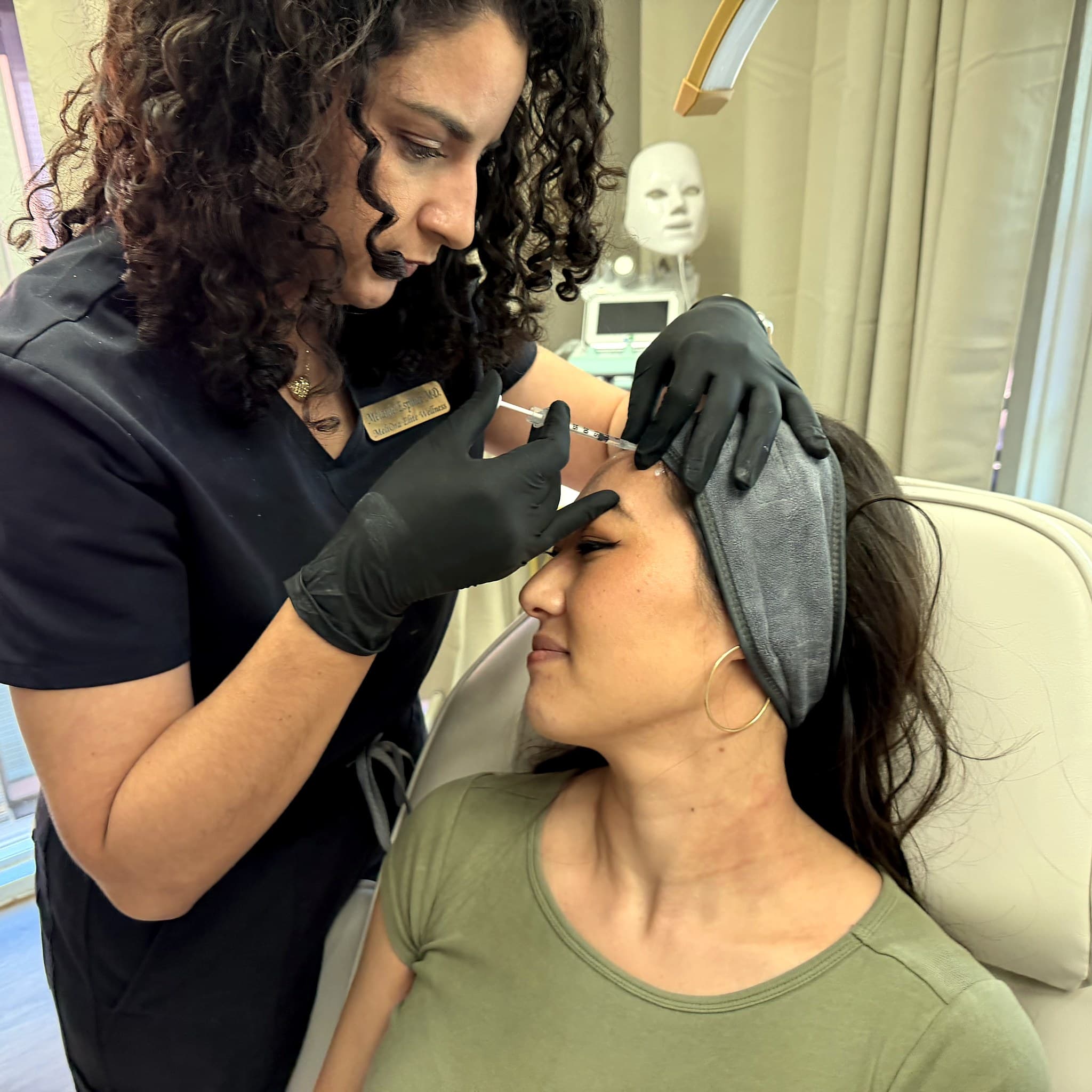
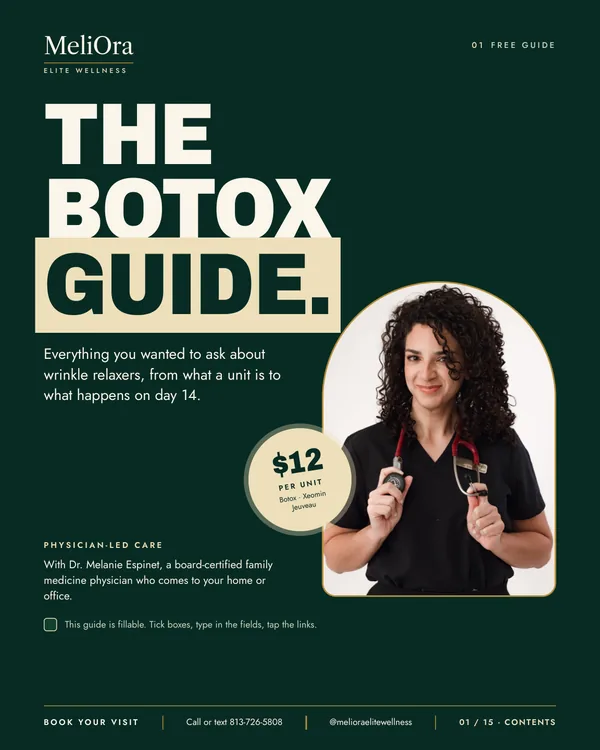
MeliOra is a physician-led concierge med spa based in Lutz. Dr. Melanie Espinet, a board-certified family physician, reviews your health history, watches how your face moves, and places every injection herself. Botox with Jeuveau or Xeomin is $12/unit, and you agree on the product, the areas, and the units before anything begins. She comes to your home or office anywhere in the Tampa Bay service area with no travel fee, and select appointments are available at the Lutz office.
Botox isn’t right for everyone. The American Family Physician review lists neuromuscular disorders such as myasthenia gravis, and allergy to an ingredient in the product, among the reasons not to inject. The FDA says cosmetic botulinum toxin isn’t recommended during pregnancy or breastfeeding; our guide to Botox while pregnant explains why. Share your conditions and medications so Dr. Espinet can advise you, and when you’re ready, book a Botox visit.
Frequently asked questions
What is Botox made of?
Botox is made of a purified protein, botulinum toxin type A, produced by Clostridium botulinum bacteria and dried into a powder with small amounts of inactive ingredients. In our Botox brands, those are human albumin plus sodium chloride (Jeuveau) or sucrose (Xeomin). The powder is mixed with sterile saline just before treatment.
Is Botox made from bacteria?
Yes. The active ingredient is a protein made by Clostridium botulinum bacteria, grown by fermentation and then purified. The FDA notes it comes from the same bacteria that cause botulism, but cosmetic doses are purified and many orders of magnitude smaller.
How does Botox work?
Botox works by blocking the nerve signal that tells a muscle to contract. It stops nerve endings from releasing acetylcholine, so the injected muscle relaxes and the skin over it folds less. The effect typically fades over about three to four months as the nerve forms new endings.
What is botulinum toxin type A?
Botulinum toxin type A is one of several toxins made by Clostridium botulinum, and it’s the type in both Jeuveau and Xeomin. All of the types block the nerve messenger acetylcholine, but each type A product has its own manufacturing process and its own unit scale.
Is Botox a neuromodulator?
Yes. Neuromodulator is the clinical term for botulinum toxin injections, including our Botox brands, Jeuveau and Xeomin, because at treatment doses they turn down a nerve’s signal to a muscle. Wrinkle relaxer is the everyday name for the same thing.
Does Botox contain human albumin?
Yes, a small amount. Both of our Botox brands contain human albumin, a protein derived from human blood, alongside the toxin. Their FDA labels say donor screening and manufacturing make the risk of transmitting a virus extremely remote, and no such case has ever been identified for licensed albumin.
Is Botox permanent?
No. Botox is temporary because the nerve recovers: new nerve endings form and the muscle gradually moves again, typically within about three to four months. Both of our Botox brands’ labels say retreatment should be no more often than every three months.
Which Botox brands does MeliOra use?
MeliOra’s Botox brands are Jeuveau and Xeomin, both FDA-approved botulinum toxin type A products, at $12/unit each. MeliOra doesn’t carry the Botox brand itself. Dr. Espinet recommends one based on your history and goals.
Related Services
Sources & References
Ready to take the next step?
Serving Lutz, Wesley Chapel, Land O'Lakes, Carrollwood, New Tampa & greater Tampa Bay.
Book Your Consultation