The short answerTrue Botox resistance, when your immune system makes antibodies that block the toxin, is rare at cosmetic doses. A weaker result usually has another cause: it was judged before two weeks, the dose or injection points changed, or the product wasn’t handled well or wasn’t genuine. Check at two weeks, compare your records, and talk to your injector before switching.
Botox resistance is the first worry when a treatment that used to work fades faster or barely takes. At MeliOra Elite Wellness, Botox means Jeuveau or Xeomin at $12/unit, given by Dr. Melanie Espinet at house calls across Hillsborough, Pasco, and Pinellas counties. For every area and price, see Botox in Lutz, FL.
What is Botox resistance?
Botox resistance is a loss of effect caused by neutralizing antibodies, immune proteins that bind botulinum toxin and stop it from blocking the nerve signal to a muscle. The Jeuveau label puts it plainly: botulinum toxins may cause antibodies that may reduce the effect of later treatments by inactivating the toxin.
Primary vs secondary non-response
Primary non-response: Botox never worked well. A 2025 review describes it as an innate insensitivity, seen more often in medical treatment than cosmetic
Secondary non-response: Botox worked, then later treatments faded or stopped working. The same review says most reported cosmetic cases are this kind
Partial non-response: a weaker effect rather than none
Only some secondary non-response comes from antibodies. A 2019 review in Toxins notes that antibody test results don’t consistently match how a person responds.
How common is Botox resistance?
Rare, and rarest at cosmetic doses. A 2022 meta-analysis of 43 studies and 8,833 people treated for medical conditions found neutralizing antibodies in 1.8%, highest in dystonia at 7.4%, where doses are far larger than for wrinkles. The 2019 review says cosmetic use has generally been linked to few antibodies, probably because the doses are low.
Low isn’t zero. A 2014 report described five cosmetic patients whose treatment failed after antibodies formed. In a 2024 survey of 673 Korean physicians who use toxin, about half of them aesthetic physicians, 53.9% said they had seen resistance, yet the largest group, 59.4%, estimated it affects fewer than 1% of patients. And one clinic’s records of 50 people treated with Allergan’s Botox, a brand MeliOra doesn’t carry, for an average of 15 years showed no treatment failure.
What the Jeuveau and Xeomin labels say about antibodies
Each FDA label has its own immunogenicity section, measured with its own tests. Read them side by side:
Label
What its antibody section reports
Jeuveau (prabotulinumtoxinA-xvfs), April 2023
Of 1,414 people treated, 2 had antibodies before treatment and 2 developed them. The label warns that antibodies to botulinum toxins may reduce the effect of later treatments
Xeomin (incobotulinumtoxinA), June 2026
Of 2,649 people treated in its trials for every use, 13 tested positive for neutralizing antibodies afterward: 9 whose status before treatment was unknown and 4 who developed them. None lost their response because of them. In the frown-line trials, none of 464 people developed them
Both labels warn against comparing these rates: Xeomin says differences in test methods rule out meaningful comparisons with other studies, and Jeuveau says comparisons with other studies or products may be misleading. So the table shows each brand’s own record, not which brand is safer. For choosing between them, see Jeuveau vs Xeomin.
Why Botox stops working: the common causes
Botox not working is usually not resistance. A 2025 review says to rule out handling and technique first.
What changed
Why the result can look weaker
You judged it early
The full effect typically takes about 2 weeks to develop, says a review in American Family Physician. A day-5 check can look like failure
The dose or the injection points
A lighter dose, a missed muscle, or a new injector’s different pattern can soften the result, the 2025 review notes
The brand
Both labels say their units can’t be converted into units of any other botulinum toxin, so the same number on a new brand isn’t the same dose
Handling
The 2025 review names improper dilution and prolonged storage. Both labels say mixed product is refrigerated and used within 24 hours
Lines etched at rest
The AFP review says lines seen during movement respond more dramatically than lines visible at rest
A shorter result alone doesn’t prove resistance, since duration varies with dose, area, and muscle strength (see how long Botox lasts). But results that keep shortening at the same dose, or need more units for the same effect, are early signs a 2022 review says physicians watch for. If your brand is Xeomin, our Xeomin calendar shows when movement usually returns. On a GLP-1? The claim that it shortens Botox comes from a computer simulation, not a study of patients; see Botox on Ozempic.
Counterfeit or mishandled Botox
In 2024, the CDC reported 22 people in 11 states, Florida among them, with harmful effects linked to counterfeit or mishandled botulinum toxin injections. The FDA tells patients to confirm the product comes from an authorized source and that the injector is licensed and trained. Toxin sold online for do-it-yourself injections carries the same risks; see DIY Botox.
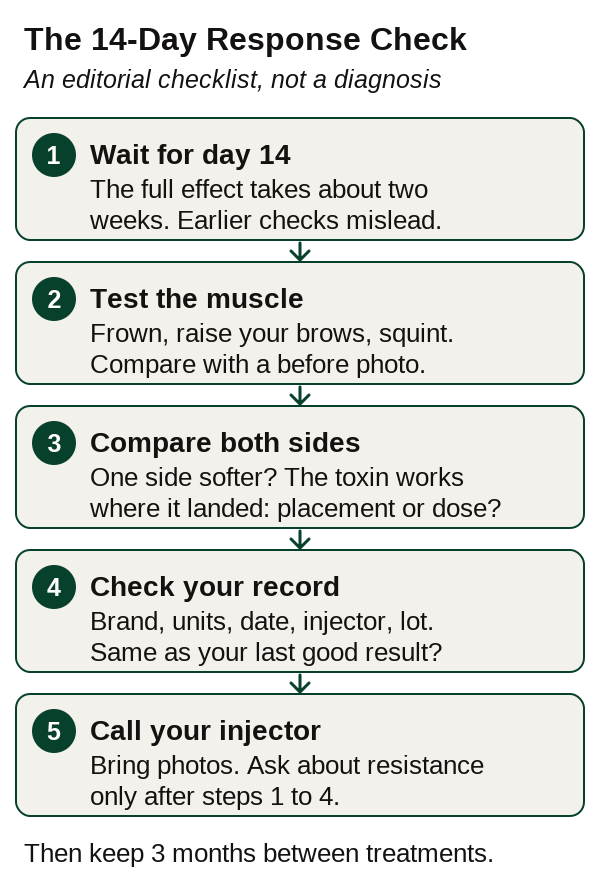
The 14-Day Response Check
The 14-Day Response Check is our editorial checklist for deciding whether Botox really stopped working. It organizes the label facts and reviews above. It isn’t a diagnosis or a clinical protocol, and it’s only for a weaker result: new symptoms such as trouble swallowing, speaking, or breathing can’t wait (see the warning table below).
Wait for day 14. The full effect takes about two weeks, so earlier checks mislead
Test the muscle in a mirror. Frown, raise your brows, and squint, and compare with a photo taken before treatment
Compare both sides. If one side softened and the other didn’t, the toxin is working where it landed, which points to placement or dose rather than resistance
Pull your record: brand, units per area, date, injector, and the lot number if you have it. Compare it with your last good result
Call the injector who treated you, with your photos, before getting more anywhere else. The 2019 review names “booster” injections 1 to 2 weeks after a treatment among the strongest risk factors for antibodies
Keep your spacing. Both labels say not to retreat more often than every three months
Many “Botox stopped working” answers turn up in steps 1 to 4, before antibodies need to be considered.
Not sure your last Botox worked? Contact the injector who treated you at day 14, with your photos. When you’re next due, at least three months after your last treatment, book a Botox visit and bring your record. Dr. Espinet confirms your brand, units, and total at $12/unit before anything begins.
How is Botox resistance confirmed?
There is no home test, and lab tests have limits. The 2019 review describes a unilateral brow injection: a standard dose goes into the frown muscle above one eyebrow, and about two weeks later you frown and check whether that side moves less. If it does, the toxin still works. A similar forehead test exists, but the review calls it cosmetically unacceptable, because it can leave one brow lower.
Blood tests exist, but results don’t always match the clinical response, and a 2022 survey of 128 Asia-Pacific injectors found the best bioassays unavailable to most. So confirming resistance starts with ruling out the common causes.
The next-step hurdle: what to do if Botox stopped working
Switching Botox brands
In the Korean survey, 43.7% of physicians said they would change to another company’s product, though the authors said a plain brand swap misreads how resistance works. Units don’t convert between brands, so your physician resets the dose (see how many units of Botox you need), and you judge a new brand at two weeks.
Does Xeomin help with Botox resistance?
Maybe. The Xeomin label describes a 150 kDa neurotoxin without accessory proteins, while the Jeuveau label describes a 900 kDa complex. A 2025 review found mixed results: in one small study, 30% of people who stopped responding to Allergan’s Botox responded after switching to incobotulinumtoxinA (Xeomin), but in published cosmetic case reports the switch didn’t restore results in the short term. A 2018 review concluded that the complexing proteins don’t influence immunogenicity at all. Some experts on each side have industry ties, and no head-to-head cosmetic trial settles it (Xeomin vs Botox).
Taking a break from Botox
For complete non-response, the 2025 review says many experts advise a 12 to 18 month break, so antibody levels can fall (a 2022 survey panel suggested 2 to 2.5 years), before trying a highly purified toxin, while others prefer switching right away. That choice belongs with your physician.
Protecting your Botox response for the long run
Space treatments at least three months apart, as both labels require
Use the lowest dose that gives the look you want. Larger doses per session and larger lifetime totals are both linked to antibodies
Choose an experienced injector who records brand and units at each visit, so a weaker result is easier to trace
If you also get botulinum toxin for a medical reason, such as migraine, tell both physicians. Antibodies act against the toxin whatever it’s used for
When a weaker result needs a doctor today
A treatment that didn’t take isn’t an emergency. Some new symptoms are, especially after toxin from an online seller, an unlicensed injector, or an unknown product.
If you notice
What to do
Trouble swallowing, speaking, or breathing, trouble saying words clearly, or weakness all over the body
Call 911 or get emergency care right away. The labels warn these can appear hours to weeks after treatment
Double vision or blurred vision
Go to the emergency room or see a health care provider right away. Don’t wait, and don’t drive yourself
Wheezing, swelling of your face, eyes, or tongue, or feeling dizzy or faint
This could be a severe allergic reaction. Call 911 right away
Chest pain or pressure, or a racing or irregular heartbeat
Call 911 right away, and don’t drive yourself. The Jeuveau label and Allergan’s Botox Cosmetic label report irregular heartbeats and heart attacks after botulinum toxin products, some fatal
Hives, itching, or a rash with no trouble breathing
A possible allergic reaction. Get medical help right away, and call 911 if it gets worse
Hoarseness, a change or loss of voice, or loss of bladder control
Get medical care right away. The labels list these among the signs of toxin spread
Eye pain or sudden vision changes
Go to the emergency room or an eye doctor right away, and don’t drive yourself. Call 911 if you suddenly lose vision
An eye that feels dry, irritated, or gritty, is sensitive to light, or won’t close fully
Get medical care right away. The Jeuveau label notes toxins can reduce tears and blinking, and the Xeomin label says reduced blinking can injure the eye’s surface
Sudden drooping on one side of your mouth or face, sudden numbness or weakness in your face, arm, or leg, sudden confusion, or a sudden severe headache
These can have causes other than Botox, including a stroke. Call 911 right away, and don’t drive yourself
A droop, blurred vision, slurred speech, dry mouth, or weakness after toxin from an online seller, an unlicensed injector, or an unknown product
Go to the emergency room now, don’t drive yourself, and call 911 if breathing or swallowing gets harder. Tell them what was injected, how many units, and when. The CDC lists drooping eyelids, blurred vision, and slurred speech among early botulism signs
Redness, warmth, or swelling where you were treated that spreads or worsens, or pus or a fever
Call your injector or doctor today. The Jeuveau label lists infection among the effects an injection can cause
A drooping eyelid or heavy brow on its own, after treatment by a licensed provider
Call your injector. Don’t drive or do other risky activities while an eyelid droops or your vision is blurred, as both labels advise
A weaker result with no other symptoms
Wait for day 14, then contact the physician who treated you
Both labels say not to treat anyone allergic to any botulinum toxin product or with an infection at the injection site. Safety in pregnancy and breastfeeding hasn’t been established, so treatment is generally postponed; see Botox while pregnant. Tell your physician first about a nerve or muscle condition such as myasthenia gravis, or trouble swallowing or breathing. For every warning sign, see Botox side effects; for a brow or lid that drops, see does Botox migrate.
This guide is general information, not medical advice. Ask your own physician about your health and any treatment.
Botox at MeliOra: bring your history
Dr. Melanie Espinet, a board-certified family physician, performs every Botox treatment herself, with Jeuveau or Xeomin at $12/unit. She reviews your health history, confirms your areas, units, and total before beginning, and records your product and units at every visit, so a result that changes can be compared with real numbers. If you’ve had Botox elsewhere, bring the brand, units, dates, and photos.
Dr. Espinet performs every Botox treatment herself, including at house calls.
House calls cover Hillsborough, Pasco, and Pinellas counties across Tampa Bay with no travel fee, and select appointments are available at the Lutz office. At any house call, including ours, ask how the product was stored on the way and what the plan is for a serious reaction. If you’re tempted to fix a weak result with a lot more units, read what too much Botox looks like first.
Frequently asked questions about Botox resistance
Can you become immune to Botox?
Yes, but it’s rare at cosmetic doses. Some people make neutralizing antibodies that block the toxin, so later treatments work less well or not at all. A 2022 meta-analysis found these antibodies in 1.8% of people treated for medical conditions, which use larger doses than wrinkle treatment.
Why is my Botox not working anymore?
Usually the cause isn’t resistance. The result may have been judged before two weeks, the dose, brand, or injection points may have changed, or the product may have been mishandled or not genuine. Compare your records with your last good result, then talk to the injector who treated you.
Can you become resistant to Botox after 20 years?
It can happen, but it isn’t inevitable. One clinic’s records of 50 people treated with Allergan’s Botox, a brand MeliOra doesn’t carry, for an average of 15 years, up to 26, showed no treatment failure. In medical patients, a longer treatment history was linked to more antibodies, so spacing and sensible doses still matter.
How do I know if I’m resistant to Botox?
Wait two weeks, then check whether the treated muscles move any less than before. If nothing changed after a dose that worked before, a physician may suggest a test injection above one eyebrow. If that side moves less two weeks later, the toxin still works for you.
Is Botox not working after 2 weeks a sign of resistance?
Not by itself. A weak result at two weeks more often points to the dose, the injection points, a brand switch, or deep lines at rest. If nothing changed after a dose that worked before, ask your physician about resistance and bring your records.
Get a straight answer on your Botox
Give it two weeks, bring your record, and get a physician’s read. Book your Botox visit with Dr. Espinet, at your home in Hillsborough, Pasco, or Pinellas County or at the Lutz office, with your total at $12/unit confirmed before the first injection.
THE PATIENT AND ANY OTHER PERSON RESPONSIBLE FOR PAYMENT HAS A RIGHT TO REFUSE TO PAY, CANCEL PAYMENT, OR BE REIMBURSED FOR PAYMENT FOR ANY OTHER SERVICE, EXAMINATION, OR TREATMENT THAT IS PERFORMED AS A RESULT OF AND WITHIN 72 HOURS OF RESPONDING TO THE ADVERTISEMENT FOR THE FREE, DISCOUNTED FEE, OR REDUCED FEE SERVICE, EXAMINATION, OR TREATMENT.
Free download · 15 pages
The MeliOra Botox Guide
Typical units and cost by area, Botox brands Jeuveau vs. Xeomin, aftercare, a results timeline and a planner you can fill in. Free, and yours to keep.