The short answerConcierge medicine is primary care you pay a membership fee for, often yearly, in exchange for more time with your doctor and easier access. Many practices still bill insurance for visits. A concierge med spa uses the same personal model for aesthetics and weight care, not primary care.
If you searched for concierge medicine in Clearwater, Wesley Chapel, or St. Pete and found a med spa, here is a straight answer: what concierge medicine is, what it costs, how it differs from direct primary care, and the questions to ask before you sign.
MeliOra Elite Wellness is a physician-led concierge med spa, not a primary care practice. Dr. Melanie Espinet brings Botox, GLP-1 weight loss, and wellness shots to your home or office. For checkups, sick visits, and ongoing conditions, you need a primary care doctor, and this guide helps you choose one. For our own model, see what concierge medical aesthetics is.
What is concierge medicine?
Concierge medicine is a primary care practice that charges patients a membership or retainer fee, often yearly, for extra access: longer visits, quicker appointments, and a doctor who is easier to reach. Many concierge practices also bill insurance for covered visits.
The American Academy of Family Physicians describes concierge care as an annual membership contract whose fees cover an in-depth physical exam and screenings, with practices that may still bill insurance and government programs. The AMA Code of Medical Ethics calls these retainer practices. It says physicians must explain the terms clearly, including what they mean for your insurance, and must take care not to imply that more or better medical services come with the contract.
The model is growing. A 2025 Health Affairs study, funded by federal and foundation grants, counted concierge and direct primary care sites rising from 1,658 in 2018 to 3,036 in 2023, an 83.1 percent increase, with Florida among the states with the most practices.
What does a concierge doctor do?
A concierge doctor is usually a primary care physician with a smaller panel of patients. In a fall 2004 government survey of 112 concierge physicians (GAO, 2005), nearly all practiced primary care, and the features they offered most often were same-day or next-day appointments for nonurgent care, 24-hour phone access, and periodic preventive physicals. Practices differ, so ask what yours includes.
Concierge medicine vs direct primary care
Direct primary care, or DPC, is the closest cousin. Both trade a fee for access, but they handle money and insurance differently:
Concierge medicine vs direct primary care
Feature
Concierge medicine
Direct primary care
The fee
A yearly retainer, often a few thousand dollars
A monthly fee, often smaller
Insurance
Usually still billed for covered visits
Not billed for the services the fee covers
What the fee covers
Extra access, an in-depth physical, and screenings
Most primary care visits and basic lab work
Who it serves
Often higher-income patients
A wider range of incomes, the AAFP says
The line blurs in practice. The Health Affairs authors note that some physicians, even within one practice, mix features of both, and that hybrid models with lower fees that also bill insurance may account for part of the growth. Our concierge vs online GLP-1 guide applies the same lens to weight loss programs.
How much does concierge medicine cost?
Concierge medicine cost depends on the practice, and we found no current national price survey. These are the published figures, each with its source and year:
Source and year
Published fee
GAO survey of 112 concierge physicians, fall 2004 (report 2005)
$60 to $15,000 a year for one person; about half charged $1,500 to $1,999
Health Affairs study, 2025, citing a 2023 industry blog
Concierge retainers average a few thousand dollars a year and reach tens of thousands; insurance is still billed for visits
American Academy of Family Physicians, 2026
Direct primary care: typically $50 to $100 a month
The fee is rarely the whole bill
A concierge retainer usually sits on top of your insurance premiums, copays, and deductibles, because the practice still bills insurance for visits. Direct primary care skips insurance for covered services, but the AAFP notes that DPC practices often suggest a high-deductible policy to cover emergencies. Specialists and hospital care sit outside a primary care fee, so ask what is excluded.
Medicare and concierge fees
If you have Medicare, the law limits what a participating physician’s fee can cover. In a 2004 alert, the HHS Office of Inspector General reminded participating physicians that they may charge for items and services Medicare doesn’t cover, but asking for other payment for covered services can bring penalties. It described a physician whose $600 annual contract included services the OIG alleged Medicare already paid for; he settled and stopped offering it.
Is concierge medicine worth it?
It depends on what you value. A 2025 systematic review found limited evidence that concierge medicine improves clinical outcomes, though it reported higher patient and physician satisfaction. A 2023 study of patients whose doctors switched to concierge medicine found large increases in spending and no average effect on deaths. A retainer buys time and access, and the AMA says it shouldn’t be sold as better medicine. If you’re pricing aesthetics instead, see what a mobile med spa is and what it should cost.
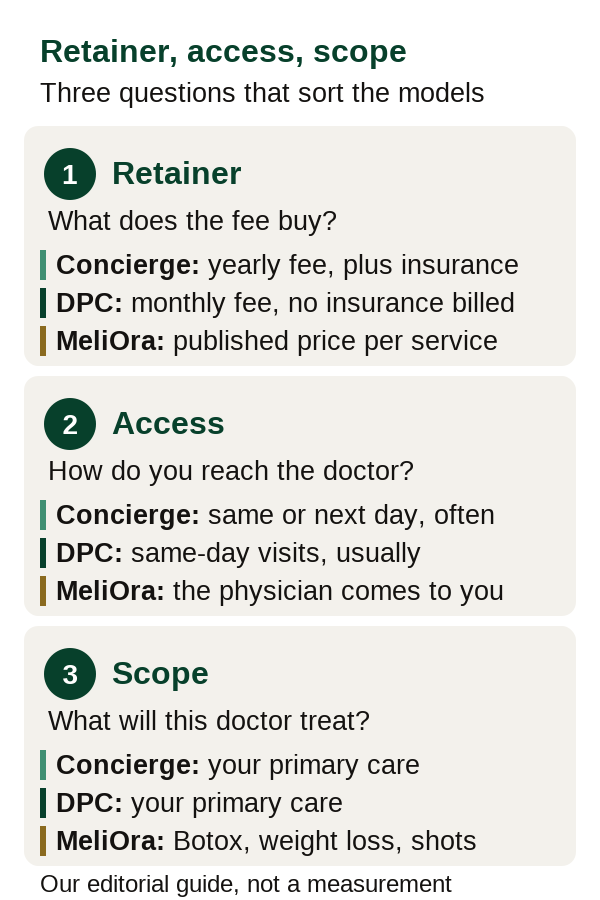
Retainer, access, scope: three questions that sort the models
Concierge medicine, direct primary care, and a concierge med spa can look alike online. Three questions separate them. This is our editorial guide, not a measurement, and it works for any practice you’re considering.
1. Retainer: what does the fee buy?
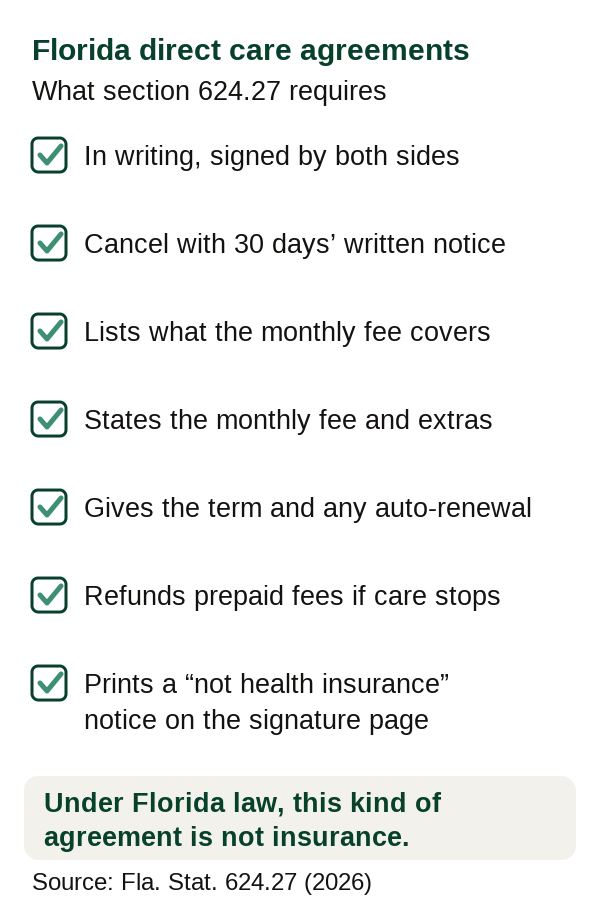
Ask for the fee in writing, what it covers, what is billed separately, and how to cancel. If the practice offers a direct care membership, Florida law spells out what that agreement must contain to stay outside insurance law. Under section 624.27, a direct health care agreement is not insurance, and it must be written and signed, allow cancellation with 30 days’ written notice, list what the monthly fee covers and any other fees, give the term and renewal terms, and refund prepaid fees if the provider stops offering care.
Before you sign a direct care membership in Florida, check the agreement against section 624.27.
2. Access: how do you reach the doctor?
Ask how fast you can be seen, how after-hours questions are handled, and whether visits happen in the office, by video, or at your home. The AAFP reports that nearly all DPC practices offer same-day appointments. Concierge features vary, so get the promise in the agreement, not the brochure.
3. Scope: what will this doctor treat?
This is the question people skip. A concierge or DPC physician is your primary care doctor: checkups, new symptoms, chronic conditions, screenings, and referrals. A concierge med spa treats a short list of aesthetic and weight concerns and expects you to keep a primary care doctor for everything else. Before booking any physician, you can confirm their Florida license on the Department of Health site in our sources.
Concierge medicine and direct primary care differ on the fee; a concierge med spa differs on scope.
Looking for Botox or GLP-1 weight loss rather than primary care?Tell us what you’re looking for, and we’ll say plainly whether MeliOra fits. Our prices are published, below.
Concierge medicine vs a concierge med spa: where MeliOra fits
MeliOra uses the concierge service model, a physician who knows your history and comes to you, for a short menu. Botox with Jeuveau or Xeomin is $12/unit. GLP-1 weight loss with semaglutide starts at $150/month, and tirzepatide runs $230 to $320/month. That monthly price includes in-home physician visits, lab work, medication and supplies, dose adjustments, and check-ins, with no consultation fee. Wellness shots are $30 each.
Dr. Espinet is a board-certified Family Medicine physician; MeliOra offers Botox, GLP-1 weight loss, and wellness shots, not primary care.
Visits happen at your home, your office, or the Lutz office, with no travel fee across Hillsborough, Pasco, and Pinellas counties. At any house call, including ours, ask how the product was stored on the way and what the plan is for a serious reaction. Anyone located in Florida can do GLP-1 care by telehealth video visits, with medication shipped home at the same monthly price. The one membership we offer is the MeliOra Reset, a 12-month plan pairing tirzepatide with Botox every 3 months.
What MeliOra doesn’t do matters as much. There are no physicals, sick visits, urgent care, primary care for chronic conditions, or primary care memberships. For how the service model works day to day, see the concierge difference.
Who needs a primary care doctor instead, and where to go when it can’t wait
A concierge med spa is not a substitute for primary care. Keep or find a primary care doctor, concierge, DPC, or traditional, if you:
Are due for a physical, screenings, or vaccines
Have a new symptom you haven’t had checked
Live with an ongoing condition such as diabetes, high blood pressure, or heart disease
Need referrals, prescriptions, or care coordination beyond Botox, weight care, and wellness shots
For anything sudden, MedlinePlus, from the National Library of Medicine, sorts care by how fast you need it. This table follows its guidance; its full list is in our sources.
If you have
Where to go
Severe chest pain or pressure, severe shortness of breath, choking, or stopped breathing
Call 911 now
Suddenly unable to speak, see, walk, or move, or sudden weakness or drooping on one side of the body
Call 911 now
Trouble breathing, fainting, pain in the arm or jaw, a sudden bad headache, sudden confusion, or heavy bleeding
Go to the emergency room or call 911
A severe allergic reaction with trouble breathing, swelling, or hives
Go to the emergency room or call 911
Severe pain anywhere in the body, or throwing up or loose stools that will not stop
Go to the emergency room or call 911
Dizziness or weakness that does not go away
Go to the emergency room or call 911
Poisoning or an overdose of a medicine, drug, or alcohol
Go to the emergency room or call 911. Poison Help: 1-800-222-1222
Thoughts of hurting yourself or someone else
Call or text 988, or call 911 if anyone is in danger now
A cold, flu, earache, sore throat, low fever, sprain, or minor cut, and your doctor can’t see you soon
An urgent care clinic
Not sure how serious it is, and none of the signs above
Call your primary care provider. After hours, your call may be forwarded to someone on call
A new symptom after Botox or a GLP-1 medicine that is not in the rows above
Call the clinician who treated you today, and read the urgent table in our side effect guide for that treatment, linked below
If you’re treated with us, the treatment-specific signs live in our Botox side effects guide and our GLP-1 side effects guide, which includes the FDA’s November 2026 vision warning. If you came here wondering about injections from someone without a license, read DIY Botox first.
Frequently asked questions about concierge medicine
What is concierge medicine in simple terms?
Concierge medicine is primary care with a membership fee. You pay the practice a retainer, often yearly, and in return get more time with your doctor, quicker appointments, and easier access. Most concierge practices still bill your insurance for covered visits, so the fee is in addition to your usual costs.
How much does concierge medicine cost per year?
We found no current national survey. A 2004 government survey (GAO, 2005) found fees from $60 to $15,000 a year, about half charging $1,500 to $1,999. A 2025 Health Affairs study, citing a 2023 industry blog, describes retainers averaging a few thousand dollars. Always ask what the fee includes.
Does concierge medicine take insurance?
Often, yes. Concierge practices usually bill insurance for covered visits and charge the retainer separately, while direct primary care practices typically don’t bill insurance for the services the fee covers. If you have Medicare, a participating physician can’t charge you extra for services Medicare already covers, beyond deductibles and coinsurance.
What is the difference between concierge medicine and direct primary care?
Concierge medicine usually charges a larger yearly retainer and still bills insurance. Direct primary care usually charges a smaller monthly fee that covers most primary care and doesn’t bill insurance for those services. In Florida, a direct care agreement must be written, cancelable on 30 days’ notice, and is not insurance.
Is a concierge med spa the same as concierge medicine?
No. Both use a personal, access-first model, but concierge medicine is primary care, while a concierge med spa treats a short list of aesthetic and wellness concerns. MeliOra, for example, offers Botox, GLP-1 weight loss, and wellness shots, and you keep your own primary care doctor for everything else.
Does MeliOra offer concierge primary care?
No. MeliOra is a physician-led concierge med spa in Tampa Bay. Dr. Melanie Espinet provides Botox with Jeuveau or Xeomin, GLP-1 weight loss, and wellness shots at your home, your office, or the Lutz office. Physicals, sick visits, urgent care, and primary care for chronic conditions belong with a primary care doctor.