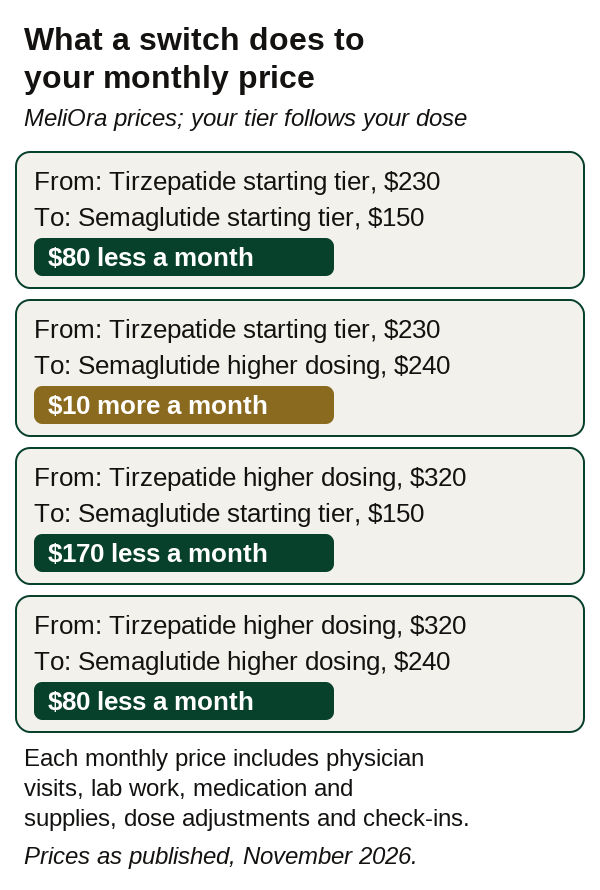
The short answerYes, you can switch from tirzepatide to semaglutide, as long as a prescriber plans it with you. No official dose conversion exists, so your prescriber decides when your first semaglutide dose goes in and how high it starts. Never take the two together. At MeliOra, semaglutide costs less ($150 a month at starting doses, $240 at higher dosing, against $230 to $320 for tirzepatide), but in a head-to-head trial in adults without diabetes, where everyone also had diet and exercise counseling, average weight loss was lower on semaglutide, and results varied.
This is the other half of our guide to switching from semaglutide to tirzepatide. Searches like “Mounjaro to Ozempic” or “Zepbound to Wegovy” use popular brand names; MeliOra prescribes semaglutide and tirzepatide, and the label facts here describe the brand-name products.
Can you switch from tirzepatide to semaglutide?
Yes. Both are weekly injections used for weight management, and a prescriber can move you from one to the other.
Eli Lilly sells tirzepatide as Zepbound (weight) and Mounjaro (type 2 diabetes); Novo Nordisk sells semaglutide as Wegovy (weight) and Ozempic (type 2 diabetes). Both the Zepbound and Wegovy labels say not to combine their medicine with another GLP-1 medicine. Our guides to Mounjaro vs Zepbound and Wegovy vs Ozempic explain the brand pairs.
Why people switch from tirzepatide to semaglutide
Cost usually comes first. In a Cleveland Clinic review of 288 adults in Ohio and Florida who stopped semaglutide or tirzepatide within a year, 47.6% stopped over cost or insurance, 14.6% over side effects, 11.8% over shortages, and 1.7% over disappointing weight loss. It counted stopping, not switching, but the same pressures push a switch.
Price changes matter too. After a UK tirzepatide list-price increase of up to 170% in September 2025, an analysis by one UK telehealth company of its own records for over a million self-paying adults showed switches to semaglutide jump, then ease. Compare the medicines first in our semaglutide vs. tirzepatide comparison.
The Reason-First Test for switching from tirzepatide to semaglutide
Name your main reason before you change anything; each carries a different tradeoff. This table is our editorial guide, not a measurement or a MeliOra protocol. The American College of Physicians’ 2026 guideline names semaglutide and tirzepatide as first-line choices and says a switch should weigh benefits, harms, cost, access and your goals.
Your reason
The honest tradeoff
Cost
Same tier at MeliOra: $80 a month less on semaglutide. Tirzepatide starting tier to semaglutide higher tier: $10 a month more. Average loss was lower on semaglutide up to 2.4 mg
Side effects
In SURMOUNT-5 (below), nausea, diarrhea and constipation rates were similar; vomiting was reported by 21.3% on semaglutide vs 15.0% on tirzepatide. Ask about a dose hold first
Supply
Confirm a shortage is real and current; a new medicine means a new start-up period
Weak response
Semaglutide averaged less loss, yet one published case responded only after switching. One case can’t predict yours
Keeping weight off
No trial has tested moving to semaglutide for maintenance. Plan weigh-ins and a review date
About that trial: SURMOUNT-5, funded by Eli Lilly, randomly assigned 751 adults with obesity, or overweight with a weight-related condition, and without diabetes, to the highest weekly dose they tolerated of tirzepatide (10 or 15 mg) or semaglutide (1.7 or 2.4 mg) for 72 weeks. It was open-label, and everyone received counseling on a reduced-calorie diet and more physical activity. Average weight loss was 20.2% on tirzepatide and 13.7% on semaglutide, and results varied from person to person. It didn’t test the 7.2 mg semaglutide dose now on the Wegovy label.
Lilly said the study was not powered to compare safety, so its side-effect counts are descriptions, not a ranking. For shortages, check the FDA’s public Drug Shortages database (linked in the sources below); for the start-up period, see our semaglutide side effects guide.
Your tier follows your dose, so a switch changes your price by anything from a little more to a lot less each month.
Is there a tirzepatide to semaglutide dose conversion?
No. Neither label converts one medicine’s milligrams into the other’s, and online charts that pair doses are someone’s estimate. The Wegovy label’s only switching steps run between its own injection and tablet; the Zepbound label has none for semaglutide.
Each label starts low and climbs. Wegovy injection starts at 0.25 mg weekly for 4 weeks, then steps up every 4 weeks (0.5, 1, 1.7 mg) to 1.7 or 2.4 mg, with up to 7.2 mg if 2.4 mg is tolerated for at least 4 weeks and more weight loss is needed. Zepbound starts at 2.5 mg weekly for 4 weeks and rises in 2.5 mg steps at least 4 weeks apart to 5, 10 or 15 mg. Both climb slowly to limit stomach side effects. The ladders don’t line up rung for rung.
Where you restart is a judgment call. Starting low gives your stomach time to adjust; a November 2026 expert review of switching between the two argued, without trial data, that always restarting at the lowest dose risks a gap and regain, and proposed rough dose matches that no switching trial has tested. We don’t print those estimates. Your prescriber weighs your current dose, how each step felt, and your goals. Our page on semaglutide weight loss in Lutz and Tampa explains dosing at MeliOra.
When to take your first semaglutide dose after tirzepatide
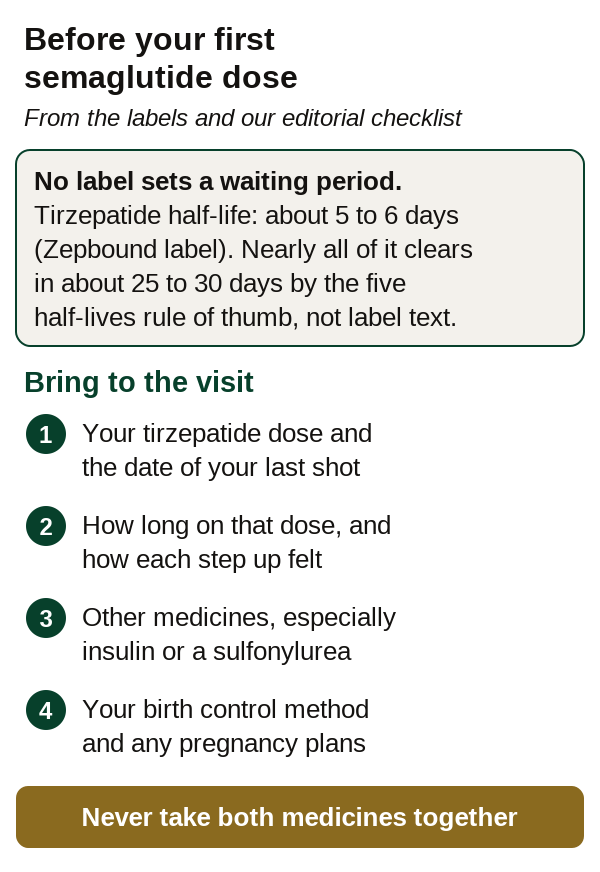
No label sets a waiting period, but the Zepbound label says how long tirzepatide lingers. Tirzepatide’s half-life is about 5 to 6 days, so by the five half-lives rule of thumb nearly all of it clears in about 25 to 30 days; our guide to how long tirzepatide stays in your system shows the math.
Bring these to the visit:
Your tirzepatide dose and the date of your last shot.
How long you’ve been on that dose, and how each step felt.
Other medicines, especially insulin, a sulfonylurea, or a pill that needs blood-level checks.
Your birth control method and any pregnancy plans.
Keep your usual schedule until you get a stop date, and don’t double up. Both labels ask for closer monitoring of pills with a narrow safety margin (Zepbound’s example is warfarin), because a slower stomach can change absorption.
No label sets a waiting period, so the date of your last tirzepatide shot anchors the plan your prescriber makes.
Will you regain weight after switching from tirzepatide to semaglutide?
Nobody knows yet. We found no trial or group study that followed weight after a switch in this direction, only a single case report. What the evidence does say:
In SURMOUNT-5, people who started on semaglutide lost less on average, but nobody switched.
In SURMOUNT-4 (Lilly-funded, diet and activity advice for all), people switched to placebo regained 14.0% over 52 weeks on average; results varied.
Semaglutide isn’t a placebo, so that doesn’t predict a switch.
A 2026 systematic review found little evidence on moving between medicines to hold weight off.
A 2026 case report describes a man on a prescribed reduced-calorie diet who lost under 5% on tirzepatide and 20% in 6 months on semaglutide.
Its authors say one case supports no general conclusions. Treat a switch as a trial: agree on how often you’ll weigh in and how much regain would prompt a call. Our guides to stopping semaglutide and a GLP-1 weight loss plateau cover regain and stalls.
Side effects when you start semaglutide after tirzepatide
Expect a familiar start-up period, with stomach effects most common while the dose climbs. In the Wegovy weight trials, nausea was reported by 44% of adults on 2.4 mg and 16% on placebo. A 2025 joint nutrition advisory suggests small, regular meals and sipped fluids, and your prescriber can hold a step. Tiredness can show up too; our guide to fatigue on a GLP-1 covers what to check.
Who should be careful, and when to see a professional instead
Don’t switch on your own or with leftover pens. Talk with a physician first if you:
Have diabetes or take insulin or a sulfonylurea; check your blood sugar as your prescriber advises through the switch.
Have had pancreatitis, gallbladder or kidney disease, diabetic eye disease, or severe gastroparesis.
Have a personal or family history of medullary thyroid carcinoma, or MEN 2.
Are pregnant, trying to conceive, or breastfeeding.
Have or have had an eating disorder.
A switch changes your pregnancy clock: neither tirzepatide label sets a wait before conceiving, but the semaglutide labels say to stop at least 2 months before a planned pregnancy. ACOG’s October 2026 advisory says to consider stopping GLP-1 medicines 1 to 2 months before conception and advises against them in pregnancy and while breastfeeding a preterm baby or newborn. If you become pregnant, stop and call your prescriber that day. See our guide to tirzepatide, birth control, and pregnancy.
These warning signs match our tirzepatide side effects and semaglutide side effects guides, with emergency steps added:
Warning sign
What to do
Swelling of the face, lips, tongue, or throat, trouble breathing or swallowing, severe rash or itching, fainting or dizziness, or a very rapid heartbeat
A serious allergic reaction. Stop the medicine and call 911 or go to an emergency room
Low blood sugar you can’t treat yourself, passing out, or a seizure, if you take insulin or a sulfonylurea
Someone should call 911
Thoughts of harming yourself
Call or text 988, the Suicide and Crisis Lifeline, right away. If you might act on them or are in immediate danger, call 911
Sudden vision loss in one eye (often noticed on waking), blurred or missing patches of vision, faded or distorted colors, or eyesight that gets worse quickly
Call 911 or go to an emergency room now, and don’t drive yourself. The FDA warns GLP-1s may raise the risk of NAION, a rare optic nerve problem
Severe stomach pain that will not go away, sometimes reaching the back, with or without vomiting
Possible pancreatitis. Stop the medicine and call your prescriber right away; if you can’t reach them quickly, go to an emergency room, not urgent care
Upper stomach pain, fever, yellow skin or eyes, or clay-colored stools
Possible gallbladder disease. Inflamed gallbladder was reported in 0.7% on Zepbound and 0.6% on Wegovy injection, vs 0.2% on placebo in each. Call your prescriber right away; if you can’t reach them quickly, go to an emergency room, not urgent care
Vomiting or diarrhea that will not stop, or not being able to keep fluids down
Dehydration, which can lead to kidney injury (0.5% vs 0.2% in the Zepbound trials). Call your prescriber right away. Go to the emergency room now if you can’t keep fluids down, are barely urinating, your urine is very dark, you feel dizzy or lightheaded, or your heart is racing. Call 911 if you become confused or faint. If you have kidney disease, call at the first sign
You took too much, took two doses close together, or took tirzepatide and semaglutide close together
Call your prescriber or Poison Help at 1-800-222-1222, or go to an emergency room right away
Shakiness, sweating, dizziness, confusion or drowsiness, headache, blurred vision, slurred speech, hunger, or a fast heartbeat
Possible low blood sugar, more likely with insulin or a sulfonylurea. Treat it as your prescriber taught you, then call them
Heart racing or pounding at rest for several minutes
Increased heart rate, which the Wegovy label says to report. Call your prescriber
A lump in the neck, lasting hoarseness, trouble swallowing, or shortness of breath
Possible thyroid tumor, the risk behind the label’s boxed warning. Call your prescriber
Vision changes in someone with type 2 diabetes
Possible worsening of diabetic eye disease. Tell your prescriber
Before surgery or sedation, tell the team your medicine and last dose date: both labels warn food can enter the lungs under anesthesia.
How MeliOra handles a switch to semaglutide
Dr. Melanie Espinet, a board-certified family medicine physician, prescribes weekly semaglutide and tirzepatide, reviews your history and lab work, and sets and adjusts your dose. She screens for eating disorders before prescribing, and if support from a dietitian or therapist would help, she discusses it at your consultation. If tirzepatide is working and cost isn’t the issue, staying put may be the better plan.
Your tier follows your dose, and each monthly price includes in-home physician visits, lab work, medication and supplies, dose adjustments and check-ins, with no consultation fee. Dr. Espinet makes house calls across Hillsborough, Pasco and Pinellas counties with no travel fee. At any house call, including ours, ask how the product was stored on the way and what the plan is for a serious reaction. If you’re located in Florida, GLP-1 telehealth offers video visits at the same monthly price, with medication shipped to your home.
Anywhere in Florida, you can plan a switch with Dr. Espinet by video at the same monthly price.
Frequently asked questions about switching from tirzepatide to semaglutide
Can you switch from tirzepatide to semaglutide?
Yes, with a prescriber. Both are weekly medicines used for weight management, but no label gives a schedule for moving between them, so your prescriber sets the timing and the restart dose. Never take them together: the Zepbound and Wegovy labels both say not to combine their medicine with another GLP-1 medicine.
Is there a Mounjaro to Ozempic or Zepbound to Wegovy dose conversion?
No. Mounjaro and Zepbound are tirzepatide; Ozempic and Wegovy are semaglutide. None of their labels converts one medicine’s dose into the other’s, and the milligram numbers measure different molecules. Charts online are estimates. MeliOra prescribes semaglutide and tirzepatide, and your prescriber chooses your dose from your history.
Will I lose less weight on semaglutide than on tirzepatide?
On average, probably. In SURMOUNT-5, a Lilly-funded trial with diet and activity counseling for everyone, average weight loss at 72 weeks was 13.7% on semaglutide and 20.2% on tirzepatide, and results varied widely. No trial has followed weight after a switch, so your own response is the real test.
Does semaglutide have fewer side effects than tirzepatide?
Not clearly. In SURMOUNT-5, nausea, diarrhea and constipation were reported at similar rates on both, while vomiting was reported by 21.3% on semaglutide and 15.0% on tirzepatide. Lilly said the trial wasn’t powered to compare safety. On either medicine, stomach effects are most common while the dose climbs.
How much less does semaglutide cost at MeliOra?
At the same tier, $80 a month less: $150 versus $230 at starting doses, or $240 versus $320 at higher dosing. Moving from tirzepatide’s starting tier to semaglutide’s higher tier costs $10 more. Each price includes visits, lab work, medication and supplies, dose adjustments and check-ins.