The short answerHair Botox is a salon name for a hair treatment sold to calm frizz and add shine. It isn’t botulinum toxin, the drug in real Botox, and it has no standard formula; some versions are smoothing treatments sealed with a flat iron, which can release formaldehyde. Judge it by the ingredient list.
The name makes people wonder whether a neurotoxin is going on their hair. It isn’t. Below: how hair Botox compares with keratin, three ingredient questions, and when a reaction needs care. MeliOra Elite Wellness doesn’t offer hair treatments; for the real thing, see what Botox is made of and how it works.
What is hair Botox?
Hair Botox is a cosmetic hair treatment, done in a salon or at home, that’s sold to smooth frizz and boost shine. The name is marketing. It borrows Botox’s reputation for smoothing lines, not its ingredient.
We found no legal or industry definition of hair Botox. The FDA doesn’t approve cosmetics before sale; makers are responsible for their safety and labels. A 2015 review in the International Journal of Trichology lists “hair botox” as a name for the Brazilian keratin treatment, a smoothing service, so only the ingredient list tells you what you’re getting.
Does hair Botox have Botox in it?
No. Products sold as hair Botox are cosmetics, and the 2015 review that lists the name describes a treatment that seals hair with heat and formaldehyde-type chemistry, not a toxin. Real Botox is botulinum toxin type A, a prescription drug that, for facial lines, is injected into a muscle, where it blocks the nerve signal that makes the muscle contract, per the Jeuveau and Xeomin labels. A hair treatment sits on the strand, with no muscle to relax. See Botox in Lutz with Jeuveau or Xeomin.
Nor does it rebuild damaged hair: protein and amino acid ingredients cling to the cuticle and may reduce frizz, but they don’t restore damaged keratin, the same review explains.
Is there real Botox for hair loss?
Real botulinum toxin injected into the scalp has been tried for pattern hair loss, with higher hair counts in a 2025 meta-analysis of eight mostly small studies. Hair loss isn’t an approved use on the Xeomin or Jeuveau label, and scalp treatment isn’t on our treatment chart; ask Dr. Espinet whether any treatment fits you.
Hair Botox vs keratin: the chemistry matters more than the name
A Brazilian keratin treatment sets hair in a straight shape that holds even when wet. In many products, formaldehyde or a chemical that releases it does that work: water and blow drying loosen bonds in the hair’s keratin, and formaldehyde locks the realigned keratin in place, the 2015 review explains.
If a salon pitches hair Botox as gentler than keratin, ask what’s in it. A 2026 Columbia University scoping review of 21 studies and reports found keratin treatments more often contained formaldehyde or formaldehyde-releasing preservatives than chemical relaxers did, and several studies found formaldehyde in products labeled formaldehyde-free. Skincare plays the same naming game; see argireline, the “Botox in a bottle” peptide.
Hair Botox, keratin smoothing, and real Botox
Question
Hair Botox
Keratin smoothing
Real Botox
What it is
A cosmetic hair treatment with no standard formula
A cosmetic smoothing treatment sealed with heat
A prescription botulinum toxin injection
Where it works
On the hair strand
On the hair strand
For lines, in the injected muscle, by blocking a nerve signal
Formaldehyde
Depends on the formula
Found in many tested products, even some labeled formaldehyde-free
Not on the Jeuveau or Xeomin ingredient list
Read the label, not the name: three questions for any hair Botox
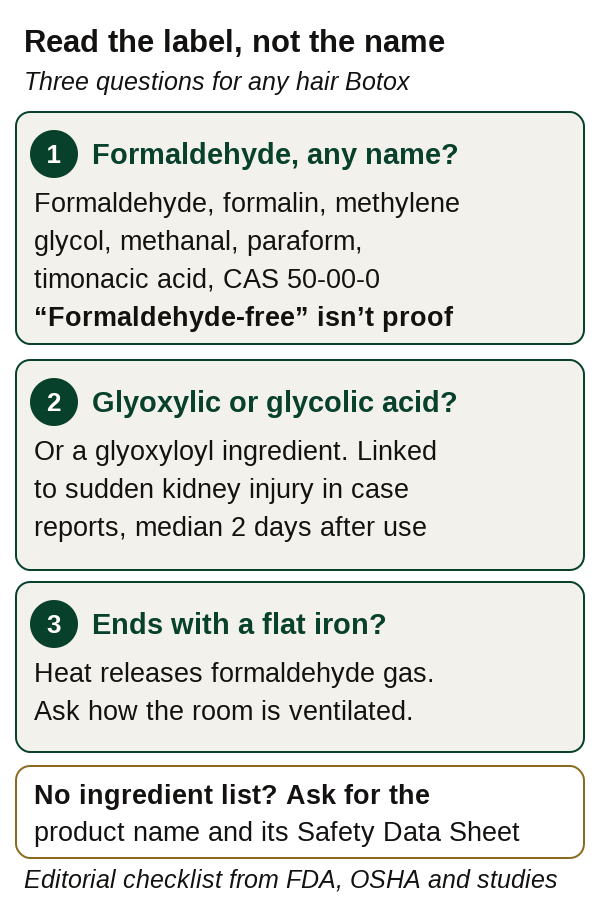
Because hair Botox has no fixed recipe, its name tells you nothing about safety. Our editorial checklist, built from FDA and OSHA guidance and published studies, asks three questions about the ingredient list.
1. Does it contain formaldehyde under any name?
The FDA tells shoppers to look for formaldehyde, formalin, and methylene glycol, and notes that formaldehyde is classified as a human carcinogen, linked to certain cancers at high levels or with prolonged exposure. OSHA’s hazard alert adds methylene oxide, paraform, formic aldehyde, methanal, oxomethane, oxymethylene, and CAS number 50-00-0, and flags timonacic acid, which can release formaldehyde during smoothing. In 2013, the Cosmetic Ingredient Review expert panel called formaldehyde and methylene glycol unsafe in hair smoothing products as then used.
Don’t rely on “formaldehyde-free” alone
A 2014 study in the Journal of the American Academy of Dermatology tested all 7 keratin treatment brands sold in South Africa in 2012. Six held 0.96% to 1.4% formaldehyde, about five times the review panel’s limit, and five of those six were labeled formaldehyde-free. OSHA also measured formaldehyde above its limits in salons using a smoothing product labeled formaldehyde-free.
When there’s no ingredient list
Salon-only products may not list ingredients, the FDA explains, but OSHA requires a Safety Data Sheet for products with hazardous chemicals, so ask for it. If the salon isn’t sure whether formaldehyde is present, the FDA suggests you may not want the product, especially if you’ve reacted before.
2. Does it list glyoxylic acid or glycolic acid?
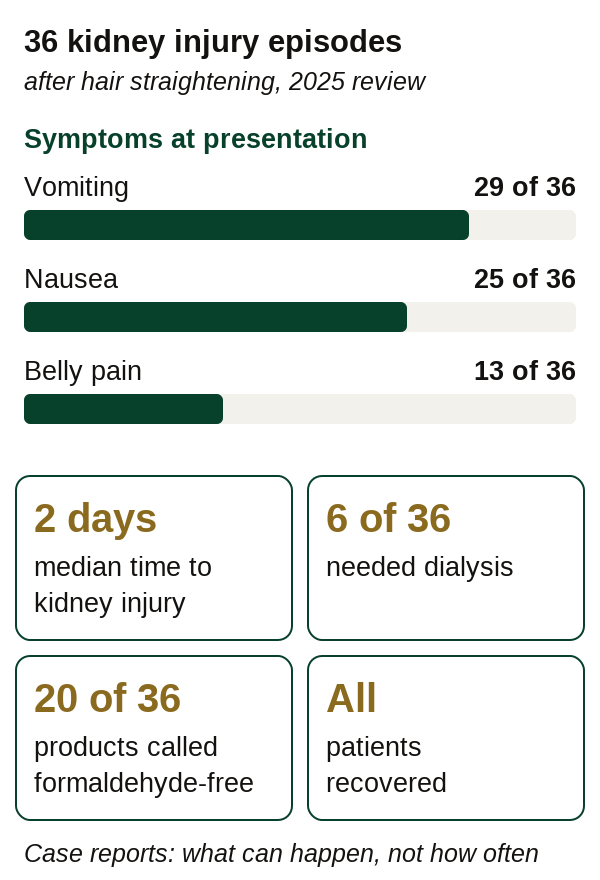
Many formaldehyde-free smoothing products use these acids instead. Check for related names too: the 2015 review describes “glyoxyloyl carbocysteine” treatments as glyoxylic acid combined with cysteine, and an Israeli kidney study found most local keratin products contained glycolic acid derivatives. A 2025 systematic review in the World Journal of Nephrology found 36 episodes of sudden kidney injury in 34 women and girls, aged 10 to 58, after hair straightening. In 20 episodes the product was described as formaldehyde-free; in the rest, its ingredients were unknown. Six episodes needed dialysis, and everyone recovered.
In published cases after hair straightening, vomiting was the most common symptom, and kidney injury came a median of 2 days later.
Newer reports point the same way. In a 2025 Tel Aviv case series, 12 of 13 female patients who reached a toxicology service with nausea, vomiting, or belly pain after glyoxylic acid smoothing products had kidney injury; none needed dialysis. In a 2024 mouse study, glyoxylic acid absorbed through skin formed calcium oxalate crystals in the kidneys. A 2026 study written mostly by employees of Wella and Kao, which sell these straighteners, estimated that realistic salon use stays far below harmful levels. After France’s health agency raised kidney concerns, the European Commission gathered safety data through April 2026, then in May asked its Scientific Committee on Consumer Safety whether glyoxylic acid is safe in hair straighteners at up to 16%. As of November 15, 2026, that opinion hasn’t been published.
3. Does the service end with a flat iron?
The FDA says formaldehyde in these products is released into the air as a gas when heated, and the 2015 review notes that methylene glycol and glyoxylic acid can both release formaldehyde under a blow dryer and hot iron. If your hair Botox ends with a flat iron, treat it as a smoothing treatment and ask how the room is ventilated.
Three questions to ask about any hair Botox or keratin treatment before the first coat goes on.
Came here looking for real Botox? MeliOra’s Botox with Jeuveau or Xeomin is $12/unit, and frown lines take about 20 units, about $240. Dr. Melanie Espinet reviews your history first, and you approve the brand, areas, and units before anything begins. Book a Botox visit at your home, your office, or the Lutz office.
Where the FDA’s proposed formaldehyde ban stands
As of November 15, 2026, the FDA hasn’t proposed its ban. Its 2026 regulatory agenda targets November 2026 for a proposed rule to prohibit formaldehyde and formaldehyde-releasing chemicals, such as methylene glycol, in hair smoothing and straightening products that are applied and then heated. The rule has been on the agenda since 2023, the entry doesn’t say whether acid-based products would be covered, and a proposal isn’t final until rulemaking ends.
Until then, the FDA acts case by case and has sent warning letters to two smoothing product companies. Real Botox needs FDA approval and a prescription, though counterfeits exist; see what a low Botox price can hide and why DIY Botox is risky.
Who should skip hair Botox, and when to get help
The FDA lists reactions reported after formaldehyde smoothing products: eye irritation, headaches, dizziness, sore throat, cough, wheezing, nausea, chest pain, vomiting, and rash. Talk to your doctor first, or skip smoothing treatments, if you:
Have asthma, or have reacted to formaldehyde before: two case reports describe stylists who developed asthma from these products
Have kidney disease or have had kidney stones: ask about glyoxylic and glycolic acid first
Have eczema, psoriasis, a burn, or broken skin on your scalp
Are a child or teen: published kidney injury cases include girls as young as 8
When to see a professional instead
If your hair is breaking, shedding, or thinning, or your scalp itches, burns, or flakes, see a dermatologist before booking any treatment. Hair Botox is a cosmetic, not a hair loss treatment, and a 2022 review of chemical straighteners linked them to scalp inflammation, burns, hair shaft damage, and hair loss.
If something feels wrong during or after a hair treatment, use this table, built from the FDA’s reaction list, the kidney reports above, and poison center first aid.
During or after a hair treatment, if you notice
What to do
Trouble breathing, wheezing that won’t stop, chest pain, or swelling of your face, lips, tongue, or throat
Call 911
Collapse, a seizure, or someone you can’t wake
Call 911
Solution splashed in your eye
Rinse with lots of room temperature water for at least 15 to 20 minutes, then call Poison Help at 1-800-222-1222. Go to the emergency room if pain, redness, or vision problems last an hour after you start rinsing, or right away if severe
Nausea, vomiting, belly or side pain, or passing much less urine in the days after a smoothing treatment
Get seen today somewhere that can run a kidney blood test, such as an emergency room, and go now if you’re passing little or no urine or can’t keep fluids down. Say you had a hair straightening treatment and bring the product name. In published cases, kidney injury appeared a median of 2 days after treatment
Burning, blistering, or oozing on your scalp
Rinse with lots of room temperature running water for at least 15 minutes, then call Poison Help at 1-800-222-1222. See a doctor right away if blisters, a large or deep burn, pain, redness, or swelling get worse or don’t go away. If it’s severe, go straight to the emergency room after rinsing. After a smoothing treatment, also watch for nausea, vomiting, or belly pain in the next few days: in one Israeli series, 10 of 26 people with kidney injury had a scalp rash
Burning eyes, nose, or throat, coughing, headache, or dizziness during the treatment
Ask to stop, move to fresh air, then call Poison Help at 1-800-222-1222. Call 911 for trouble breathing or chest pain
An itchy, red rash along your hairline, ears, or neck in the days after
Stop using the product and contact your doctor. Repeated contact with formaldehyde-related ingredients can cause a skin allergy. After a smoothing treatment, also watch for nausea, vomiting, or belly pain in the next few days: in one Israeli series, 10 of 26 people with kidney injury had a scalp rash
Then report the reaction to the FDA: it asks consumers to stop using the product, contact a health care provider, and file a cosmetic complaint. If your treatment was a real botulinum toxin injection, use the warning table in our Botox side effects guide instead.
Botox at MeliOra: for facial lines, not hair
MeliOra doesn’t offer hair Botox, keratin, or any hair treatment. Our Botox brands are Jeuveau and Xeomin, both $12/unit, for forehead lines, frown lines, crow’s feet, and other areas on our treatment chart. Dr. Melanie Espinet, a board-certified Family Medicine physician, reviews your prior units and areas and places every Botox injection herself.
Visits happen at your home, your office, or the Lutz office, with no travel fee in Hillsborough, Pasco, and Pinellas counties. At any house call, including ours, ask how the product was stored on the way and what the plan is for a serious reaction. See Botox in Lutz, FL for areas and pricing, or book a Botox visit.
Frequently asked questions about hair Botox
What is hair Botox?
Hair Botox is a cosmetic hair treatment sold to smooth frizz and add shine. The name is marketing, and there’s no standard formula. A 2015 dermatology review lists it as another name for the Brazilian keratin smoothing treatment, so read the ingredient list to know what you’re getting.
Does hair Botox have Botox in it?
No. Real Botox is botulinum toxin type A, a prescription drug that, for facial lines, is injected into a muscle to block the nerve signal that makes it contract. Hair Botox is a cosmetic applied to the hair strand. It borrows the Botox name for its smoothing promise, not its ingredient.
Is hair Botox better than keratin?
Neither name tells you which is safer or works better. Keratin smoothing treatments often contain formaldehyde or chemicals that release it, and some products sold as hair Botox are smoothing treatments too. Compare ingredient lists for formaldehyde names and glyoxylic acid, and ask whether the service ends with a flat iron.
Is hair Botox safe?
It depends on the formula. Any cosmetic can cause an allergic rash. Smoothing products heated with a flat iron can release formaldehyde, which irritates eyes and airways, and acid-based formaldehyde-free versions have been linked to sudden kidney injury in case reports. Ask for the ingredient list or Safety Data Sheet first.
Can hair Botox treat hair loss or damaged hair?
No. Hair Botox is a cosmetic. Its proteins can coat the cuticle and reduce frizz, but a 2015 review notes they don’t restore damaged keratin. If your hair is shedding, thinning, or breaking, see a dermatologist, since hair loss can have medical causes that need a diagnosis.
Does MeliOra offer hair Botox?
No. MeliOra doesn’t offer hair Botox, keratin, or any hair treatment. We offer Botox for facial lines with Jeuveau or Xeomin, placed by Dr. Melanie Espinet at your home, your office, or the Lutz office, with no travel fee in Hillsborough, Pasco, and Pinellas counties.