Blog · Aesthetics
Argireline: What “Botox in a Bottle” Can and Can’t Do
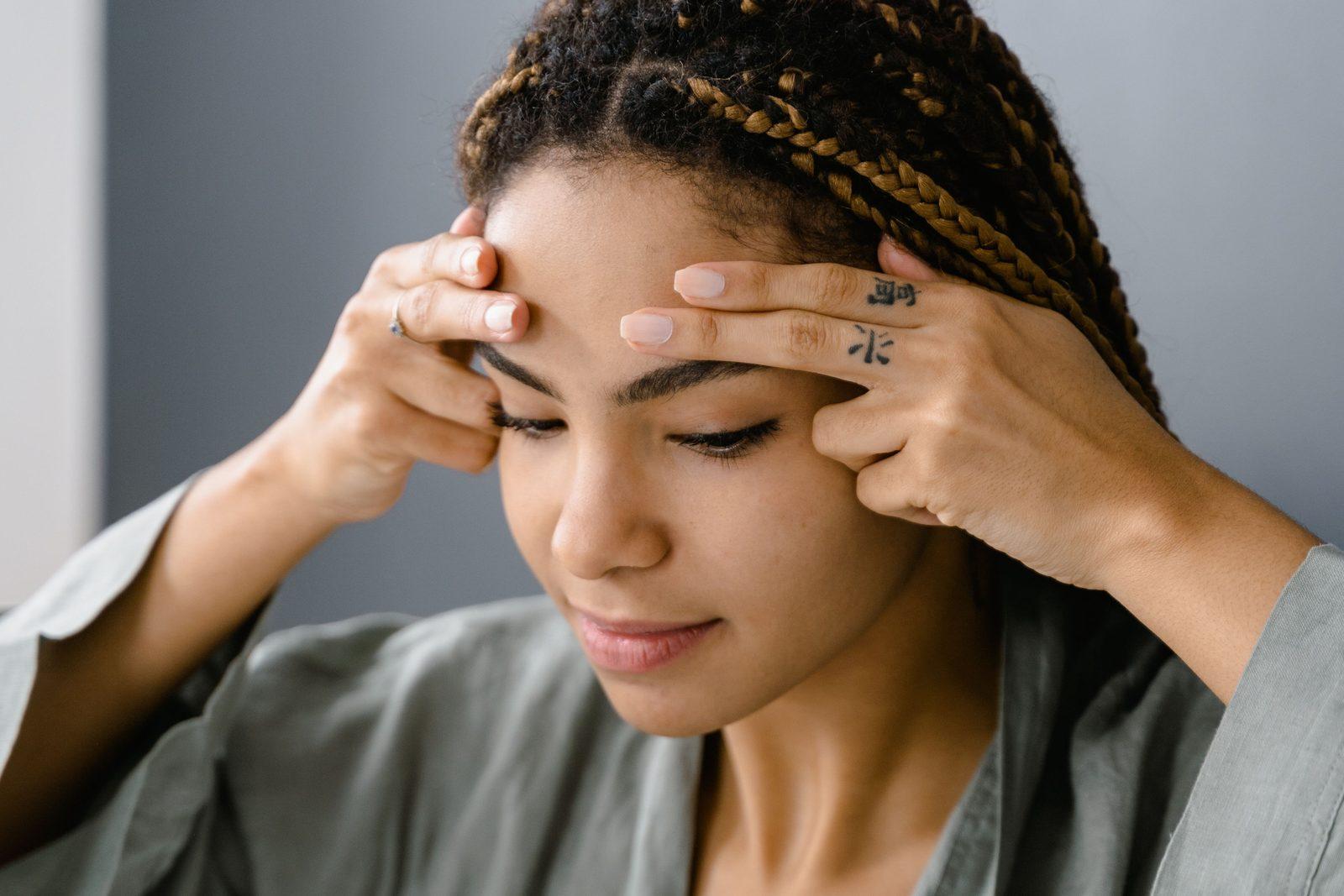
Argireline serums sit on the skin; Botox for lines is a prescription injection into the muscle. Photo: Maria Lupan on Unsplash
Blog · Aesthetics
Argireline serums sit on the skin; Botox for lines is a prescription injection into the muscle. Photo: Maria Lupan on Unsplash
Searches for “Argireline” and “Botox in a bottle” jumped in 2022, when the peptide took off on TikTok, a 2024 study in JMIR Dermatology reports. Below: its studies, our four-measure comparison with real Botox, and when a skin reaction needs care. MeliOra Elite Wellness offers Botox, not argireline products; for the real thing, see what Botox is made of and how it works.
Argireline is a synthetic peptide, a chain of six amino acids, added to creams and serums for expression lines. Its ingredient name is acetyl hexapeptide-8, also listed as acetyl hexapeptide-3, and Argireline is the brand name of the Spanish peptide maker Lipotec.
Its developers patented it in 2000 and published the first study in 2002, designing it from one end of SNAP-25, a protein nerve endings need to release the chemical signal that makes a muscle contract. In lab cells, the developers found it reduced that release, with much lower effect than botulinum toxin. Like other skincare peptides, it’s sold as a cosmetic ingredient; our guide to what peptides are covers the injected kind.
No. Real Botox is botulinum toxin type A, a prescription drug that, for facial lines, is injected into the muscle. According to the Jeuveau and Xeomin labels, the toxin enters the nerve ending and cuts SNAP-25, and the effect lasts until the nerve grows new endings. Argireline only imitates a fragment of SNAP-25 and competes with it in lab tests. A 2026 review in Life says it should not be treated as pharmacologically equivalent to injected botulinum toxin.
Argireline has been tested in a handful of small human studies, most lasting about a month. Results run from clear improvement to no measurable difference, and the first numbers came from its inventors.
| Study | What it tested and found |
|---|---|
| 2002, the inventors | A cream with 10% of the peptide on healthy women for 30 days: wrinkle depth fell by up to 30% |
| 2013, Xi’an, China, 60 people | Twice daily around the eyes for 4 weeks, against a placebo cream: rated effective in 48.9% vs 0% |
| 2023, Germany, 19 women | The same serum with and without argireline, one on each side of the face, for 4 weeks: no significant difference |
| 2017, Athens, 24 people in four groups | Creams for 60 days: one wrinkle measure differed from the no-peptide group at day 20, and the authors reported antiwrinkle activity |
| 2013, NIH pilot, 24 people with blepharospasm | Daily alongside toxin shots: symptom control lasted 3.7 vs 3.0 months, a trend that wasn’t statistically significant |
A 2023 summary of the 2002 study says it enrolled 10 women, and the cream base alone reduced wrinkle depth by up to 10%. The 2002 study came from the peptide’s inventors: six of its nine authors are named on the argireline patent that Lipotec, the company that sells it, filed in 2000, and the 2023 German study notes the 2002 paper counted results as significant at a looser cutoff than usual. We couldn’t find who paid for the 2002, 2013 Xi’an, or 2017 Athens studies; their published records don’t say. In the NIH pilot, BCN Peptides, part of Lipotec’s group, made the study creams, and two of its staff were co-authors. The German split-face study’s author declared no competing interests.
Newer studies test multi-ingredient serums. A 2026 study by L’Oréal researchers found wrinkle scores improved from where they started over 12 weeks with a five-ingredient serum, so the result can’t be credited to argireline alone. The 2026 review in Life adds that many peptide trials are small, short, industry sponsored, or test several ingredients at once, the same pattern our KLOW peptide guide found for copper peptides.
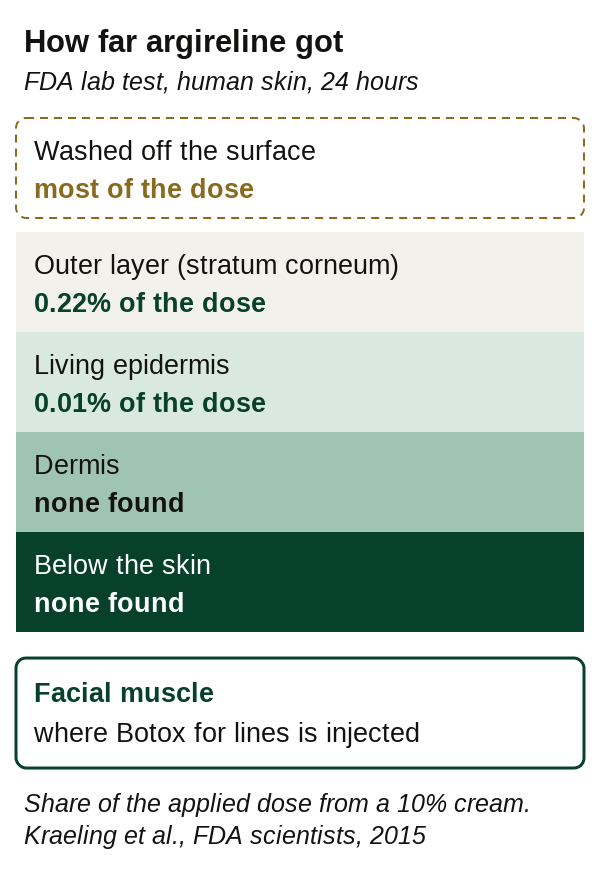
Scientists at the FDA applied a cream with 10% acetyl hexapeptide-8 to human skin in the lab for 24 hours. Most of it washed off the surface. About 0.22% of the dose stayed in the outer layer, the stratum corneum, and 0.01% reached the living epidermis. None was found in the dermis or below the skin. The developers had reported more getting through in their own test, but a 2025 review concluded that topical argireline reaching the muscle to relax it is likely impossible.
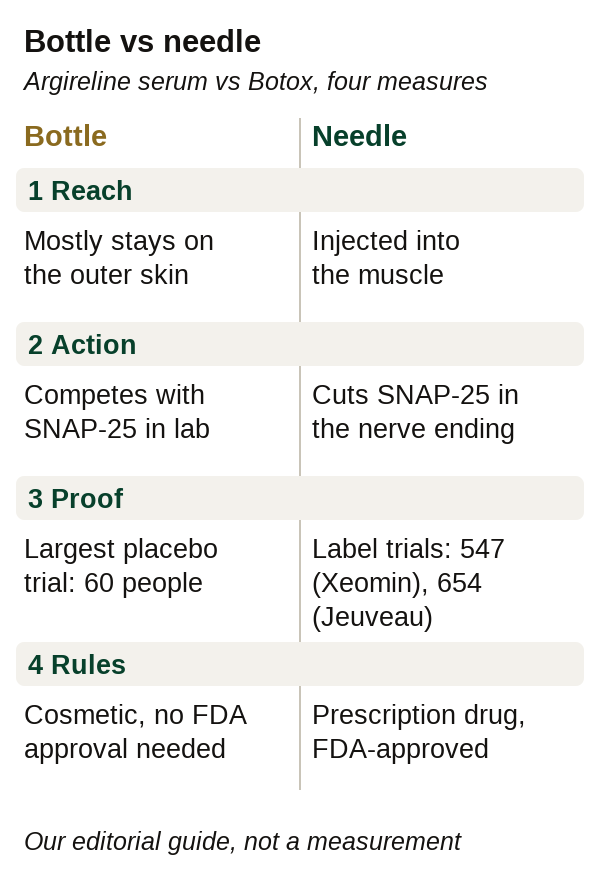
Argireline vs Botox compares a skincare ingredient with a prescription drug. This is our editorial guide, not a measurement, and no human trial has compared the two head to head.
In the FDA test, almost none of the peptide got past the outer layers. Botox for facial lines is injected into the muscle that creases the skin.
In lab tests, argireline competes with SNAP-25 and interferes with the protein complex a nerve ending uses to release its signal. The toxin cuts SNAP-25 inside the nerve ending, according to the Jeuveau and Xeomin labels, which is why its effect lasts until the nerve recovers.
The largest placebo-controlled trial of argireline alone that we found had 60 people for 4 weeks. The Xeomin label’s two frown line trials enrolled 547 people and the Jeuveau label’s two enrolled 654, all against placebo and reviewed by the FDA before approval. Trial size isn’t effect size, but it shows how much more testing stands behind the needle.
Cosmetics don’t need FDA approval before sale, and they’re meant to change how skin looks, not how it works. The FDA says a product intended to remove wrinkles is a drug or a medical device, and in a 2016 warning letter it cited a seller’s claim that acetyl hexapeptide-8 “resembles the effects of Botox” as evidence the serum was intended for use as a drug. In 2025, the Cosmetic Ingredient Review panel called the peptide safe in cosmetics at up to 0.005% and said the data were insufficient above that. That limit is for the peptide itself; the NIH pilot’s cream held 0.005%, which its authors called the low level used in cosmetics. Botox is a prescription drug with an FDA label and a boxed warning.
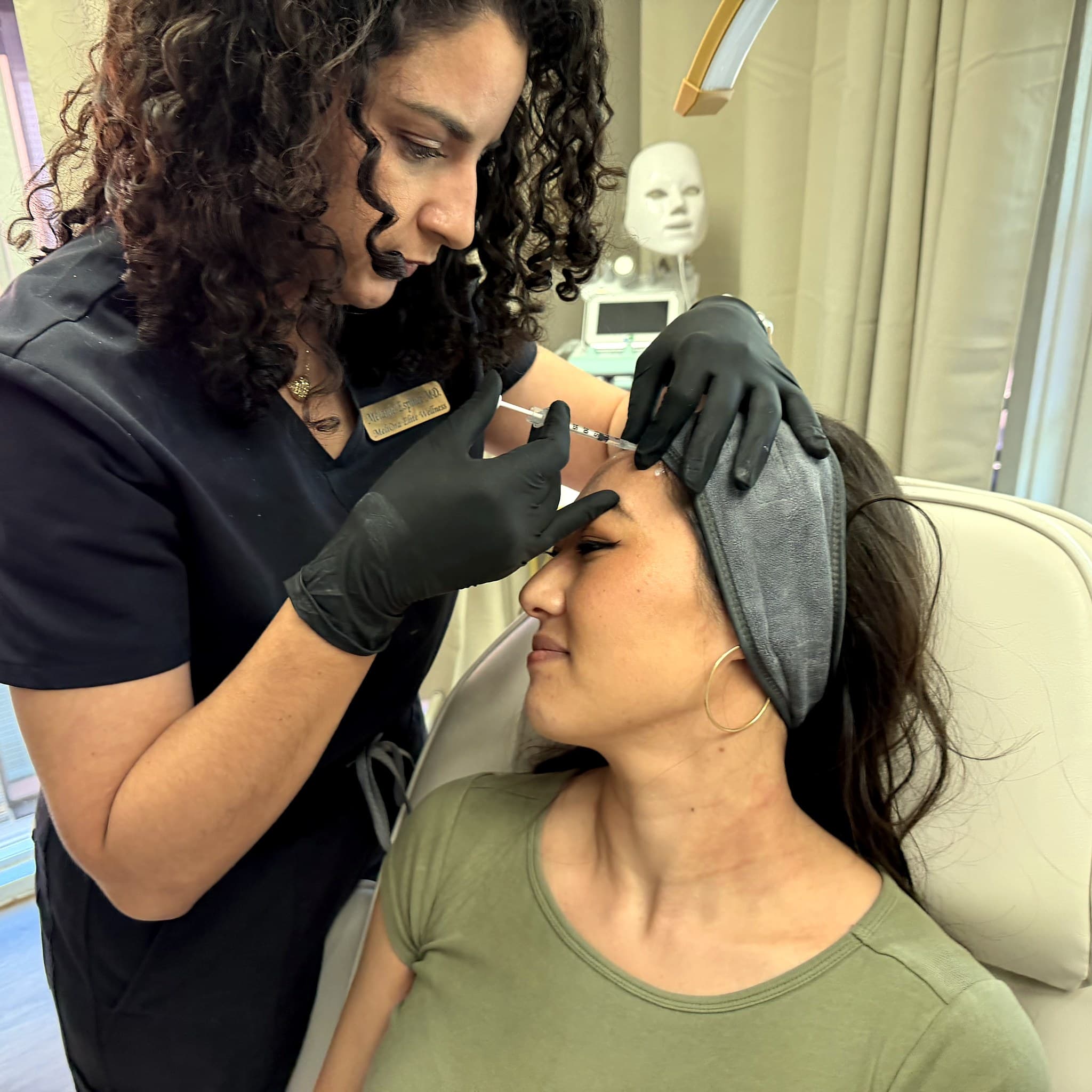
Want the needle instead? At MeliOra, Botox with Jeuveau or Xeomin is $12/unit, and frown lines take about 20 units, about $240. Dr. Melanie Espinet reviews your history first, and you approve the brand, areas, and units before anything begins. Book a Botox visit at your home, your office, or the Lutz office.
We found no trial showing that argireline makes cosmetic Botox last longer. The closest is the NIH pilot above, where a daily argireline cream alongside toxin shots for an eyelid spasm condition showed a trend, not a proven difference. A 2024 journal supplement gathered cases from seven doctors who paired a five-ingredient serum containing argireline with toxin and reported better-looking skin, but it was a set of cases, not a controlled trial; one co-author lists a SkinCeuticals affiliation. A 2026 split-face trial of 36 people, funded by SkinCeuticals with three L’Oréal employees as co-authors, found that serum improved skin scores more than a plain base after toxin injections, but it stopped at 8 weeks, didn’t measure how long the toxin lasted, and can’t separate argireline from the other four actives. If you use a peptide serum, tell your injector, and follow the aftercare you’re given; see our Botox aftercare guide. Dr. Espinet reviews personalized aftercare with you at your visit.
Serums also use pentapeptide-18, acetyl octapeptide-3, and a dipeptide modeled on a snake venom protein. The 2026 Life review treats acetyl octapeptide-3 and pentapeptide-18 as related commercial concepts, not interchangeable substitutes, and says the evidence doesn’t justify assigning the group equal efficacy. The same naming habit shows up at the salon; see what hair Botox really is.
Argireline trials report few problems; the German study saw no allergic reactions or skin irritation. Any cosmetic can still irritate skin or cause an allergic rash. The American Academy of Dermatology suggests testing a new product on your inner forearm twice a day for 4 to 5 days, stopping products that sting or burn, and giving most products at least six weeks to work.
Ask a dermatologist before starting if you have a skin condition or have reacted to any ingredient on the label: the trials left those people out. Go slowly near your eyes: in the NIH pilot, 4 of 24 people had mild eyelid irritation, which the authors tied to the thick cream, with or without the peptide.
Never inject a skincare product. A 2021 case report describes a woman who had argireline injected into her forehead and temples at a private cosmetic clinic and developed a mycobacterial skin infection, with nodules and abscesses, that needed 5 months of antibiotics. If you’re tempted by injectables sold online, read why DIY Botox is risky first.
See a dermatologist for a rash that doesn’t clear after you stop a product, and a physician if you want expression lines treated rather than masked. Lines you see only when you move respond differently from lines that stay at rest; our guide to Botox vs fillers explains the difference.
| After a skincare product or injection, if you notice | What to do |
|---|---|
| Trouble breathing, wheezing, or swelling of your face, lips, tongue, or throat | This could be a severe allergic reaction. Call 911 right away |
| Hives or a rash spreading beyond where you applied the product | Stop using it and get medical help today. Call 911 if your breathing changes |
| Itching, redness, stinging, or blisters where you applied it | Stop using it and rinse with lots of room temperature running water for at least 15 minutes. See a dermatologist if it doesn’t clear, and a doctor right away if blisters, pain, or swelling get worse or don’t go away |
| Serum in your eye, with pain, redness, or blurred vision | Rinse with lots of room temperature water for at least 15 to 20 minutes, then call Poison Help at 1-800-222-1222. Go to the emergency room if symptoms last an hour after you start rinsing, or right away if severe |
| Red, swollen, or painful lumps, or pus, where anything was injected, days to weeks later | See a doctor today and say exactly what was injected. Some injection infections need specific tests and months of treatment |
| Sudden drooping on one side of your face, sudden numbness or weakness in your face, arm, or leg, or trouble speaking | Call 911 right away, and don’t drive yourself. These can be signs of a stroke; a skin cream isn’t a likely cause |
Report a reaction to a cosmetic to the FDA after you contact your health care provider. If you had a real or online-bought botulinum toxin injection, use the warning table in our Botox side effects guide instead.
Argireline products aren’t on MeliOra’s menu. Our Botox brands are Jeuveau and Xeomin, both $12/unit, for forehead lines, frown lines, crow’s feet, and other areas on our treatment chart. Dr. Melanie Espinet, a board-certified Family Medicine physician, reviews your prior units and areas and places every Botox injection herself.
Visits happen at your home, your office, or the Lutz office, with no travel fee in Hillsborough, Pasco, and Pinellas counties. At any house call, including ours, ask how the product was stored on the way and what the plan is for a serious reaction. See Botox in Lutz, FL for areas and pricing, or book a Botox visit.
Argireline is the brand name for acetyl hexapeptide-8, a synthetic six-amino-acid peptide in creams and serums for expression lines. Its developers patented it in 2000 to mimic part of SNAP-25, a nerve protein. It’s sold as a cosmetic ingredient, not a drug, and it isn’t injected into muscle like Botox.
No. Botox is injected into a muscle and cuts SNAP-25 inside the nerve ending. Argireline only competes with a piece of SNAP-25 in lab tests, and an FDA lab study found almost none of it got past the skin’s outer layers. Its wrinkle trials are small and short, with mixed results.
No. “Botox in a bottle” is a nickname from TikTok, not a scientific claim. The FDA treats a product claimed to remove wrinkles as a drug or a medical device, and in 2016 it cited a seller’s claim that the peptide resembles Botox. Argireline is a cosmetic ingredient with modest, mixed evidence.
Most trials ran about four weeks, and results ranged from a 48.9% response in one placebo trial to no significant difference in a split-face study. The American Academy of Dermatology says most anti-aging products take at least six weeks to work, so judge a serum after a steady trial, not days.
No trial has shown that argireline makes cosmetic Botox last longer; one industry-funded trial stopped at 8 weeks. If you use a peptide serum, tell your injector, and follow your aftercare instructions, including not rubbing or massaging the treated area for 24 hours. Ask about restarting skincare at your visit.
As a cream, it has few reported problems, and a 2025 expert panel called it safe in cosmetics at up to 0.005%, with too little data above that. Any product can irritate or cause an allergic rash, so patch test first. Never inject it: a case report describes a serious skin infection after injections.
Serving Lutz, Wesley Chapel, Land O'Lakes, Carrollwood, New Tampa & greater Tampa Bay.
Find the Right Treatment
Free download · 15 pages
Typical units and cost by area, Botox brands Jeuveau vs. Xeomin, aftercare, a results timeline and a planner you can fill in. Free, and yours to keep.
Get the free guide