The short answerFace taping means sticking tape or patches, such as Frownies, over expression lines, often overnight, so the skin can’t fold. It holds skin flat only while it’s on. We found no published trial showing it reduces wrinkles, experts say lines can return within hours, and taping night after night can irritate or injure skin.
An August 2026 Ochsner Health article counted more than 35 million TikTok views on #facetaping. Here is what tape, LED face masks, and Botox each do to a line. MeliOra sells no tape or LED masks; we offer Botox in Lutz with Jeuveau or Xeomin, so weigh our view with that in mind.
What is face taping?
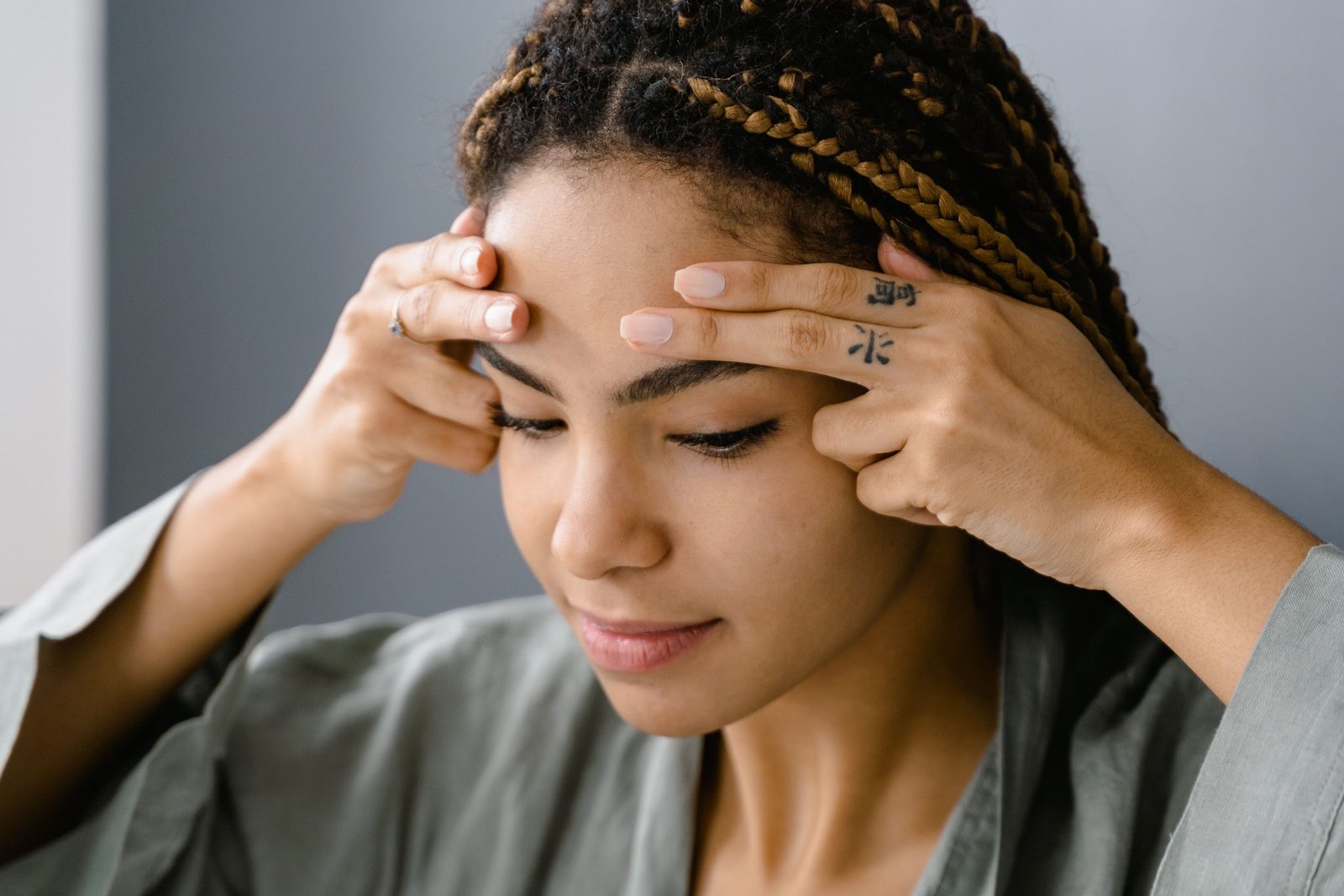
Face taping is applying adhesive tape or patches across expression lines, usually on the forehead, between the brows, or beside the eyes, so the skin can’t crease while you sleep or rest.
People use kinesiology tape, medical tape, or precut patches. Frownies, a name many people search, is a brand of precut patches; Ochsner traces the first anti-wrinkle facial patch to 1889. Creams sold as “Botox in a jar” make a different claim, covered in our argireline guide.
Face taping isn’t mouth taping
Mouth taping seals the lips at night to force nose breathing. A 2025 systematic review of 10 small studies (213 patients) found better sleep apnea measures in two, no difference in the others, and a potentially serious risk of harm, including suffocation when the nose is blocked. Loud snoring or waking up gasping can signal sleep apnea, MedlinePlus notes; see a physician.
Does face taping work? What the evidence shows
Not in any way that has been measured. Our PubMed search in November 2026 found no clinical trial of face tape, Frownies, or similar patches for wrinkles. What exists is expert opinion: the Ochsner article says tape can soften fine lines right after removal, but they’re likely to re-form within hours, and it typically doesn’t help deep wrinkles.
Why expression lines form
The idea behind face tape for wrinkles isn’t silly. The American Academy of Dermatology says contracting the same facial muscles for years can make expression lines permanent, and suggests sunglasses to cut squinting plus daily SPF 30 or higher sunscreen. The Xeomin and Jeuveau labels tie frown lines to the muscles between the brows.
Expression lines vs sleep lines
A 2016 review in Aesthetic Surgery Journal says sleep wrinkles, from the face being compressed as you sleep on your side or stomach, differ from expression lines in cause, location, and pattern. For how Botox acts on the muscles behind expression lines, see what Botox is and how it works.
The Train, Hold, Relax test for any wrinkle fix
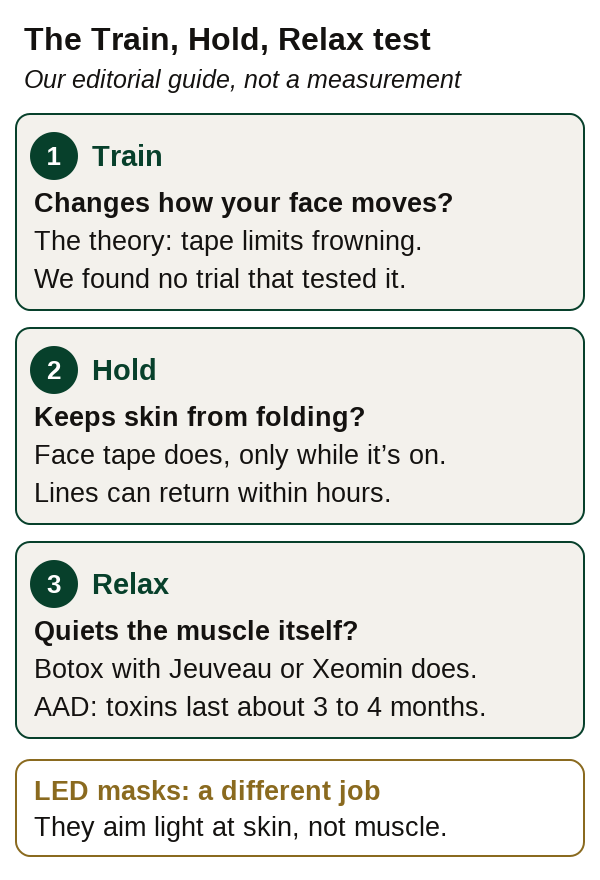
Every wrinkle hack claims one of three jobs; ask which it can back with evidence. This is our editorial guide, not a measurement or a MeliOra procedure.
1. Train: does it change how your face moves for good?
The theory, as Ochsner describes it, is that tape limits your muscles overnight so you can’t frown in your sleep. We found no published study testing whether a face moves differently once the tape comes off, so treat “retraining” as a claim, not a result.
2. Hold: does it keep skin from folding, and for how long?
This is the job tape really does: while it’s on, the skin under it can’t crease as deeply. Once it’s off, the hold ends, and Ochsner’s experts expect fine lines back within hours.
3. Relax: does it quiet the muscle itself?
Botox does this job. Our Botox brands, Jeuveau and Xeomin, block the nerve signal that tells a muscle to contract, so the lines over it soften. For botulinum toxins in general, the AAD says the effect lasts about 3 to 4 months, sometimes longer. Xeomin is FDA-approved for frown lines, forehead lines, and crow’s feet, and Jeuveau for frown lines.
Face tape can claim the hold job, and only while it’s on; relaxing the muscle is a different job.
Taping every night and still seeing the 11s? Botox with Jeuveau or Xeomin is $12/unit; frown lines take about 20 units, about $240, and you approve the brand, areas, and units first. For faint lines, read about preventative Botox, or book a Botox visit.
LED face masks: what light does to a line
An LED face mask shines red, near-infrared, or blue light onto the skin for a few minutes at a time. It targets the skin, not the muscle or the fold, so it does none of the three jobs above. For the muscle job, see Botox in Lutz.
FDA cleared doesn’t mean proven for your lines
Over-the-counter light devices for wrinkles are a class II, moderate-risk FDA device category; the FDA explains they can be sold after 510(k) clearance, once the maker shows the device is substantially equivalent to one already legally sold. Approval of a new drug or biologic is different: the company must show it is safe and effective for its use.
What LED face mask trials found
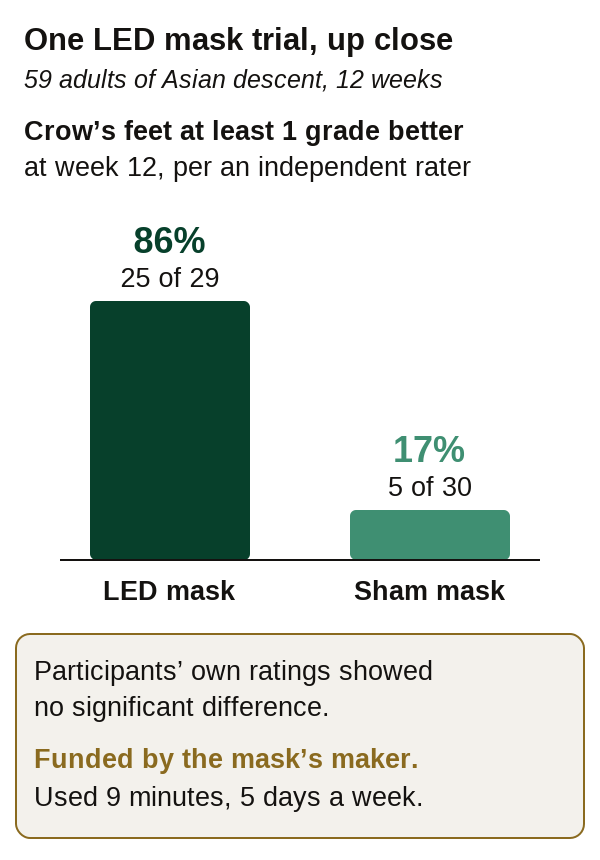
A 2026 systematic review found eight studies of at-home LED devices with 365 people: wrinkles, texture, and elasticity improved, side effects were infrequent and mild, and the authors asked for larger comparative trials with more diverse skin types. In one maker-funded, sham-controlled trial we read in full, 59 adults of Asian descent with crow’s feet used a red and near-infrared mask or a sham for 12 weeks.
An independent rater saw better crow’s feet in most mask users, but the participants’ own ratings didn’t differ significantly.
At week 12, an independent rater scored crow’s feet at rest at least one grade better in 25 of 29 mask users and 5 of 30 sham users (the sham gave off a tenth of the red light). The participants’ own ratings showed no significant difference between the groups.
Protect your eyes
A 2020 case report described retinal damage and distorted vision after a blue LED face mask; its authors advise keeping the eyes covered. A 2026 case report described sudden angle-closure glaucoma in both eyes of a woman two weeks into a red light mask; she recovered after stopping it and treatment. A 2026 lab test of four masks found light output varied widely, some above sunlight.
Face tape for wrinkles vs Botox: which fits your lines?
Face tape, LED mask, and Botox
Question
Face tape
LED mask
Botox
What it acts on
The skin fold, while worn
The skin, with light
The muscle’s nerve signal
How long the effect lasts
Hours, by expert opinion
Not established
About 3 to 4 months for toxins in general, per the AAD
Evidence
No published trial
Eight small studies in a 2026 review
FDA labels and placebo-controlled trials
Risks to know
Redness, rash, or stripped skin
Eye injury in case reports
Bruising, headache, or a droopy eyelid or brow, rarely spread of the toxin effect
Of the lines people tape, our treatment chart includes forehead lines, frown lines, and crow’s feet; the full chart on our Botox page also lists bunny lines, chin dimpling, and other areas, some off-label. Smile lines, another taping spot, aren’t on our treatment chart; ask Dr. Espinet whether any treatment fits you, and see Botox for smile lines.
Can you tape your face after Botox?
Ask Dr. Espinet first. MeliOra’s aftercare asks you not to rub or massage the treated area, and pressing tape on and peeling it off works that skin. She reviews personalized aftercare with you at your visit; our Botox aftercare guide covers the first day.
Who should skip face taping, and when to see a professional instead
A 2024 nursing consensus on adhesive skin injury, sponsored by the adhesives maker Solventum, counts redness, blisters, raw spots, or tears lasting 30 minutes or more after removal as an injury, and lists repeated application and adhesives left on too long as risks. Skip tape, or ask a physician first, if you:
Have eczema or dermatitis, or have had skin tears or reactions to tape
Have very dry or sun-damaged skin
Take a blood thinner, an anti-inflammatory medicine, chemotherapy, or long-term steroids
Have a rash, broken skin, or an infection where the tape would go
The panel advises peeling adhesive slowly, low and parallel to the skin, while supporting it. MedlinePlus notes an adhesive allergy can start suddenly or after years of use. If lines bother you enough to tape nightly, a physician can tell you whether they move or are etched at rest; see the best age for Botox.
After face tape or an LED mask, if you notice
What to do
Redness, a blister, or raw or torn skin that’s still there 30 minutes after the tape comes off
Stop taping that spot. Contact your physician if it’s severe or not getting better
An itchy rash where the tape sat
Stop using that tape and contact your physician. It may be contact dermatitis
Spreading redness, warmth, swelling, or pain, or a fever
Contact your physician right away. These can be signs of a skin infection
Eye pain, blurred or distorted vision, a red, painful eye, rainbow-like halos around lights, or eye pain with nausea or vomiting, after an LED mask
Stop the mask. Go to the emergency room or an eye doctor right away, and don’t drive yourself. Call 911 if you suddenly lose vision
Loud snoring, waking up gasping, or heavy daytime sleepiness
Don’t tape your mouth. See a physician about a sleep evaluation
Go to the emergency room or see a health care provider right away. Don’t wait, and don’t drive yourself
Hoarseness, a change in your voice, or loss of bladder control
Get medical care right away
Wheezing, swelling of your face, eyes, or tongue, or feeling faint
This could be a severe allergic reaction. Call 911 right away
Chest pain or pressure, or a racing or irregular heartbeat
Call 911 right away, and don’t drive yourself. The Jeuveau label and Allergan’s Botox Cosmetic label report irregular heartbeats and heart attacks after botulinum toxin products, some fatal
Hives, itching, or a rash with no trouble breathing
A possible allergic reaction. Get medical help right away, and call 911 if it gets worse
Eye pain or sudden vision changes
Go to the emergency room or an eye doctor right away, and don’t drive yourself. Call 911 if you suddenly lose vision
An eye that feels dry, irritated, or gritty, is sensitive to light, or won’t close fully
Get medical care right away. The Jeuveau label notes toxins can reduce tears and blinking, and the Xeomin label says reduced blinking can injure the eye’s surface
A droop, blurred vision, slurred speech, dry mouth, or weakness after toxin from an online seller, an unlicensed injector, or an unknown product
Go to the emergency room now, don’t drive yourself, and call 911 if breathing or swallowing gets harder. Tell them what was injected, how many units, and when. The CDC lists drooping eyelids, blurred vision, and slurred speech among early botulism signs
Sudden drooping on one side of your mouth or cheek, sudden numbness or weakness in your face, arm, or leg, sudden confusion, or a droop with a severe headache, eye pain, or one pupil larger than the other
These can have causes other than Botox, including a stroke. Call 911 right away, and don’t drive yourself
Redness, warmth, or swelling where you were treated that spreads or worsens, or pus or a fever
Call your injector or doctor today. The Jeuveau label lists infection among the effects an injection can cause
A drooping eyelid or heavy brow on its own, after treatment by a licensed provider with a product you can identify
Call your injector, or call or text Dr. Espinet if she treated you. The labels say to avoid driving if you have a drooping eyelid or muscle weakness
Tape or Botox: your next step at MeliOra
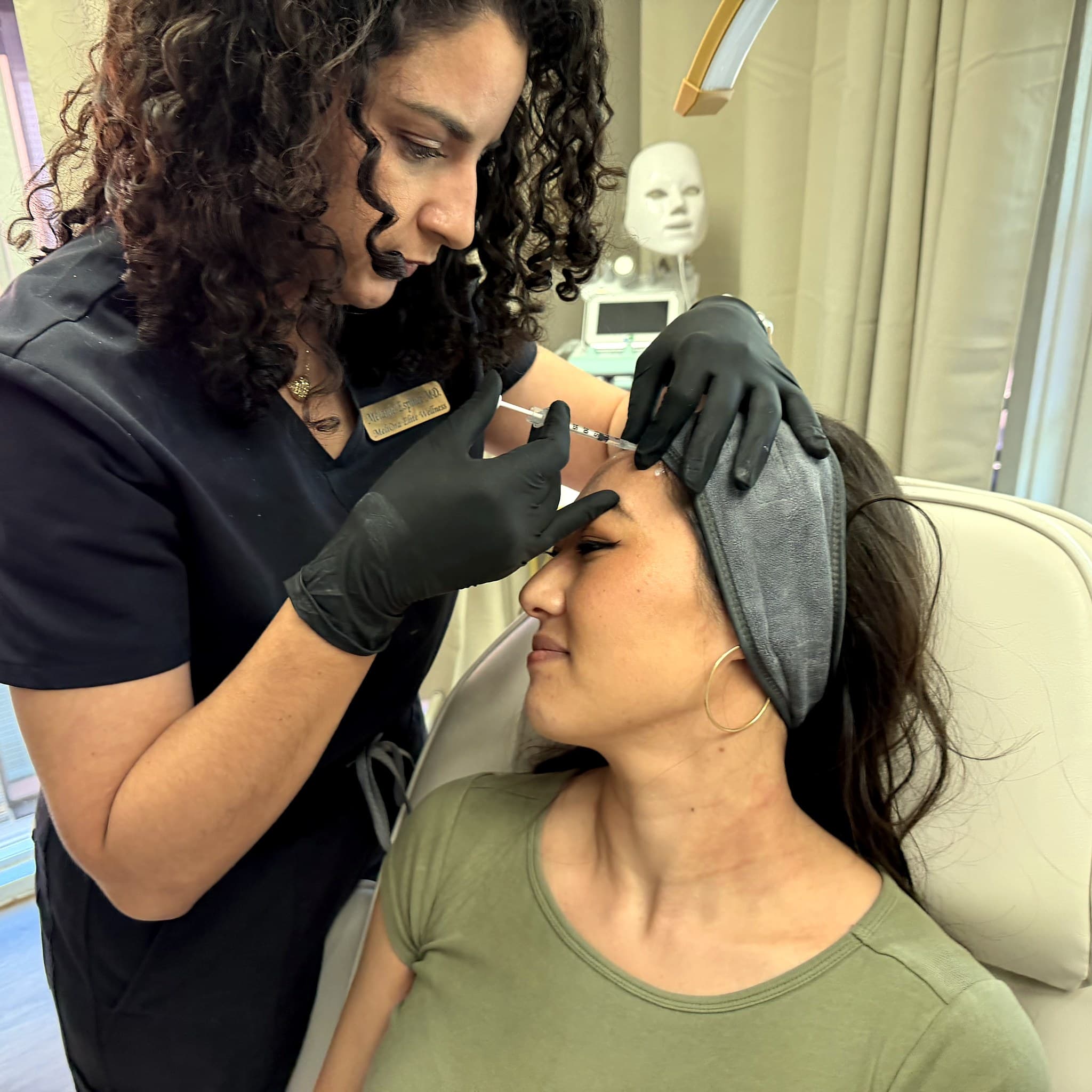
For the relax job, Dr. Melanie Espinet, a board-certified Family Medicine physician, reviews your prior units and areas at the consultation and places every Botox injection herself, at $12/unit with no travel fee anywhere in Hillsborough, Pasco, and Pinellas counties. Botox isn’t for anyone allergic to a botulinum toxin product or with a skin infection where they’d be treated; our Botox side effects guide lists who else should talk it through first.
Visits happen at your home, your office, or the Lutz office. At any house call, including ours, ask how the product was stored on the way and what the plan is for a serious reaction. When you’re ready, book a Botox visit.
Frequently asked questions about face taping
Does face taping really work for wrinkles?
Tape holds skin flat only while it’s on. We found no published clinical trial showing it reduces wrinkles, and experts quoted by Ochsner Health say fine lines are likely to return within hours of removing it. Tape doesn’t reach the muscle that makes expression lines, and it typically doesn’t help deep wrinkles.
Is it safe to tape your face every night?
Experts quoted by Ochsner Health say face tape shouldn’t be used daily, because repeatedly applying and removing it can irritate or damage the skin’s outer layer. Repeated use and adhesive left on too long raise the risk of skin injury, and an adhesive allergy can develop after months of use. Skip it with eczema, fragile skin, or a rash.
Do Frownies work?
Frownies are a brand of facial patches meant to hold skin flat while you wear them. We found no published clinical trial of Frownies or similar patches for wrinkles. Any smoothing after you remove them is temporary by expert accounts, and any adhesive can irritate the skin underneath.
Can face taping replace Botox?
Not for the same job. Tape holds skin flat while it’s on. Botox with Jeuveau or Xeomin relaxes the muscle behind the line, and the American Academy of Dermatology says botulinum toxin’s effect generally lasts about 3 to 4 months, sometimes longer. Daily sunscreen and sunglasses, which the AAD recommends, matter whichever you choose.
Do LED face masks work for wrinkles?
Small trials suggest they can help. A 2026 review of eight studies with 365 people found improved wrinkles and mild side effects, and called for larger comparative trials. In one maker-funded, sham-controlled mask trial, a rater saw better crow’s feet in most users, but the participants’ own ratings didn’t differ significantly from the sham group.
Is face taping the same as mouth taping?
No. Face tape covers expression lines to stop creasing. Mouth taping seals the lips at night to force nose breathing. A 2025 systematic review found benefit in only two small studies and a potentially serious risk of harm, especially with a blocked nose. Snoring or gasping at night deserves a sleep evaluation instead.