The short answerBotox for smile lines works well on crow’s feet, the creases at the outer corners of your eyes, and Xeomin is FDA-approved there. It’s a poor fit for nasolabial folds, the lines from nose to mouth: those are mostly volume and skin, and toxin near them can weaken your smile.
“Smile lines” names two creases, and the answer to “does Botox work?” is nearly opposite for each. At MeliOra Elite Wellness, Botox means Jeuveau or Xeomin; crow’s feet are on our treatment chart and the nose-to-mouth folds are not. For every area we treat, see Botox in Lutz, FL.
What are smile lines? Two creases share one name
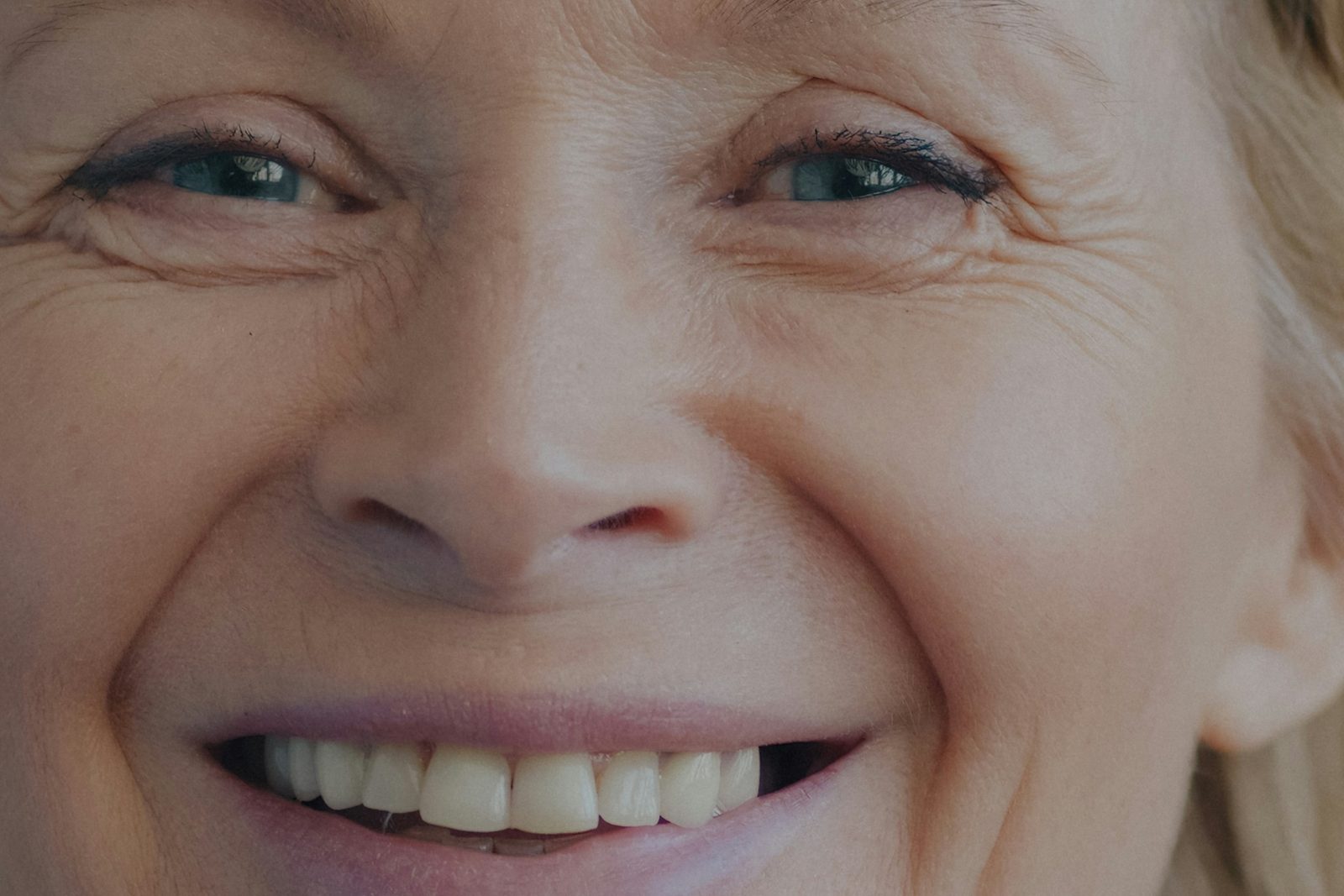
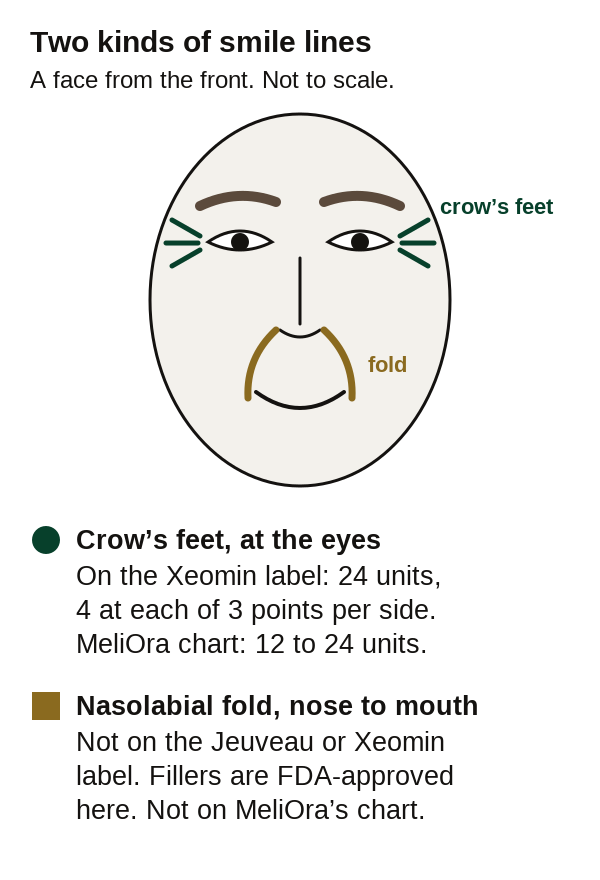
Smile lines are the creases that deepen when you smile. The name covers two different lines: crow’s feet, which fan out from the outer corners of the eyes, and nasolabial folds, which run from the sides of the nose to the corners of the mouth.
Crow’s feet: the smile lines at your eyes
Crow’s feet form where the ring of muscle around each eye, the orbicularis oculi, tightens as you smile or squint. The FDA has approved Xeomin for moderate to severe crow’s feet caused by that muscle. Our Botox for crow’s feet guide covers units, cost, and results in detail.
Nasolabial folds: the laugh lines from nose to mouth
A nasolabial fold isn’t a simple wrinkle. A 1989 anatomy study called it the keystone of the smiling mechanism: absent in newborns, gone in a paralyzed face, with the lip-lifting muscles running into it. A 2020 micro-CT study of 12 cadavers found muscle along its inner edge and fat in fibrous pockets on the cheek side, and suggested that age-related changes in that fat could deepen the fold. A 2012 study of Japanese women, by researchers at the cosmetics company Shiseido, linked deeper folds to less elastic skin and thicker fat, and proposed that these let the upper cheek sag.
The two smile lines sit in different places, and only the eye-corner lines appear on a Botox label.
Does Botox work for smile lines? It depends which one
Botox for smile lines works at the eyes and is a weak, risky tool for the folds beside the mouth. Here’s what the labels and studies show for each.
Crow’s feet: yes, and it’s on the label
The Xeomin label approves crow’s feet and lists 4 units at each of three points per side, 24 units in total. Jeuveau is approved for frown lines only, so using it at the eyes is off-label: the FDA lets doctors choose an unapproved use when they judge it medically appropriate. The American Academy of Dermatology says results for lines last about 3 to 4 months, and sometimes longer; see how long Botox lasts.
Nasolabial folds: small studies, no label
Neither the Jeuveau nor the Xeomin label lists nasolabial folds, so Botox for nasolabial folds is off-label with either brand. In a 2023 study of 76 people whose folds the authors judged to be driven by muscle, or by muscle and fat, toxin made the folds shallower at one month, more when laughing than at rest, and they gradually returned at three and six months; the abstract doesn’t name the brand. A 2008 expert consensus called hyaluronic acid fillers central to the midface because of the need to restore volume.
Why Botox for nasolabial folds can drop your upper lip
Here’s the part laugh lines Botox ads skip: the fold is where your smile happens. A 2017 cadaver study mapped where two lip-lifting muscles insert into the fold, looking for points that soften it without changing upper lip position or the smile. For crow’s feet, the Xeomin label warns against injecting too close to the zygomaticus major, the muscle that pulls up the mouth corner, to prevent a drooping lip. A 2020 review lists an uneven smile, a drooping lip, and changed expression as technique-related effects around the mouth, with no specific treatment, and says slightly higher doses there can make drinking, whistling, and talking harder.
The gummy smile treatment on our chart relaxes the muscles that lift the upper lip too far, so less gum shows. In the fold, that same change is the side effect. For lines on the lips, see Botox for lip lines.
The Smile, Rest, Recline Check: which smile line is yours?
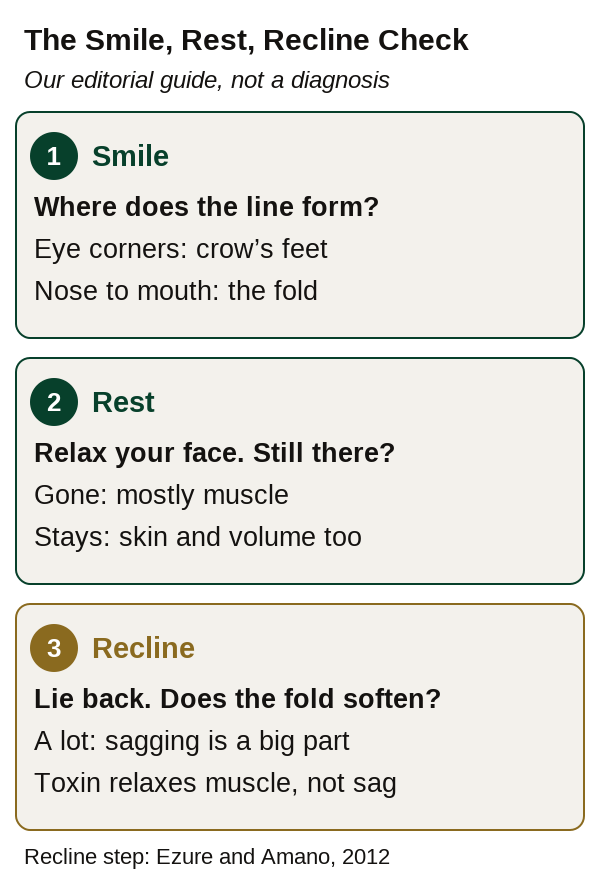
The Smile, Rest, Recline Check is our editorial guide for sorting smile lines before you spend anything. It isn’t a diagnosis or a MeliOra procedure. You need a hand mirror, daylight, and about a minute.
Smile: smile wide and watch where the line forms. A fan at the outer eye corners is crow’s feet. A curve from the side of the nose to the mouth corner is the nasolabial fold.
Rest: relax your whole face. A line that disappears is mostly muscle at work. A line that stays is etched skin, lost volume, or both.
Recline: lie back and hold the mirror above your face. If the fold softens a lot, sagging cheek tissue is a big part of it. In the 2012 Shiseido study, folds shrank sharply or disappeared when the women lay down.
Smile shows which line you have, Rest shows how much is muscle, and Recline shows how much is sagging.
Here’s how the results usually read. This table is our editorial guide, not a measurement. For more on lines that move versus lines that stay, see Botox vs fillers.
What you see
What it points to, and what tends to help
A fan of lines at the eye corners when you smile
Crow’s feet. Toxin can soften them, and Xeomin is FDA-approved there
Eye-corner lines that stay when you relax
Muscle plus skin aging. Toxin can soften them but may not erase them
A nose-to-mouth fold that deepens mainly when you smile
The smile muscles at work. Toxin studies are small, and the lip droop risk is real
A fold that stays when your face is relaxed
Volume loss and skin change. Fillers are FDA-approved for this; toxin adds no volume
A fold that flattens when you lie back
Sagging of the upper cheek. Toxin relaxes muscle and doesn’t lift tissue
A 2025 filler technique review focused on Korean patients sorts folds into the same three drivers, volume loss, loose tissue, and muscle pull, and says two together are not uncommon. Toxin touches only the muscle part.
Lines at the corners of your eyes? That’s crow’s feet, on our chart at 12 to 24 units for both sides, or $144 to $288 at $12/unit. Book a Botox visit: Dr. Espinet places every injection herself, and you approve the brand, areas, and units first.
Botox vs filler for smile lines: who treats the folds
For the nose-to-mouth fold, the FDA has approved dermal fillers: absorbable fillers for moderate to severe folds such as nasolabial folds, and permanent fillers only for nasolabial folds and cheek acne scars. MeliOra doesn’t offer fillers; see Botox vs fillers for how the two differ.
A 2021 meta-analysis of randomized filler trials in the nasolabial area found the folds improved right after treatment and had partly faded by 12 months; lumpiness, tenderness, swelling, and bruising were the most common complications. The FDA adds rarer, serious risks: filler in a blood vessel can cause tissue death, blindness, or stroke.
Who to ask about the folds
The FDA recommends a licensed provider experienced in dermatology or plastic surgery and trained to inject fillers. If your folds deepened after major weight loss, our Ozempic face guide covers facial volume loss.
Who should skip Botox for smile lines, and when to see a professional instead
Both of our Botox brands carry a boxed warning: the effect can spread beyond the injection site hours to weeks later, and swallowing or breathing problems can be life threatening, with deaths reported. Before any Botox for smile lines, tell your physician if:
You’re allergic to any botulinum toxin product, or have a skin infection where you’d be treated
You have a nerve or muscle disease such as ALS, myasthenia gravis, or Lambert-Eaton syndrome
You have trouble swallowing or breathing, or a breathing problem such as asthma or emphysema
You have heart disease. The Jeuveau label and Allergan’s Botox Cosmetic label note reports of heart rhythm problems and heart attacks after botulinum toxins, some in people with existing heart disease; the Xeomin label has no such section, which doesn’t rule out the risk
Your face is markedly uneven, a caution on both labels, or you’ve had facial surgery, which the Xeomin label adds
You sing professionally, play a wind instrument, or scuba dive: a 2020 review says lip-area toxin may be ruled out for you
You’re pregnant or breastfeeding, or you’ve had any botulinum toxin in the last four months
When to see a professional instead
A fold that stays at rest is a volume and skin question for a dermatologist or plastic surgeon. A sudden one-sided change is different: the fold vanishes in a paralyzed face, so a fold that suddenly flattens on one side, a drooping mouth corner, or a smile that won’t lift can mean a stroke or Bell’s palsy. Call 911 for sudden face drooping.
After any Botox, use this table. It matches our Botox side effects guide row for row; the last row adds the FDA’s filler warning signs, since deep folds are often treated with filler elsewhere.
If you notice
What to do
Trouble swallowing, speaking, or breathing
Call 911 or get emergency care right away
Weakness all over the body
Call 911 or get emergency care right away
Double vision or blurred vision
Go to the emergency room or see a health care provider right away. Don’t wait, and don’t drive yourself
Hoarseness, a change in your voice, or loss of bladder control
Get medical care right away
Wheezing, swelling of your face, eyes, or tongue, or feeling faint
This could be a severe allergic reaction. Call 911 right away
Chest pain or pressure, or a racing or irregular heartbeat
Call 911 right away, and don’t drive yourself. The Jeuveau label and Allergan’s Botox Cosmetic label report irregular heartbeats and heart attacks after botulinum toxin products, some fatal
Hives, itching, or a rash with no trouble breathing
A possible allergic reaction. Get medical help right away, and call 911 if it gets worse
Eye pain or sudden vision changes
Go to the emergency room or an eye doctor right away, and don’t drive yourself. Call 911 if you suddenly lose vision
An eye that feels dry, irritated, or gritty, is sensitive to light, or won’t close fully
Get medical care right away. The Jeuveau label notes toxins can reduce tears and blinking, and the Xeomin label says reduced blinking can injure the eye’s surface
A droop, blurred vision, slurred speech, dry mouth, or weakness after toxin from an online seller, an unlicensed injector, or an unknown product
Go to the emergency room now, don’t drive yourself, and call 911 if breathing or swallowing gets harder. Tell them what was injected, how many units, and when. The CDC lists drooping eyelids, blurred vision, and slurred speech among early botulism signs
Sudden drooping on one side of your mouth or cheek, sudden numbness or weakness in your face, arm, or leg, sudden confusion, or a droop with a severe headache, eye pain, or one pupil larger than the other
These can have causes other than Botox, including a stroke. Call 911 right away, and don’t drive yourself
Redness, warmth, or swelling where you were treated that spreads or worsens, or pus or a fever
Call your injector or doctor today. The Jeuveau label lists infection among the effects an injection can cause
A drooping eyelid or heavy brow on its own, after treatment by a licensed provider with a product you can identify
Call your injector, or call or text Dr. Espinet if she treated you. The labels say to avoid driving if you have a drooping eyelid or muscle weakness
During or after a filler treatment: unusual pain, vision changes, or skin near the injection turning white, gray, or blue
Get emergency care right away. The FDA warns filler in a blood vessel can cause tissue death, blindness, or stroke
Botox for smile lines at MeliOra
At MeliOra Elite Wellness, Botox means Jeuveau or Xeomin, both $12/unit. Crow’s feet are on our treatment chart at 12 to 24 units for both sides, or $144 to $288. Xeomin is FDA-approved there and Jeuveau is off-label, which Dr. Espinet explains before you decide. She reviews any prior units and areas, places every injection herself, and you approve the brand, areas, and units first.
Nasolabial folds aren’t on our treatment chart; ask Dr. Espinet whether any treatment fits you. MeliOra doesn’t offer fillers. Visits are at your home, your office, or the Lutz office, with no travel fee anywhere in Hillsborough, Pasco, and Pinellas counties. At any house call, including ours, ask how the product was stored on the way and what the plan is for a serious reaction. When you’re ready, book a visit, and read our Botox aftercare guide beforehand.
Frequently asked questions about Botox for smile lines
Does Botox work for smile lines?
It depends which smile lines. For crow’s feet at the outer corners of the eyes, yes: Xeomin is FDA-approved there, and the American Academy of Dermatology says results last about 3 to 4 months. For nasolabial folds from nose to mouth, evidence is thin, neither of our brands is approved there, and toxin can weaken your smile.
Can Botox fix nasolabial folds?
Usually not. Folds that stay when your face is relaxed come mostly from volume loss, looser skin, and sagging cheek tissue, which toxin doesn’t replace or lift. Small studies softened folds that deepen with a smile, but the muscles there also lift your upper lip, so a drooping lip or uneven smile is a real risk.
Is Botox or filler better for smile lines?
For crow’s feet, toxin is the usual choice, because the eye muscle causes them. For nasolabial folds, the FDA has approved dermal fillers, and neither the Jeuveau nor the Xeomin label lists the folds. MeliOra doesn’t offer fillers, so ask a dermatologist or plastic surgeon about them.
How many units of Botox for smile lines?
For crow’s feet, MeliOra’s chart lists 12 to 24 units for both sides, $144 to $288 at $12/unit, and the Xeomin label dose is 24 units. Nasolabial folds have no label dose and aren’t on our chart, and study doses of other brands don’t convert to Jeuveau or Xeomin units.
Can Botox make laugh lines look worse?
It can change your smile instead of smoothing the fold. Toxin that reaches the muscles lifting the lip can make the lip droop or the smile look uneven, a 2020 review notes, and the Xeomin label warns about lip droop even for crow’s feet. These effects are temporary, but a 2020 review lists no specific treatment while they last.
How long does Botox for smile lines last?
For crow’s feet, the American Academy of Dermatology says toxin results for lines usually last about 3 to 4 months, sometimes longer, and both of our brands’ labels say not to retreat more often than every three months. In one 2023 study of nasolabial fold injections, the folds gradually returned at three and six months.
THE PATIENT AND ANY OTHER PERSON RESPONSIBLE FOR PAYMENT HAS A RIGHT TO REFUSE TO PAY, CANCEL PAYMENT, OR BE REIMBURSED FOR PAYMENT FOR ANY OTHER SERVICE, EXAMINATION, OR TREATMENT THAT IS PERFORMED AS A RESULT OF AND WITHIN 72 HOURS OF RESPONDING TO THE ADVERTISEMENT FOR THE FREE, DISCOUNTED FEE, OR REDUCED FEE SERVICE, EXAMINATION, OR TREATMENT.
Free download · 15 pages
The MeliOra Botox Guide
Typical units and cost by area, Botox brands Jeuveau vs. Xeomin, aftercare, a results timeline and a planner you can fill in. Free, and yours to keep.