The short answerThe Jeuveau label doesn’t say how long Jeuveau lasts. It reports one result, at day 30, and allows retreatment no more often than every three months. For botulinum toxins in general, the American Academy of Dermatology says the effect on lines lasts about 3 to 4 months, sometimes longer.
How long does Jeuveau last? The honest answer has two parts: what the FDA label measured, and what you’ll see in the mirror. At MeliOra Elite Wellness, Jeuveau is one of our two Botox brands, with Xeomin: Botox in Lutz, FL.
How long does Jeuveau last? What the label says, and what it doesn’t
The Jeuveau label gives no duration and no onset time. It approves Jeuveau for the temporary improvement of moderate to severe frown lines between the brows in adults, reports its main result at day 30, and says retreatment should be given no more often than every three months.
So any duration you hear for Jeuveau comes from elsewhere. For botulinum toxins as a class, the American Academy of Dermatology says about 3 to 4 months, sometimes longer, and a 2026 American Family Physician review says approximately 3 to 4 months. A 2018 literature review found two to six months, most often three to four. These are class figures, not a Jeuveau measurement. For how it varies by area and dose, see how long Botox lasts.
What is Jeuveau?
Jeuveau (prabotulinumtoxinA-xvfs) is a prescription botulinum toxin type A injection from Evolus, first approved by the FDA in 2019. It temporarily improves the look of moderate to severe frown lines between the brows in adults, at 20 units split across five injection points.
It’s made for Evolus by Daewoong Pharmaceutical in Korea. Is it the same drug as Allergan’s Botox Cosmetic, a brand MeliOra doesn’t carry? See Jeuveau vs Botox.
Jeuveau results: what the day 30 number means
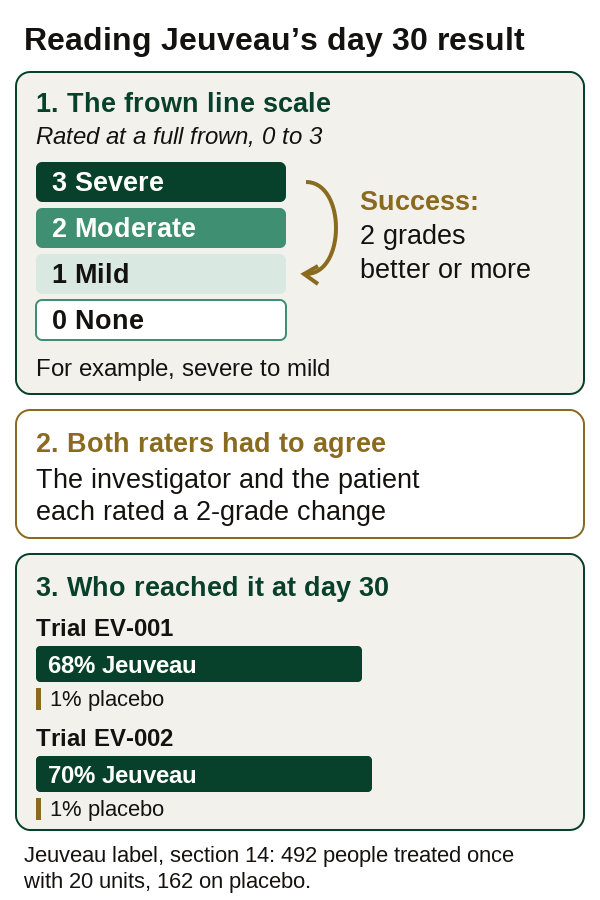
Jeuveau results on the label come from two identical U.S. trials that treated 492 adults once with 20 units and gave 162 a placebo. At day 30, 68% and 70% of treated people were responders, against 1% on placebo in each trial.
Responder is a strict word here. Lines were graded at maximum frown on a 4-point scale (0 none, 1 mild, 2 moderate, 3 severe), and the investigator and the patient each had to rate at least two grades of improvement. Severe to mild counts. Severe to moderate doesn’t.
The day 30 result counts people whose full frown improved at least two grades, as rated by both the investigator and the patient.
Ratings of none or mild were exploratory in the published report, with no statistical testing, and aren’t on the label. The approval is for temporary improvement, not lines that disappear. For dose planning by area, see how many units of Botox you need.
Who the day 30 result describes
The trials enrolled 654 healthy adults aged 18 to 81, mean age 51, mostly women (91%) and white (84%). The 68 people aged 65 or older were too few, the label says, to tell whether older adults respond differently. People with a drooping lid or brow, deep scarring, or lines that didn’t soften when spread apart by hand were excluded. Evolus funded both trials, and its chief medical officer coauthored the report.
Label clock vs mirror clock: timing your own Jeuveau result
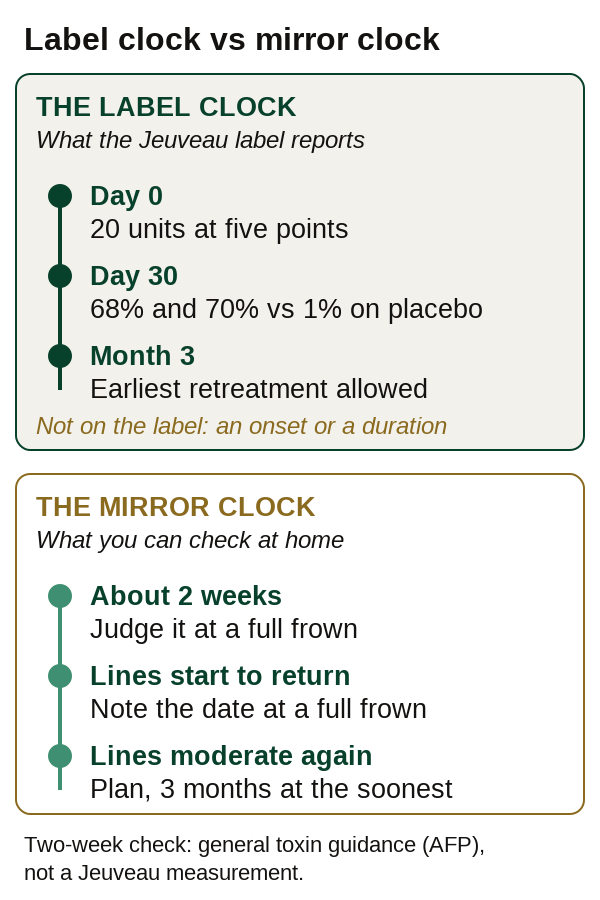
The label clock is fixed: what the trials measured, and when. The mirror clock is yours: what you can check at home, using the frown the trials graded. It’s our editorial tool, not a MeliOra protocol, built from the label and the published trials.
The label clock: day 0, day 30, month 3
Day 0: 20 units, 0.1 mL at each of five points in the frown muscles
Day 30: the one efficacy result the label prints
Month 3: the earliest the label allows another treatment
What’s missing: a day Jeuveau starts and a day it ends.
The mirror clock: what you can check at home
Frown the way the trials did
Trial participants were asked to “frown as much as possible, as if concentrating hard,” and their lines were graded at that maximum frown. Photograph that frown before treatment, repeat it in the same light each time you check, and rate it yourself from 0 to 3. Your rating isn’t the trial’s, but it tracks the same expression.
Check at about two weeks
For botulinum toxins in general, the 2026 American Family Physician review says clinical effects typically take about two weeks to fully develop. Treat two weeks as your first fair check, and day 30 as the point the label measured. For the general day-by-day picture across brands, see how long Botox takes to work.
Watch for the frown to come back
When your full-frown photo looks moderate again, a 2 on the scale, plan the next visit, as long as three months have passed. Jeuveau’s one-year repeat-dose safety studies used a similar rule: retreatment from day 90 on, only once the investigator rated the lines moderate or severe again at maximum frown.
The label clock shows what was measured and when; the mirror clock is what you can track at home.
New to Botox, or three months past your last toxin treatment?Book a Botox visit. Dr. Melanie Espinet reviews any past units and areas, then confirms your plan with Jeuveau or Xeomin at $12/unit, about $240 for frown lines, before anything begins.
Jeuveau wearing off: why the frown comes back
Jeuveau wearing off is a slow return of movement, not a switch. The label describes partial chemical denervation: the treated muscle gets a weaker signal, new nerve sprouts may form, and the muscle may regain its nerve supply, slowly reversing the effect. Watch the full frown, the expression the trials graded. For the everyday signs, see signs your Botox is wearing off.
Why Jeuveau might wear off sooner than you expected
Dose: the label dose for frown lines is 20 units, and the label says not to exceed the recommended dose or how often it’s given
Area: frown lines are Jeuveau’s only approved area, so other areas have no label data
Timing: retreating early isn’t the fix; the label’s minimum is three months
Antibodies, rarely: 2 of 1,414 people treated with Jeuveau developed them, and the label says they may weaken later treatments
If results get shorter over several visits rather than once, read Botox resistance before switching anything.
The next-step problem: planning your next Jeuveau visit
Once you know your mirror clock, the next problem is the calendar. The label and Medication Guide set one rule: no more than one treatment every three months. Beyond that, the timing comes from your result.
What to record after each visit
The date, the brand, and the units in each area
Your full-frown photo at two weeks, with your own 0 to 3 rating
The date your frown looked moderate again
Anything you didn’t like, such as a heavy brow or a droop
Any other botulinum toxin you’ve had, for any reason
That last one matters. The Medication Guide asks about any botulinum toxin in the last four months, and which product, and Jeuveau units can’t be converted into another brand’s. For our two brands side by side, see Jeuveau vs Xeomin.
Jeuveau beyond frown lines
Forehead lines and crow’s feet are off-label for Jeuveau, so its label has no data for them, while the Xeomin label covers both. Ask which brand is planned for each area, and hear about any off-label use before treatment. For our other brand’s label timeline, see how long Xeomin lasts.
Who should be careful with Jeuveau, and when to see a professional instead
Jeuveau’s boxed warning says the effects of all botulinum toxin products can spread beyond the injection area hours to weeks later, and trouble swallowing or breathing can be life threatening, with deaths reported. Don’t get Jeuveau if you’re allergic to any botulinum toxin product or its ingredients, or have a skin infection where you’d be treated. Before treatment, tell your physician about all your conditions and medicines, especially:
A nerve or muscle disease such as ALS, myasthenia gravis, or Lambert-Eaton syndrome
Trouble swallowing or breathing, or asthma or emphysema
Heart problems: the label reports irregular heartbeats and heart attacks after botulinum toxins, some fatal
Pregnancy or breastfeeding: it isn’t known whether Jeuveau can harm an unborn baby or passes into breast milk
Aminoglycoside antibiotics, muscle relaxants, or anticholinergic medicines
Drooping eyelids, weak forehead muscles, facial surgery, bleeding problems, or dry eye after a past toxin
When to see a professional instead
Jeuveau isn’t right for every line. The label urges caution with deep scarring, thick oily skin, marked facial asymmetry, or lines that don’t lessen when spread apart by hand. Lines from volume loss or sun damage may need a dermatologist or facial plastic surgeon; MeliOra doesn’t offer fillers or lasers. A result that fades early every time, or a droop that lasts past about three months, needs an exam.
This page can’t diagnose a reaction. If something feels wrong after treatment, use this table, which matches our Botox side effects guide. For what’s common and when each effect shows up, see Jeuveau side effects.
If you notice
What to do
Trouble swallowing, speaking, or breathing
Call 911 or get emergency care right away
Weakness all over the body
Call 911 or get emergency care right away
Double vision or blurred vision
Go to the emergency room or see a health care provider right away. Don’t wait, and don’t drive yourself
Hoarseness, a change in your voice, or loss of bladder control
Get medical care right away
Wheezing, swelling of your face, eyes, or tongue, or feeling faint
This could be a severe allergic reaction. Call 911 right away
Chest pain or pressure, or a racing or irregular heartbeat
Call 911 right away, and don’t drive yourself. The Jeuveau label and Allergan’s Botox Cosmetic label report irregular heartbeats and heart attacks after botulinum toxin products, some fatal
Hives, itching, or a rash with no trouble breathing
A possible allergic reaction. Get medical help right away, and call 911 if it gets worse
Eye pain or sudden vision changes
Go to the emergency room or an eye doctor right away, and don’t drive yourself. Call 911 if you suddenly lose vision
An eye that feels dry, irritated, or gritty, is sensitive to light, or won’t close fully
Get medical care right away. The Jeuveau label notes toxins can reduce tears and blinking, and the Xeomin label says reduced blinking can injure the eye’s surface
A droop, blurred vision, slurred speech, dry mouth, or weakness after toxin from an online seller, an unlicensed injector, or an unknown product
Go to the emergency room now, don’t drive yourself, and call 911 if breathing or swallowing gets harder. Tell them what was injected, how many units, and when. The CDC lists drooping eyelids, blurred vision, and slurred speech among early botulism signs
Sudden drooping on one side of your mouth or cheek, sudden numbness or weakness in your face, arm, or leg, sudden confusion, or a droop with a severe headache, eye pain, or one pupil larger than the other
These can have causes other than Botox, including a stroke. Call 911 right away, and don’t drive yourself
Redness, warmth, or swelling where you were treated that spreads or worsens, or pus or a fever
Call your injector or doctor today. The Jeuveau label lists infection among the effects an injection can cause
A drooping eyelid or heavy brow on its own, after treatment by a licensed provider with a product you can identify
Call your injector, or call or text Dr. Espinet if she treated you. The labels say to avoid driving if you have a drooping eyelid or muscle weakness
Jeuveau at MeliOra: Botox you can plan around
At MeliOra Elite Wellness, Botox means Jeuveau or Xeomin, both $12/unit, with no travel fee anywhere in Hillsborough, Pasco, and Pinellas counties. Frown lines at about 20 units come to about $240. For every area and price, see Botox in Lutz, FL.
Dr. Melanie Espinet, a board-certified Family Medicine physician, reviews any prior units and areas at the consultation, and you approve the brand, areas, and units before she places every injection herself. At any house call, including ours, ask how the product was stored on the way and what the plan is for a serious reaction. When you’re ready, book a Botox visit at your home, your office, or the Lutz office.
Frequently asked questions about how long Jeuveau lasts
How long does Jeuveau last?
The Jeuveau label doesn’t state a duration. It reports one result, at day 30, and says not to retreat more often than every three months. For botulinum toxins in general, the American Academy of Dermatology says the effect on lines lasts about 3 to 4 months, sometimes longer.
What do Jeuveau results look like at day 30?
In Jeuveau’s two U.S. trials, 68% and 70% of treated people had frown lines rated at least two grades better at a full frown, by both the investigator and themselves, against 1% on placebo. It’s the only result the label prints, and it describes improvement, not lines that disappear.
When should I judge my Jeuveau results?
The Jeuveau label gives no onset time, and its trials measured their main result at day 30. For botulinum toxins in general, a 2026 American Family Physician review says the effect typically takes about two weeks to fully develop. Check your full frown at about two weeks, then again at a month.
How often can you get Jeuveau?
No more than once every three months, according to the Jeuveau label and Medication Guide. Beyond that minimum, timing depends on your result: a practical signal is when your lines at a full frown look moderate again. Tell your physician about any toxin in the last four months.
Why is my Jeuveau wearing off so fast?
The Jeuveau label states no duration, so it sets no benchmark for a short result. With botulinum toxins in general, a 2018 review found results lasting two to six months. Rarely, antibodies can weaken later treatments: among 1,414 people treated with Jeuveau, 2 developed them. Note how long your result lasted, and tell your physician before more treatment elsewhere.
What is Jeuveau?
Jeuveau (prabotulinumtoxinA-xvfs) is a prescription botulinum toxin type A from Evolus, FDA approved in 2019 for the temporary improvement of moderate to severe frown lines between the brows in adults. The label dose is 20 units across five injection points, no more often than every three months.