Blog · Botox
Masseter Botox Before and After: What Changes, and When You’ll See It
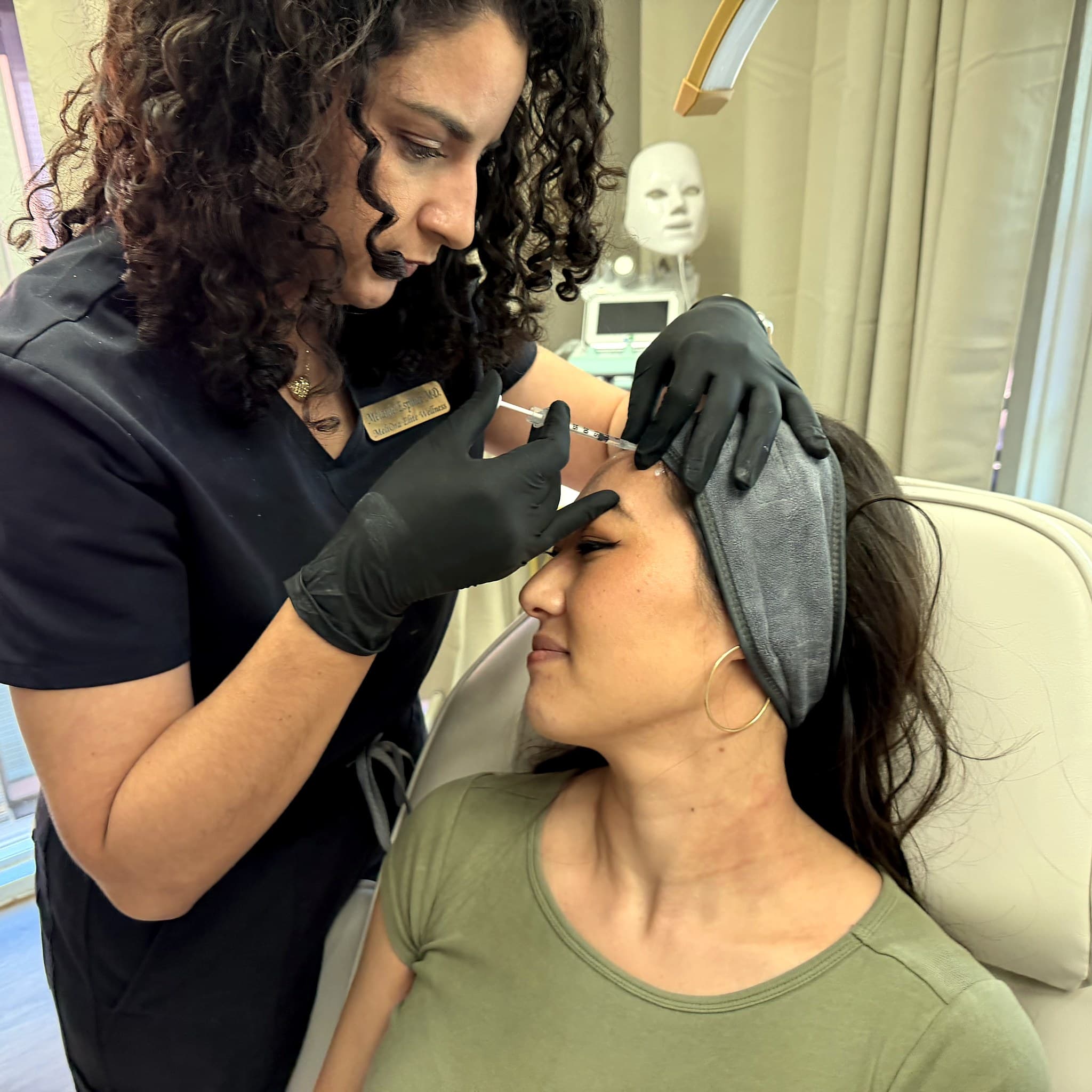
Masseter Botox before and after photos are all over social media, and they can make the change look fast and dramatic. Real results are slower and vary more from person to person. This guide comes from MeliOra, where board-certified physician Dr. Melanie Espinet performs masseter Botox in Lutz and Tampa herself. It explains what changes and when, why those photos can mislead, and how to tell whether you are a good candidate.
You won’t find before and after photos on this page. MeliOra doesn’t have consented masseter photos to share, and we won’t use stock images in their place. So this guide does the job in words, and it shows you how to take a fair set of your own.
Two things happen at different speeds. The muscle relaxes first, which is when clenching may ease. It shrinks later, which is when the jawline may change. These are typical patterns, not promises, and results vary with muscle size, dose, and habits.
| Timeframe | What you may notice |
|---|---|
| First week | The effect starts to build, and you may notice a softer bite. No visible change yet. |
| About 2 weeks | The muscle-relaxing effect is usually well under way. There is little to see, because the muscle has relaxed but not slimmed. |
| 4 to 8 weeks | A slimmer contour starts to show. Tough foods may tire your jaw sooner. |
| About 10 to 12 weeks | The slimmer shape is usually near its fullest by about now: in two placebo-controlled trials of a different brand, the change peaked around 3 months. In one large study, muscle strength was at its lowest at this point, so chewing can stay weaker well after the first two weeks. |
| 3 to 6 months | Any easing of clenching may fade first, as muscle strength returns. Slimming fades more gradually. If you repeat treatment, keep visits at least three months apart. |
The evidence supports a real, though variable, change. A 2026 meta-analysis pooled five placebo-controlled trials with 536 people. Treatment improved masseter prominence, muscle thickness, and patient satisfaction, but results varied widely between studies, and the authors said the exact size of the change should be interpreted cautiously. They also said these results are short term, and that an ideal dose hasn’t been defined.
Think softer, not different. A good result usually tapers the lower face a little and takes the bulk off the corner of the jaw. Treatment works on the muscle, not the shape of your jawbone. It doesn’t change puffiness or a round face from fluid or fat either; see cortisol face. Friends may say you look rested or slimmer without being able to say why.
How much you see depends on how large the muscle was to begin with. In one large study cited by the 2025 review, muscle thickness was 31% lower on average three months after treatment, in the people who could be followed that long. Those people were treated with a different brand, and units can’t be compared between brands, so that result may not carry over directly. It came from one clinic’s case series in Korea, with no comparison group. In a 2026 placebo-controlled trial of another brand, sponsored by its maker, with 376 people, most of them Asian women, the lower face narrowed by about 5 millimeters on average at three months. About half of those treated said they were satisfied, and the authors suggest some wanted a more dramatic change. If your muscle is modest, expect a modest change.
The two sides of your jaw may not match, either before or after treatment. Most faces aren’t symmetrical, and the muscle on your chewing side may be larger. Dr. Espinet checks each side separately and can dose them differently.
A jawline is easy to change in a photo without changing the jaw. Before you judge a result from a picture, look for these:
Photos also can’t show why a jaw is wide. If the width comes from the jawbone rather than the muscle, masseter Botox will do less, however good someone else’s result looks. A jawline blurred by cords in the neck is a different muscle, covered in our Nefertiti lift guide.
Most masseter Botox side effects are mild and temporary. A 2025 review reports these, and they are the same ones we cover on our masseter Botox page.
| Side effect | What to know |
|---|---|
| Tenderness, a small bump, a bruise, or a mild headache | Common and usually gone within days |
| Chewing fatigue | Tough or chewy foods can tire your jaw for a few weeks, and bite strength can stay lower for about three months. Everyday meals are usually fine |
| Uneven results or a change in your smile | The review’s table puts uneven results at roughly 2% to 15% and smile changes under 2%. Most effects are temporary |
| A bulge in part of the muscle | Uncommon, about 2% in one large placebo-controlled trial. The review links it to the product spreading unevenly in the muscle |
| Looser skin along the jaw | Reported in 0.2% to 2.3% of people in the review, and more often in older people or those with thinner skin. A small 2024 study of 43 people found a less sharp jawline on about half of treated sides, so a subtle change may be more common than those numbers suggest |
| A hollow or sunken look | More common than sagging. The review’s table groups sunken cheeks with effects seen in roughly 2% to 15% of people |
| The bone’s outer layer | Small studies raise a concern that treatment may slightly thin it. A 12-month placebo-controlled trial by the maker of a different brand found no difference after one or two treatments, but it couldn’t rule out effects after a year. Long-term data on repeat treatment are limited |
Toxin placed near the mouth corners has its own smile risks; see DAO Botox.
Rarely, the effect can spread beyond the treated area, even hours to weeks later. Both labels carry a boxed warning about this, and trouble swallowing or breathing can be life threatening. Call 911 for trouble swallowing, speaking, or breathing, or for muscle weakness away from the jaw. Get emergency care right away for blurred or double vision or drooping eyelids. Also call 911 for swelling of your face or throat or wheezing, which can mean a serious allergic reaction. For a wider view, see Botox side effects.
The masseter is a large muscle, so it takes more units than fine-line areas: commonly 40 to 60 in total for both sides. Botox with Jeuveau or Xeomin at MeliOra is $12/unit, which puts that range at $480 to $720, with no travel fee in our Tampa Bay service area. This is an illustration, not a quote. Dr. Espinet sets your dose at your consultation, and the label for neither brand lists a masseter dose, because this use is off-label.
For more scenarios, see what Botox costs per unit and the Botox unit chart.
Masseter results commonly last about 3 to 6 months, and slimming fades more slowly than any relief from clenching. In one large study cited by the 2025 review, half of the people needed a second treatment after 4 to 7 months. Treatment is often repeated every three to six months, though there is no set schedule: placebo-controlled trials retreated at about six months, and the labels’ minimum spacing is three months. With consistent treatment, some people can space visits further apart because the muscle stays smaller between sessions.
If you stop, muscle strength gradually comes back, and the muscle usually regains its size over several months. After repeated treatment that can take longer: one small study, in the six women who finished it, still found about 12% less muscle volume a year after a series of three treatments given six months apart. A 2025 review also warns that repeat treatment at short intervals may cause a lasting loss of thickness and function, which is one more reason to space your visits. The labels for Jeuveau and Xeomin say not to retreat more often than every three months.
Masseter Botox isn’t right for every wide jaw. It may not be the best choice if:
Some reasons are firmer than a poor fit. Don’t have this treatment if you have ever had an allergic reaction to any botulinum toxin product, or if you have an infection where the shots would go: both labels rule out treatment in those cases. Wait if you are pregnant or breastfeeding, because there isn’t enough safety data. Tell Dr. Espinet first if you have a neuromuscular condition such as myasthenia gravis, trouble swallowing or breathing, a bleeding problem, or heart disease, and share all your medications, including certain antibiotics and muscle relaxants.
If clenching is your main concern, start with your dentist and simple steps, such as a night guard that protects your teeth. Botox can lower bite force, but research hasn’t clearly shown that it eases clenching or grinding, and this use is off-label too. See masseter Botox vs a night guard. Dr. Espinet will tell you honestly if she thinks the trade-off isn’t worth it for you.
To find out whether your jaw is a good fit, request a Botox visit and tell her it’s for your jaw. She will examine each muscle as you clench before setting a dose. You can read more about our other Botox treatments too.
A slimmer jawline usually starts to show at about 4 to 8 weeks. The muscle relaxes sooner, usually within the first two weeks, but it needs more time to get smaller. Results vary with muscle size, dose, and habits.
Masseter Botox commonly lasts about 3 to 6 months, and slimming fades more gradually than any relief from clenching. It is often repeated every three to six months, though there is no set schedule: trials retreated at about six months, and the labels’ minimum spacing is three months. Some people can space visits further apart over time.
Masseter Botox commonly takes 40 to 60 units in total, which is $480 to $720 at MeliOra’s $12/unit. Your own dose depends on your muscle size and goal. Dr. Espinet confirms the units and total before treatment starts.
It can make looseness along the jaw more noticeable in some people. A 2025 review reports sagging of the skin and soft tissue in the jaw area in 0.2% to 2.3% of people, more often in older people or those with thinner skin, and a small 2024 study of 43 people found a less sharp jawline on about half of treated sides. Ask about this before treatment if your skin is already loose.
It can if your face is already slim, because a smaller muscle leaves less fullness along the jaw. Sunken cheeks are among the aesthetic concerns a 2025 review lists. A careful exam and a conservative dose help, and sometimes the honest advice is to skip it.
We don’t have consented masseter photos to share, and we won’t use stock images in their place. Photos can also mislead, because angle, lighting, clenching, and weight change can all alter a jawline. This guide explains what to expect instead.
Serving Lutz, Wesley Chapel, Land O'Lakes, Carrollwood, New Tampa & greater Tampa Bay.
Book Your ConsultationTHE PATIENT AND ANY OTHER PERSON RESPONSIBLE FOR PAYMENT HAS A RIGHT TO REFUSE TO PAY, CANCEL PAYMENT, OR BE REIMBURSED FOR PAYMENT FOR ANY OTHER SERVICE, EXAMINATION, OR TREATMENT THAT IS PERFORMED AS A RESULT OF AND WITHIN 72 HOURS OF RESPONDING TO THE ADVERTISEMENT FOR THE FREE, DISCOUNTED FEE, OR REDUCED FEE SERVICE, EXAMINATION, OR TREATMENT.

Free download · 15 pages
Typical units and cost by area, Botox brands Jeuveau vs. Xeomin, aftercare, a results timeline and a planner you can fill in. Free, and yours to keep.
Get the free guide