Wegovy 7.2 mg (Wegovy HD): Is a Higher Dose the Answer to Your Plateau?
Dr. Melanie Espinet, board-certified Family Medicine physician ·
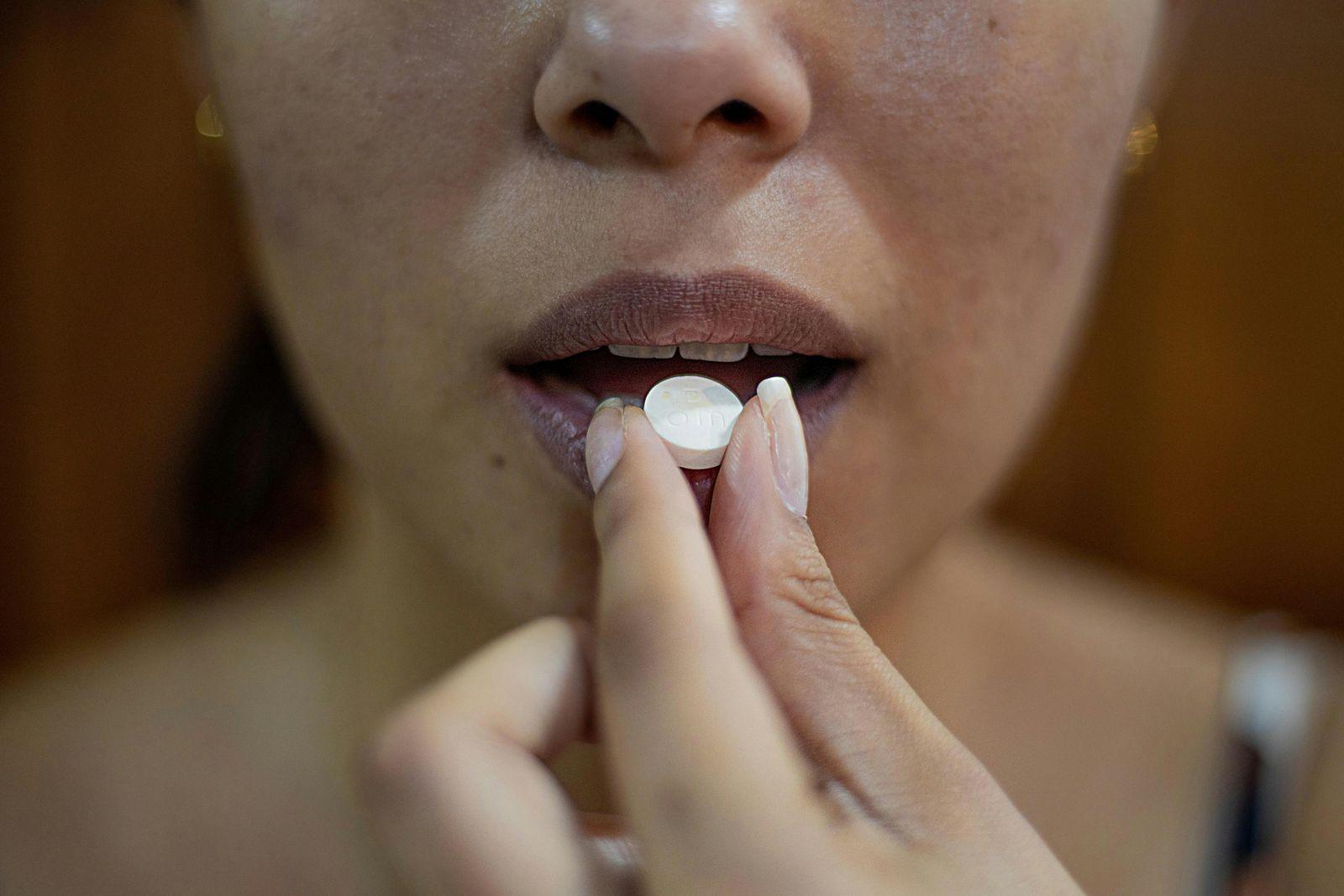
Before any step up to Wegovy 7.2 mg, a month of notes on weight, side effects, and missed doses makes the conversation clearer. Photo: Marissa Grootes on Unsplash
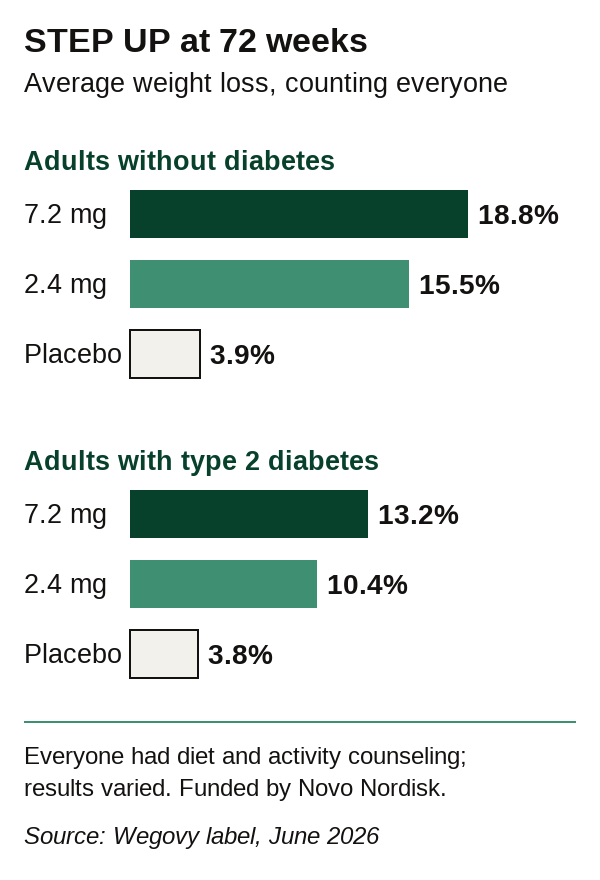
The short answerWegovy 7.2 mg, sold as Wegovy HD, is a higher weekly dose of semaglutide, approved by the FDA on March 19, 2026, for adults who have tolerated 2.4 mg for at least 4 weeks when more weight loss is clinically indicated. In the STEP UP trial, adults without diabetes lost 18.8% on average at 72 weeks, against 15.5% on 2.4 mg and 3.9% on placebo, with diet and activity counseling for everyone; results varied. Tingling or burning skin was far more common at 7.2 mg.
Wegovy is Novo Nordisk’s brand of semaglutide, and the label facts below describe that brand-name product. Dr. Melanie Espinet prescribes weekly semaglutide or tirzepatide for medical weight loss. If you’re stalled on 2.4 mg, the useful question isn’t only “should I go higher?” but “is my stall a dose problem at all?” This is general information, not medical advice.
What is Wegovy 7.2 mg?
Wegovy 7.2 mg is the highest weekly dose of the Wegovy injection, sold as Wegovy HD in a single-dose pen. It’s the same medicine, semaglutide, at three times the usual 2.4 mg maintenance dose, for weight reduction in adults.
The label lets adults step up once they’ve tolerated 2.4 mg for at least 4 weeks and more weight reduction is clinically indicated. The 7.2 mg dose is labeled for weight reduction only: the heart-risk use stays at 2.4 mg or 1.7 mg, and the label says 7.2 mg isn’t established for teens or for the liver condition MASH. Every step before it is in our semaglutide dosage chart.
Approval came on March 19, 2026, under an FDA pilot program for faster reviews, and Novo Nordisk said the pen would reach pharmacies in April 2026.
Wegovy 7.2 mg results: what the STEP UP trials found
STEP UP enrolled 1,407 adults with obesity and no diabetes, assigned by chance to 7.2 mg, 2.4 mg, or placebo for 72 weeks, all with diet and activity counseling. Counting everyone, the Wegovy label reports average weight loss of 18.8% on 7.2 mg, 15.5% on 2.4 mg, and 3.9% on placebo; the published trial report, using a slightly different analysis, gives 18.7% and 15.6%. Losing a fifth or more of body weight was more common too: 45.5% on 7.2 mg, 32.3% on 2.4 mg, and 2.8% on placebo. Results varied from person to person, and Novo Nordisk funded both trials.
STEP UP T2D enrolled 512 adults with obesity and type 2 diabetes. Average weight loss was 13.2% on 7.2 mg, 10.4% on 2.4 mg, and 3.8% on placebo. Blood sugar control was about the same on the two doses: A1C fell 1.7 points on 7.2 mg and 1.6 on 2.4 mg. Everyone also had diet and activity counseling, and results varied.
In both trials, 7.2 mg added about 3 points over 2.4 mg on average; the bigger gap is against placebo.
Headlines quoting about 21% use a different count: Novo’s estimate if everyone had stayed on treatment. For how a semaglutide year usually unfolds at 2.4 mg, see the semaglutide weight loss timeline.
Wegovy 7.2 mg side effects: what the higher dose costs
Most side effects were a little more common at 7.2 mg, and one was much more common. The label’s rates across both trials:
7.2 mg vs 2.4 mg vs placebo
Side effect
7.2 mg
2.4 mg
Placebo
Nausea
39%
35%
13%
Vomiting
22%
16%
6%
Tingling, burning, or sensitive skin (dysesthesia)
22%
6%
0.3%
Constipation
20%
19%
8%
Fatigue
11%
9%
5%
Hair loss
6%
3%
1%
Stopped because of side effects
5%
5%
2%
Serious adverse events were not more common at the higher dose in STEP UP: 6.8% on 7.2 mg, 10.9% on 2.4 mg, and 5.5% on placebo. For the two effects people ask about most, see GLP-1 hair loss, where 7.2 mg hair loss hit women far more than men, and fatigue on GLP-1 medicine.
The skin sensation problem
Dysesthesia means skin that tingles, burns, hurts, or feels unusually sensitive. The label says it rose with the dose and with drug levels in the blood. Of the 288 people who had it on 7.2 mg, 2% stopped treatment, 8% paused, and 23% had their dose lowered, and most of those recovered; 18% overall didn’t report recovering during the trial. When 38 people went back up to 7.2 mg, it returned in 17 of them (45%). The FDA called it a known serious risk when it approved the dose and required Novo Nordisk to study it further.
Ceiling or plateau? A four-question check before going to Wegovy 7.2 mg
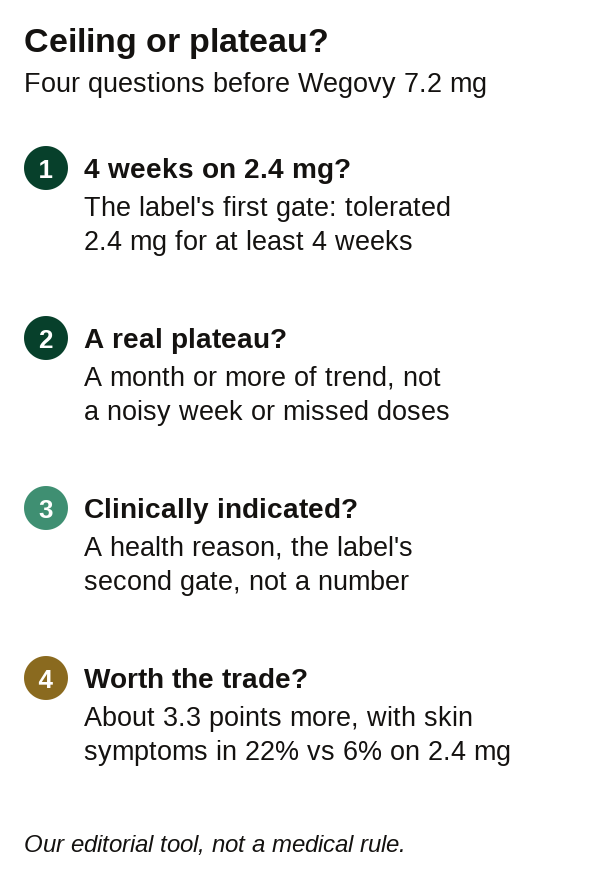
A stall on 2.4 mg can mean two different things. It can be a dose ceiling: the medicine is doing what it can at this dose, and more of it might move the scale. Or it can be a plateau: your body adapting to a lower weight, the normal leveling off our plateau guide explains, which a higher dose may push lower but can’t switch off. This check is our editorial tool, not a medical rule.
1. Have you tolerated 2.4 mg for at least 4 weeks?
That’s the label’s first gate. If you’re still climbing the dose steps, it’s too early to ask. If side effects at 2.4 mg are already wearing you down, 7.2 mg brought more of them in the trials, so your question is comfort, not dose.
2. Is it a real plateau, or noise?
A flat week or two is normal. Look at a month or more of trend, and rule out what a dose can’t fix: missed doses, weight-raising medicines, short sleep. Our guide to the semaglutide plateau walks through how to read your numbers.
3. Is more weight loss clinically indicated?
That’s the label’s second gate. The label doesn’t define it. Your prescriber weighs your health, for example blood pressure, blood sugar, joint pain, or sleep apnea, not just the number on the scale. In STEP UP, the extra over 2.4 mg averaged 3.3 points, with diet and activity counseling for all, and results varied. An independent analysis of the trials, funded by its own authors, put the average extra at about 2 to 3 points and called it modest.
4. Is the trade worth it to you?
Weigh the side effects above against that gain, plus the price: at Novo Nordisk’s November 2026 self-pay prices, the HD pen costs $399 a month against $349 for other Wegovy pen doses. And know the evidence gap. STEP UP assigned people to 7.2 mg at the start, by chance, not after a stall: everyone climbed from the lowest dose, and the 7.2 mg group spent 4 weeks on 2.4 mg before moving up. As of November 15, 2026, we found no published trial of stepping up after weight loss stalled on 2.4 mg.
Four questions to answer with your prescriber before any step up from 2.4 mg.
Sometimes the better move is a different medicine. SURMOUNT-5 compared tirzepatide with semaglutide at up to 2.4 mg, not 7.2 mg, so no trial ranks tirzepatide against Wegovy 7.2 mg; our Zepbound vs Wegovy comparison covers what it did show, and switching from semaglutide to tirzepatide covers the how.
Sometimes it’s holding steady: if you’ve lost enough to improve your health and side effects are manageable, staying at 2.4 mg can be the plan. And if you do step up, in our view you should expect a later stall too: a higher dose can move the leveling-off point, not end it.
Who should be careful with Wegovy 7.2 mg, and when to get help
The Wegovy label’s boxed warning applies at every dose: no semaglutide with a personal or family history of medullary thyroid cancer or MEN 2, a rare inherited condition. Tell your prescriber about pancreatitis, gallbladder or kidney disease, diabetic eye disease, an eating disorder, and insulin or a sulfonylurea, which raise the risk of low blood sugar. The label says to stop semaglutide at least 2 months before a planned pregnancy, and ACOG’s October 2026 advisory advises against GLP-1s while breastfeeding a preterm baby or newborn; see GLP-1 medicines, birth control, and pregnancy.
Don’t raise your own dose or build 7.2 mg from other pens or vials: the U.S. label supplies it only as the Wegovy HD pen. The FDA urges anyone buying these medicines online to use only state-licensed pharmacies.
When to see a professional instead
These rows match our semaglutide side effects guide, plus emergency steps and one sign from the 7.2 mg trials, sorted from most to least urgent:
Warning sign
What to do
Swelling of the face, lips, tongue, or throat, trouble breathing or swallowing, severe rash or itching, fainting or feeling dizzy, or a very rapid heartbeat
A serious allergic reaction. Stop the medication and get medical help right away: call 911 or go to an emergency room
Low blood sugar you can’t treat yourself, passing out, or a seizure, if you take insulin or a sulfonylurea
Someone should call 911
Thoughts of harming yourself
Call or text 988, the Suicide and Crisis Lifeline, right away. If you might act on them or are in immediate danger, call 911
Sudden vision loss in one eye (often noticed on waking), blurred or missing patches of vision, faded or distorted colors, or eyesight that gets worse quickly
Call 911 or go to an emergency room now, and don’t drive yourself. The FDA warns GLP-1s may raise the risk of NAION, a rare optic nerve problem
Severe stomach pain that will not go away, sometimes reaching the back, with or without vomiting
Possible pancreatitis. Stop semaglutide and call your provider right away; if you can’t reach them quickly, go to an emergency room, not urgent care
Pain in the upper stomach, fever, yellow skin or eyes, or clay-colored stools
Possible gallbladder problems. Gallstones were reported in 1.6% on Wegovy injection vs 0.7% on placebo. Call your provider right away; if you can’t reach them quickly, go to an emergency room, not urgent care
Nausea, vomiting, or diarrhea that will not go away, or not being able to keep fluids down
Dehydration, which can lead to kidney problems. Drink fluids and call your provider right away. Severe dehydration is an emergency: go to the emergency room now if you can’t keep fluids down, are barely urinating, your urine is very dark, you feel dizzy or lightheaded, or your heart is racing. Call 911 if you become confused or pass out. If you have kidney disease, call at the first sign
You took too much, or took a dose twice
Call your prescriber or Poison Help at 1-800-222-1222, or go to an emergency room right away
Shakiness, sweating, confusion, or a fast heartbeat in someone with diabetes
Low blood sugar. Treat it as your prescriber taught you, then call them
Heart racing or pounding at rest for several minutes
Increased heart rate, which the label says to report. Call your prescriber
A lump or swelling in the neck, hoarseness, trouble swallowing, or shortness of breath
Possible thyroid tumor, the risk behind the label’s boxed warning. Call your prescriber
Vision changes in someone with type 2 diabetes
Possible worsening of diabetic eye disease. Tell your prescriber
Skin that tingles, burns, hurts, or feels unusually sensitive, on 7.2 mg or after a dose increase
Dysesthesia, reported by 22% on 7.2 mg. Call your prescriber; in the trials, it cleared faster when the dose was paused or lowered
No list covers everything. Before any procedure, tell your surgeon or anesthesia team that you take semaglutide, because slower stomach emptying can raise the risk of food entering the lungs under anesthesia or deep sedation. Tell any emergency team you take semaglutide, your dose, and when you last took it.
How MeliOra fits: semaglutide with a physician who sets the dose
Dr. Melanie Espinet, a board-certified family medicine physician in Lutz, prescribes weekly semaglutide or tirzepatide injections and sets and adjusts each dose with you. She screens for eating disorders before prescribing, and if support from a dietitian or therapist would help, she discusses it at your consultation. Ask her which medication and which doses you would receive.
Semaglutide weight loss at MeliOra starts at $150/month, or $240/month at higher dosing. “Higher dosing” is MeliOra’s own price tier, not Wegovy HD. Each monthly price includes in-home physician visits, lab work, the medication and supplies, and dose adjustments and check-ins, with no consultation fee.
Dr. Espinet makes house calls across Hillsborough, Pasco, and Pinellas counties with no travel fee, and sees select appointments at the Lutz office. At any house call, including ours, ask how the product was stored on the way and what the plan is for a serious reaction.
Frequently asked questions about Wegovy 7.2 mg
Is Wegovy 7.2 mg FDA approved?
Yes. Wegovy 7.2 mg, sold as Wegovy HD, received FDA approval on March 19, 2026, for weight reduction in adults. The label allows it for adults who have tolerated 2.4 mg for at least 4 weeks when more weight reduction is clinically indicated. It isn’t established for teens.
How much more weight do you lose on Wegovy 7.2 mg?
In STEP UP, adults without diabetes lost 18.8% on average at 72 weeks on 7.2 mg, 15.5% on 2.4 mg, and 3.9% on placebo, counting everyone. That’s about 3.3 points more than 2.4 mg. Everyone also had diet and activity counseling, and results varied from person to person.
What are the side effects of Wegovy 7.2 mg?
The same kinds as 2.4 mg, usually a little more often: nausea in 39% vs 35%, vomiting in 22% vs 16%. The big difference is tingling, burning, or sensitive skin, reported by 22% on 7.2 mg vs 6% on 2.4 mg and 0.3% on placebo. Hair loss was also more common.
Can you start Wegovy at 7.2 mg?
No. The label starts every adult at 0.25 mg and steps up every 4 weeks toward 2.4 mg. The 7.2 mg dose comes only after at least 4 weeks on 2.4 mg that you tolerate, and only if more weight reduction is clinically indicated. Your prescriber makes that call with you.
Should I go up to 7.2 mg if I hit a plateau?
Not automatically. First check that it’s a real plateau and not missed doses, other medicines, or normal ups and downs. The STEP UP trial assigned doses at the start, so it didn’t test stepping up after a stall. Weigh the likely gain, side effects, and cost with your prescriber.
Is MeliOra’s higher dosing the same as Wegovy 7.2 mg?
No. “Higher dosing” is MeliOra’s own monthly price tier for semaglutide, not the Wegovy HD pen. Dr. Espinet prescribes weekly semaglutide or tirzepatide and sets each dose with you at your visits. Ask her which medication and doses you would receive and whether a dose change fits you.