Semaglutide Dosage Chart: Wegovy and Ozempic Doses, and Why Their Ladders Differ
Dr. Melanie Espinet, board-certified Family Medicine physician ·
Wegovy and Ozempic share their first rungs, 0.25 mg then 0.5 mg, then climb to different tops because each label serves a different job. Photo: Biao Xie on Unsplash
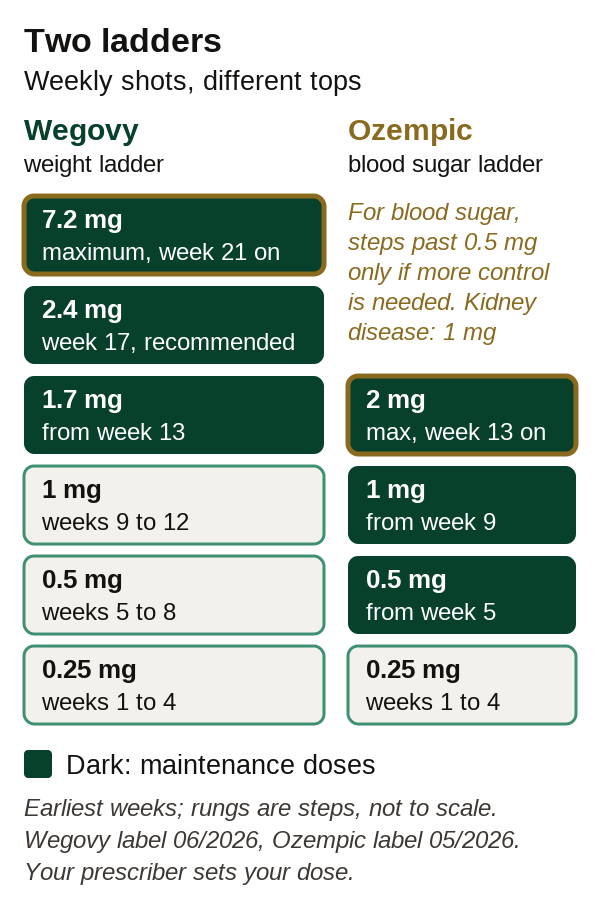
The short answerThe Wegovy and Ozempic weekly shots both start at 0.25 mg for 4 weeks, then 0.5 mg. Wegovy then climbs every 4 weeks, through 1 mg and 1.7 mg, to 1.7 mg or 2.4 mg from week 17, with up to 7.2 mg for some adults. For blood sugar, the Ozempic shot climbs past 0.5 mg only if more control is needed, to 2 mg; for kidney protection in chronic kidney disease, it moves to 1 mg.
This semaglutide dosage chart covers the weekly shots, using the June 2026 Wegovy label and the May 2026 Ozempic label, in milligrams (mg) only; daily tablets have their own ladders, noted below. Dr. Melanie Espinet prescribes weekly semaglutide for medical weight loss and sets each patient’s dose herself. MeliOra doesn’t publish a dosing schedule for its own medication, so ask her which medication you’d receive and how its dose is written.
This is general information, not medical advice. Took an extra dose, or have severe stomach pain or trouble breathing now? Get care now; warning signs are below.
Semaglutide dosage chart: the weekly Wegovy shot
A semaglutide dosage chart lists each weekly dose and when it starts. On the Wegovy label, the shot starts at 0.25 mg and rises every 4 weeks, through 0.5 mg, 1 mg, and 1.7 mg, to a maintenance dose from week 17.
Weeks; role on the label
Wegovy weekly dose
Weeks
Role on the label
0.25 mg
Weeks 1 to 4
Starting dose
0.5 mg
Weeks 5 to 8
Step
1 mg
Weeks 9 to 12
Step
1.7 mg
Weeks 13 to 16, and can continue
Step, then a maintenance option
2.4 mg
Week 17 onward
The recommended maintenance dose for weight in adults
7.2 mg
After at least 4 weeks on 2.4 mg, so week 21 at the earliest
The maximum, for adults who tolerate 2.4 mg and need more weight reduction
Ozempic dosage chart: the weekly shot’s blood sugar ladder
The Ozempic shot, for type 2 diabetes, shares Wegovy’s first two rungs, then changes the rule. After 0.5 mg, each blood sugar step happens only “if additional glycemic control is needed,” and only after at least 4 weeks on the current dose.
When; role on the label
Ozempic weekly dose
When
Role on the label
0.25 mg
Weeks 1 to 4
Starting dose
0.5 mg
From week 5
A maintenance dose
1 mg
After at least 4 weeks on 0.5 mg, if blood sugar needs more control
A maintenance dose, and the one set for type 2 diabetes with chronic kidney disease
2 mg
After at least 4 weeks on 1 mg, if blood sugar needs more control
The maximum
For the other differences between the brands, see Wegovy vs Ozempic.
Both ladders share their first two rungs; after that, Wegovy climbs on a calendar, and for blood sugar Ozempic climbs only when more control is needed.
Two ladders: why Ozempic and Wegovy climb to different tops
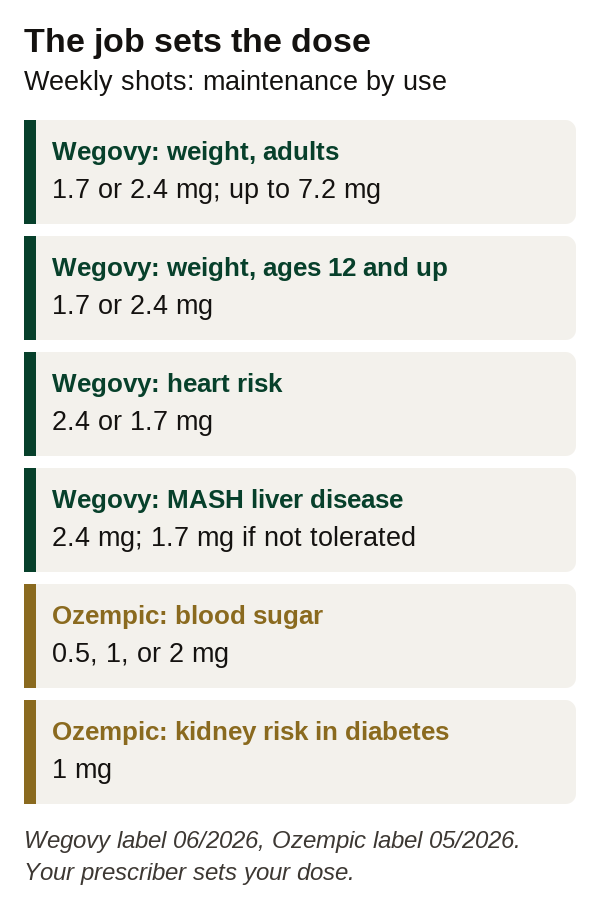
Two ladders is our editorial framework, built from the two labels and not a medical protocol: each ladder serves its own job, and the job sets the top.
The shared rungs are there for your stomach
Both weekly shots start at 0.25 mg for 4 weeks and climb in steps “to reduce the risk of gastrointestinal adverse reactions.” Their labels report stomach side effects clustering in the climb: on Ozempic, most nausea, vomiting, and diarrhea came during dose escalation, and Wegovy’s stomach reactions were reported most often then.
Ozempic’s ladder climbs when blood sugar asks
The Ozempic shot’s maintenance dose is 0.5 mg, 1 mg, or 2 mg, chosen “based on glycemic control.” The label backs its top step with a 40-week trial in 961 adults with type 2 diabetes that compared 2 mg with 1 mg on A1C, a blood sugar measure.
Wegovy’s ladder climbs on a calendar to a weight dose
The Wegovy shot’s schedule is a 16-week climb for every approved use, with room to wait 4 more weeks at a step that isn’t tolerated, ending at a maintenance dose that depends on the use. For weight in adults, that’s 1.7 mg or 2.4 mg (2.4 mg recommended), chosen by response and tolerability. Adults who tolerate 2.4 mg for at least 4 weeks and need more weight reduction may go up to 7.2 mg, studied in two 72-week trials.
Each labeled use of the shots has its own maintenance dose, so the milligram number alone tells you little.
What the two ladders mean for you
Read the brand and the use, not just the number: 1 mg is a step on Wegovy but can be a maintenance dose on Ozempic.
A brand switch isn’t a dose conversion; your prescriber picks the new dose.
The top rung is optional: both shots’ labels list more than one maintenance dose.
Climbing slows in real life, too: at one US obesity clinic, fewer than 1 in 4 semaglutide users ever received a 2.4 mg prescription, though 55% reached 2 mg (Ozempic’s top dose) or more.
That 2025 Vanderbilt study of 2,306 adults, funded by an NIH translational science award, didn’t record why people stopped climbing; its authors list how often doses must be adjusted, supply problems, side effects at higher doses, and staying on a dose that worked, and call missed steps a barrier to results. Want a physician to choose your rung? See how semaglutide weight loss in Lutz and Tampa works, or book a weight loss consultation.
Missed a semaglutide dose? The Wegovy and Ozempic rules
The shots’ missed-dose rules differ, and only Wegovy’s covers several missed weeks:
Situation
What the label says
Missed one Wegovy shot
Take it as soon as possible if your next dose is more than 2 days away; if it’s less than 2 days away, skip it and resume on your usual day
Missed 2 or more Wegovy shots in a row
Restart the climb at a lower dose to reduce stomach side effects; your prescriber chooses where
Missed one Ozempic shot
Take it as soon as possible within 5 days; after 5 days, skip it and take the next dose on your usual day
Changing your injection day
Ozempic: allowed if at least 2 days (more than 48 hours) separate two doses. The Wegovy Medication Guide: allowed if your last dose was 2 or more days before
At every rung, it’s one shot a week on the same day, any time, with or without meals. The Ozempic shot’s label recommends no dose adjustment for kidney or liver impairment; in the Wegovy trials, kidney problems were more common with past kidney impairment and during the climb, so fluids matter most then. Insulin or sulfonylurea doses may need lowering when semaglutide starts.
Daily tablets climb separate ladders whose numbers don’t line up with the shots: Wegovy tablets 1.5, 4, and 9 mg for 30 days each, then 25 mg; Ozempic tablets, for type 2 diabetes, 1.5 mg, then 4 mg, then 9 mg only if blood sugar needs more control. MeliOra doesn’t offer GLP-1 pills, including the Wegovy pill, Ozempic tablets, and Rybelsus; our Wegovy pill vs injection guide compares the forms.
Why this chart shows milligrams only
Every semaglutide label writes doses in milligrams. If your prescription isn’t one fixed dose per pen, get each dose in writing from your prescriber and pharmacist, not from a chart. A dose the labels don’t list is off-label; see our guide to doses below the label.
Who should be careful, and when to get help
Semaglutide isn’t for anyone with a personal or family history of medullary thyroid carcinoma or MEN 2, because of a boxed warning about thyroid tumors in rodents, or after a serious allergic reaction to it. No Wegovy or Ozempic label recommends it with severe gastroparesis. Tell your prescriber about pancreatitis, gallbladder or kidney disease, diabetic eye disease, insulin or a sulfonylurea, and planned surgery or sedation; see Ozempic before surgery.
Every Wegovy and Ozempic label says to stop semaglutide at least 2 months before a planned pregnancy. ACOG’s October 2026 advisory suggests considering a stop 1 to 2 months before conception for any GLP-1, advises against them during pregnancy, and recommends against them while breastfeeding a preterm baby or newborn. See our pregnancy planning guide.
When to see a professional instead of using a chart
A chart can’t tell you whether to step up, hold, or step down, so never change your dose on your own. Call your prescriber if side effects keep you from eating or drinking normally, you’ve missed two or more weeks, your dose plan came from a seller or a social post, or you can’t tell what dose you take. Sorted from most to least urgent, these rows match our semaglutide side effects guide, plus emergency steps:
Warning sign
What it can mean and what to do
Swelling of the face, lips, tongue, or throat, trouble breathing or swallowing, severe rash or itching, fainting or feeling dizzy, or a very rapid heartbeat
A serious allergic reaction. Stop the medication and get medical help right away. Call 911 if breathing or swallowing is hard
Low blood sugar you can’t treat yourself, passing out, or a seizure, if you take insulin or a sulfonylurea
Someone should call 911
Sudden, painless vision loss in one eye (sometimes noticed on waking), blurred or missing patches of vision, faded or distorted colors, a new blurry or hazy spot, or eyesight that gets worse quickly
Call 911 or go to an emergency room now, and don’t drive yourself. On November 9, 2026, the FDA warned of a possible increased risk of NAION, a rare optic nerve problem, with GLP-1 medicines
Severe stomach pain that will not go away, sometimes reaching the back, with or without vomiting
Possible pancreatitis. Stop semaglutide and call your provider right away; if you can’t reach them quickly, go to an emergency room, not urgent care
Pain in the upper stomach, fever, yellow skin or eyes, or clay-colored stools
Possible gallbladder problems. Gallstones were reported in 1.6% on Wegovy injection vs 0.7% on placebo. Call your provider right away; if you can’t reach them quickly, go to an emergency room, not urgent care
Nausea, vomiting, or diarrhea that will not go away, or not being able to keep fluids down
Dehydration, which can lead to kidney problems. Drink fluids and call your provider right away. Severe dehydration is an emergency: go to the emergency room now if you can’t keep fluids down, are barely urinating, your urine is very dark, you feel dizzy or lightheaded, or your heart is racing. Call 911 if you become confused or pass out. If you have kidney disease, call at the first sign
You took too much, or took two doses close together
Call your prescriber or Poison Help at 1-800-222-1222, or go to an emergency room right away
A lump or swelling in the neck, hoarseness, trouble swallowing, or shortness of breath
Possible thyroid tumor, the risk behind the label’s boxed warning
Shakiness, sweating, confusion, or a fast heartbeat in someone with diabetes
Low blood sugar
Heart racing or pounding at rest for several minutes
Increased heart rate, which the label says to report
Vision changes in someone with type 2 diabetes
Possible worsening of diabetic eye disease
No table covers everything. If something feels wrong, call your prescriber, and tell any emergency team you take semaglutide, your dose, and your last shot’s date. Our guide to Ozempic vision loss and NAION explains the FDA’s new warning.
How MeliOra fits: a physician sets your semaglutide dose
Dr. Melanie Espinet, a board-certified family medicine physician in Lutz, sets and adjusts each semaglutide dose herself. She screens for eating disorders before prescribing, and if support from a dietitian or therapist would help, she discusses it at your consultation.
Semaglutide at MeliOra starts at $150/month, or $240/month at higher dosing. Each price includes in-home physician visits, lab work, the medication and supplies, and dose adjustments and check-ins, with no consultation fee.
Dr. Espinet makes house calls across Hillsborough, Pasco, and Pinellas counties with no travel fee, and sees select appointments at the Lutz office. At any house call, including ours, ask how the product was stored on the way and what the plan is for a serious reaction. Anywhere in Florida, you can choose telehealth weight loss instead: video visits replace in-home visits, the medication ships to your home, and the monthly price is the same.
Frequently asked questions about the semaglutide dosage chart
What is the starting dose of semaglutide?
Both the Wegovy and Ozempic weekly shots start semaglutide at 0.25 mg once a week for 4 weeks, then move to 0.5 mg. The slow start is there to reduce stomach side effects such as nausea, vomiting, and diarrhea. Wegovy and Ozempic tablets start differently, at 1.5 mg a day.
What is the max dose of Wegovy?
The maximum dose of the Wegovy shot is 7.2 mg once a week, for adults who have tolerated 2.4 mg for at least 4 weeks and need more weight reduction. For weight in adults, the recommended maintenance dose is 2.4 mg, or 1.7 mg.
What is the highest dose of Ozempic?
The highest dose of the Ozempic shot is 2 mg once a week. Its label allows it only after at least 4 weeks on 1 mg, and only if blood sugar needs more control. Ozempic tablets, a separate daily form for type 2 diabetes, top out at 9 mg a day.
Is 1 mg of Ozempic the same as 1 mg of Wegovy?
It’s the same amount of the same medicine in a different role. On Wegovy, 1 mg is a 4-week step toward maintenance; on the Ozempic shot, it can be a maintenance dose. No Wegovy or Ozempic label gives a dose exchange between the two brands, so a switch is your prescriber’s call.
What happens if you miss two weeks of Wegovy?
The Wegovy label says that after 2 or more missed doses in a row, the climb restarts at a lower dose to reduce stomach side effects. Call your prescriber before your next shot, and say how many doses you missed, rather than resuming your old dose.