The short answerBotox usually hurts a little: a pinch or sting at each injection point. The FDA labels for Jeuveau and Xeomin, our Botox brands, name a 30 to 33 gauge needle, thinner than the 22 to 25 gauge needles the CDC lists for vaccines in the arm. In studies, people rated upper-face injections about 3 to 6 out of 10 on average.
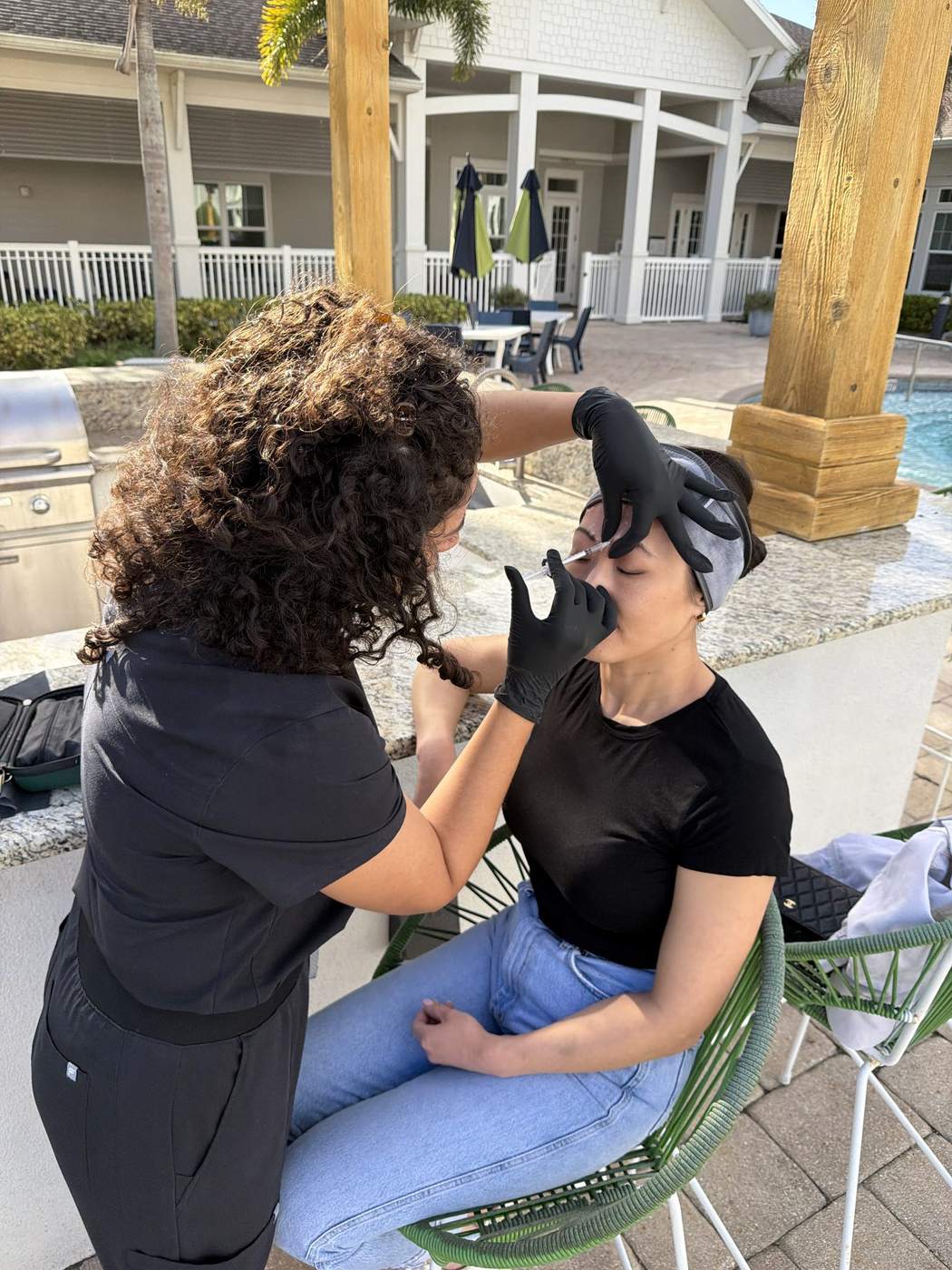
Does Botox hurt? A little, and briefly. Cleveland Clinic says some people describe a slight pinching or stinging, and that the procedure is over quickly. At MeliOra Elite Wellness, Botox means Jeuveau or Xeomin at $12/unit, given by Dr. Melanie Espinet at house calls across Hillsborough, Pasco, and Pinellas counties with no travel fee. This guide puts numbers on the pinch: the needle, the injection points, what studies found for numbing cream, ice, and vibration, and which pain afterward needs help. For every area and price, see Botox in Lutz, FL. Skin-level micro Botox is a different technique, with many tiny droplets placed in the skin.
How painful is Botox? What studies measured
Online answers often say Botox is a 1 or 2 out of 10. Research that asked people to score their injections tells a more useful story. These are average scores from four trials, on the side with no comfort aid:
Study
Average pain, out of 10
Frown lines, 22 patients (2019)
About 2.9, and ice or vibration made no significant difference
Forehead and frown lines, 20 women (2015)
3.4 with a 32-gauge needle, 4.2 with a 30-gauge needle
Upper face, 100 women (2026)
5.5 to 6.0 on the placebo side, in the groups testing numbing cream or vibration
Jaw muscle (masseter), 216 patients (2025)
4.7 on the side treated without vibration
So the honest range is about 3 to 6 out of 10, and Cleveland Clinic notes the procedure is over quickly. Averages also hide a wide spread: in the 2015 trial, 8 of 20 women rated the 30-gauge side as clinically significant pain, while the rest rated it lower. Expect a real pinch, not nothing, and know that it is brief.
Why some numbers make Botox sound painless
Side-effect reports measure something different from the pinch. In Xeomin’s two placebo-controlled upper-face trials, only 0.6% of people treated reported injection-site discomfort as a side effect. That is a count of discomfort recorded as a side effect, not a score of how each injection felt. Both numbers can be true at once.
How big is the Botox needle?
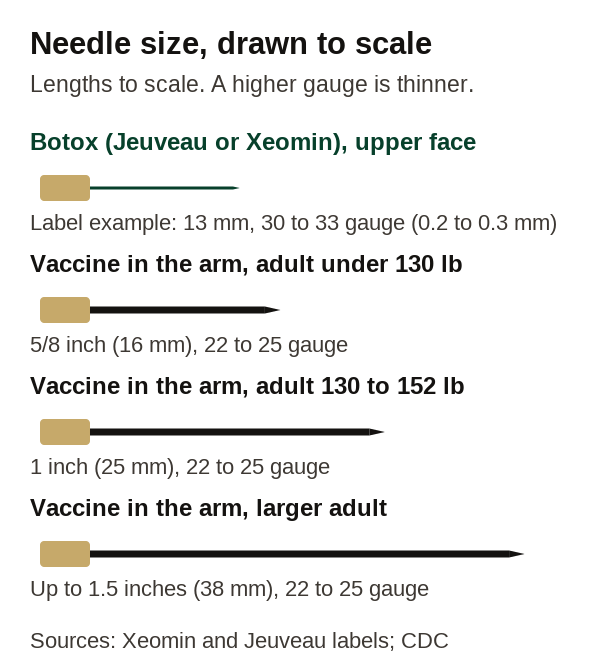
The Botox needle for facial lines is 30 to 33 gauge on both the Jeuveau and Xeomin labels, and the Xeomin label’s example needle is 13 mm long, about half an inch. A higher gauge number means a thinner needle.
For comparison, CDC guidance for vaccines given into the arm muscle, such as a flu shot, uses 22 to 25 gauge needles. For adults, those are 5/8 inch to 1.5 inches long, depending on body weight. The Botox needle for facial lines is thinner and shorter than any of them.
The Xeomin label’s example needle for facial lines is shorter and thinner than any adult vaccine needle in CDC guidance.
Does a thinner Botox needle hurt less?
A little, for some people. In the 2015 split-face trial, average pain wasn’t significantly different between 30-gauge and 32-gauge needles. But clinically significant pain was more common on the 30-gauge side, 8 of 20 women versus 3 of 20. Both labels name the 30 to 33 gauge range, so if you feel injections strongly, ask about needle size at your visit.
Which Botox area hurts the most?
We found no study that compares Botox pain area by area, and clinic blogs disagree: some rank the frown lines as the most painful area, others as the least. What research does link to more pain is more injection points and higher doses, in the 216-patient jaw trial above. So the useful number is how many points your plan needs.
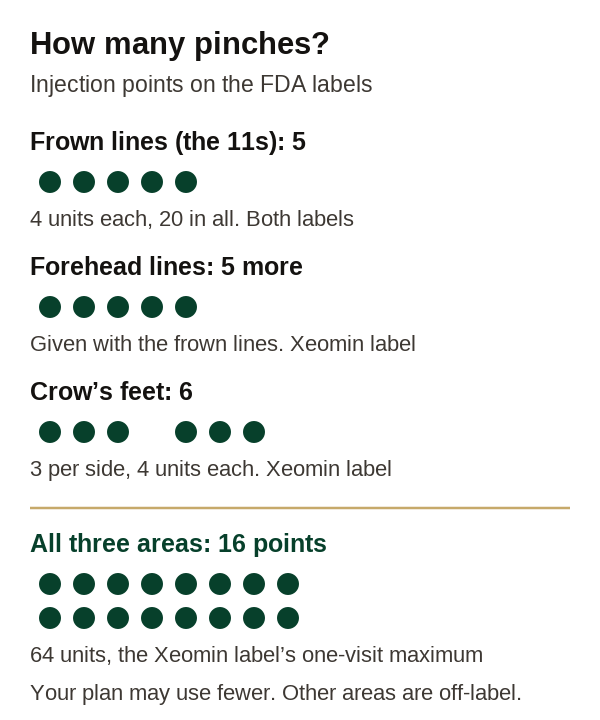
On the Xeomin label, the full upper face is 16 injection points of 4 units each. The Jeuveau label covers the frown lines only, at the same 5 points.
Jaw (masseter), brow-lift, and bunny-line treatments aren’t on either label, so your physician sets the points from an exam. For the units each area usually takes, see how many units of Botox you need.
The Pinch Plan: Count, Cool, Calm
The Pinch Plan is our editorial checklist for a calmer first visit: three questions to settle before the first injection. It organizes the label facts and studies above. It isn’t a clinical protocol.
1. Count: know your number
Ask for your plan before anything begins: which areas, how many units, and about how many injection points. Frown lines alone are 5 points on both labels. Units also set your price: at $12/unit, the 20 units both labels list for frown lines come to $240. Daxxify, a brand we don’t carry, uses the same 5 frown-line points but lists 40 units on its own scale; see Daxxify vs Botox.
2. Cool: Botox numbing cream, ice, and vibration
Each comfort aid has been tested, mostly in small studies. Here is what they found:
Comfort aid
What studies found
Numbing cream or gel
In the 100-woman trial, 4.7 out of 10 with numbing cream versus 5.5 with a placebo. Women who tried both cream and vibration preferred the cream for next time
Ice or a cold pack
A 2025 review found cooling lowered pain compared with nothing. In the 2019 frown-line trial, ice, vibration, and nothing scored about the same
Vibration device
In a 50-patient trial, 1.3 versus 2.4 on a 5-point scale, and 86% wanted vibration again. Five had brief tingling teeth, bruising, or headache. In the 100-woman trial, numbing cream beat vibration
The pattern: in the trials scored out of 10, the aids took about 1 point off, and nearly 2 in the jaw trial. None made Botox painless, and none is clearly best. The 2025 review of 14 studies rated the evidence low to moderate quality. You may also read online that “bacteriostatic saline” stings less. A 2002 trial of 15 people, using an older botulinum toxin product, found saline with a preservative hurt less, but the Jeuveau and Xeomin labels say to mix them only with preservative-free saline. If you want a comfort option, tell Dr. Espinet before your first injection, and she’ll walk you through what’s available at your visit.
Skip strong numbing creams at home
Don’t put on a numbing product at home unless your physician says to. The FDA warns consumers not to use over-the-counter pain relief products with more than 4% lidocaine on their skin, not to apply them heavily over large areas or on irritated skin, and not to wrap the treated skin. Used that way, high-strength lidocaine may cause serious injury, such as an irregular heartbeat, seizures, and breathing trouble.
3. Calm: needle nerves and fainting
Nerves are real, and the Jeuveau label takes them seriously: needle-related pain or anxiety can cause a vasovagal response, including fainting and a drop in blood pressure, which may need treatment. If you’ve ever fainted or felt woozy with a shot or a blood draw, tell Dr. Espinet before the first injection so she can plan for it.
The talk before the first injection is the time to mention needle nerves or a past faint.
Feeling faint can have another cause. The Xeomin Medication Guide lists dizziness or feeling faint among the signs of an allergic reaction, along with itching, rash, redness, swelling, wheezing, or trouble breathing. Tell the physician right away if you feel faint, and call 911 for wheezing or trouble breathing.
Nervous about the needle?Book a Botox visit and tell Dr. Espinet up front. She’ll confirm your areas, units, and total at $12/unit before anything begins.
The next-step hurdle: does Botox hurt afterward?
Botox can leave the area tender afterward, but the pinch itself ends with the injection. The AAD says the injections, rather than the toxin, cause most mild side effects, such as swelling, redness, soreness, or a bruise that lasts about a week. The Jeuveau label adds that most side effects appear in the first week and are generally temporary, though some can last several months or longer.
Headaches happen too, though not always from the toxin: in Jeuveau’s trials, 12% of people treated and 13% on placebo got one. In Xeomin’s frown-line trials, it was 5% versus 2%. For the full data, see Botox side effects, and for what to do in the first 24 hours, see our Botox aftercare guide.
When pain after Botox is a warning sign
If you notice
What to do
Trouble swallowing, speaking, or breathing, or weakness all over the body
Call 911 or get emergency care right away. The labels warn these can appear hours to weeks after treatment
Wheezing, swelling of your face, eyes, or tongue, or feeling faint with a rash or itching
This could be a severe allergic reaction. Call 911 right away
Chest pain or pressure, or a racing or irregular heartbeat
Call 911 right away, and don’t drive yourself. The Jeuveau label and Allergan’s Botox Cosmetic label report irregular heartbeats and heart attacks after botulinum toxin products, some fatal
A sudden, severe headache, the worst headache you’ve had, or a headache with vision changes, weakness, or trouble speaking, swallowing, or breathing
Call 911 or get emergency care right away
Hoarseness, a change in your voice, or loss of bladder control
Get medical care right away. The labels list these among the signs of toxin spread
Eye pain or sudden vision changes, including double or blurred vision
Go to the emergency room or an eye doctor right away, and don’t drive yourself. Call 911 if you suddenly lose vision
An eye that feels dry, irritated, or gritty, is sensitive to light, or won’t close fully
Get medical care right away. The Jeuveau label notes toxins can reduce tears and blinking, and the Xeomin label says reduced blinking can injure the eye’s surface
Fainting or feeling faint
During treatment, tell the physician right away. After your visit, get medical help right away, and call 911 if you pass out or also have wheezing, swelling, a rash, or trouble breathing
Redness, warmth, or swelling where you were treated that spreads or worsens, or pus or a fever
Call your injector or doctor today. The Jeuveau label lists infection among the effects an injection can cause
Tenderness, small bumps, a small bruise, or a mild headache
Usually normal and temporary. Ask Dr. Espinet which pain reliever suits you, since some can make bruising more likely, and call her if a headache is severe or keeps getting worse
For a drooping eyelid or brow and every warning sign on the labels, see the full table in our Botox side effects guide.
Who should wait or tell the physician first
Both labels say not to treat anyone who has had an allergic reaction to any botulinum toxin product, or anyone with an infection where they’d be injected. Treatment should also wait during pregnancy or breastfeeding. Tell Dr. Espinet first if you have a muscle or nerve condition, trouble breathing or swallowing, asthma or emphysema, or heart disease, take blood thinners or aspirin, or have ever fainted with needles. The Xeomin Medication Guide says people who already have swallowing or breathing problems have the highest risk of serious ones. Our guide to what to avoid before Botox lists the medicines and conditions the labels ask about.
This guide is general information, not medical advice. Ask your own physician about your health and any treatment.
Botox at MeliOra: what to expect at your visit
Dr. Melanie Espinet, a board-certified family physician, performs every Botox treatment herself, with Jeuveau or Xeomin at $12/unit. She reviews your health history, confirms your areas, units, and total before beginning, and doses conservatively for a rested look. Ask her about needle size or a comfort option at your visit.
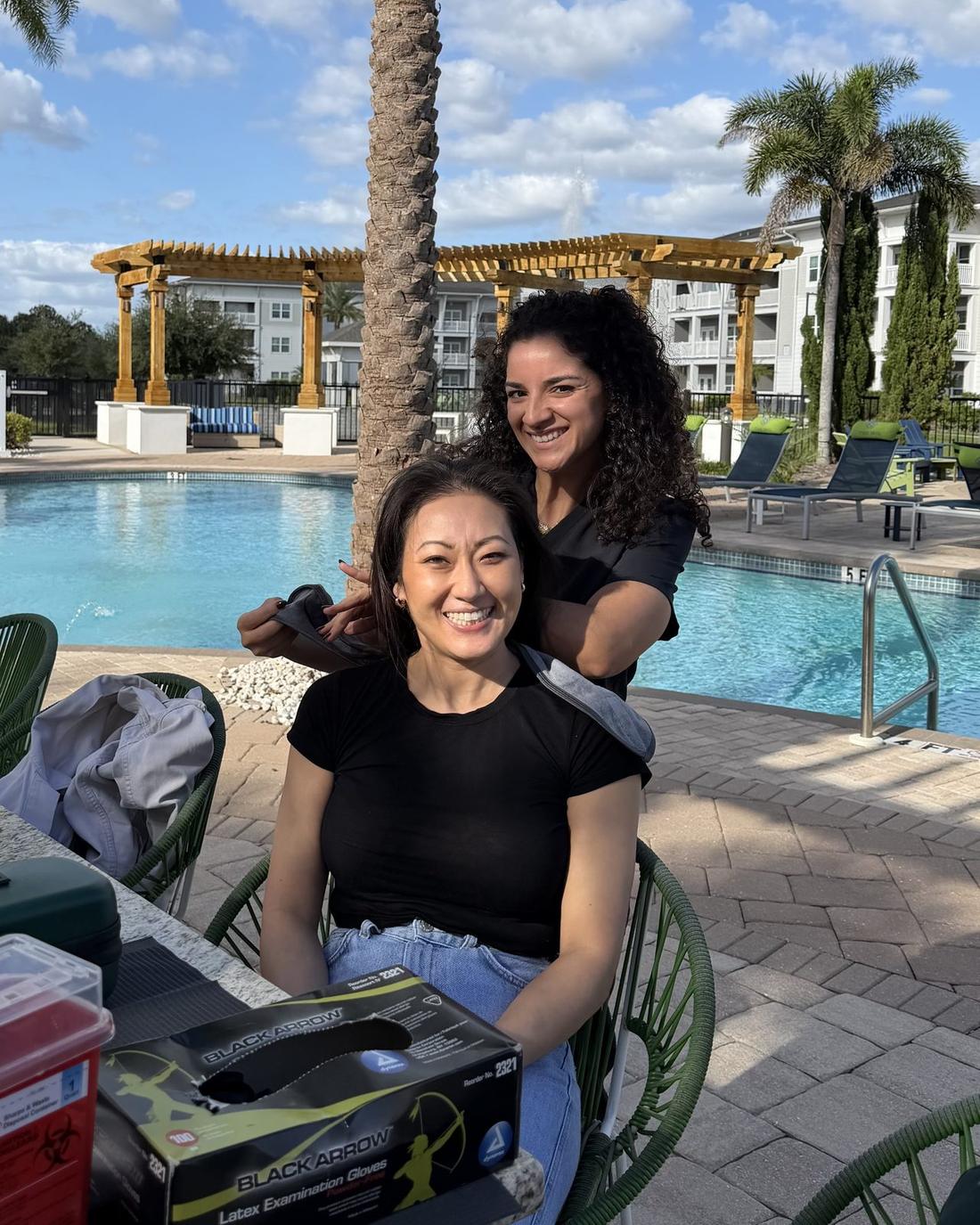
House calls cover Hillsborough, Pasco, and Pinellas counties across Tampa Bay with no travel fee, and select appointments are available at the Lutz office. At any house call, including ours, ask how the product was stored on the way and what the plan is for a serious reaction. To choose a brand, see Jeuveau vs Xeomin, and for when results show, see how long Botox takes to work.
Frequently asked questions about whether Botox hurts
Does Botox hurt the first time?
A little, and briefly. In studies, people rated upper-face Botox injections about 3 to 6 out of 10 on average. Before your first visit, tell your physician if you’ve ever fainted with needles, and ask how many injection points your plan needs so you know what to expect.
What does Botox feel like?
Botox feels like a slight pinch or sting at each injection point, and Cleveland Clinic says the discomfort is usually mild and over quickly. Afterward, you may notice swelling, soreness, or redness, or a small bruise, which the American Academy of Dermatology says lasts about a week.
Do you need numbing cream for Botox?
Numbing cream for Botox is optional, but it can take the edge off. In a 2026 trial of 100 women, average pain was 4.7 out of 10 with numbing cream versus 5.5 with a placebo. Don’t put any numbing product on at home unless your physician says to, since the FDA warns that high-strength lidocaine can cause serious harm.
How big is a Botox needle?
A Botox needle is 30 to 33 gauge on the Jeuveau and Xeomin labels, and the Xeomin label’s example for facial lines is 13 mm long. That is thinner and shorter than the 22 to 25 gauge, 5/8 inch to 1.5 inch needles the CDC lists for adult vaccines in the arm.
What is the most painful area for Botox?
We found no study that compares Botox pain area by area, and clinics disagree. One 216-patient jaw trial linked more injection points and higher doses to more pain. On the Xeomin label, frown lines take 5 points, forehead lines 5 more, and crow’s feet 6, so ask how many points your plan needs.
Does Botox hurt the next day?
Usually only mildly. The next day, some people have tenderness, swelling, or a bruise, and some get a headache. Pain that keeps getting worse, spreading redness, or a fever needs a call to your physician that day, and trouble swallowing, speaking, or breathing needs 911.
Can you pass out from Botox?
It can happen, usually from needle nerves rather than the toxin. The Jeuveau label says needle pain or anxiety can cause fainting and a drop in blood pressure. Tell your physician beforehand if you faint with shots, and call 911 if faintness comes with wheezing, swelling, or trouble breathing.
Ready for Botox without guessing about the pinch?
The pinch is real, brief, and easier to manage when you know your number of injection points and what to ask for. Book your Botox visit with Dr. Espinet. She’ll confirm your plan and your total at $12/unit before the first injection, at your home or the Lutz office.