The short answerDysport and Botox Cosmetic are both FDA-approved botulinum toxin type A injections that relax the muscles behind expression lines. They use different unit scales: the labels list 50 units of Dysport and 20 units of Botox Cosmetic for frown lines.
Most Dysport vs Botox comparisons repeat three claims: Dysport takes three units to match one of Botox, works faster, and spreads more. None appears on either FDA label, so this guide compares all four labels line by line.
MeliOra Elite Wellness carries neither brand. We carry two of their competitors, Jeuveau and Xeomin, so read this comparison with that in mind. Here, “Botox” means the Botox Cosmetic brand. Elsewhere on our site it’s the everyday word for the wrinkle relaxers we offer: Botox in Lutz, FL with Jeuveau or Xeomin. Salon hair Botox borrows the word too, but it contains no botulinum toxin.
Dysport vs Botox at a glance
Dysport vs Botox comes down to what each FDA label says. Here are the Dysport and Botox Cosmetic labels side by side, with Xeomin and Jeuveau added because they’re the brands we carry. For the two newest brands, see Daxxify vs Botox and Letybo vs Botox.
Dysport, Botox Cosmetic, Xeomin, and Jeuveau
What the label says
Dysport
Botox Cosmetic
Xeomin
Jeuveau
FDA-approved cosmetic areas
Frown lines, in adults under 65
Frown lines, crow’s feet, forehead lines, and neck bands
Frown lines, forehead lines, and crow’s feet
Frown lines
Label dose for frown lines
50 units
20 units
20 units
20 units
Onset stated on the label (wording differs)
Not stated
Begins in 1 to 2 days and builds over the first week
Median of 2 to 7 days, across all its uses
Not stated
How long it lasts for frown lines, per the label
Up to four months
About 3 to 4 months
Up to 12 to 16 weeks, across all its uses
Not stated
Extra allergy warning
Cow’s milk protein
None
None
None
At MeliOra
Not offered
Not offered
$12/unit
$12/unit
All four also contain human albumin. For the rest of the ingredient list, see what Botox is made of.
What is Dysport?
Dysport (abobotulinumtoxinA) is a prescription botulinum toxin type A injection made by Ipsen and distributed in the U.S. with Galderma. The FDA approved it in 2009. Its one cosmetic use is frown lines between the brows in adults under 65.
Dysport units vs Botox units: why 50 and 20 can’t be compared
Dysport units and Botox units aren’t the same measurement. Each maker tests potency its own way, and all four labels say their units can’t be compared with or converted into units of any other botulinum toxin product.
The 3 to 1 ratio isn’t on any label
You’ll see Dysport described as needing 2.5 or 3 units for every unit of Botox. Those ratios come from physician consensus papers, not the FDA. A 2016 comparison of nine consensus guidelines notes that most international guidance supports about 2.5 to 1, found the ratio shifted by facial area, and put the U.S. average at 2.8 to 1.
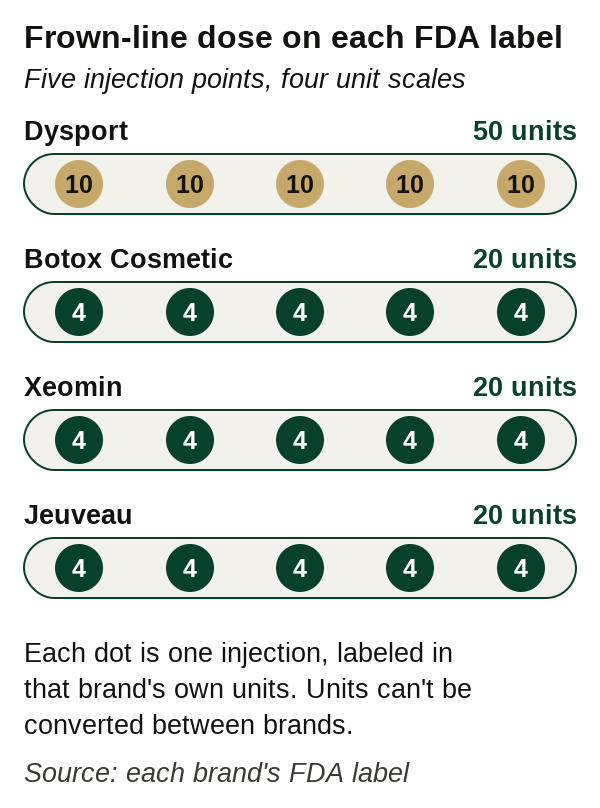
The labels give only each brand’s own dose. For frown lines that’s 50 units of Dysport, or 20 units of Botox Cosmetic, Xeomin, or Jeuveau, each split across five injection points. Fifty Dysport units can’t be called more or less than 20 units of another brand. Each number is that brand’s own label dose, on its own ruler.
Fifty units of Dysport and 20 units of the other three brands are each brand’s own label dose for the same five points.
Is Dysport cheaper than Botox? Compare the area price
Per-unit prices can’t be compared, because a Dysport unit is priced for a 50-unit dose and a Botox unit for 20. Compare the area price instead: the units your injector plans for the area, times the price per unit.
Dysport for frown lines: 50 units times the Dysport price
Botox Cosmetic, Xeomin, or Jeuveau: 20 units times that brand’s price
Break-even: a Dysport unit at 40% of the other brand’s unit price
At MeliOra, Botox with Jeuveau or Xeomin is $12/unit, so the 20-unit label dose for frown lines is $240. A Dysport quote for the 50-unit label dose comes to the same $240 at $4.80 per unit ($240 divided by 50). That’s label arithmetic, not a dosing conversion or a price from any Dysport clinic. For more, see how many units of Botox you need and what Botox costs in Lutz.
The Four A Check: a fairer way to compare Dysport and Botox
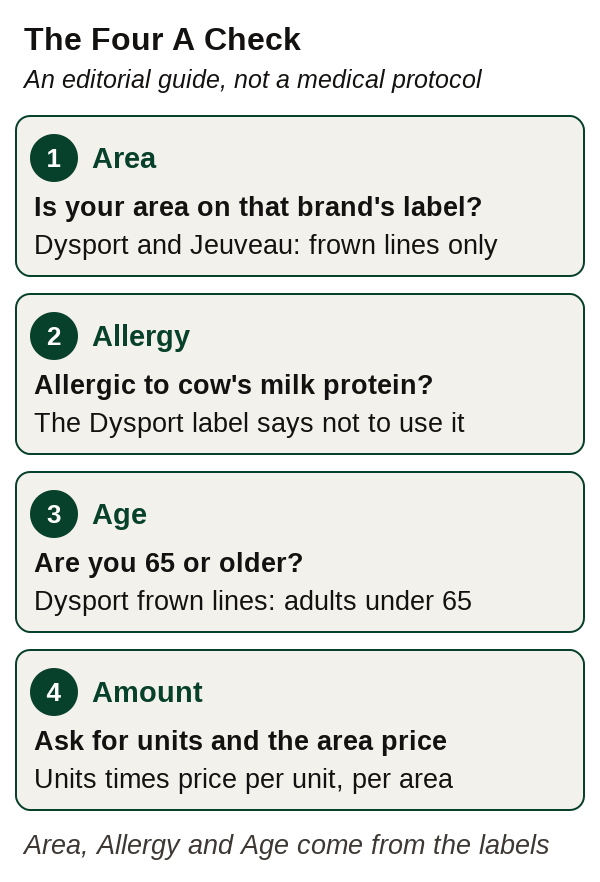
Because units and trial percentages don’t transfer between brands, we compare them with four questions: Area, Allergy, Age, and Amount. This is our editorial guide for readers, not a medical protocol. Each answer comes from the labels.
1. Area: is your treatment area on that brand’s label?
Botox Cosmetic: frown lines, crow’s feet, forehead lines, and platysma bands in the neck
Xeomin: frown lines, forehead lines, and crow’s feet
Dysport: frown lines only
Jeuveau: frown lines only
What off-label means for you
Off-label means that brand’s FDA label doesn’t include the area. Physicians use botulinum toxin off-label often, and you should hear it before treatment, with the planned dose and the risks.
2. Allergy: Dysport and cow’s milk protein
The Dysport label says not to use it if you’re allergic to cow’s milk protein. Dysport contains lactose and may contain trace amounts of that protein. The label names cow’s milk protein allergy and does not mention lactose intolerance. If you have either, tell your physician before choosing Dysport.
The other three labels have no such line. All four contain human albumin, a protein derived from human blood, and none should be used if you’re allergic to any botulinum toxin product.
3. Age: Dysport’s cosmetic approval stops at 65
Dysport is approved for frown lines in adults under 65. Its trials included only eight people 65 or older, and none of the four who received Dysport met the success target at day 30. The Botox Cosmetic label has no age cutoff but notes that response appeared lower at 65 and older. The Jeuveau and Xeomin labels have no age cutoff either, but both say their trials included too few people 65 and older to tell whether they respond differently.
4. Amount: ask for units and the area price
Ask for the brand, the units per area, and the total. Units can’t be converted, but that record helps plan your next visit anywhere. To see what a low advertised price can hide, read cheap Botox.
Four label questions to ask before choosing Dysport, Botox Cosmetic, Xeomin, or Jeuveau.
Had Dysport or Botox before, and wondering what we’d use?Book a Botox visit. Dr. Melanie Espinet reviews your past brand, units, and areas, then confirms your Jeuveau or Xeomin plan at $12/unit before anything begins. First, read who should skip these treatments, below.
Does Dysport work faster or last longer than Botox?
Neither label shows that Dysport works faster or lasts longer than Botox. In the two trials here that measured onset, Dysport started slightly sooner. On how long each lasts, the trials disagree.
How long does Dysport take to work?
The Dysport label states no onset time for frown lines. The Botox Cosmetic label says the muscle effect typically begins one to two days after injection and builds through the first week, and the Xeomin label gives a median of 2 to 7 days across all its approved uses, not frown lines alone.
In an 85-person split-face trial, Dysport began working about half a day sooner on average in the frown area, by patients’ own reports; the study was self-funded, and its lead author was a paid trainer for Dysport’s U.S. distributor at the time. A 2025 trial of 143 women in JAMA Dermatology, funded by Jeuveau’s maker, measured four brands with a 3D camera: Dysport was among the quickest at the day 3 check, and peak effect was similar across all four. For when to judge your own result, see our Botox onset timeline.
How long does Dysport last?
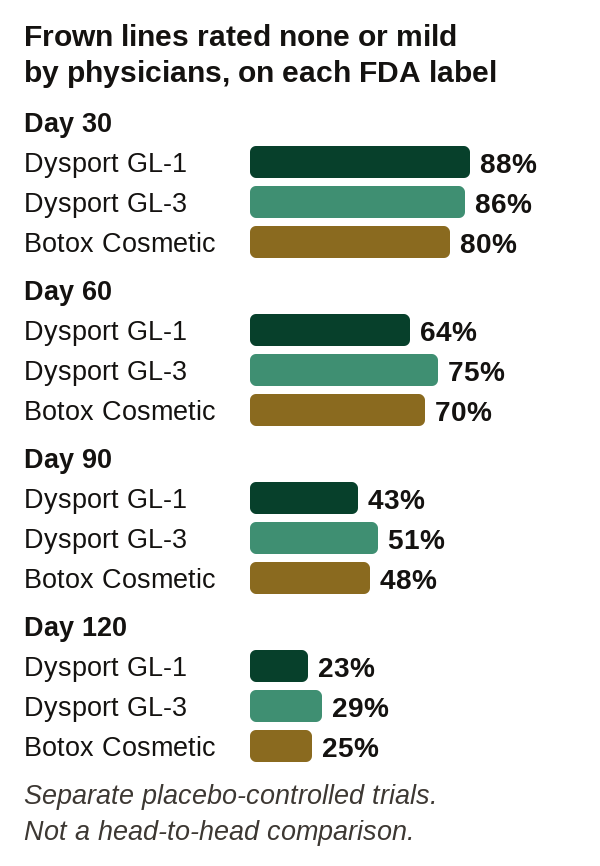
The Dysport label says the effect may last up to four months, and the Botox Cosmetic label says approximately three to four months. Both labels report the same measure over time: the share of people whose frown lines physicians rated none or mild at full frown. The Dysport figures are from two of its three label trials, GL-1 and GL-3.
Rated none or mild at full frown
Days after treatment
Dysport GL-1
Dysport GL-3
Botox Cosmetic
Day 30
88%
86%
80%
Day 60
64%
75%
70%
Day 90
43%
51%
48%
Day 120
23%
29%
25%
From day 60 on, the Botox figure sits between the two Dysport trials. These are separate placebo-controlled trials, so they can’t rank the brands, but they show how alike the fade looks.
From day 60 on, the Botox Cosmetic figure sits between the two Dysport trials on the same physician-rated measure.
Head-to-head trials don’t agree. A 62-person trial found Botox held longer. The 85-person trial and a 20-person split-forehead trial found Dysport did. A 53-person split-face trial run without company funding found no significant difference. A Cochrane review found one trial comparing the two for success at four weeks (388 people) and saw no difference. Eyelid drooping and similar eye side effects were probably more likely with Dysport, though the estimate was too imprecise to rule out no difference, and side effects overall were probably no different. See also how long Botox lasts.
Does Dysport spread more?
You’ll often read that Dysport spreads further. A 2018 review in Dermatologic Surgery, funded by Galderma, which distributes Dysport in the U.S., concluded that spread depends mostly on dose, not brand. Independent studies that settle it either way are scarce. All four labels carry the same boxed warning about spread beyond the injection site. See does Botox migrate.
Dysport vs Xeomin and Dysport vs Jeuveau
Dysport vs Xeomin and Dysport vs Jeuveau are the comparisons that matter at MeliOra, because those are the two Botox brands we carry. No trial on any of these labels compares one brand with another.
Dysport vs Xeomin
Xeomin’s label covers three cosmetic areas, frown lines, forehead lines, and crow’s feet, to Dysport’s one. Of these four brands, Xeomin is the one whose label describes the toxin as separated from accessory proteins. It uses sucrose instead of lactose, and unopened vials don’t need refrigeration. The label claims no clinical advantage from any of these.
Dysport vs Jeuveau
Both labels list one cosmetic area, frown lines, at 20 units of Jeuveau or 50 of Dysport. Jeuveau’s label has no milk protein warning and no under-65 limit, though it notes too few people 65 and older were studied to tell whether they respond differently. Jeuveau is cosmetic only, while Dysport is also approved for cervical dystonia and spasticity.
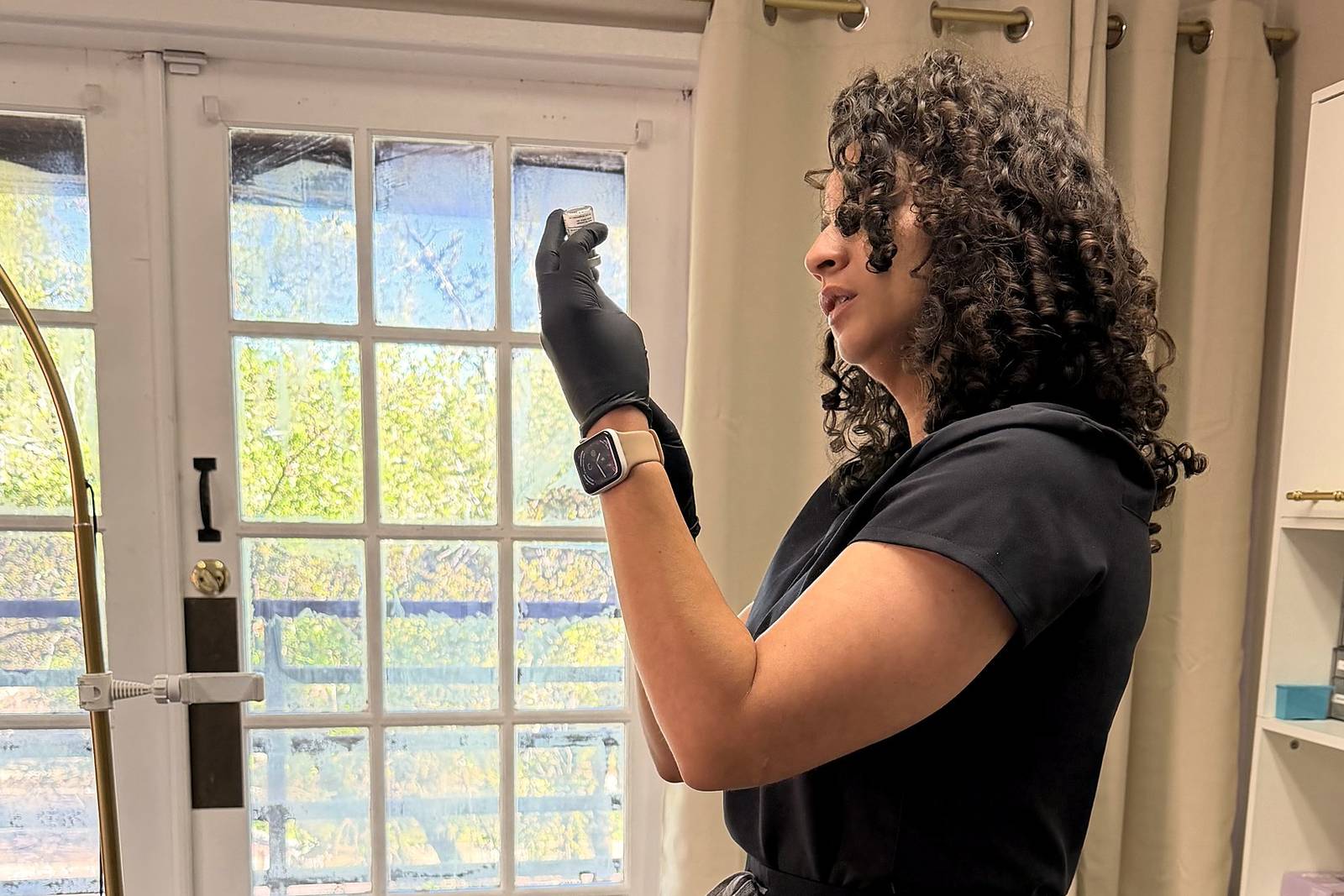
Dr. Espinet holding a vial up to the light. At MeliOra, the choice is between Jeuveau and Xeomin.
Switching from Dysport to Botox brands: what happens to your dose
Once you’ve compared the brands, the next problem is the switch. Your Dysport number won’t carry over, because the labels rule out converting units, but your history still matters. If you’ve had Dysport or Botox Cosmetic elsewhere, Dr. Espinet reviews your prior units and areas at the consultation to plan your Jeuveau or Xeomin dose.
What to bring to your first visit
The product name and the date of your last treatment
The units used in each area
How many weeks the result lasted
Anything you didn’t like, such as a heavy brow
Your allergies, health conditions, and medications
When to switch
No label sets a waiting time for switching brands. The Dysport, Xeomin, and Jeuveau labels set three months as the minimum between treatments with the same brand, and the labels caution that the effect of giving different toxins within several months of each other is unknown. All four Medication Guides say to tell your provider about any botulinum toxin you’ve had in the last four months, so bring the date. If a brand seems to have stopped working, read Botox resistance before assuming a new brand is the fix.
Who should skip Dysport or Botox, and when to get medical care
Dysport, Botox Cosmetic, Xeomin, and Jeuveau share one boxed warning. The effect can spread beyond the injection site, hours to weeks later, and swallowing or breathing problems can be life threatening, with deaths reported. Before any of them, tell your physician about all your health conditions and medicines, including if:
You’re allergic to any botulinum toxin product or its ingredients, or to cow’s milk protein (Dysport)
You have a nerve or muscle disease such as ALS, myasthenia gravis, or Lambert-Eaton syndrome
You have trouble swallowing or breathing
You’re pregnant, planning a pregnancy, or breastfeeding. The Medication Guides say it isn’t known whether these products can harm an unborn baby or pass into breast milk
You take aminoglycoside antibiotics, muscle relaxants, or anticholinergic medicines
You have a skin infection where you’d be treated
You’ve had any botulinum toxin in the last four months, and which brand
You have drooping eyelids, weak forehead muscles, past facial surgery, bleeding problems, or surgery planned
This page can’t diagnose a reaction. If something feels wrong after any brand, use this table, which matches our Botox side effects guide; on this page, the heart and eye rows name the labels that carry those warnings.
If you notice
What to do
Trouble swallowing, speaking, or breathing
Call 911 or get emergency care right away
Weakness all over the body
Call 911 or get emergency care right away
Double vision or blurred vision
Go to the emergency room or see a health care provider right away. Don’t wait, and don’t drive yourself
Hoarseness, a change in your voice, or loss of bladder control
Get medical care right away
Wheezing, swelling of your face, eyes, or tongue, or feeling faint
This could be a severe allergic reaction. Call 911 right away
Chest pain or pressure, or a racing or irregular heartbeat
Call 911 right away, and don’t drive yourself. The Botox Cosmetic and Jeuveau labels report irregular heartbeats and heart attacks after toxin treatment, some fatal
Hives, itching, or a rash with no trouble breathing
A possible allergic reaction. Get medical help right away, and call 911 if it gets worse
Eye pain or sudden vision changes
Go to the emergency room or an eye doctor right away, and don’t drive yourself. Call 911 if you suddenly lose vision
An eye that feels dry, irritated, or gritty, is sensitive to light, or won’t close fully
Get medical care right away. The Dysport and Jeuveau labels note toxins can reduce tears and blinking, and the Xeomin label says reduced blinking can injure the eye’s surface
A droop, blurred vision, slurred speech, dry mouth, or weakness after toxin from an online seller, an unlicensed injector, or an unknown product
Go to the emergency room now, don’t drive yourself, and call 911 if breathing or swallowing gets harder. Tell them what was injected, how many units, and when. The CDC lists drooping eyelids, blurred vision, and slurred speech among early botulism signs
Sudden drooping on one side of your mouth or cheek, sudden numbness or weakness in your face, arm, or leg, sudden confusion, or a droop with a severe headache, eye pain, or one pupil larger than the other
These can have causes other than Botox, including a stroke. Call 911 right away, and don’t drive yourself
Redness, warmth, or swelling where you were treated that spreads or worsens, or pus or a fever
Call your injector or doctor today. The Jeuveau label lists infection among the effects an injection can cause
A drooping eyelid or heavy brow on its own, after treatment by a licensed provider with a product you can identify
Call your injector, or call or text Dr. Espinet if she treated you. The labels say to avoid driving if you have a drooping eyelid or muscle weakness
Choosing a Botox brand with a physician at MeliOra
Brand matters less than the match. At MeliOra Elite Wellness, Botox means Jeuveau or Xeomin, both FDA-approved and both $12/unit, with no travel fee across Hillsborough, Pasco, and Pinellas counties. MeliOra does not offer Dysport or the Botox Cosmetic brand, and we’d rather you read that here than hear it at your door.
Dr. Melanie Espinet, a board-certified Family Medicine physician, reviews your history, watches how your face moves, and places every injection herself. At any house call, including ours, ask how the product was stored on the way and what the plan is for a serious reaction. When you’re ready, book a Botox visit at your home, your office, or the Lutz office.
Frequently asked questions about Dysport vs Botox
How many units of Dysport equal one unit of Botox?
No official conversion exists. The Dysport and Botox Cosmetic labels both say their units can’t be converted into units of any other botulinum toxin product. Consensus papers often cite about 2.5 to 3 units of Dysport per unit of Botox, and the labeled frown-line doses are 50 and 20 units.
Is Dysport cheaper than Botox?
Per unit, a Dysport price and a Botox price can’t be compared, because the frown-line label doses are 50 and 20 units. Compare the area price: units times price per unit. A Dysport unit priced at 40% of a Botox unit costs the same for frown lines. Ask any clinic for the total.
How long does Dysport last compared with Botox?
The Dysport label says the effect may last up to four months, and the Botox Cosmetic label says approximately three to four months. Head-to-head trials have gone both ways, and a Cochrane review found too little evidence on duration to settle it. Neither label supports treating more often than every three months.
Can I get Dysport if I’m allergic to milk?
The Dysport label says not to use it if you’re allergic to cow’s milk protein, because the product may contain trace amounts. The Botox Cosmetic, Xeomin, and Jeuveau labels don’t carry that warning. Tell your physician about any milk allergy before treatment, whichever brand you’re considering.
Do you offer Dysport in Lutz or Tampa?
No. MeliOra Elite Wellness doesn’t carry Dysport or the Botox Cosmetic brand. Our Botox brands are Jeuveau and Xeomin, both $12/unit, at your home, your office, or the Lutz office. If you’ve had Dysport elsewhere, bring your product, units, areas, and date, and Dr. Espinet plans your dose from there.